Middle East and Africa Interior Doors Market Analysis and Forecast by Size, Share, Growth, Trends 2031
Middle East & Africa Interior Doors Market Size and Forecast (2021 - 2031), Regional Share, Trend, and Growth Opportunity Analysis Report Coverage: By Mechanism (Swinging, Sliding, Folding, Revolving, and Rolling Shutter), Material Type (Wood, Metal, Glass, Fiberboard, Fiberglass, Vinyl, and Others), and End User (Residential and Commercial)
Historic Data: 2021-2023 | Base Year: 2024 | Forecast Period: 2025-2031- Status : Published
- Report Code : TIPRE00043007
- Category : Manufacturing and Construction
- No. of Pages : 182
- Available Report Formats :


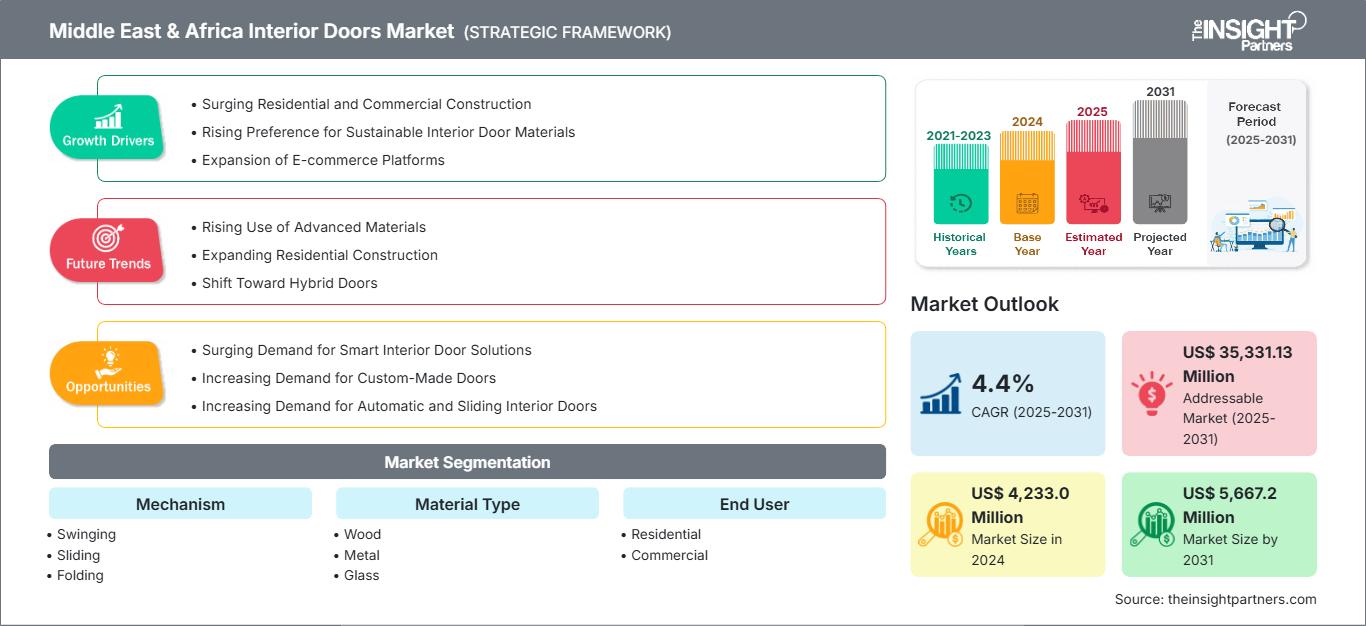
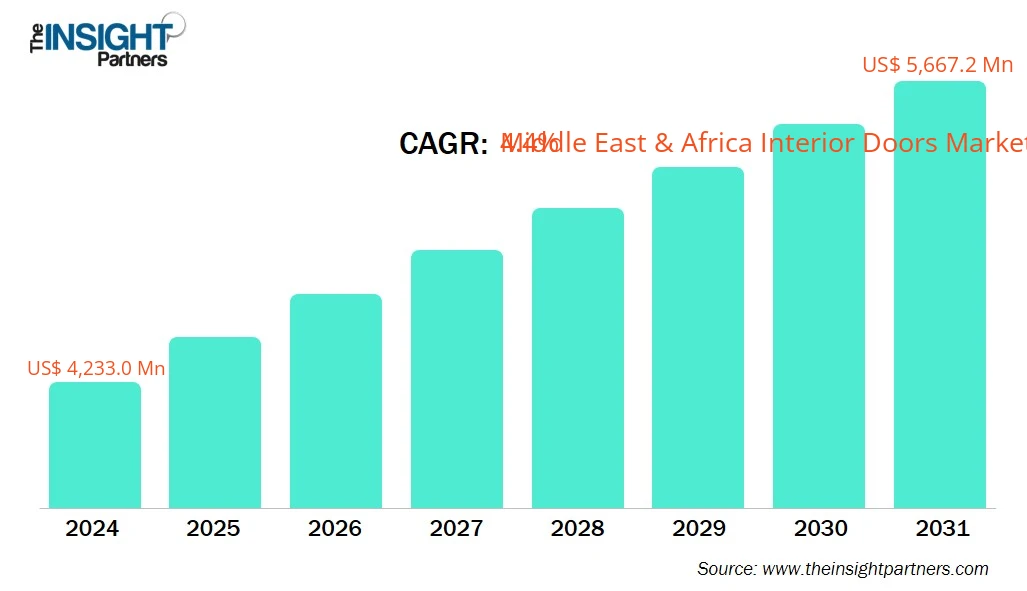
The Middle East and Africa Interior Doors Market size is expected to reach US$ 5,667.2 Million by 2031 from US$ 4,233.0 Million in 2024. The market is estimated to record a CAGR of 4.4% from 2025 to 2031.
Executive Summary and Middle East and Africa Interior Doors Market Analysis:
In Gulf Cooperation Council (GCC) nations such as Saudi Arabia and the UAE, ambitious development plans, luxury housing, and high-end villas are pushing demand for premium, custom-finish interior doors. In Africa, countries with rapid urbanization-e.g., South Africa-are increasingly investing in new housing and renovation, leading to growing adoption of durable and aesthetically pleasing internal doors. Large public works, hotels, and tourism infrastructure in the region are influencing specifications toward higher quality materials, stylish designs, and better finishes. In 2023, Saudi Arabia's construction events and trade shows signaled growing interest in interior finishes and door systems. At The Big 5 Saudi Arabia 2023, organizers introduced a dedicated "Windows, Doors & Facades" segment under the broader construction show, reflecting rising demand and specialization in door systems. Sedar Global, a GCC region interiors firm, exhibited expanded folding doors and sustainable décor at INDEX Saudi 2023, positioning itself to service the ambitious gigaprojects emerging under Saudi Vision 2030.
Customize This Report To Suit Your Requirement
Get FREE CUSTOMIZATIONMiddle East & Africa Interior Doors Market: Strategic Insights
-
Get Top Key Market Trends of this report.This FREE sample will include data analysis, ranging from market trends to estimates and forecasts.
Middle East and Africa Interior Doors Market Segmentation Analysis:
- By Mechanism, the Middle East and Africa Interior Doors Market is segmented into Swinging, Sliding, Folding, Revolving, and Rolling Shutter. The Swinging segment dominated the market in 2024.
- By Material Type, the Middle East and Africa Interior Doors Market is segmented into Wood, Metal, Glass, Fiberboard, Fiberglass, Vinyl, and Others. The Wood segment dominated the market in 2024.
- By End User, the Middle East and Africa Interior Doors Market is segmented into Residential and Commercial. The Residential segment dominated the market in 2024.
Middle East & Africa Interior Doors Market Report Scope
| Report Attribute | Details |
|---|---|
| Market size in 2024 | US$ 4,233.0 Million |
| Market Size by 2031 | US$ 5,667.2 Million |
| CAGR (2025 - 2031) | 4.4% |
| Historical Data | 2021-2023 |
| Forecast period | 2025-2031 |
| Segments Covered |
By Mechanism
|
| Regions and Countries Covered |
Middle East and Africa
|
| Market leaders and key company profiles |
|
Middle East & Africa Interior Doors Market Players Density: Understanding Its Impact on Business Dynamics
The Middle East & Africa Interior Doors Market is growing rapidly, driven by increasing end-user demand due to factors such as evolving consumer preferences, technological advancements, and greater awareness of the product's benefits. As demand rises, businesses are expanding their offerings, innovating to meet consumer needs, and capitalizing on emerging trends, which further fuels market growth.
Middle East and Africa Interior Doors Market Outlook
Ongoing innovations in material science and manufacturing technologies enable door manufacturers to deliver products that meet stringent safety standards as well as cater to evolving architectural and aesthetic demands. Advanced materials such as reinforced steel, intumescent seals, fire-rated glass, and composite cores enhance the durability of doors against environmental factors such as moisture and impact, while simultaneously providing superior fire resistance. Intumescent materials expand under heat exposure, sealing gaps and preventing the spread of fire and smoke, enhancing safety during emergencies. This technology extends fire containment time, which is crucial for lifesaving evacuation windows. The incorporation of materials such as treated stainless steel and advanced composites allows manufacturers to offer doors that sustain structural integrity even at temperatures as high as 1000°C, far surpassing traditional fire door performance.
From a design perspective, such advanced materials afford architects and interior designers unprecedented flexibility during the development of their products. Modern fire doors blend high safety performance with aesthetic appeal, featuring customizable finishes, textures, and styles that seamlessly integrate with interior decor. This convergence of safety and style means that fire-rated doors are no longer viewed as purely functional barriers but as integral design elements that complement various interior themes-from sleek, minimalist commercial spaces to high-end residential projects.
The durability offered by advanced materials reduces maintenance needs and extends product lifespan, thus lowering lifecycle costs and providing environmental benefits by minimizing waste and frequency of replacement. Additionally, the industry is witnessing a shift toward eco-friendly material choices, reflecting a broader sustainability agenda.
Overall, the increased use of advanced materials enables the development of doors that are safer, more durable, aesthetically versatile, and aligned with contemporary demands for sustainability and disaster resilience. This trend is exemplified by innovations such as intumescent seals, fire-rated steel doors, and composite cores that balance rigorous fire safety compliance with architectural elegance and operational longevity.
Middle East and Africa Interior Doors Market Country Insights
By country, the Middle East and Africa Interior Doors Market is segmented into South Africa, Saudi Arabia, United Arab Emirates, Rest of Middle East and Africa. The Rest of Middle East and Africa held the largest share in 2024.
The rest of the Middle East & Africa interior doors market is segmented into Turkey, Iran, Egypt, and others. In African countries (outside South Africa), interior doors are heavily tied to urbanization and housing expansion, new housing projects, growing middle classes, and infrastructural development in cities. In parts of the Middle East beyond the UAE and Saudi Arabia (e.g. Jordan, Egypt, Iraq, etc.), reconstruction, commercial property growth (hotels, malls), and rising consumer preferences for better interior finishes are pushing up demand. Factors influencing market growth include economic growth and stability (which affect construction investment), rising disposable incomes, increasing awareness of aesthetics and design among consumers, access to imported materials or improved local manufacturing, and more stringent building codes or sustainability requirements. However, challenges are greater: supply chain and logistics in remote or less developed regions; inconsistent regulation or enforcement of quality, fire safety, etc.; cost sensitivity (many buyers prefer lowercost, utilitarian doors rather than premium or custom ones); and varying access to sustainable materials. Also, political instability or economic volatility can slow large projects.
Middle East and Africa Interior Doors Market Company Profiles
Some of the key players operating in the market include Simpson Door Co, JELD-WEN Inc, Rustica, Lowe's Companies Inc, Masonite Corporation, Bayer Built Inc., Colonial Elegance Inc., Superior Doors LTD, Contractors Wardrobe, Fenesta Building Systems
These players are adopting various strategies such as expansion, product innovation, and mergers and acquisitions to provide innovative products to their consumers and increase their market share.
Middle East and Africa Interior Doors Market Research Methodology
The following methodology has been followed for the collection and analysis of data presented in this report:
Secondary Research
The research process begins with comprehensive secondary research, utilizing internal and external sources to gather qualitative and quantitative data for each market. Commonly referenced secondary research sources include, but are not limited to:
- Company websites, annual reports, financial statements, broker analyses, and investor presentations
- Industry trade journals and other relevant publications
- Government documents, statistical databases, and market reports
- News articles, press releases, and webcasts specific to companies operating in the market
Note:
All financial data included in the Company Profiles section has been standardized to US$. For companies reporting in other currencies, figures have been converted to US$ using the relevant exchange rates for the corresponding year.Primary Research
The Insight Partners conducts a significant number of primary interviews each year with industry stakeholders and experts to validate its data analysis and gain valuable insights. These research interviews are designed to:
- Validate and refine findings from secondary research
- Enhance the expertise and market understanding of the analysis team
- Gain insights into market size, trends, growth patterns, competitive dynamics, and future prospects
Primary research is conducted via email interactions and telephone interviews, encompassing various markets, categories, segments, and sub-segments across different regions. Participants typically include:
- Industry stakeholders: Vice Presidents, Business Development Managers, Market Intelligence Managers, and National Sales Managers
- External experts: Valuation specialists, research analysts, and key opinion leaders with industry-specific expertise

- Historical Analysis (2 Years), Base Year, Forecast (7 Years) with CAGR
- PEST and SWOT Analysis
- Market Size Value / Volume - Regional, Country
- Industry and Competitive Landscape
- Excel Dataset
Recent Reports
Testimonials

The Insight Partners' SCADA System Market report is comprehensive, with valuable insights on current trends and future forecasts. The team was highly professional, responsive, and supportive throughout. We are very satisfied and highly recommend their services.
RAN KEDEM Partner, Reali Technologies LTDs
I requested a report on a very specific software market and the team produced the report in a few days. The information was very relevant and well presented. I then requested some changes and additions to the report. The team was again very responsive and I got the final report in less than a week.
JEAN-HERVE JENN Chairman, Future Analytica
We worked with The Insight Partners for an important market study and forecast. They gave us clear insights into opportunities and risks, which helped shape our plans. Their research was easy to use and based on solid data. It helped us make smart, confident decisions. We highly recommend them.
PIYUSH NAGPAL Sr. Vice President, High Beam Global
The Insight Partners delivered insightful, well-structured market research with strong domain expertise. Their team was professional and responsive throughout. The user-friendly website made accessing industry reports seamless. We highly recommend them for reliable, high-quality research services
YUKIHIKO ADACHI CEO, Deep Blue, LLC.
This is the first time I have purchased a market report from The Insight Partners.While I was unsure at first, I visited their web site and felt more comfortable to take the risk and purchase a market report.I am completely satisfied with the quality of the report and customer service. I had several questions and comments with the initial report, but after a couple of dialogs over email with their analyst I believe I have a report that I can use as input to our strategic planning process.Thank you so much for taking the extra time and making this a positive experience.I will definitely recommend your service to others and you will be my first call when we need further market data.
JOHN SUZUKI President and Chief Executive Officer, Board Director, BK Technologies
I wish to appreciate your support and the professionalism you displayed in the course of attending to my request for information regarding to infectious disease IVD market in Nigeria. I appreciate your patience, your guidance, and the fact that you were willing to offer a discount, which eventually made it possible for us to close a deal. I look forward to engaging The Insight Partners in the future, all thanks to the impression you have created in me as a result of this first encounter.
DR CHIJIOKE ONYIA MANAGING DIRECTOR, PineCrest Healthcare Ltd.Reason to Buy
- Informed Decision-Making
- Understanding Market Dynamics
- Competitive Analysis
- Identifying Emerging Markets
- Customer Insights
- Market Forecasts
- Risk Mitigation
- Boosting Operational Efficiency
- Strategic Planning
- Investment Justification
- Tracking Industry Innovations
- Aligning with Regulatory Trends
Unlock Exclusive Report Discounts
Enquire Now



 Get Free Sample For