Middle East & Africa Pipe Relining Market Analysis and Forecast by Size, Share, Growth, Trends 2031
Middle East & Africa Pipe Relining Market Size and Forecast (2021 - 2031), Regional Share, Trend, and Growth Opportunity Analysis Report Coverage: By Solution [Product (CIPP Equipment, Liner, High Pressure Water Jetters, Inversion Drum, Pulling Machine, and Others) and Service (Cured-in-Place Pipe {Patch or Spot Repair and Liner or Longer Repair}, Pull-in-Place, Pipe Bursting and Internal Pipe Coating)], Curing Method (Ambient Cure, Hot Water Cure, Steam Cure, and UV Light Cure), and End User (Oil and Gas, Chemicals, Municipal, and Others)
Historic Data: 2021-2023 | Base Year: 2024 | Forecast Period: 2025-2031- Status : Published
- Report Code : TIPRE00042112
- Category : Manufacturing and Construction
- No. of Pages : 193
- Available Report Formats :


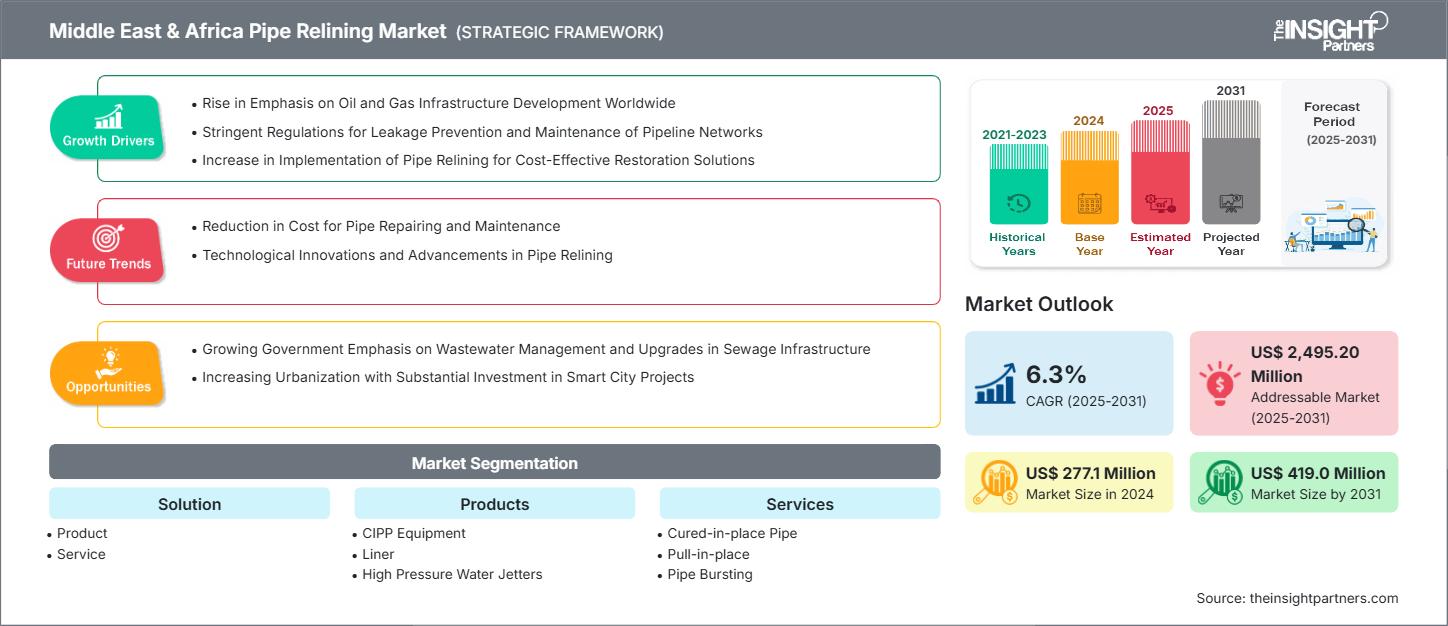
The Middle East & Africa Pipe Relining Market size is expected to reach US$ 419.0 Million by 2031 from US$ 277.1 Million in 2024. The market is estimated to record a CAGR of 6.3% from 2025 to 2031.
Executive Summary and Middle East & Africa Pipe Relining Market Analysis:
The pipe relining market in the Middle East & Africa (MEA) is segmented into South Africa, the UAE, Saudi Arabia, and the Rest of the Middle East & Africa. The market is projected to proliferate owing to mounting investments in the oil and gas sector, developments in sewerage infrastructure, and advancements in water and wastewater treatment facilities. The oil and gas sector contributes a substantial share of the GDP of these countries. In 2024, Abu Dhabi National Oil Company (ADNOC) planned to invest more than US$ 13 billion between 2024 and 2029 for the expansion of its LNG gas exploration operations. In 2023, the total capital investments of Aramco totaled US$ 49.7 billion, which signifies an increase of 28% compared to 2022. In 2024, the company's capital investments are expected to reach ~US$ 48-58 billion.
A spike in per capita income, an ongoing recovery of economic conditions, and government spending on infrastructure development are among the factors contributing to the demand for pipe relining services in the region. Oil and gas production is one of the foremost businesses in the region. Saudi Arabia, Libya, Iran, the UAE, and Qatar witness significant growth in their oil businesses annually. Despite a slowdown in economic development and significant macroeconomic disparities from lower oil prices in the last few years, oil and gas-producing countries in the Middle East & Africa are focusing on achieving greater oil and gas production by partnering with foreign firms to scale up their activities at huge offshore and onshore oil and gas fields. The continuation of efforts to ramp up oil and gas extraction and production fuels the pipe relining market in the Middle East & Africa.
Customize This Report To Suit Your Requirement
Get FREE CUSTOMIZATIONMiddle East & Africa Pipe Relining Market: Strategic Insights
-
Get Top Key Market Trends of this report.This FREE sample will include data analysis, ranging from market trends to estimates and forecasts.
Middle East & Africa Pipe Relining Market Segmentation Analysis:
- By Solution, the Middle East & Africa Pipe Relining Market is segmented into Product and Service. Service held the largest share of the market in 2024.
- By Products, the Middle East & Africa Pipe Relining Market is segmented into CIPP Equipment, Liner, High Pressure Water Jetters, Inversion Drum, Pulling Machine, and Others. CIPP Equipment held the largest share of the market in 2024.
- By Services, the Middle East & Africa Pipe Relining Market is segmented into Cured-in-place Pipe, Pull-in-place, Pipe Bursting, and Internal Pipe Coating. Cured-in-place Pipe held the largest share of the market in 2024.
- By Cured-in-place Pipe, the Middle East & Africa Pipe Relining Market is segmented into Patch or Spot Repair and Liner or Longer Repair. Liner or Longer Repair held the largest share of the market in 2024.
- By Curing Method, the Middle East & Africa Pipe Relining Market is segmented into Ambient Cure, Hot Water Cure, Steam Cure, and UV Light Cure. Hot Water Cure held the largest share of the market in 2024.
- By End-user, the Middle East & Africa Pipe Relining Market is segmented into Oil and Gas, Chemicals, Municipal, and Others. Oil and Gas held the largest share of the market in 2024.
Middle East & Africa Pipe Relining Market Report Scope
| Report Attribute | Details |
|---|---|
| Market size in 2024 | US$ 277.1 Million |
| Market Size by 2031 | US$ 419.0 Million |
| CAGR (2025 - 2031) | 6.3% |
| Historical Data | 2021-2023 |
| Forecast period | 2025-2031 |
| Segments Covered |
By Solution
|
| Regions and Countries Covered |
Middle East and Africa
|
| Market leaders and key company profiles |
|
Middle East & Africa Pipe Relining Market Players Density: Understanding Its Impact on Business Dynamics
The Middle East & Africa Pipe Relining Market is growing rapidly, driven by increasing end-user demand due to factors such as evolving consumer preferences, technological advancements, and greater awareness of the product's benefits. As demand rises, businesses are expanding their offerings, innovating to meet consumer needs, and capitalizing on emerging trends, which further fuels market growth.
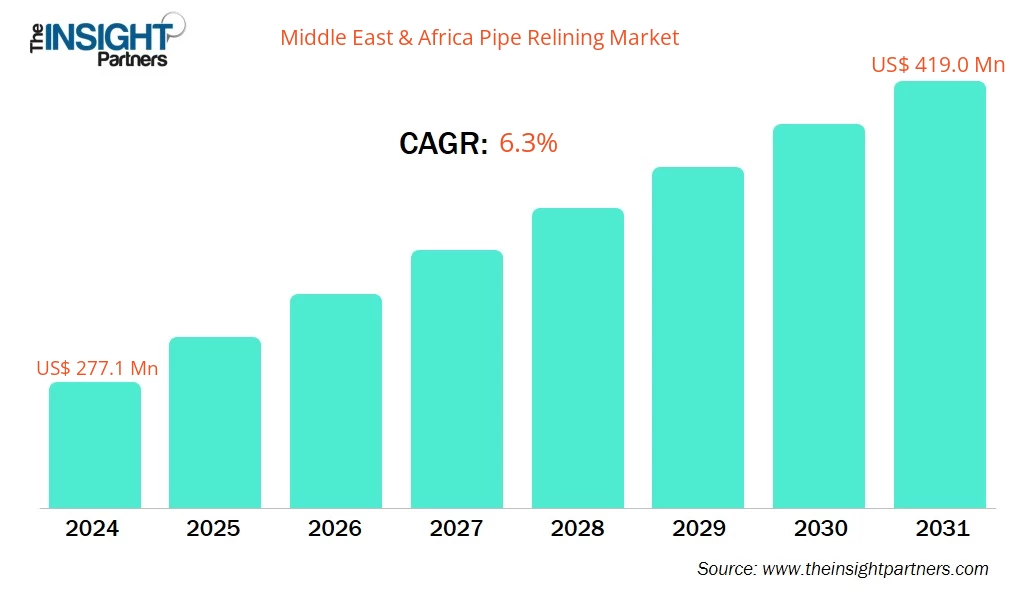
Middle East & Africa Pipe Relining Market Outlook
Trenchless technologies involve methods of new pipe installation with minimum surface and environmental disruptions. The introduction of robotics is a prominent technological advancement in the field of trenchless pipe relining. Pipe repair robotic lateral reinstatement cutters are essential for cutting holes from the inside of a small-diameter pipe and restoring existing connections. These rugged robots are configured to allow specialized situations to be navigated with straightforward design and assembly. Additionally, ProKASRO offers pipe rehabilitation with advanced robots. Its pipe rehabilitation works without traffic obstructions and noise pollution, ensuring workforce safety while saving time and effort. In addition, in February 2023, GE demonstrated carbon-cutting pipe-building robots to inspect and restore natural gas pipelines.
The Cape Flats Bulk Sewer Rehabilitation Project in Cape Town serves as a model for the future of pipeline infrastructure in the MEA region, particularly highlighting the potential of spirally wound pipe (SWP) relining. This trenchless technology, which involves inserting a continuous strip of PVC into existing pipes to create a corrosion-resistant inner lining, is revolutionizing how deteriorating pipelines are rehabilitated. Unlike traditional methods, which often require disruptive excavation, SWP relining minimizes environmental impact and reduces project costs while offering faster installation times and a longer-lasting solution. With urbanization accelerating in MEA countries and many cities grappling with ageing infrastructure, technologies like SWP lining are poised to play a crucial role in modernizing critical sewer and water systems. The use of CCTV inspections and vacuum excavation technology, as demonstrated in the Cape Flats project, further supports this trend, allowing for more precise assessments and safer, less invasive repairs. As the region faces increasing demands on its infrastructure, innovations in pipe relining are not only addressing immediate repair needs but also laying the foundation for more sustainable, resilient urban systems in the future.
Middle East & Africa Pipe Relining Market Country Insights
By country, the Middle East & Africa Pipe Relining Market is segmented into South Africa, Saudi Arabia, the United Arab Emirates, and the Rest of Middle East & Africa. South Africa held the largest share in 2024.
South Africa is expanding its oil and gas industry, with ~15 projects in the pipeline. These projects are expected to help raise its annual crude oil production to ~27 billion barrels and gas production to ~60 trillion cubic feet from 2023 to 2027. In 2022, Tetra4, a subsidiary of Renergen, started the commercial production of liquefied natural gas (LNG) from its plant in the northern Free State in South Africa. Further, several oil and gas projects are focused onshore in the country. A joint venture agreement on the African Renaissance Pipeline project (~US$ 6 billion) was concluded in Southern Africa. The pipeline will transport gas from Mozambique to South Africa. The agreement lies between Empresa Nacional de Hidrocarbonetos (the Mozambican oil and gas company), Profin Consulting Sociedade Anandoacute;nima (a private sector consortium), the South African SacOil Holdings, and the China Petroleum Pipeline Bureau. Thus, the growing oil production and exploration activities are propelling the demand for pipeline networks, which benefits the pipe relining market in South Africa.
Middle East & Africa Pipe Relining Market Company Profiles
Some of the key players operating in the market include Roto-Rooter Group Inc, Silverlining Holding Corp, Aegion Corp, RPB Inc, Pipe Restoration Solutions Inc, The Charles Machine Works Inc, Sekisui Chemical Co Ltd, Waterline Renewal Technologies Inc, NuFlow Technologies Inc, Brawo Systems GmbH, Advanced Trenchless Solutions LLC, Picote GROUP, Atlantic Pipe Services, Roddie Inc., TRIC Tools, Inc., PURIS Corp.
These players are adopting various strategies such as expansion, product innovation, and mergers and acquisitions to provide innovative products to their consumers and increase their market share.
Middle East & Africa Pipe Relining Market Research Methodology
The following methodology has been followed for the collection and analysis of data presented in this report:
Secondary Research
The research process begins with comprehensive secondary research, utilizing internal and external sources to gather qualitative and quantitative data for each market. Commonly referenced secondary research sources include, but are not limited to:
- Company websites, annual reports, financial statements, broker analyses, and investor presentations
- Industry trade journals and other relevant publications
- Government documents, statistical databases, and market reports
- News articles, press releases, and webcasts specific to companies operating in the market
Note:
All financial data included in the Company Profiles section has been standardized to US$. For companies reporting in other currencies, figures have been converted to US$ using the relevant exchange rates for the corresponding year.Primary Research
The Insight Partners conducts a significant number of primary interviews each year with industry stakeholders and experts to validate its data analysis and gain valuable insights. These research interviews are designed to:
- Validate and refine findings from secondary research
- Enhance the expertise and market understanding of the analysis team
- Gain insights into market size, trends, growth patterns, competitive dynamics, and future prospects
Primary research is conducted via email interactions and telephone interviews, encompassing various markets, categories, segments, and sub-segments across different regions. Participants typically include:
- Industry stakeholders: Vice Presidents, Business Development Managers, Market Intelligence Managers, and National Sales Managers
- External experts: Valuation specialists, research analysts, and key opinion leaders with industry-specific expertise

- Historical Analysis (2 Years), Base Year, Forecast (7 Years) with CAGR
- PEST and SWOT Analysis
- Market Size Value / Volume - Regional, Country
- Industry and Competitive Landscape
- Excel Dataset
Recent Reports
Testimonials

The Insight Partners' SCADA System Market report is comprehensive, with valuable insights on current trends and future forecasts. The team was highly professional, responsive, and supportive throughout. We are very satisfied and highly recommend their services.
RAN KEDEM Partner, Reali Technologies LTDs
I requested a report on a very specific software market and the team produced the report in a few days. The information was very relevant and well presented. I then requested some changes and additions to the report. The team was again very responsive and I got the final report in less than a week.
JEAN-HERVE JENN Chairman, Future Analytica
We worked with The Insight Partners for an important market study and forecast. They gave us clear insights into opportunities and risks, which helped shape our plans. Their research was easy to use and based on solid data. It helped us make smart, confident decisions. We highly recommend them.
PIYUSH NAGPAL Sr. Vice President, High Beam Global
The Insight Partners delivered insightful, well-structured market research with strong domain expertise. Their team was professional and responsive throughout. The user-friendly website made accessing industry reports seamless. We highly recommend them for reliable, high-quality research services
YUKIHIKO ADACHI CEO, Deep Blue, LLC.
This is the first time I have purchased a market report from The Insight Partners.While I was unsure at first, I visited their web site and felt more comfortable to take the risk and purchase a market report.I am completely satisfied with the quality of the report and customer service. I had several questions and comments with the initial report, but after a couple of dialogs over email with their analyst I believe I have a report that I can use as input to our strategic planning process.Thank you so much for taking the extra time and making this a positive experience.I will definitely recommend your service to others and you will be my first call when we need further market data.
JOHN SUZUKI President and Chief Executive Officer, Board Director, BK Technologies
I wish to appreciate your support and the professionalism you displayed in the course of attending to my request for information regarding to infectious disease IVD market in Nigeria. I appreciate your patience, your guidance, and the fact that you were willing to offer a discount, which eventually made it possible for us to close a deal. I look forward to engaging The Insight Partners in the future, all thanks to the impression you have created in me as a result of this first encounter.
DR CHIJIOKE ONYIA MANAGING DIRECTOR, PineCrest Healthcare Ltd.Reason to Buy
- Informed Decision-Making
- Understanding Market Dynamics
- Competitive Analysis
- Identifying Emerging Markets
- Customer Insights
- Market Forecasts
- Risk Mitigation
- Boosting Operational Efficiency
- Strategic Planning
- Investment Justification
- Tracking Industry Innovations
- Aligning with Regulatory Trends




 Get Free Sample For