
Mining Drill Bits Market Demand, Share & Growth by 2034
Coverage: By Type (Roller Bit, Fixed-Head Bit, Rotary Bit, DTH Bit, Others); Material (Steel, Diamond, Carbide, Others); Operation (Underground Drilling, Surface Drilling); Bit Size (Up to 150 mm, (150-300) mm, Above 300 mm) , and Geography (North America, Europe, Asia Pacific, and South and Central America)
- Status : Data Released
- Report Code : TIPRE00015735
- Category : Manufacturing and Construction
- No. of Pages : 150
- Available Report Formats :


- Last update date : July 24, 2026


2025 Market Size
US$ 1.74 Bn
Base year value
2034 Forecast
US$ 2.98 Bn
Projected by 2034
CAGR 2026-2034
6.17 %
Growth rate
Addressable Market
US$ 21.38 Bn
(2026-2034)
The global Mining Drill Bits Market size stood at US$ 1.74 Billion in 2025 and is estimated to reach US$ 2.98 Billion by 2034, with a CAGR of 6.17% during 2026-2034. The market will be driven by deep mining operations, abrasive rock formation, and the use of drilling technology to increase production efficiency while minimizing downtime.
In North America, replacement demand and exploration of critical minerals will drive the CAGR in the 5.8–6.4% range until 2034. The market size in North America is impacted by activities related to copper, lithium, potash, and metallurgical coal. Mining operators are focused on wearing-resistant drill bits such as carbide, diamond, and rotary drills to overcome the limitation of labor and equipment availability.
Mining Drill Bits Market Assessment and Insights
- North America accounted for 28–32% share in 2025 and is expected to grow at a CAGR of 5.8–6.4% during 2026–2034, supported by critical minerals drilling and equipment modernization.
- US represented 72–76% of North America in 2025 and is projected to grow at a CAGR of 5.9–6.5% during 2026–2034.
- Europe held 17–21% share in 2025 and is expected to grow at a CAGR of 4.8–5.4%, led by Germany, the UK, Sweden, France, and Spain.
- Asia Pacific captured 34–38% share in 2025 and is forecast to grow at a CAGR of 6.8–7.4%, led by China, India, Australia, Japan, and South Korea.
- Largest Segment Surface Drilling held 58–62% market share in 2025 and is expected to grow at a CAGR of 5.7–6.3% during 2026–2034.
- High Growth Segment DTH Bit held 18–22% market share in 2025 and is expected to grow at a CAGR of 7.0–7.6% during 2026–2034.
- Key companies analyzed in detail: Brunner & Lay, Inc.; Caterpillar Inc.; Epiroc AB; Halliburton Company; Mitsubishi Materials Corporation; Robit Plc; Rockmore International; Sandvik AB; Western Drilling Tools Inc.; Xiamen Prodrill Equipment Co., Ltd.
Source: The Insight Partners' analysis based on proprietary research, government publications, company annual reports, investor presentations, industry databases, and expert interviews.
Drill bit technologies are moving away from commoditized consumables towards engineered production tools as the mining industry requires increased bit life, predictable fragmentation, and reduced energy consumption per meter drilled. Changes in the market are evident, with an inclination towards optimizing button shapes, higher carbide grades, diamond-studded cutters, and digitalization through automated drilling systems. The performance aspect in the selection of drill bits is now considered in relation to ore hardness, blasting designs, maintenance schedules, and energy efficiency.
Further progress will be spurred by the availability of deep deposits, newly discovered copper and lithium fields, and new safety policies that favor reliable drilling components. Investments in Africa, Latin America, Australia, India, and Southeast Asia are adding customers from developing projects involving metals other than coal and iron ores. Government policies promoting critical metals along with the adoption of electric drills and automation, will help suppliers localize their servicing operations.
Mining Drill Bits Market Report Scope
| Report Attribute | Details |
|---|---|
| Market size in 2025 | US$ 1.74 Billion |
| Market Size by 2034 | US$ 2.98 Billion |
| Global CAGR (2026 - 2034) | 6.17% |
| Historical Data | 2021-2024 |
| Forecast period | 2026-2034 |
Mining Drill Bits Market Analysis
The future development prospects will be backed by mineral intensiveness of clean energy, power grid expansion, infrastructure redevelopment, and military supply chains. In accordance with the International Energy Agency, there was a 30% increase in lithium demand in 2024, while demand for nickel, cobalt, graphite, and rare earths increased 6–8%, which will necessitate further exploration and drilling activity. For this reason, drill bits are being upgraded to reduce the frequency of bit changes and improve hole precision.
The supply side will be driven by the availability of tungsten carbide, steel, artificial diamonds, and special alloys. It is crucial for manufacturers to balance volatility of their raw materials with the customers' requirement for consistency of operating cost per meter. Proximity of services, bit restoration, and ability to work with automatic drilling machines have become crucial value chain elements, especially at remote mines where logistics costs are high and skilled labor is scarce.
The Mining Drill Bits Market analysis shows a competitive landscape among global players competing on the basis of durability, application engineering, distribution networks, and life-cycle services. Sandvik AB and Epiroc AB enjoy the advantage of complete drilling equipment product line. Meanwhile, Robit Plc, Rockmore International, Western Drilling Tools Inc., and Brunner & Lay, Inc. enjoy the advantage of specializing in tools.
Materials expertise and presence of mining equipment portfolio add value for Caterpillar Inc. and Mitsubishi Materials Corporation. Drill-bit engineering expertise from subsurface drilling experience helps in positioning Halliburton Company. Cost-effective supply is ensured by Xiamen Prodrill Equipment Co., Ltd. Increasingly, strategic positioning needs to be based on field trials, localized inventories, and technical consultancy.
● REPORT CUSTOMIZATION
Tailor This Report To Align With Your Specific Business Requirements
This report can be customized to align precisely with your business objectives, scope, and target markets. Customization options include tailored segmentation, geography, competitive analysis, and strategic insights to support informed decision-making.
Customize This Report →WHAT YOU CAN ADJUST
- ● Segmentations
- ● Geography
- ● Competitive Analysis
- ● Language Preferences
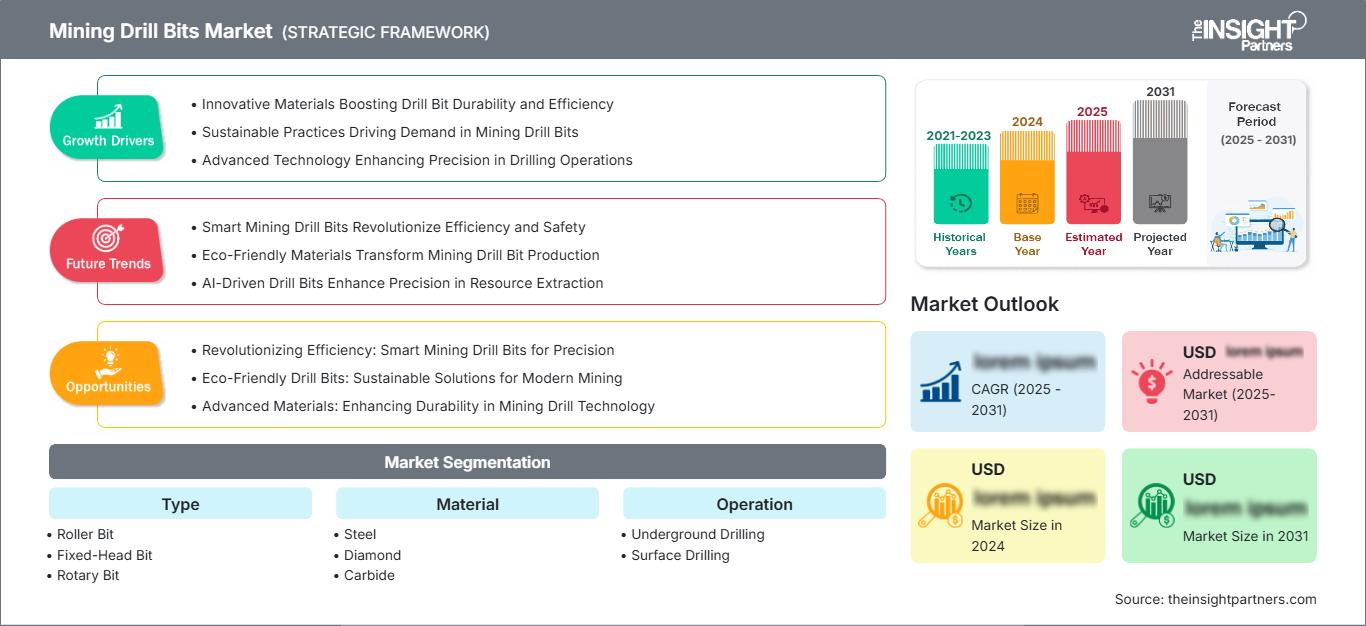
Mining Drill Bits Market: Strategic Insights
Regional Insights
North America Mining Drill Bits Market
North America held 28–32% share in 2025 and is projected to expand at a CAGR of 5.8–6.4% during 2026–2034. The Mining Drill Bits Market share in the region is supported by copper, gold, potash, lithium, and metallurgical coal projects across the US and Canada. Mine operators are emphasizing longer bit life because labor scarcity and remote site logistics raise the cost of unplanned stoppages.
Regional demand is also linked to the critical mineral strategies of both the federal and provincial governments, who are ramping up their exploratory drilling activities and brownfield mine expansions. Surface drilling continues to dominate the market, but underground hard rock drill rigs have begun using diamond and carbide bits in situations requiring precision, such as narrow veins and high-pressure conditions.
U.S. Mining Drill Bits Market
US was the dominant market within North America constituting 72–76% in 2025 and the forecast for growth for this period is a compound annual growth rate of 5.9–6.5% during 2026–2034. Growth is driven by demand from copper deposits in Arizona, lithium in Nevada, gold deposits in Nevada and Alaska, and coal operations in Appalachia and Powder River Basin.
Market presence is maintained by firms like Caterpillar Inc., Sandvik AB, Epiroc AB, Brunner & Lay, Inc., and Western Drilling Tools Inc. Market trends suggest growing preference for automation of drill rigs, telemetry-based drilling systems, and drill bits that offer a consistent drilling rate. Consumers tend to focus on the cost of drilling rather than the price of the drill bit.
Europe Mining Drill Bits Market
Share in Europe is estimated to be between 17% and 21%, growing at a CAGR of 4.8% and 5.4% respectively up to 2034. Key players include Germany and the UK, as well as Nordics for underground metal mining through quarrying, tunneling, and specialty mining applications. The region's most successful market is in Sweden because iron ore and battery mineral drilling projects help drive growth.
German customers value industrial minerals and underground construction interfaces; this makes steel and carbide drill bits preferred over other options for high-equipment standards. The UK market is more selective and includes aggregates, infrastructure drilling, and specialist contractors that require replacement tooling. Both are focused on safety, supplier documentation, and lifecycle cost.
French, Italian, and Spanish markets are driven by quarrying, cement raw materials, tunneling, and some base-metal exploration projects. In South Europe, the market is more project-oriented; however, the modernization of infrastructure and mineral security programs increases its visibility. Mining Drill Bits Market in Europe has positive perception of companies providing technical assistance and fast delivery.
APAC Mining Drill Bits Market
The APAC market had a share of 34-38% in 2025 and is predicted to register a CAGR of 6.8-7.4% over 2026-2034, making it the leading region. Consumption in APAC is led by China with coal, iron ore, copper and rare earth mining, and India’s growth of coal and metal mining is driving volumes.
Technology-driven procurement and foreign mining activities in Japan and South Korea, along with Australia’s importance in iron ore, gold, lithium and coal mining, have been contributing to growth. Policies ensuring domestic mineral security, increasing mine mechanization, and open pit mines have been boosting the need for rotary, DTH, and carbide drill bits in APAC.
Middle East & Africa Mining Drill Bits Market
MEA demand is forecasted for a CAGR of 5.6% to 6.2% during the period 2026–2034. South Africa will dominate regional demand via gold, platinum group metals, coal, and manganese mining, whereas Saudi Arabia and UAE will boost their mineral exploration activity due to their economic diversification initiatives.
Demand in the rest of MEA is linked to copperbelt operations, gold mining exploration, and quarrying for infrastructure. Energy projects, transport networks, and modern mining codes are boosting drilling equipment purchases. Companies that manufacture toughened drilling tools and have local service providers are expected to benefit from harsh conditions.
Segmentation Analysis
Type
Type is expected to grow at a CAGR of 6.1–6.7% during 2026–2034 as operators select bit designs according to rock hardness, hole diameter, drilling method, and equipment compatibility. The Mining Drill Bits Market scope across type categories is widening because mines increasingly standardize drilling consumables around productivity, safety, and predictable maintenance.
- Roller Bit remains important in rotary drilling where crushing action, stable boreholes, and cost efficiency support high-volume surface mining in coal, iron ore, and industrial minerals.
- Fixed-Head Bit is used where dimensional stability and controlled cutting action matter, particularly in hard formations requiring consistent hole quality and reduced deviation.
- Rotary Bit supports large-diameter production drilling in surface mines, with demand tied to blast-hole programs, fleet automation, and penetration rate optimization.
- DTH Bit is gaining strategic relevance in hard-rock drilling because direct hammer energy improves accuracy, productivity, and performance in fractured or abrasive ground.
Material
Material is projected to grow at a CAGR of 6.0–6.6% during 2026–2034 as mines balance wear life, impact resistance, and acquisition cost. Material selection has become more technical because abrasive ore bodies, deeper drilling, and automated rigs expose bits to higher loads and narrower performance tolerances.
- Steel remains widely used for structural strength and affordability, especially in less abrasive conditions where replacement economics and broad availability are key purchasing criteria.
- Diamond is favored in hard, abrasive, and precision drilling applications where longer life, cleaner cutting, and lower downtime justify higher upfront cost.
- Carbide holds strong demand due to impact resistance and wear performance, making it essential for button bits, DTH tools, and hard-rock production drilling.
Operation
Operation is expected to grow at a CAGR of 6.2–6.8% during 2026–2034 as both surface and underground mines raise drilling efficiency targets. Surface operations generate higher volume, while underground mines demand tighter accuracy, safety, and bit reliability due to constrained access and higher interruption costs.
- Underground Drilling requires compact, durable, and accurate bits for development headings, production stopes, and exploration holes where deviation control and safety are central.
- Surface Drilling remains the largest application base, driven by open-pit blast-hole drilling, quarrying, and bulk mineral extraction requiring high penetration and predictable wear.
Bit Size
Bit Size is projected to grow at a CAGR of 5.9–6.5% during 2026–2034 as hole diameter choices reflect blast design, rig capacity, orebody geometry, and drilling economics. Demand is moving toward application-specific sizing that improves fragmentation, explosives efficiency, and downstream crushing performance.
- Up to 15 mm serves precision, pilot, and smaller-scale drilling applications where control, accessibility, and low material removal requirements shape demand.
- 15-3 mm addresses mid-range drilling needs in mixed formations, supporting flexibility for contractors and mines that require balanced penetration, durability, and cost efficiency.
- Above 3 mm supports heavy-duty production drilling and large-hole applications where throughput, blast performance, and equipment productivity determine procurement priorities.
Opportunity Snapshot
| Operation | Revenue Contribution | Trend Tag | Adoption Stage |
| Underground Drilling | Medium | Deep Mining | Scaling |
| Surface Drilling | High | Blast Optimization | Mature |
Mining Drill Bits Market Growth Drivers and Impact Analysis
Critical Mineral Exploration Expands Drilling Intensity
The demand for battery metals, copper, rare earths, uranium, and graphite will lead to an increase in exploration drilling and infill drilling operations. According to IEA figures, the demand for lithium in 2024 was up almost 30%, while there was a 6-8% rise in demand for nickel, cobalt, graphite, and rare earths; thus, the need for discovering and developing new deposits will be persistent. This will translate into greater utilization of diamond, carbide, rotary, and DTH drill bits for exploration and mining activities. Those vendors who can prove their products' efficiency in drilling difficult formations will capitalize on this trend.
Automation Pushes Demand for Consistent Bit Performance
Autonomous and semi-autonomous drills depend on drill bits that exhibit consistent penetration, vibration, and wear over extended working intervals. If drilling conditions are digitally controlled, unpredictable drill-bit performance will lead to underutilization of the machinery and poor blasting results. This driver is particularly important for large open-pit mines with automated fleets operating across multiple shifts and requiring reliable tooling input. As a result, there is a transition from inexpensive consumables to engineered drill bits based on application data, maintenance schedules, and supplier advice.
Deeper Mines Increase Wear and Reliability Requirements
As accessible deposits mature, operators are moving toward deeper pits and underground extensions where rock stress, heat, water ingress, and abrasive conditions raise bit failure risk. Each unplanned bit change can delay drilling cycles, increase labor exposure, and reduce overall equipment productivity. This makes durability and reliability more valuable than initial purchase price. The market benefits from this shift because mines are adopting premium materials and specialized designs to manage harsher drilling environments. Suppliers with metallurgical expertise, rapid replacement logistics, and site-level engineering support can capture higher-margin opportunities as customers focus on operational continuity and safer maintenance practices.
Mining Drill Bits Market Future Trends
Data-Linked Bit Selection Becomes Standard Practice
The Mining Drill Bits Market trends point toward bit selection guided by penetration data, vibration records, rig telemetry, and geological models rather than manual experience alone. Over the forecast period, suppliers will increasingly package bits with advisory tools that recommend products by formation, rig type, and target hole quality. This will create stronger links between consumables and mine planning software. Procurement teams are expected to compare bit options using cost per meter, energy per hole, and blast fragmentation results. As datasets expand, manufacturers that convert field performance into repeatable recommendations can improve retention, reduce trial cycles, and support outcome-based commercial models.
Material Engineering Shifts Toward Longer Service Life
Future product development will focus on carbide grades, diamond-enhanced surfaces, heat treatment, and body designs that extend life in abrasive and high-impact formations. Longer service intervals can reduce transportation, labor exposure, and waste from discarded consumables, aligning drilling performance with mine sustainability goals. This trend will be most visible in hard-rock copper, gold, lithium, and iron ore operations where bit wear materially affects productivity. Manufacturers are likely to invest in laboratory testing, simulation, and field validation to prove performance improvements. The competitive advantage will move toward measurable durability rather than broad product availability alone.
Mining Drill Bits Market Opportunities
Localized Service Hubs Near Emerging Mining Districts
Suppliers can build stronger positions by establishing inventory, repair, and technical service hubs near emerging copper, lithium, gold, and rare earth districts. Remote mines often face high logistics costs, long lead times, and limited maintenance capacity, making local availability a strategic differentiator. Service hubs can support bit inspection, failure analysis, refurbishment, and operator training, converting one-time sales into recurring relationships. In fast-growing regions such as India, Africa, Latin America, and Australia, this model can reduce downtime and improve customer confidence. Companies that combine local stock with application engineering are better placed to win multi-year supply agreements.
Premium Bits for Energy-Efficient Drilling Programs
Mine operators are seeking ways to reduce diesel use, electricity consumption, and blasting inefficiencies, creating an opportunity for premium bits that improve penetration and hole consistency. Better drilling performance can lower rig hours, optimize explosive loading, and reduce downstream crushing energy. This opportunity is action-oriented because suppliers can quantify savings through field trials and cost-per-meter contracts. The Mining Drill Bits Market can benefit as procurement teams increasingly justify premium products using lifecycle economics rather than unit price. Manufacturers that document energy, productivity, and wear advantages will be positioned for preferred supplier status.
Recent Developments
- July 2026: Nexcel Metals Corp. announce that it has selected an experienced local drilling contractor for the Company's fully permitted 2026 diamond drill program at its Burnt Hill Tungsten Project located in central New Brunswick, Canada. Following the Company’s recent announcement regarding receipt of drill permits for the Burnt Hill Project, execution of the drilling services agreement represents another significant milestone in advancing the Burnt Hill Project toward active exploration and resource estimation.
- June 2026: Robit has signed several supply agreements in strategically important mining markets for the company in Australia, North America, and South Africa. Deliveries will commence in the third quarter of 2026. The agreements cover the supply of Robit’s drilling consumables and drilling technology solutions for customers’ operational mining activities.
- February 2026: Sandvik introduces the mid-range RG550Be, expanding its innovative drill bit resharpening machine portfolio. The range now covers all operational needs for top hammer (TH) and down-the-hole (DTH) drilling, with high-end, mid-range, and handheld machines designed for safety, ergonomics and performance.
Frequently Asked Questions

- Comprehensive Market Sizing and Forecast Analysis
- Detailed Segmentation Analysis
- In-Depth Market Dynamics Assessment
- Regional and Country-Level Insights
- Competitive Landscape and Company Benchmarking
- Strategic Business Intelligence
Recent Reports
Testimonials

The Insight Partners' SCADA System Market report is comprehensive, with valuable insights on current trends and future forecasts. The team was highly professional, responsive, and supportive throughout. We are very satisfied and highly recommend their services.
RAN KEDEM Partner, Reali Technologies LTDs
I requested a report on a very specific software market and the team produced the report in a few days. The information was very relevant and well presented. I then requested some changes and additions to the report. The team was again very responsive and I got the final report in less than a week.
JEAN-HERVE JENN Chairman, Future Analytica
We worked with The Insight Partners for an important market study and forecast. They gave us clear insights into opportunities and risks, which helped shape our plans. Their research was easy to use and based on solid data. It helped us make smart, confident decisions. We highly recommend them.
PIYUSH NAGPAL Sr. Vice President, High Beam Global
The Insight Partners delivered insightful, well-structured market research with strong domain expertise. Their team was professional and responsive throughout. The user-friendly website made accessing industry reports seamless. We highly recommend them for reliable, high-quality research services
YUKIHIKO ADACHI CEO, Deep Blue, LLC.
This is the first time I have purchased a market report from The Insight Partners.While I was unsure at first, I visited their web site and felt more comfortable to take the risk and purchase a market report.I am completely satisfied with the quality of the report and customer service. I had several questions and comments with the initial report, but after a couple of dialogs over email with their analyst I believe I have a report that I can use as input to our strategic planning process.Thank you so much for taking the extra time and making this a positive experience.I will definitely recommend your service to others and you will be my first call when we need further market data.
JOHN SUZUKI President and Chief Executive Officer, Board Director, BK Technologies
I wish to appreciate your support and the professionalism you displayed in the course of attending to my request for information regarding to infectious disease IVD market in Nigeria. I appreciate your patience, your guidance, and the fact that you were willing to offer a discount, which eventually made it possible for us to close a deal. I look forward to engaging The Insight Partners in the future, all thanks to the impression you have created in me as a result of this first encounter.
DR CHIJIOKE ONYIA MANAGING DIRECTOR, PineCrest Healthcare Ltd.Reason to Buy
- Informed Decision-Making
- Understanding Market Dynamics
- Competitive Analysis
- Identifying Emerging Markets
- Customer Insights
- Market Forecasts
- Risk Mitigation
- Boosting Operational Efficiency
- Strategic Planning
- Investment Justification
- Tracking Industry Innovations
- Aligning with Regulatory Trends





 Get Free Sample for