
Nitrogen Oxide Control Systems Market Size, Trends & Demand by 2034
Coverage: by Technology (Selective Catalytic Reduction (SCR), Selective Non-Catalytic Reduction (SNCR), Low Nox Burner, Fuel Reburning, Others); Application (Transportation, Industrial, Energy, Others) , and Geography (North America, Europe, Asia Pacific, and South and Central America)
- Status : Data Released
- Report Code : TIPRE00006306
- Category : Manufacturing and Construction
- No. of Pages : 150
- Available Report Formats :


- Last update date : July 30, 2026


2025 Market Size
US$ 19.78 Bn
Base year value
2034 Forecast
US$ 32.21 Bn
Projected by 2034
CAGR 2026-2034
5.57 %
Growth rate
Addressable Market
US$ 235.73 Bn
(2026-2034)
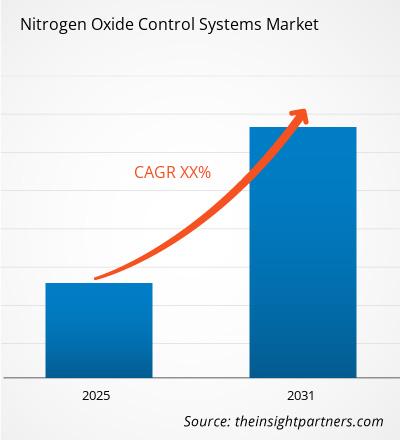
The Nitrogen Oxide Control Systems Market size was assessed to be worth US$ 19.78 Billion in 2025 and expected to reach US$ 32.21 Billion in 2034, indicating an anticipated CAGR of 5.57% between 2026 and 2034. Growth drivers for this market include stringent regulations on air quality in industries, utility retrofits, and increased deployment of combustion optimization in transport, industrial, and energy applications, where nitrogen oxide emissions continue to be important regulatory issues.
North America continues to be an attractive market in terms of adoption due to the growth in turbine requirements, refinery retrofits, and municipal waste-to-energy retrofits. The market size in North America is expected to show a CAGR of 4.8–5.2% from 2026 to 2034, with selective catalytic reduction installations, low NOx burners replacement, and ammonia delivery systems making up much of the demand.
Nitrogen Oxide Control Systems Market Assessment and Insights
- North America accounted for 24–27% share in 2025 and is projected to grow at a CAGR of 4.8–5.2% during 2026–2034, led by power, refinery, and institutional boiler retrofits.
- US represented 78–82% of North America in 2025 and is expected to expand at a CAGR of 4.7–5.1% through utility and turbine compliance spending.
- Europe held 21–24% share in 2025 and is forecast to grow at a CAGR of 4.4–4.8%, with Germany, the UK, France, Italy, and Spain leading industrial abatement demand.
- Asia Pacific captured 34–38% share in 2025 and is projected to grow at a CAGR of 6.1–6.5%, supported by China, India, Japan, South Korea, and Australia.
- Largest Segment Selective Catalytic Reduction held 50–55% market share in 2025 and is expected to grow at a CAGR of 5.6–6.0% during 2026–2034.
- High Growth Segment Transportation held 20–24% market share in 2025 and is projected to grow at a CAGR of 6.0–6.4% during 2026–2034.
- Key companies analyzed in detail: John Wood Group PLC, Babcock & Wilcox Enterprises, Inc., CECO Environmental Corp., BorgWarner Inc., Fuel Tech, Inc., Honeywell International Inc., Mitsubishi Heavy Industries, Ltd., Hamon S.A., Siemens Energy AG, and Yara International ASA.
Source: The Insight Partners' analysis based on proprietary research, government publications, company annual reports, investor presentations, industry databases, and expert interviews.
Initially, industrial operators engaged in isolated combustion tuning; now they opt for integrated NOx reduction solutions, including burners, reagent handling systems, catalysts, controls, and monitors. The market trends suggest a preference for modular selective catalytic reduction skids, low temperature catalysts, and flexible designs because brownfield facilities continue playing a crucial role in power generation, refining, cement production, chemicals, and marine industries.
The market should benefit from future growth in the manufacturing corridor of emerging Asia, additional capacity of gas-fired power in the Middle East, as well as permits of European industries. Companies invest in nitrogen oxide control systems with reduced ammonia slip, minimized downtimes, and built-in digital monitoring technology. Regulatory tailwinds create sustainable retrofit opportunities for the market.
Nitrogen Oxide Control Systems Market Report Scope
| Report Attribute | Details |
|---|---|
| Market size in 2025 | US$ 19.78 Billion |
| Market Size by 2034 | US$ 32.21 Billion |
| Global CAGR (2026 - 2034) | 5.57% |
| Historical Data | 2021-2024 |
| Forecast period | 2026-2034 |
Nitrogen Oxide Control Systems Market Analysis
Growth in the market is driven by regulatory compliance in industries that use intensive combustion processes. The power generation industry, industrial boilers, cement kilns, refineries, and fleet managers are now looking for control systems that would enable them to reduce the formation of NOx or to treat the emissions stream without impacting their operational efficiency.
The ecosystem comprises manufacturers of burners, catalysts, reagents, engineering firms, and maintenance services. Catalyst metals, ammonia/urea, and capacity to execute projects are among the factors that affect the supply chain. More and more buyers are considering life cycle costs, safety of reagents, pressure drop, and maintenance schedules as part of their decision process when selecting Nitrogen Oxide Control Systems.
The market study indicates that the industry is relatively concentrated. Babcock & Wilcox Enterprises, Inc., CECO Environmental Corp., Fuel Tech, Inc., Mitsubishi Heavy Industries, Ltd., Siemens Energy AG, and Yara International ASA compete through retrofit engineering, reagents management, catalyst efficiency, and services. John Wood Group PLC and Honeywell International Inc. bring in process control capabilities and industrial integration expertise.
Investment priorities include digital optimization, reagent conversion safety, SCR reactor miniaturization, and combined SNCR/SCR systems. BorgWarner Inc. retains its relevance in vehicle emission control systems while Hamon S.A. contributes its expertise in thermal power plants and industrial air purification projects. Positioning increasingly depends on aftermarket revenues, access to installed base, and compliance guarantees under varying loads.
● REPORT CUSTOMIZATION
Tailor This Report To Align With Your Specific Business Requirements
This report can be customized to align precisely with your business objectives, scope, and target markets. Customization options include tailored segmentation, geography, competitive analysis, and strategic insights to support informed decision-making.
Customize This Report →WHAT YOU CAN ADJUST
- ● Segmentations
- ● Geography
- ● Competitive Analysis
- ● Language Preferences
Nitrogen Oxide Control Systems Market: Strategic Insights

Regional Insights
North America Nitrogen Oxide Control Systems Market
North America accounted for 24–27% of Nitrogen Oxide Control Systems Market Share in 2025 and is estimated to grow at a CAGR of 4.8-5.2% during 2026-2034. Utility gas turbines, refinery heaters, boilers, and municipal waste systems are important sources of demand. Regulation is strengthened by the NOx Programs in the U.S. power industry, whereby emissions dropped 89% between 1995 and 2023 according to EPA data.
Project work is shifting from coal retrofit to gas turbine SCR, institutional steam generation, and boiler upgrades in industry. Operators look for systems with a track record that allows compliance with regulation even when cycling loads and during ozone season. Safety of reagents, ammonia slip management, and service agreements over time are key purchase considerations.
U.S. Nitrogen Oxide Control Systems Market
The U.S. accounted for 78–82% of North American demand in 2025 and is expected to record a CAGR of 4.7–5.1% during 2026–2034. Demand is linked to stationary combustion turbines, university and hospital boilers, waste-to-energy units, and industrial process heaters. Company presence is broad, with Fuel Tech, Inc., Babcock & Wilcox Enterprises, Inc., and CECO Environmental Corp. supporting domestic retrofit activity.
Application trends show stronger spending on SCR reagent handling, low NOx burner upgrades, and monitoring controls that help facilities maintain permit margins. EPA actions on stationary combustion turbines and power-sector emissions programs continue to influence capital planning. The Nitrogen Oxide Control Systems Market benefits from long operating lives of installed energy assets and regional ozone-season compliance needs.
Europe Nitrogen Oxide Control Systems Market
In Europe, the share was 21–24% in 2025 and the growth rate is estimated to be 4.4–4.8% in terms of the CAGR during 2026–2034. Germany leads due to its chemical, waste incineration, metals, and distributed energy plants requiring continuous emissions monitoring. Modernizing permits in the context of the industrial emissions directive makes SCR, SNCR, and combustion optimization important technologies for brownfields.
UK concentrates on waste-to-energy, refinery, and industrial boiler upgrade projects, whereas France prioritizes district heating, cement, and public infrastructural emissions control projects. In Italy and Spain, the demand originates from cement, glass, refining, and natural gas power generation. Regional procurement tends to favor energy efficiency, less reagent use, and service-based solutions that will allow to meet NOx restrictions without affecting capacity.
APAC Nitrogen Oxide Control Systems Market
The APAC segment occupied 34-38% market share in 2025 and will have a CAGR growth of 6.1-6.5% until 2034. China is dominating the regional demand while Japan, South Korea, India, and Australia drive demand via power, steel, cement, refineries, and marine industry applications. The use of coal and gas and permitting activities along with clean air regulations are fueling the Nitrogen Oxide Control Systems Market.
Industrial policy is driving demand for efficient burner technology, selective catalytic reduction catalysts, and hybrid NOx control technologies. According to the IEA and regional energy forecasts, Asia still uses coal as the major electricity generation resource, and NOx control system implementation is needed despite the increasing role of renewable energy.
Middle East & Africa Nitrogen Oxide Control Systems Market
The Middle East and Africa is forecast to experience a CAGR of 5.0%-5.4% during the period of 2026-2034, driven by Saudi Arabia. Boilers driven by gas-fired power, petrochemicals, refineries, desalination, and infrastructure will present selective growth prospects. The UAE, South Africa, and Rest of MEA will be installing control equipment where energy security and permit approval needs coincide.
Specification-led procurement is usually tied to new capacities or upgrades rather than general retrofit initiatives. Robust equipment that is suited to operation at high temperatures, reagent availability constraints, and remote maintenance is favored in procurement. The Nitrogen Oxide Control Systems Market in the region is supported by the diversification of industry and investments in power infrastructure.
Segmentation Analysis
Technology
Technology is projected to grow at a CAGR of 5.3–5.7% during 2026–2034. The Nitrogen Oxide Control Systems Market scope spans post-combustion treatment, combustion modification, and staged fuel strategies. Selection depends on emission limits, fuel type, load profile, space constraints, reagent access, and lifecycle economics, making technology fit a core procurement decision.
- Selective Catalytic Reduction remains the dominant technology because it offers high NOx reduction performance for turbines, boilers, marine engines, and industrial furnaces where strict permit limits require reliable post-combustion treatment.
- Selective Non-Catalytic Reduction is adopted where capital budgets, temperature windows, and moderate abatement targets align, especially in boilers, kilns, and waste units requiring simpler installation than catalyst-based systems.
- Low Nox Burner demand is sustained by combustion-stage reduction needs, with users selecting burner retrofits to lower baseline NOx formation and improve compliance margins before add-on controls.
- Fuel Reburning serves specialized combustion systems where staged fuel injection can reduce NOx formation, although adoption is more selective due to fuel compatibility and operational complexity.
Application
Application is expected to expand at a CAGR of 5.6–6.0% during 2026–2034. Demand differs by asset type: transportation requires compact systems and precise dosing, industrial users prioritize uptime and retrofit flexibility, and energy operators focus on large-flow reliability. This diversity supports a broad supplier base across the Nitrogen Oxide Control Systems Market.
- Transportation is the fastest-growing application as heavy-duty vehicles, marine engines, rail, and off-road equipment require tighter aftertreatment integration, catalyst durability, and sensor-based control under variable operating cycles.
- Industrial applications remain broad across cement, chemicals, refining, metals, glass, and waste incineration, where retrofits must balance emissions performance with process continuity and maintenance access.
- Energy is the largest demand pool, driven by gas turbines, coal units, biomass plants, and waste-to-energy assets that require proven NOx compliance over long operating lives.
Opportunity Snapshot
| Application | Revenue Contribution | Trend Tag | Adoption Stage |
| Transportation | Medium | Fleet Retrofit | Scaling |
| Industrial | High | Permit Renewal | Mature |
| Energy | High | Turbine SCR | Scaling |
Nitrogen Oxide Control Systems Market Growth Drivers and Impact Analysis
Stricter Air-Quality Rules for Combustion Assets
NOx emissions from power plants, turbines, boilers, cement kilns, ships, and vehicles are being reduced by regulators due to the ability of nitrogen oxide to cause ozone pollution and fine particulate creation. Data collected by the EPA reveals that NOx emissions from U.S. power plants have reduced by 89% between 1995 and 2023, which indicates that policy-led control initiatives influence equipment requirements. However, the next stage is difficult since a number of these systems will be operated at different loads, using mixed fuels, and have limited space availability. The need is for systems that incorporate combustion management, SCR, SNCR, optimization of reagents, and digital monitoring.
Industrial Retrofitting of Long-Life Energy Infrastructure
However, many coal, gas, biomass, refinery, petrochemical, waste-to-energy, and institutional boiler facilities are economically required regardless of decarbonization goals. According to IEA analysis, there is still a lot of coal power generation for several nations' electricity requirements, as well as an increase in gas generation due to its ability to provide flexible power. Emissions reductions are a priority for these long-living facilities, not replacing the facility itself, when reliable power production, industrial production, and district heating obligations are involved. Retrofits favor equipment manufacturers, as engineering, changes to the system's ducts, catalyst choice, ammonia or urea storage, and start-up services are required for each installation.
Shift Toward Integrated and Safer Reagent Management
Management of reagents will become a key purchasing consideration because ammonia management in terms of handling, storage, slippage, and logistics affect safety, permitting, and operation costs. Technology to generate urea in situ, control its injection, or manage reagent slippage will ensure compliance with NOx standards without causing secondary environmental and occupational hazards. It will be particularly important for university campuses, hospitals, municipal solid waste plants, shipping companies, and plants located near communities. Manufacturers with experience in reagent management may be able to add value beyond equipment alone by offering systems for monitoring, dosing, and other services. The market effects include increased uptake of systems bundles and service-based business models.
Nitrogen Oxide Control Systems Market Future Trends
Low-Temperature Catalysts and Hybrid Control Architectures
Future technology roadmaps will emphasize low-temperature catalyst performance, modular reactors, and hybrid SNCR-SCR configurations that can operate across wider load ranges. These Nitrogen Oxide Control Systems Market trends are important because industrial assets increasingly cycle to support renewable-heavy grids, which changes exhaust temperature and flow stability. Conventional SCR designs may underperform during low-load operation, while SNCR can face efficiency limits outside its temperature window. Hybrid systems can reduce peak NOx formation before catalytic polishing, lowering reagent use and improving permit margins. Vendors able to validate catalyst durability, manage pressure drop, and integrate controls will capture upgrades from plants that need flexible compliance rather than single-point performance.
Digital Emissions Optimization as a Service
Digital optimization will move NOx control from periodic tuning to continuous performance management. Sensors, predictive analytics, and automated reagent dosing can help operators respond to fuel variability, catalyst aging, changing load profiles, and seasonal air-quality restrictions. This trend is especially relevant for fleets of boilers, distributed turbines, marine engines, and industrial furnaces where centralized monitoring can lower compliance risk. Service providers can package diagnostics, optimization, and maintenance into recurring contracts, improving customer retention and system uptime. Over time, verified emissions data may also support environmental reporting, insurance assessments, and permit negotiations, making digital capability a strategic differentiator in procurement decisions.
Nitrogen Oxide Control Systems Market Opportunities
Retrofit Packages for Gas Turbines and Industrial Boilers
Gas turbines and industrial boilers offer a practical investment opportunity because they are widely deployed, often operate near populated areas, and increasingly face stricter NOx limits. Vendors can target standardized retrofit packages that combine burner tuning, SCR modules, reagent systems, controls, and compliance documentation. The strongest opportunities will be facilities seeking predictable downtime, compact footprints, and lower ammonia risk. Nitrogen Oxide Control Systems Market Forecasts indicate that retrofit-led demand will remain resilient because replacing entire combustion assets is usually more expensive than upgrading emissions control. Suppliers that create repeatable engineering templates for universities, hospitals, refineries, and district energy plants can improve margins and shorten sales cycles.
Localized Service Networks in Asia Pacific and Middle East
Asia Pacific and the Middle East present service-led expansion opportunities because installed industrial capacity is large, operating conditions are demanding, and local compliance regimes are becoming more structured. International suppliers can strengthen competitiveness by building local catalyst handling, reagent supply, commissioning, and spare-parts capabilities. This reduces project risk for customers and improves response times when systems require tuning or maintenance. Partnerships with regional engineering firms can also help navigate procurement rules, language requirements, and site-specific installation challenges. The opportunity is not limited to new equipment; lifecycle services, operator training, and digital monitoring can create recurring revenue across high-utilization assets.
Recent Developments
- June 2026: Yanmar Holdings Co., Ltd. will showcase a broad range of technologies supporting the future of construction at the 8th Construction & Survey Productivity Improvement Expo (CSPI 2026), held at Makuhari Messe in Chiba Prefecture, Japan, from June 17 to June 20, 2026. YPT will also introduce its new Compact ATD, an exhaust aftertreatment device that reduces particulate matter (PM) and nitrogen oxide (NOx) emissions. Compared with conventional systems, the Compact ATD offers a smaller installation footprint, enabling greater flexibility for customers across a wider range of applications.
- August 2025: China released its Action Plan for Controlling Industrial-Sector Nitrous Oxide (N₂O) Emissions (“Action Plan”), jointly issued by the Ministry of Ecology and Environment (MEE), the National Development and Reform Commission, and the Ministry of Industry and Information Technology. This interagency Action Plan tasks MEE to lead the establishment of a comprehensive industrial N₂O management system, strengthen policy and standards, and coordinate with air-pollution reduction and ozone-layer protection agendas. The release of the Action Plan follows the Chinese workshop on controlling emissions of N₂O, convened in September 2024.
- May 2025: thyssenkrupp Uhde is proud to announce the successful commissioning of its EnviNOx system for Covestro Polymers (China) Co. Ltd. at their nitric acid plant in Shanghai Chemical Industry Park (SCIP). This state-of-the-art technology will significantly reduce nitrogen oxides (NOx) and nitrous oxide (N2O) emissions. Covestro’s NAUCI plant in SCIP is part of their global network of facilities dedicated to producing high-performance polymers and plastics such as polyurethanes, polycarbonates and precursors for paints, coatings, adhesives and sealants. The successful commissioning of the EnviNOx system at this site marks another milestone in Covestro’s journey towards full circularity and climate neutrality.
Frequently Asked Questions

- Comprehensive Market Sizing and Forecast Analysis
- Detailed Segmentation Analysis
- In-Depth Market Dynamics Assessment
- Regional and Country-Level Insights
- Competitive Landscape and Company Benchmarking
- Strategic Business Intelligence
Recent Reports
Testimonials

The Insight Partners' SCADA System Market report is comprehensive, with valuable insights on current trends and future forecasts. The team was highly professional, responsive, and supportive throughout. We are very satisfied and highly recommend their services.
RAN KEDEM Partner, Reali Technologies LTDs
I requested a report on a very specific software market and the team produced the report in a few days. The information was very relevant and well presented. I then requested some changes and additions to the report. The team was again very responsive and I got the final report in less than a week.
JEAN-HERVE JENN Chairman, Future Analytica
We worked with The Insight Partners for an important market study and forecast. They gave us clear insights into opportunities and risks, which helped shape our plans. Their research was easy to use and based on solid data. It helped us make smart, confident decisions. We highly recommend them.
PIYUSH NAGPAL Sr. Vice President, High Beam Global
The Insight Partners delivered insightful, well-structured market research with strong domain expertise. Their team was professional and responsive throughout. The user-friendly website made accessing industry reports seamless. We highly recommend them for reliable, high-quality research services
YUKIHIKO ADACHI CEO, Deep Blue, LLC.
This is the first time I have purchased a market report from The Insight Partners.While I was unsure at first, I visited their web site and felt more comfortable to take the risk and purchase a market report.I am completely satisfied with the quality of the report and customer service. I had several questions and comments with the initial report, but after a couple of dialogs over email with their analyst I believe I have a report that I can use as input to our strategic planning process.Thank you so much for taking the extra time and making this a positive experience.I will definitely recommend your service to others and you will be my first call when we need further market data.
JOHN SUZUKI President and Chief Executive Officer, Board Director, BK Technologies
I wish to appreciate your support and the professionalism you displayed in the course of attending to my request for information regarding to infectious disease IVD market in Nigeria. I appreciate your patience, your guidance, and the fact that you were willing to offer a discount, which eventually made it possible for us to close a deal. I look forward to engaging The Insight Partners in the future, all thanks to the impression you have created in me as a result of this first encounter.
DR CHIJIOKE ONYIA MANAGING DIRECTOR, PineCrest Healthcare Ltd.Reason to Buy
- Informed Decision-Making
- Understanding Market Dynamics
- Competitive Analysis
- Identifying Emerging Markets
- Customer Insights
- Market Forecasts
- Risk Mitigation
- Boosting Operational Efficiency
- Strategic Planning
- Investment Justification
- Tracking Industry Innovations
- Aligning with Regulatory Trends





 Get Free Sample for