
Optical Underwater Connector Market Trends, Size & Forecast by 2034
Coverage: By Type (Rubber Molded, Inductive Coupling, Fluid-filled Underwater Mateable Connector, Rigid-shell/Bulk-headed), Application (Military & Defense, Oil and Gas, Telecommunications, Oceanography, ROVs/AUVs, Others) and Geography (North America, Europe, Asia Pacific, Middle East and Africa, and South and Central America)
- Status : Published
- Report Code : TIPRE00043448
- Category : Electronics and Semiconductor
- No. of Pages : 201
- Available Report Formats :


- Last update date : June 08, 2026


2025 Market Size
US$ 0.74 Bn
Base year value
2034 Forecast
US$ 1.50 Bn
Projected by 2034
CAGR 2026-2034
8.1 %
Growth rate
Addressable Market
US$ 10.03 Bn
(2026-2034)
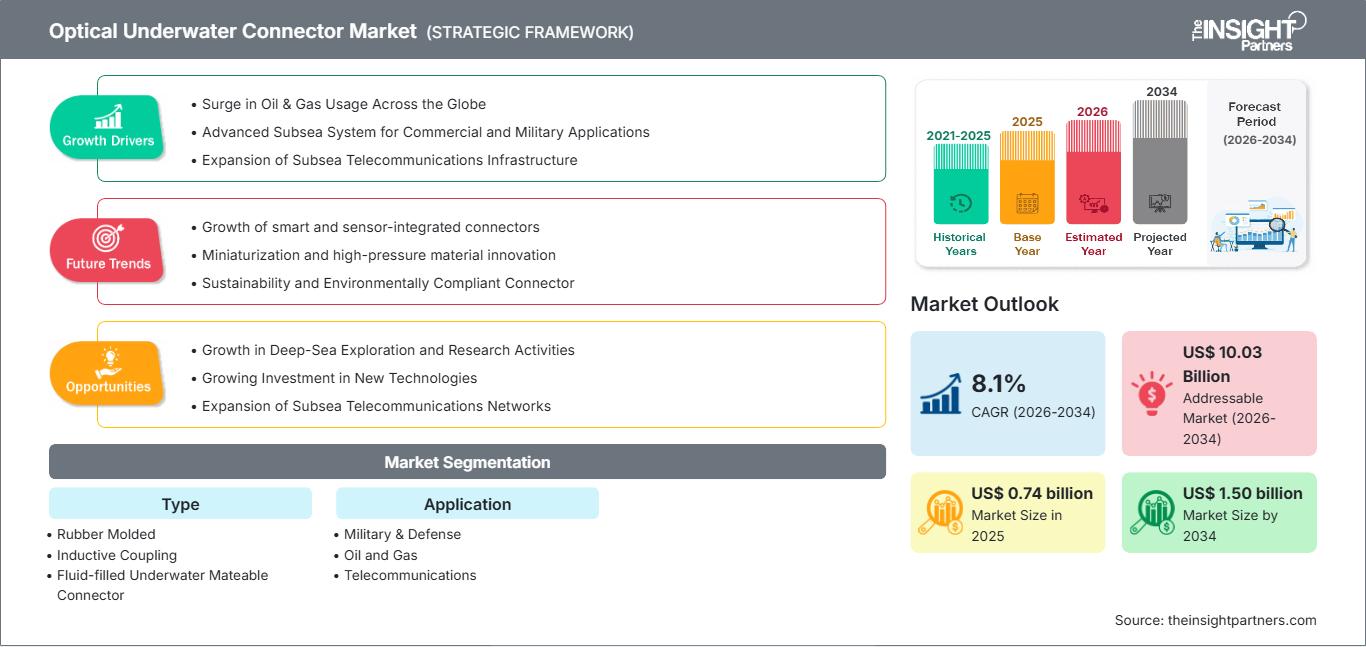
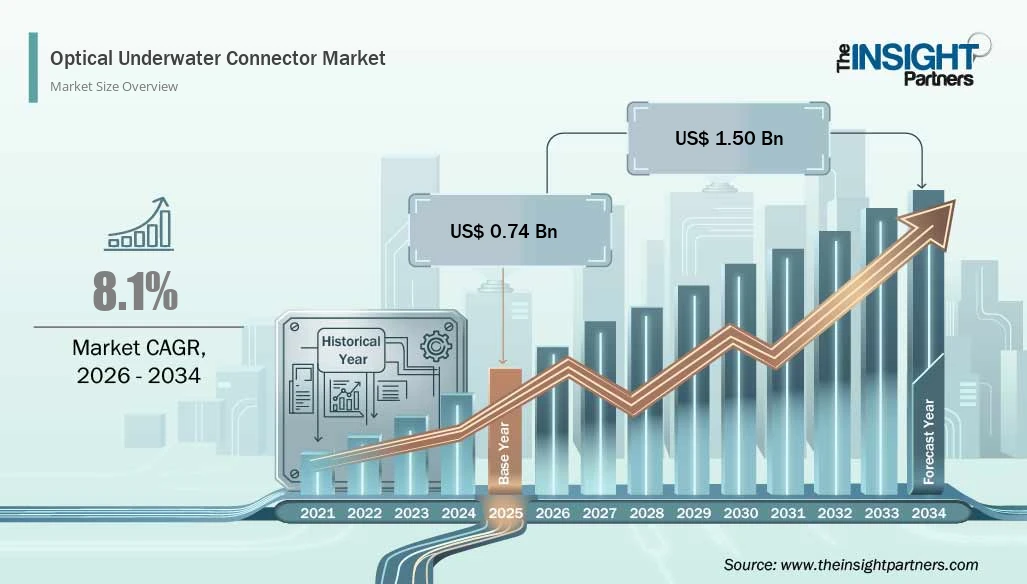
The Optical Underwater Connector Market size is expected to reach US$ 1.50 billion by 2034 from US$ 0.74 billion in 2025. The market is anticipated to register a CAGR of 8.1% during 2026–2034.
Optical Underwater Connector Market Analysis
Optical underwater connectors are used to provide fast and reliable data communication in subsea environments across applications such as offshore energy, marine research, defense, and underwater robotics. The market is growing due to the increasing use of subsea sensors, autonomous underwater vehicles (AUVs), and deep-sea exploration systems that require stable fiber-optic connections. Growth in offshore renewable energy projects is also supporting demand, as these projects rely on real-time monitoring and control systems with dependable underwater connectivity.
Improvements in sealing technologies, pressure resistance, and corrosion-resistant materials are helping enhance connector durability and performance in harsh marine environments. The integration of advanced optical fiber systems is also improving data transmission efficiency across long-distance underwater communication networks. Rising defense investments are encouraging the adoption of secure underwater communication and surveillance systems. At the same time, increasing interest in ocean research, environmental monitoring, and marine data collection is expanding the use of these connectors across both scientific and commercial sectors. Continuous advancements in materials and photonics technologies are further improving product capabilities and broadening their application areas.
Optical Underwater Connector Market Overview
The optical underwater connectors market deals with specialized connectors designed to reliably transmit optical signals in underwater environments with minimal signal loss. Such connectors are vital for providing connectivity between various underwater equipment such as sensors, video cameras, remotely operated vehicles (ROVs), and offshore facilities. The market growth is driven by the rising demand for reliable communication and real-time data exchange during undersea exploration, marine environmental monitoring, and underwater inspection operations.
Optical underwater connectors offer several advantages over conventional electrical cables, including higher bandwidth and immunity to electromagnetic interference. Advances in waterproof sealing technologies, pressure-resistant materials, and connector design innovations have improved their performance in increasingly harsh underwater environments. Growing investments in offshore infrastructure and marine research projects related to marine ecosystem studies and seabed mapping are also driving demand for optical underwater connectors. Additionally, integration with advanced networking systems is supporting efficient long-distance underwater data transmission across a wide range of marine applications.
Market Research Highlights
- Europe dominated the market with 33.9% share in 2025.
- Asia Pacific is poised to grow at a CAGR of 12.5% over the forecast period.
- United States market is projected to grow at a CAGR of 8% over the forecast period.
- By Type, the Rubber Molded segment accounted for the largest market share of 37.5% in 2025.
- By Application, the Telecommunications segment is anticipated to witness the fastest growth, registering a CAGR of 9.2% over the forecast period
Source: The Insight Partners' analysis based on proprietary research, government publications, company annual reports, investor presentations, industry databases, and expert interviews.
● REPORT CUSTOMIZATION
Tailor This Report To Align With Your Specific Business Requirements
This report can be customized to align precisely with your business objectives, scope, and target markets. Customization options include tailored segmentation, geography, competitive analysis, and strategic insights to support informed decision-making.
Customize This Report →WHAT YOU CAN ADJUST
- ● Segmentations
- ● Geography
- ● Competitive Analysis
- ● Language Preferences
Optical Underwater Connector Market: Strategic Insights
-
Get Top Key Market Trends of this report.This FREE sample will include data analysis, ranging from market trends to estimates and forecasts.
Optical Underwater Connector Market Drivers and Opportunities
Market Drivers:
- Expansion of Offshore Renewable Energy Infrastructure: The growing deployment of offshore wind and tidal energy systems is increasing the need for reliable subsea communication links. Optical underwater connectors enable real-time monitoring and control of underwater equipment, ensuring operational efficiency and system stability. Their ability to support high-speed data transmission makes them essential in energy installations.
- Rising Adoption of Subsea Sensors and Autonomous Systems: The increasing use of underwater sensors, remotely operated vehicles, and autonomous underwater systems is driving demand for robust optical connectivity. These connectors provide stable, high-bandwidth communication in deep-sea conditions, enabling accurate data collection, navigation, and system coordination across complex marine operations and scientific missions.
Market Opportunities:
- Advancements in Deep-Sea Exploration Technologies: Ongoing innovation in deep-sea exploration equipment is creating new opportunities for optical underwater connectors. Enhanced exploration tools require dependable high-speed data links to transmit images, measurements, and environmental data from extreme depths, encouraging wider integration of advanced optical connectivity solutions in research and commercial exploration projects.
- Development of Intelligent Ocean Monitoring Networks: Smart ocean monitoring systems rely on interconnected sensors and devices to track environmental conditions, marine life, and seabed activity. Optical connectors enable efficient, low-latency data transfer, supporting continuous and accurate monitoring across large underwater areas.
Optical Underwater Connector Market Report Segmentation Analysis
The optical underwater connector market is categorized into distinct segments to understand its structure, growth prospects, and emerging trends. Below is the standard segmentation approach used in industry reports:
By Type:
- Rubber Molded Connectors: Rubber molded connectors use flexible sealing materials to ensure waterproofing, shock absorption, and reliable performance in shallow underwater applications.
- Inductive Coupling Connectors: Inductive coupling connectors enable contactless data and power transfer underwater, improving durability and reducing corrosion risks in harsh marine environments.
- Fluid-filled Underwater Mateable Connectors: Fluid-filled mateable connectors use dielectric fluid to balance pressure, prevent water ingress, and maintain optical signal integrity at depth.
- Rigid-shell/Bulk-headed Connectors: Rigid-shell bulk-headed connectors provide strong mechanical protection and secure fixed mounting, ensuring stable optical connections in high-pressure underwater systems.
By Application:
- Military & Defense: Used in secure underwater communication, surveillance systems, and submarine operations requiring reliable, high-speed optical connectivity in critical defense environments.
- Oil and Gas: Supports subsea exploration, drilling operations, and pipeline monitoring by enabling real-time data transmission from deep offshore energy infrastructure systems.
- Telecommunications: Enables submarine cable networks and underwater data links, ensuring high-capacity global communication and internet connectivity across long ocean distances.
- Oceanography: Facilitates scientific research by transmitting data from underwater sensors and instruments used for studying marine ecosystems and ocean conditions.
- ROVs/AUVs: Provides essential optical communication for remotely operated and autonomous underwater vehicles used in inspection, exploration, and data collection tasks.
- Others: Includes aquaculture, environmental monitoring, and underwater construction applications requiring dependable optical connections for efficient data transfer in marine environments.
By Geography:
- North America
- Europe
- Asia Pacific
- South & Central America
- Middle East & Africa
Optical Underwater Connector Market Report Scope
| Report Attribute | Details |
|---|---|
| Market size in 2025 | US$ 0.74 billion |
| Market Size by 2034 | US$ 1.50 billion |
| Global CAGR (2026 - 2034) | 8.1% |
| Historical Data | 2021-2025 |
| Forecast period | 2026-2034 |
| Segments Covered |
By Type
|
| Regions and Countries Covered |
North America
|
| Market leaders and key company profiles |
|
Optical Underwater Connector Market Players Density: Understanding Its Impact on Business Dynamics
The Optical Underwater Connector Market is growing rapidly, driven by increasing end-user demand due to factors such as evolving consumer preferences, technological advancements, and greater awareness of the product's benefits. As demand rises, businesses are expanding their offerings, innovating to meet consumer needs, and capitalizing on emerging trends, which further fuels market growth.
Optical Underwater Connector Market Share Analysis by Geography
The optical underwater connector market in Asia Pacific is driven by offshore energy expansion, marine research, submarine cables, and increasing underwater technology adoption. Additional growth is supported by rising investments in smart ocean monitoring systems, defense modernization programs, expansion of underwater communication networks, and increasing adoption of autonomous underwater vehicles and sensors.
The optical underwater connector market growth differs in each region due to variations in offshore energy development, marine research activities, defense investments, telecommunications infrastructure, and adoption of advanced subsea technologies. Below is a summary of market share and trends by region:
1. North America
- Market Share: Holds a significant portion of the global market
- Key Drivers:
- Offshore Defense and Energy Communication Demand: Expansion of offshore oil and gas exploration and deep-sea defense communication systems drives demand for reliable optical underwater connectors enabling high-speed data transfer, durability, and operational efficiency in marine environments.
- Submarine cable network upgrades are improving global connectivity
- Growing adoption of autonomous underwater vehicles in exploration
- Trends: Increasing deployment of high-capacity submarine networks and integration of advanced sensing technologies.
2. Europe
- Market Share: Substantial share owing to early, stringent EU regulations
- Key Drivers:
- Offshore Wind and Subsea Infrastructure Expansion: Growing offshore wind energy projects and modernization of submarine communication cables, along with defense naval programs, are increasing demand for robust optical underwater connectors supporting high-speed, reliable subsea data transmission.
- Strong investment in marine renewable energy projects
- Expansion of underwater scientific and defense research activities.
- Trends: Emphasis on renewable offshore infrastructure and expansion of transnational subsea cable networks.
3. Asia Pacific
- Market Share: Fastest-growing region with dominant market share
- Key Drivers:
- Offshore Energy and Submarine Connectivity Growth: Rapid expansion of offshore energy projects, submarine cable installations, and growing manufacturing of autonomous underwater vehicles are driving strong demand for optical underwater connectors across marine industrial and research applications.
- Rising adoption of underwater robotics in industrial operations
- Increasing investment in coastal surveillance and monitoring systems
- Trends: Increasing digital infrastructure investments and offshore renewable energy adoption.
4. Middle East and Africa
- Market Share: Small market share, growing at a rapid pace
- Key Drivers:
- Offshore Exploration and Cable Connectivity Expansion: Rising offshore oil and gas exploration activities, expansion of submarine cable connectivity, and increasing oceanographic research initiatives are boosting demand for optical underwater connectors in maritime and energy sector applications.
- Growth in marine scientific exploration projects
- Increasing coastal infrastructure and energy development initiatives
- Trends: Growing investment in offshore energy infrastructure and expanding submarine communication networks.
5. South & Central America
- Market Share: Growing Market with steady progress
- Key Drivers:
- Offshore Energy and Defense Modernization: Expanding offshore oil and gas operations, growing naval defense modernization programs, and increasing demand for subsea monitoring in desalination and energy projects are driving the adoption of optical underwater connector solutions.
- Rising submarine cable deployment for global connectivity
- Expansion of coastal surveillance and maritime security systems
- Trends: Strategic investments in offshore energy, defense surveillance, and submarine cable expansion.
High Market Density and Competition
Competition is intense due to the presence of major global players such as BIRNS Aquamate LLC; Hydro Group; Glenair, Inc.; Fischer Connectors SA; GISMA Steckverbinder GmbH; Eaton Corporation plc; TE Connectivity Ltd; AK Industries; Amphenol Corporation; and Teledyne Technologies Inc.
This high level of competition urges companies to stand out by offering:
- Advanced optical performance with higher bandwidth and low signal loss
- Modular and customizable connector designs for varied applications
- Compact and lightweight structures for easier deployment
- Strong after-sales support and maintenance services
- Continuous innovation in materials and photonic technologies.
Opportunities and Strategic Moves
- Increasing deployment in submarine cable networks supporting global internet traffic and cross-border data transmission infrastructure.
- Investment in advanced materials and sealing technologies to improve connector durability in extreme underwater environments.
Other companies analyzed during the course of research
- Kongsberg Maritime
- Teledyne ODI
- Teledyne Impulse
- Teledyne Marine Systems
- NKT Photonics
- JDR Cable Systems
- Glenair UK Subsea Division
- Fischer FiberOptic Systems AG
- Seacon Brantner
Optical Underwater Connector Market News and Recent Developments
- In October 2025, MacArtney expanded its partnership with Teledyne ODI, enabling European operators to access faster and certified servicing of subsea connectors. Under this arrangement, MacArtney’s workshop in Norway became an authorized facility for servicing Teledyne ODI connector systems. The site provides inspection, fault diagnosis, and refurbishment services, bringing official repair capabilities closer to customers across Europe and enabling quicker and more efficient support for operators using Teledyne ODI products.
- In September 2025, Heilind Electronics announced the addition of the SeaKing WetMate series, developed by Glenair, Inc., to its portfolio of interconnect solutions. Expanding on the established durability and precision of the SeaKing platform, the new WetMate series was designed to deliver reliable performance in real-world subsea environments, enabling secure connector mating even while fully submerged.
Optical Underwater Connector Market Report Coverage and Deliverables
The "Optical Underwater Connector Market Size and Forecast (2021–2034)" report provides a detailed analysis of the market covering below areas:
- Optical Underwater Connector Market size and forecast at global, regional, and country levels for all the key market segments covered under the scope
- Optical Underwater Connector Market trends, as well as market dynamics such as drivers, restraints, and key opportunities
- Detailed PEST and SWOT analysis
- Optical Underwater Connector Market analysis covering key market trends, global and regional framework, major players, regulations, and recent market developments
- Industry landscape and competition analysis covering market concentration, heat map analysis, prominent players, and recent developments for the optical underwater connector market
- Detailed company profiles
Frequently Asked Questions
2. Rising Adoption of Subsea Sensors and Autonomous Systems: The increasing use of underwater sensors, remotely operated vehicles, and autonomous underwater systems is driving demand for robust optical connectivity. These connectors provide stable, high-bandwidth communication in deep-sea conditions, enabling accurate data collection, navigation, and system coordination across complex marine operations and scientific missions.
1. Harsh underwater conditions: High pressure, salinity, and temperature variations can affect long-term connector reliability and performance stability.
2. Limited standardization across systems: Variations in connector designs and interfaces can create compatibility issues between different subsea platforms.
1. Hybrid connector integration growth
2. Rising demand for miniaturized and high-density connector designs
3. Increasing adoption of smart connectors with built-in monitoring and diagnostics capabilities
4. Expansion of offshore projects
5. Advanced corrosion-resistant materials

- Comprehensive Market Sizing and Forecast Analysis
- Detailed Segmentation Analysis
- In-Depth Market Dynamics Assessment
- Regional and Country-Level Insights
- Competitive Landscape and Company Benchmarking
- Strategic Business Intelligence
Recent Reports
Testimonials

The Insight Partners' SCADA System Market report is comprehensive, with valuable insights on current trends and future forecasts. The team was highly professional, responsive, and supportive throughout. We are very satisfied and highly recommend their services.
RAN KEDEM Partner, Reali Technologies LTDs
I requested a report on a very specific software market and the team produced the report in a few days. The information was very relevant and well presented. I then requested some changes and additions to the report. The team was again very responsive and I got the final report in less than a week.
JEAN-HERVE JENN Chairman, Future Analytica
We worked with The Insight Partners for an important market study and forecast. They gave us clear insights into opportunities and risks, which helped shape our plans. Their research was easy to use and based on solid data. It helped us make smart, confident decisions. We highly recommend them.
PIYUSH NAGPAL Sr. Vice President, High Beam Global
The Insight Partners delivered insightful, well-structured market research with strong domain expertise. Their team was professional and responsive throughout. The user-friendly website made accessing industry reports seamless. We highly recommend them for reliable, high-quality research services
YUKIHIKO ADACHI CEO, Deep Blue, LLC.
This is the first time I have purchased a market report from The Insight Partners.While I was unsure at first, I visited their web site and felt more comfortable to take the risk and purchase a market report.I am completely satisfied with the quality of the report and customer service. I had several questions and comments with the initial report, but after a couple of dialogs over email with their analyst I believe I have a report that I can use as input to our strategic planning process.Thank you so much for taking the extra time and making this a positive experience.I will definitely recommend your service to others and you will be my first call when we need further market data.
JOHN SUZUKI President and Chief Executive Officer, Board Director, BK Technologies
I wish to appreciate your support and the professionalism you displayed in the course of attending to my request for information regarding to infectious disease IVD market in Nigeria. I appreciate your patience, your guidance, and the fact that you were willing to offer a discount, which eventually made it possible for us to close a deal. I look forward to engaging The Insight Partners in the future, all thanks to the impression you have created in me as a result of this first encounter.
DR CHIJIOKE ONYIA MANAGING DIRECTOR, PineCrest Healthcare Ltd.Reason to Buy
- Informed Decision-Making
- Understanding Market Dynamics
- Competitive Analysis
- Identifying Emerging Markets
- Customer Insights
- Market Forecasts
- Risk Mitigation
- Boosting Operational Efficiency
- Strategic Planning
- Investment Justification
- Tracking Industry Innovations
- Aligning with Regulatory Trends





 Get Free Sample for