
Pipeline Integrity Market Growth, Share & Trends by 2034
Coverage: By Service (Testing Services, Inspection and Maintenance, Monitoring, Verification); Location of Deployment (Onshore, Offshore); Application (Oil and Gas, Chemicals, Water Transport, Others) , and Geography (North America, Europe, Asia Pacific, and South and Central America)
- Status : Data Released
- Report Code : TIPRE00009014
- Category : Manufacturing and Construction
- No. of Pages : 150
- Available Report Formats :


- Last update date : August 06, 2026


2025 Market Size
US$ 2.26 Bn
Base year value
2034 Forecast
US$ 3.29 Bn
Projected by 2034
CAGR 2026-2034
4.30 %
Growth rate
Addressable Market
US$ 25.25 Bn
(2026-2034)
The Pipeline Integrity Market is projected to grow from US$ 2.26 Billion in 2025 to US$ 3.29 Billion by 2034, registering a CAGR of 4.30% during 2026–2034. Demand is shaped by asset-aging risks, stricter safety expectations, and the need to sustain uninterrupted transport of oil, gas, chemicals, and water through increasingly complex onshore and offshore networks.
Across North America, replacement of high-consequence pipelines, methane-management pressure, and continuous inspection obligations are expected to support a 4.0–4.6% CAGR range. The Pipeline Integrity Market size in the region is influenced by large regulated pipeline mileage, expanded use of in-line inspection, and growing integration of monitoring data into risk-based maintenance planning.
Pipeline Integrity Market Assessment and Insights
- North America held 38–40% share in 2025 and is forecast to grow at 4.0–4.6% CAGR during 2026–2034, supported by PHMSA-driven integrity programs and aging transmission systems.
- US represented 82–86% of North America in 2025 and is expected to grow at 4.1–4.7% CAGR, led by gas transmission upgrades and inspection compliance.
- Europe accounted for 24–26% share in 2025 and is projected to expand at 3.8–4.4% CAGR, with Germany, the UK, France, Italy, and Spain leading demand.
- Asia Pacific captured 21–23% share in 2025 and is forecast to rise at 5.0–5.7% CAGR as China, India, Japan, South Korea, and Australia expand gas and water networks.
- Largest Segment Inspection and Maintenance held 42–45% market share in 2025 and is estimated to grow at 4.1–4.7% CAGR due to mandated recurring asset assessments.
- High Growth Segment Monitoring held 18–21% market share in 2025 and is projected to grow at 5.4–6.1% CAGR as operators adopt sensors, analytics, and remote surveillance.
- Key companies analyzed in detail: Altus Intervention, Applus Services, S.A., Baker Hughes Company, EnerMech Limited, Intertek Group plc, LIN SCAN Advanced Pipelines & Tanks Services, NDT Global GmbH & Co. KG, ROSEN Group, SGS SA, and T.D. Williamson, Inc.
Source: The Insight Partners' analysis based on proprietary research, government publications, company annual reports, investor presentations, industry databases, and expert interviews.
Technology adoption has moved the Pipeline Integrity Market from periodic manual checks toward integrated inspection, diagnostics, and risk modeling. Currently, operators integrate magnetic flux leakage, ultrasonic tests, calipers, direct assessments, and geospatial information to identify corrosion, cracks, dents, seam defects, and ground movement. The production process also evolved as oil and gas, chemicals, and water operators focus on maximizing uptime, reducing emissions, and maintaining at reduced costs as compared to repair cycles.
The future demand for the service will arise from the need to expand pipeline networks in the Asia Pacific, the need to renew gas network infrastructure in Europe, and further tightening regulations in North America and the Middle East. The industry is focusing on cloud-based integrity management systems, automated anomaly identification, and offshore pipe inspection capabilities. There is a growing importance of the industry due to projects involving hydrogen blending, carbon dioxide transportation, and water security.
Pipeline Integrity Market Report Scope
| Report Attribute | Details |
|---|---|
| Market size in 2025 | US$ 2.26 Billion |
| Market Size by 2034 | US$ 3.29 Billion |
| Global CAGR (2026 - 2034) | 4.30% |
| Historical Data | 2021-2024 |
| Forecast period | 2026-2034 |
Pipeline Integrity Market Analysis
Demand is primarily driven by aging pipe networks, higher product throughput, and regulatory requirements for inspection of high-consequence areas. Pipeline Integrity Market growth is supported by operators replacing calendar-based maintenance with risk-ranked programs that reduce unplanned shutdowns and incident exposure.
Ecosystem players consist of inspection equipment makers, non-destructive testing experts, engineering consultants, data analytics companies, and field services firms. The supply chain is capacity-driven as the availability of qualified staff, customized pigs, offshore ships, and validated software processes depends on pipeline operational windows.
The competitive landscape is relatively consolidated, with ROSEN Group, Baker Hughes Company, NDT Global GmbH & Co. KG, and T.D. Williamson, Inc. is competing on inspection precision, fleet size, and integrity engineering expertise. In terms of market analysis, differentiation is seen to become increasingly based on translating inspection results into credible priorities for remediation.
Applus Services, S.A., Intertek Group plc, SGS SA, EnerMech Limited, LIN SCAN Advanced Pipelines & Tanks Services, and Altus Intervention complement the service environment with NDT services, verification, maintenance, and geographical coverage. Funding is flowing towards multi-technology inspection devices, digital twins, and results-oriented integrity agreements.
● REPORT CUSTOMIZATION
Tailor This Report To Align With Your Specific Business Requirements
This report can be customized to align precisely with your business objectives, scope, and target markets. Customization options include tailored segmentation, geography, competitive analysis, and strategic insights to support informed decision-making.
Customize This Report →WHAT YOU CAN ADJUST
- ● Segmentations
- ● Geography
- ● Competitive Analysis
- ● Language Preferences
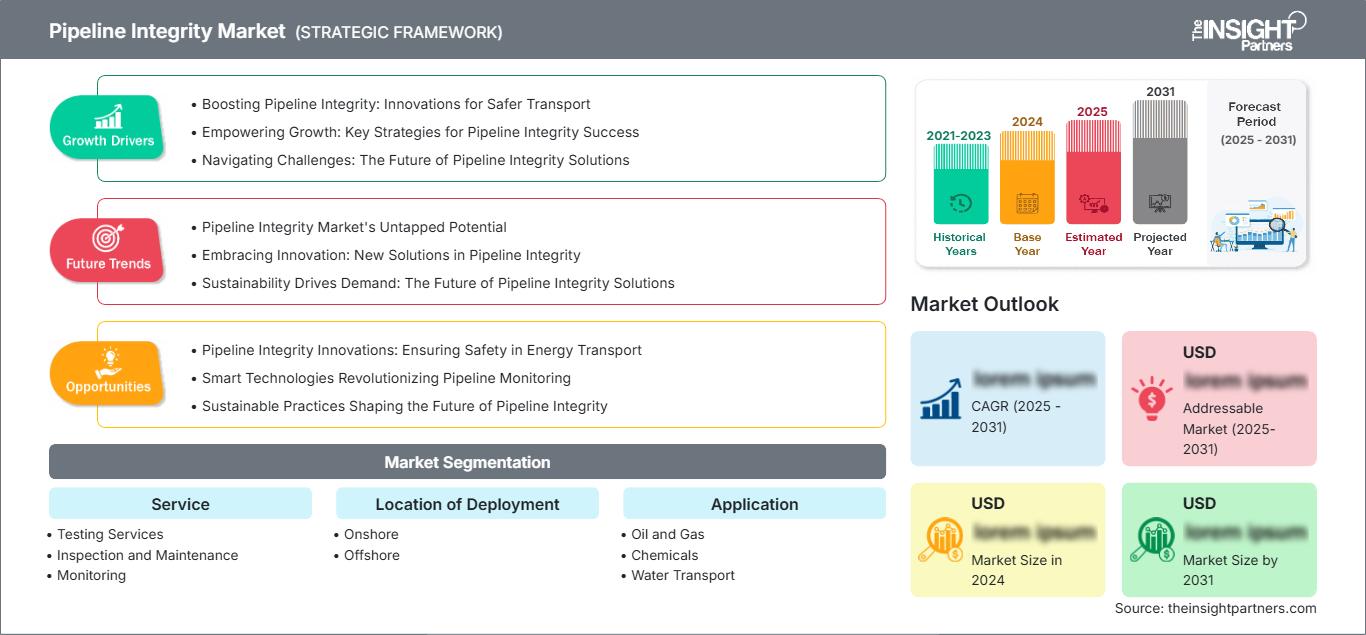
Pipeline Integrity Market: Strategic Insights
Regional Insights
North America Pipeline Integrity Market
North America held 38–40% of the Pipeline Integrity Market share in 2025 and is expected to grow at a 4.0–4.6% CAGR during 2026–2034. The region’s market position is anchored by extensive regulated pipeline mileage, mandated integrity management programs, and significant replacement requirements for aging gas transmission and hazardous liquid infrastructure. A well-established regulatory framework and continuous investment in asset reliability support sustained demand for inspection, monitoring, and maintenance services across both public and private pipeline networks.
The PHMSA databases on natural gas, hazardous liquids, and LNG plants are adding up to the region’s already robust inspection tradition, while the proposal to renew safety authorization funding in the United States emphasizes ongoing regulatory control and infrastructure modernization. The operators have been putting their focus on crack detection, corrosion growth evaluation, mitigation of methane risks, and integrity management forecasting in order to enhance safety and performance. Such concerns are driving the demand for testing, in-line inspections, monitoring, validation, and maintenance.
U.S. Pipeline Integrity Market
The U.S. market accounted for 82–86% of North America in 2025 and is projected to grow at a 4.1–4.7% CAGR. Its leadership reflects more than three million miles of pipeline infrastructure under federal and state oversight, with integrity spending concentrated in gas transmission, liquid pipelines, and high-consequence areas. Factors such as aging pipeline systems, changing regulations, and the need to enhance reliability will continue to propel investments in inspection, monitoring, and risk-based maintenance for pipeline companies.
The services provided by Baker Hughes Company, T.D. Williamson, Inc., Intertek Group plc, and SGS SA remain relevant to operators within the U.S. market through their provision of in-line inspection, field verification, and regulatory compliance services. The demand for services is highest in the oil and gas industry, where there is a concern with issues related to leak prevention, corrosion prevention, and life extension of assets. In addition, water transportation is gaining significance in terms of evaluation of buried pipelines, pressure areas, and leak-prone routes.
Europe Pipeline Integrity Market
Europe represented 24–26% of the market share in 2025 and is forecast to grow at a 3.8–4.4% CAGR. Germany leads regional demand because industrial gas corridors, refinery links, and cross-border transmission networks require documented inspection and ongoing integrity management. The UK market is shaped by offshore North Sea infrastructure and integrity requirements for mature subsea pipelines, where operators are focused on extending asset life and maintaining operational safety.
France, Italy, and Spain contribute through chemicals, refined products, gas interconnectors, and water-transfer systems. European operators are increasing inspection, verification, and monitoring activities as energy-security policies, hydrogen-readiness initiatives, and carbon-management projects place new demands on existing pipeline networks. Investment is also rising in digital monitoring, in-line inspection technologies, and risk-based maintenance programs that improve asset visibility and regulatory compliance. As a result, the Pipeline Integrity Market in Europe continues to emphasize engineering assurance, infrastructure resilience, and comprehensive compliance documentation across both legacy and emerging energy networks.
APAC Pipeline Integrity Market
APAC held 21–23% of the Pipeline Integrity Market share in 2025 and is expected to grow at a 5.0–5.7% CAGR, making it the fastest-growing regional market. China leads due to long-distance gas transmission expansion, while India’s growing city gas distribution networks and water pipeline infrastructure are increasing demand for inspection, testing, and integrity management services. Infrastructure development and increased energy transmission networks keep increasing the need for pipeline inspection solutions in the region.
While Japan and South Korea are focused on the needs related to reliability and asset performance, it is Australia that adds demand through LNG-related infrastructure and long-distance transmission pipelines. The support of government policies for gas distribution, industrial safety, and water resilience keeps increasing the addressable market size in terms of inspection and monitoring of pipeline infrastructures. The increasing investments in digital integrity management, leak detection, corrosion evaluation, and predictive maintenance solutions keep boosting the growth of the market.
Middle East & Africa Pipeline Integrity Market
The Middle East & Africa are projected to grow at 4.4–5.1% CAGR, with Saudi Arabia leading in oil, gas, and petrochemical pipeline reliability. The UAE supports demand through downstream and export infrastructure, while South Africa requires maintenance across fuel and water corridors.
The rest of MEA demand is tied to new gas monetization, desalination-linked water transport, and refinery expansions. Offshore and desert operating conditions raise corrosion, coating, sand movement, and access challenges, encouraging operators to combine inspection and monitoring for more reliable asset planning.
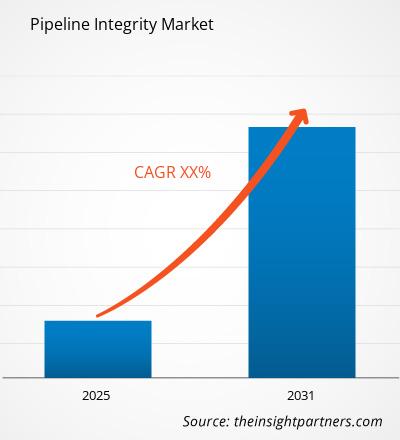
Segmentation Analysis
Service
Service is expected to grow at 4.2–4.8% CAGR during 2026–2034 as operators bundle testing, inspection, monitoring, and verification into multi-year integrity programs. The market scope is broadening as buyers request data continuity from field detection to engineering assessment, enabling better risk ranking, repair timing, and regulatory reporting.
- Testing Services support baseline assessment and defect confirmation through ultrasonic, radiographic, magnetic, and pressure-based methods, helping operators validate pipe condition before repair, rerating, or continued service decisions.
- Inspection and Maintenance remains the largest service area because recurring in-line inspection, cleaning, anomaly excavation, and repair planning are central to compliance and asset-life extension.
- Monitoring is gaining strategic importance as sensors, acoustic systems, pressure analytics, and satellite inputs help detect leaks, geohazards, movement, and operating deviations earlier.
- Verification strengthens confidence in inspection outputs by confirming anomaly dimensions, material properties, weld conditions, and fitness-for-service assumptions before operators commit capital to remediation.
Location of Deployment
Location of Deployment is forecast to grow at 4.0–4.6% CAGR during 2026–2034 as onshore scale and offshore complexity shape purchasing. Onshore systems dominate due to extensive route mileage, but offshore assets command specialized inspection planning, corrosion control, and high-reliability intervention because access windows are limited and downtime costs are high.
- Onshore pipelines generate recurring demand from gas distribution, transmission, chemicals, and water routes, where access is easier but exposure to third-party damage and terrain movement remains material.
- Offshore pipelines require higher-specification inspection and maintenance because subsea corrosion, pressure, flow assurance, and vessel availability make integrity planning technically demanding and capital-intensive.
Application
By Application, the Pipeline Integrity Market forecast indicates the segment is projected to grow at a 4.1–4.7% CAGR during 2026–2034, led by oil and gas but increasingly supported by chemicals and water transport. The segment mix reflects safety-critical hydrocarbon systems, corrosion-sensitive process pipelines, and rising municipal focus on reducing losses, contamination risk, and service disruption. Growing regulatory attention on asset reliability, leak prevention, and infrastructure modernization is further encouraging investment in monitoring, inspection, and integrity management solutions across these applications.
- Oil and Gas remains the principal application because transmission reliability, product containment, methane oversight, and high-consequence area compliance require frequent inspection and engineering-led maintenance.
- Chemical pipelines demand precise integrity management due to corrosive fluids, hazardous materials, and plant-continuity requirements, making verification and specialized NDT central to operational risk control.
- Water Transport is becoming more relevant as utilities address aging mains, leakage, pressure transients, and resilience needs through condition assessment and targeted rehabilitation planning.
Opportunity Snapshot
| Application | Revenue Contribution | Trend Tag | Adoption Stage |
| Oil and Gas | High | Methane Control | Mature |
| Chemicals | Medium | Corrosion Risk | Scaling |
| Water Transport | Medium | Leak Reduction | Scaling |
Pipeline Integrity Market Growth Drivers and Impact Analysis
Aging Pipeline Networks Requiring Risk-Based Maintenance
A significant proportion of oil and gas pipelines and chemical and water pipelines have been constructed many years ago, leading to more vulnerability to corrosion, cracks, coating deterioration, and third-party interference. Regulations now stipulate that companies need to monitor the condition of the pipelines, inspect high-consequence areas, and take action on any threats before an accident occurs. The result is a transfer of costs from reactive emergency measures to proactive integrity management activities.
Regulatory Pressure on Safety, Emissions, and Documentation
The field of pipeline safety is also becoming more data-intensive, with stakeholders expecting operators to prove that inspections have been carried out, responses have been made to anomalies, and progress is being made. In the United States, for example, PHMSA has datasets on incidents, miles of pipeline, and performance of pipelines. This type of trend is evident in Europe as well as in economies that produce energy. The bottom line is that there is market demand for auditable inspections, verifications, and monitors.
Digital Inspection Data Improving Maintenance Economics
The use of high-definition in-line inspections, analytics in the cloud, and predictive models will help operators save money by limiting unnecessary excavation activities and focusing more on repair efforts where defects pose a significant risk. Accurate information will allow for better analysis of how anomalies progress from one inspection cycle to another, improved predictions on remaining useful life, and proper scheduling of interventions during downtime periods. The business impact is that there will be an increased tendency towards bundled services instead of one-off inspections.
Pipeline Integrity Market Future Trends
AI-Enabled Integrity Decision Support
Pipeline Integrity Market trends will increasingly center on artificial intelligence that classifies anomalies, compares historical inspection runs, and recommends intervention priorities. AI will not take over the role of engineers’ judgment, but AI can assist in minimizing the time spent on reviewing things manually and increasing the consistency of the process. The best places to see adoption are where there are many assets managed by an operator, shortages of technicians, and the need for faster reporting, according to regulations.
Integrity Requirements for New Energy Carriers
Hydrogen mixing, carbon dioxide transportation, and low-carbon fuel logistics will raise new integrity issues pertaining to material compatibility, fracture toughness, seal performance, and testing frequency. Pipelines will only be able to undergo repurposing after an assessment that has shown their capability of handling the new requirements. In this way, there will be a rising need for verification and testing services and engineering analysis not only for oil and gas but also in the context of the energy transition.
Pipeline Integrity Market Opportunities
Integrated Monitoring Platforms for High-Consequence Assets
High-consequence zones represent a market opportunity to integrate various forms of monitoring technology, including pressure sensors, acoustic sensors, satellites, geohazards, and inspection history. Consumers want more warning signs and defined escalation protocols, rather than just alarms. The opportunity for service companies to extract value involves selling technology, data analysis, engineering consultation, and regulatory reports altogether. The most compelling markets include North America, Europe, and export-oriented countries in the energy sector.
Water Infrastructure Integrity Programs
Water transmission presents an underutilized area because of challenges that utilities have to cope with, like minimizing losses due to leaks, aging distribution lines, drought preparedness, and ensuring contamination-free water. Technologies designed for hydrocarbons can be repurposed for the inspection of large-diameter water lines, aqueducts, and critical transfer lines. Possible applications of the technology include condition assessment, leak localization, pressure transients analysis, and rehabilitation. Greatest potential exists in urban settings.
Recent Developments
- January 2026: Inline Services, LLC will exhibit at the 2026 Pipeline Pigging and Integrity Management (PPIM) Conference and Exhibition from January 20-22, 2026, at the George R. Brown Convention Center in Houston, Texas. Pipeline professionals are invited to meet with Inline Services’ team of Pipeline Integrity Experts at booth #519 to discuss innovative solutions for pipeline maintenance, inspection, and integrity management.
- October 2025: U.S. Senate Committee on Commerce, Science, & Transportation introduced the PIPELINE Safety Act of 2025, proposing five-year PHMSA reauthorization and US$ 1.65 billion funding for pipeline safety programs, technology development, inspection oversight, and cybersecurity-related protections affecting operators and service providers.
- September 2025: Cenosco participated and presented in the 11th European Pipeline Maintenance & Integrity Management 2025, Europe’s leading event for pipeline operators, engineers, and regulators. The conference allows operators, engineers, regulators, and technology innovators to create awareness for benefits of using smart sensors, IoT-enabled leak detection, AI-driven forecasting, and other pipeline management innovations.
Frequently Asked Questions

- Comprehensive Market Sizing and Forecast Analysis
- Detailed Segmentation Analysis
- In-Depth Market Dynamics Assessment
- Regional and Country-Level Insights
- Competitive Landscape and Company Benchmarking
- Strategic Business Intelligence
Recent Reports
Testimonials

The Insight Partners' SCADA System Market report is comprehensive, with valuable insights on current trends and future forecasts. The team was highly professional, responsive, and supportive throughout. We are very satisfied and highly recommend their services.
RAN KEDEM Partner, Reali Technologies LTDs
I requested a report on a very specific software market and the team produced the report in a few days. The information was very relevant and well presented. I then requested some changes and additions to the report. The team was again very responsive and I got the final report in less than a week.
JEAN-HERVE JENN Chairman, Future Analytica
We worked with The Insight Partners for an important market study and forecast. They gave us clear insights into opportunities and risks, which helped shape our plans. Their research was easy to use and based on solid data. It helped us make smart, confident decisions. We highly recommend them.
PIYUSH NAGPAL Sr. Vice President, High Beam Global
The Insight Partners delivered insightful, well-structured market research with strong domain expertise. Their team was professional and responsive throughout. The user-friendly website made accessing industry reports seamless. We highly recommend them for reliable, high-quality research services
YUKIHIKO ADACHI CEO, Deep Blue, LLC.
This is the first time I have purchased a market report from The Insight Partners.While I was unsure at first, I visited their web site and felt more comfortable to take the risk and purchase a market report.I am completely satisfied with the quality of the report and customer service. I had several questions and comments with the initial report, but after a couple of dialogs over email with their analyst I believe I have a report that I can use as input to our strategic planning process.Thank you so much for taking the extra time and making this a positive experience.I will definitely recommend your service to others and you will be my first call when we need further market data.
JOHN SUZUKI President and Chief Executive Officer, Board Director, BK Technologies
I wish to appreciate your support and the professionalism you displayed in the course of attending to my request for information regarding to infectious disease IVD market in Nigeria. I appreciate your patience, your guidance, and the fact that you were willing to offer a discount, which eventually made it possible for us to close a deal. I look forward to engaging The Insight Partners in the future, all thanks to the impression you have created in me as a result of this first encounter.
DR CHIJIOKE ONYIA MANAGING DIRECTOR, PineCrest Healthcare Ltd.Reason to Buy
- Informed Decision-Making
- Understanding Market Dynamics
- Competitive Analysis
- Identifying Emerging Markets
- Customer Insights
- Market Forecasts
- Risk Mitigation
- Boosting Operational Efficiency
- Strategic Planning
- Investment Justification
- Tracking Industry Innovations
- Aligning with Regulatory Trends





 Get Free Sample for