
Plant Sterols Market Growth, Demand & Size by 2034
Coverage: by Application (Food Industry, Pharmaceutical Industry, Cosmetic Industry, Others) , and Geography (North America, Europe, Asia Pacific, and South and Central America)
- Status : Data Released
- Report Code : TIPRE00009602
- Category : Consumer Goods
- No. of Pages : 150
- Available Report Formats :


- Last update date : May 27, 2026


2025 Market Size
US$ 616.43 Mn
Base year value
2034 Forecast
US$ 978.37 Mn
Projected by 2034
CAGR 2026-2034
5.27 %
Growth rate
Addressable Market
US$ 7,235.37 Mn
(2026-2034)
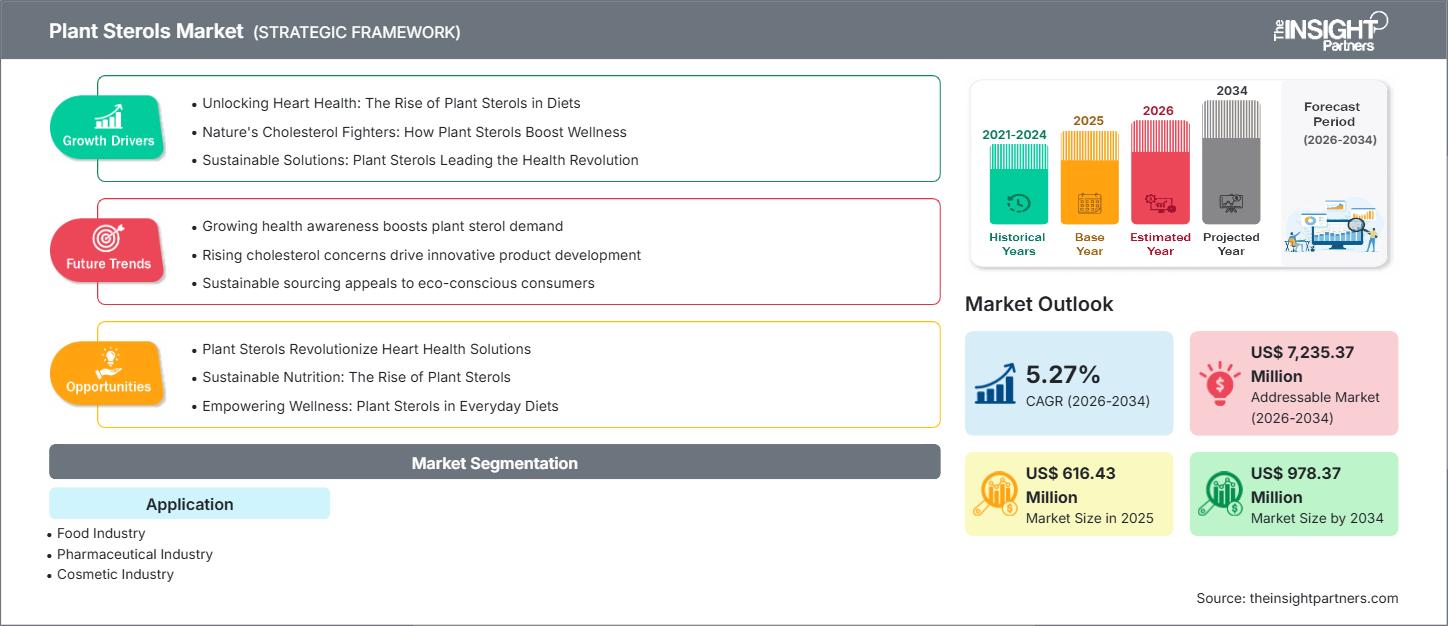
The global plant sterols market size is projected to reach US$ 978.37 million by 2034 from US$ 616.43 million in 2025. The market is anticipated to register a CAGR of 5.27% during the forecast period 2026–2034.
Key market dynamics include a heightening global focus on cardiovascular health, rising consumer demand for cholesterol-lowering functional foods, and the increasing integration of plant-based bioactives in the pharmaceutical and nutraceutical sectors. Additionally, the market is expected to benefit from regulatory approvals for heart health claims, the expansion of the clean-label movement, and the growing inclusion of phytosterols in high-value segments like premium skincare and clinical nutrition.
Plant Sterols Market Analysis
The plant sterols market analysis shows a shift toward high-purity, specialized formulations as consumers move beyond basic fortified spreads to targeted metabolic health solutions. The market is diversifying into high-growth areas like microencapsulated powders for beverages and water-dispersible esters for liquid supplements. Strategic opportunities are emerging in the healthy ageing segment, where the proven efficacy of beta-sitosterol in managing LDL cholesterol offers a clear competitive advantage for geriatric nutrition. The analysis also notes that market expansion depends on overcoming high extraction costs and ensuring raw material traceability. Competitive differentiation now stands out through clinical validation and the use of non-GMO sources like sunflower and pine, helping premium brands command higher price points in a market increasingly sensitive to ingredient origin and sustainability.
Plant Sterols Market Overview
Functional ingredients have advanced from niche additives to core components of the modern wellness lifestyle. The market includes phytosterol-enriched dairy alternatives, heart-health shots, and dermatological creams. Both global chemical giants and specialized biotech firms compete in this market, sourcing sterols from vegetable oil distillates and tall oil pitch. Growing demand for preventive healthcare options among the aging populations of Europe and North America has solidified plant sterols as a staple in the functional food pantry. Europe leads in revenue due to its early adoption of a bio-based economy, while North America is advancing rapidly through innovation in the dietary supplement and pharmaceutical channels. The US market is characterized by a mature landscape centered on preventive heart health. High consumer awareness and a robust dietary supplement infrastructure drive widespread adoption. The market is shaped by stringent regulatory health claim standards and an increasing shift toward fortifying everyday dairy and cereal products.
Market Assessment and Insights
- Global market for Plant Sterols was valued at US$ 616.43 Million in 2025
- Annual market size is expected to reach US$ 978.37 Million by 2034
- Total addressable market (TAM) during 2026-2034 is projected to reach approximately US$ 7,235.37 Million
- Market is anticipated to register a CAGR of 5.27% during the forecast period
- The United States represents a key market, supported by Unlocking Heart Health: The Rise of Plant Sterols in Diets, Nature's Cholesterol Fighters: How Plant Sterols Boost Wellness, Sustainable Solutions: Plant Sterols Leading the Health Revolution, as well as evolving industry dynamics
- Market analysis covers North America, Europe, Asia-Pacific, South and Central America, Middle East and Africa, with growth evaluated across the forecast period
- Market opportunities such as Plant Sterols Revolutionize Heart Health Solutions, Sustainable Nutrition: The Rise of Plant Sterols, Empowering Wellness: Plant Sterols in Everyday Diets are expected to influence market dynamics and addressable market
- Report profiles industry participants, including Archer Daniels Midland Company, Ashland Global Holdings Inc., BASF SE, Cargill, Incorporated, Clearwave Health, Inno Pure, Lamberts Healthcare, Merck KgaA, Nature's Best, Simply Supplements, Vitabiotics, while analyzing competitive strategies and innovation developments
-
Source: The Insight Partners' analysis based on proprietary research, government publications, company annual reports, investor presentations, industry databases, and expert interviews.
● REPORT CUSTOMIZATION
Tailor This Report To Align With Your Specific Business Requirements
This report can be customized to align precisely with your business objectives, scope, and target markets. Customization options include tailored segmentation, geography, competitive analysis, and strategic insights to support informed decision-making.
Customize This Report →WHAT YOU CAN ADJUST
- ● Segmentations
- ● Geography
- ● Competitive Analysis
- ● Language Preferences
Plant Sterols Market: Strategic Insights
-
Get Top Key Market Trends of this report.This FREE sample will include data analysis, ranging from market trends to estimates and forecasts.
Plant Sterols Market Drivers and Opportunities
Market Drivers:
- Rising Prevalence of Cardiovascular Diseases: With heart health becoming a global priority, the clinically proven ability of plant sterols to reduce LDL cholesterol absorption is a primary growth engine.
- Regulatory Support and Health Claims: Approvals from the FDA and EFSA, allowing specific heart health labels on products, have boosted consumer trust and encouraged food manufacturers to fortify mainstream products.
- Expansion of Plant-Based and Clean-Label Trends: As consumers shift away from synthetic additives, the natural origin of phytosterols from soy, corn, and pine aligns with the demand for botanical bioactives.
Market Opportunities:
- Innovation in Beauty and Personal Care: Phytosterols offer significant opportunities in skincare for their anti-inflammatory and barrier-repair properties, particularly in the premium anti-aging and sun care segments.
- Growth in Water-Dispersible Formulations: Developing advanced delivery systems, such as microencapsulation, allows for the inclusion of plant sterols in a wider range of beverages and liquid nutraceuticals without affecting taste or texture.
- Untapped Potential in Emerging APAC Markets: Increasing urbanization and rising middle-class disposable incomes in China and India present a massive opportunity for the expansion of fortified functional snacks and pediatric nutrition.
Plant Sterols Market Report Segmentation Analysis
The Plant Sterols Market share is analyzed across various segments to provide a clearer understanding of its structure, growth potential, and emerging trends. Below is the standard segmentation approach used in most industry reports:
By Composition:
- Beta-Sitosterol: The dominant segment, often accounting for over 50% of the market share due to its superior efficacy in lowering LDL cholesterol and its high prevalence in common plant sources.
- Campesterol: A significant component often found alongside sitosterol, valued for its high bioavailability and increasing use in specialized dietary supplements.
- Stigmasterol: Widely used as a precursor in the pharmaceutical industry for the synthesis of steroid hormones and semi-synthetic corticosteroids.
- Other Compositions: Includes minor sterols and stanols such as Brassicasterol and Ergosterol, which are gaining niche traction in research-led functional products.
By Application:
- Food Industry: The largest application segment, where sterols are incorporated into margarines, dairy products, bakery goods, and beverages to provide heart-health benefits.
- Pharmaceutical Industry: Utilizes high-purity plant sterols as active pharmaceutical ingredients (APIs) and chemical intermediates for drug synthesis.
- Cosmetic Industry: A rapidly growing niche where sterols are used for their moisturizing, anti-inflammatory, and skin-barrier-repairing properties in premium skincare.
By Form:
- Dry: Includes powder and granular formats. This is the fastest-growing segment due to its extended shelf life, ease of transport, and precision in dosing for supplements and dry food mixes.
- Liquid: Often presented as phytosterol oils or water-dispersible esters, favored for their ease of integration into liquid dairy, juices, and functional beverages.
By Source:
- Vegetable Oils: The primary source of plant sterols, with soybean, rapeseed, sunflower, and corn oil distillates providing the bulk of the global supply.
- Nuts & Seeds: A high-value source providing specific sterol profiles, increasingly marketed for premium, cold-pressed health applications.
- Whole Grains: Sources like wheat germ and rice bran are utilized for their unique nutrient density and appeal in the clean-label whole-food market.
- Other Sources: Includes tall oil (a byproduct of the wood pulping process) and legumes, which serve as essential raw materials for large-scale industrial sterol production.
By Geography:
- North America
- Europe
- Asia Pacific
- South & Central America
- Middle East & Africa
Plant Sterols Market Report Scope
| Report Attribute | Details |
|---|---|
| Market size in 2025 | US$ 616.43 Million |
| Market Size by 2034 | US$ 978.37 Million |
| Global CAGR (2026 - 2034) | 5.27% |
| Historical Data | 2021-2024 |
| Forecast period | 2026-2034 |
| Segments Covered |
By Application
|
| Regions and Countries Covered |
North America
|
| Market leaders and key company profiles |
|
Plant Sterols Market Players Density: Understanding Its Impact on Business Dynamics
The Plant Sterols Market is growing rapidly, driven by increasing end-user demand due to factors such as evolving consumer preferences, technological advancements, and greater awareness of the product's benefits. As demand rises, businesses are expanding their offerings, innovating to meet consumer needs, and capitalizing on emerging trends, which further fuels market growth.
Plant Sterols Market Share Analysis by Geography
Asia-Pacific is expected to grow fastest in the coming years. Emerging markets in South & Central America, the Middle East, and Africa also have many untapped opportunities for premium dairy producers and infant formula manufacturers to expand. Europe currently holds the largest share of the global plant sterols market, while North America is expected to be the fastest-growing region during the forecast period. Emerging economies in Asia-Pacific and South America are also presenting significant untapped opportunities for functional food and supplement manufacturers.
The plant sterols market is shifting from a niche European dietary staple to a mainstream global health solution. Growth is primarily fueled by the rising prevalence of hypercholesterolemia, favorable regulatory health claims, and the global transition toward plant-based preventive nutrition. Below is a summary of market share and trends by region:
1. North America
- Market Share: Holds approximately the market, characterized by the highest growth trajectory, driven by a robust nutraceutical sector.
- Key Drivers:
- High incidence of cardiovascular diseases (CVD), with US adults having some form of clinical heart condition.
- Strong regulatory support from the FDA, allowing clear heart-health claims on fortified products.
- Mainstreaming of phytosterols in mass-retail channels through gummies, softgels, and functional snacks.
- Trends: Adoption of direct-to-consumer (D2C) subscription models for personalized heart-health packages and the use of non-soy sources like sunflower to meet allergen-free demands.
2. Europe
- Market Share: The largest regional market, anchored by mature functional food industries in Germany, France, and the UK.
- Key Drivers:
- Early adoption of bio-based economies and long-standing EFSA approval for cholesterol-reduction claims.
- High consumer penetration, with countries like the UK seeing households regularly purchasing phytosterol-fortified foods.
- Presence of industry giants like BASF SE and Raisio Plc providing localized R&D.
- Trends: Strategic focus on reformulating traditional dairy and bakery products into high-margin functional variants and a strong shift toward non-GMO, sustainable sourcing.
3. Asia-Pacific
- Market Share: The third-largest region, experiencing rapid expansion due to the burgeoning middle-class populations in China and India.
- Key Drivers:
- Increasing disposable income leading to higher spending on Westernized luxury health products.
- Rising government focus on food fortification to combat the growing burden of lifestyle-related chronic diseases.
- Japan’s sophisticated market for functional beverages and FOSHU (Foods for Specified Health Uses).
- Trends: Integration of plant sterols into traditional medicine practices and the rapid growth of e-commerce as the primary distribution channel for premium supplements.
4. South and Central America
- Market Share: An emerging segment with a growing artisanal and retail sector in Brazil and Chile.
- Key Drivers:
- Expanding awareness of the link between dietary cholesterol and metabolic health.
- Modernization of regional oil refining facilities to produce high-value sterol isolates for export and local use.
- Trends: Rise of private-label phytosterol supplements in retail pharmacies to make heart-health products accessible to a broader demographic.
5. Middle East and Africa
- Market Share: A developing market with strategic focus on shelf-stable functional foods and high-nutrient pediatric/geriatric nutrition.
- Key Drivers:
- High demand for cardiovascular wellness products in urban centers like the UAE and South Africa.
- Investment in local processing infrastructure to reduce reliance on expensive imports.
- Trends: Implementation of microencapsulated sterol technology to ensure product stability in hot, arid climates.
High Market Density and Competition
Competition is intensifying due to the presence of established leaders such as BASF SE, Cargill, Incorporated, and Archer Daniels Midland Company. Regional players like Raisio Plc (Finland) and Matrix Fine Sciences (India) also play vital roles in specialized applications.
This competitive environment pushes vendors to differentiate through:
- Technological Advancement: Utilizing microencapsulation to improve the solubility and bioavailability of sterols in various food matrices.
- Diverse Product Portfolios: Moving beyond simple oils to offer microencapsulated powders and water-dispersible esters.
- Supply Chain Control: Managing the entire value chain from oil refining to final purification to ensure transparency and ethical standards.
Opportunities and Strategic Moves
- Diversification into Pharma and Cosmetics: Beyond food, high-purity sterols are increasingly used as precursors for steroid hormones and as barrier-repair ingredients in premium anti-aging skincare.
- Strategic Partnerships: Ingredient suppliers are collaborating with mainstream food brands (e.g., yogurt and bakery) to create dual-action health products, such as combining sterols with Omega-3s for comprehensive heart support.
Major Companies operating in the Plant Sterols Market are:
- Archer Daniels Midland Company
- Ashland Global Holdings Inc.
- BASF SE
- Cargill, Incorporated
- Clearwave Health
- Inno Pure
- Lamberts Healthcare
- Merck KGaA
- Nature's Best
- Simply Supplements
- Vitabiotics
Disclaimer: The companies listed above are not ranked in any particular order.
Plant Sterols Market News and Recent Developments
- In November 2025, Kensing announced the exclusive EU authorisation of Sunvasterol, a next-generation of plant sterols sourced from sunflower seeds. This EFSA approval for sunflower phytosterols offers food formulators and dietary supplement brands a clean-label, allergen-free, sustainably sourced alternative to traditional soy, rapeseed, and pine-based sterols clinically proven to reduce cholesterol.
- In December 2024, BASF signed a binding agreement to sell its Food and Health Performance Ingredients business, including the production site in Illertissen, Germany, to Louis Dreyfus Company (LDC), a leading global merchant and processor of agricultural goods, including high-quality, plant-based ingredients. BASF’s Food and Health Performance Ingredients portfolio plays a vital role in addressing growing trends in human nutrition. However, the business has limited synergies and integration into BASF and is no longer a strategic focus area.
Plant Sterols Market Report Coverage and Deliverables
The Plant Sterols Market Size and Forecast (2021–2034) report provides a detailed analysis of the market covering below areas:
- Plant Sterols Market size and forecast at global, regional, and country levels for all the key market segments covered under the scope
- Plant Sterols Market trends, as well as market dynamics such as drivers, restraints, and key opportunities
- Detailed PEST and SWOT analysis
- Plant Sterols Market analysis covering key market trends, global and regional framework, major players, regulations, and recent market developments
- Industry landscape and competition analysis covering market concentration, heat map analysis, prominent players, and recent developments in the Plant Sterols Market.
- Detailed company profiles
Frequently Asked Questions

- Comprehensive Market Sizing and Forecast Analysis
- Detailed Segmentation Analysis
- In-Depth Market Dynamics Assessment
- Regional and Country-Level Insights
- Competitive Landscape and Company Benchmarking
- Strategic Business Intelligence
Recent Reports
Testimonials

The Insight Partners' SCADA System Market report is comprehensive, with valuable insights on current trends and future forecasts. The team was highly professional, responsive, and supportive throughout. We are very satisfied and highly recommend their services.
RAN KEDEM Partner, Reali Technologies LTDs
I requested a report on a very specific software market and the team produced the report in a few days. The information was very relevant and well presented. I then requested some changes and additions to the report. The team was again very responsive and I got the final report in less than a week.
JEAN-HERVE JENN Chairman, Future Analytica
We worked with The Insight Partners for an important market study and forecast. They gave us clear insights into opportunities and risks, which helped shape our plans. Their research was easy to use and based on solid data. It helped us make smart, confident decisions. We highly recommend them.
PIYUSH NAGPAL Sr. Vice President, High Beam Global
The Insight Partners delivered insightful, well-structured market research with strong domain expertise. Their team was professional and responsive throughout. The user-friendly website made accessing industry reports seamless. We highly recommend them for reliable, high-quality research services
YUKIHIKO ADACHI CEO, Deep Blue, LLC.
This is the first time I have purchased a market report from The Insight Partners.While I was unsure at first, I visited their web site and felt more comfortable to take the risk and purchase a market report.I am completely satisfied with the quality of the report and customer service. I had several questions and comments with the initial report, but after a couple of dialogs over email with their analyst I believe I have a report that I can use as input to our strategic planning process.Thank you so much for taking the extra time and making this a positive experience.I will definitely recommend your service to others and you will be my first call when we need further market data.
JOHN SUZUKI President and Chief Executive Officer, Board Director, BK Technologies
I wish to appreciate your support and the professionalism you displayed in the course of attending to my request for information regarding to infectious disease IVD market in Nigeria. I appreciate your patience, your guidance, and the fact that you were willing to offer a discount, which eventually made it possible for us to close a deal. I look forward to engaging The Insight Partners in the future, all thanks to the impression you have created in me as a result of this first encounter.
DR CHIJIOKE ONYIA MANAGING DIRECTOR, PineCrest Healthcare Ltd.Reason to Buy
- Informed Decision-Making
- Understanding Market Dynamics
- Competitive Analysis
- Identifying Emerging Markets
- Customer Insights
- Market Forecasts
- Risk Mitigation
- Boosting Operational Efficiency
- Strategic Planning
- Investment Justification
- Tracking Industry Innovations
- Aligning with Regulatory Trends





 Get Free Sample for