
Pre-Engineered Buildings Market Trends, Share & Demand by 2034
Coverage: By Offering (Concrete based, Steel based, Modular Systems, Others); End-use (Residential Buildings, Commercial Buildings, Industrial Buildings) , and Geography (North America, Europe, Asia Pacific, and South and Central America)
- Status : Data Released
- Report Code : TIPRE00006799
- Category : Manufacturing and Construction
- No. of Pages : 150
- Available Report Formats :


- Last update date : September 07, 2026


2025 Market Size
US$ 29.57 Bn
Base year value
2034 Forecast
US$ 63.35 Bn
Projected by 2034
CAGR 2026-2034
8.83 %
Growth rate
Addressable Market
US$ 416.06 Bn
(2026-2034)
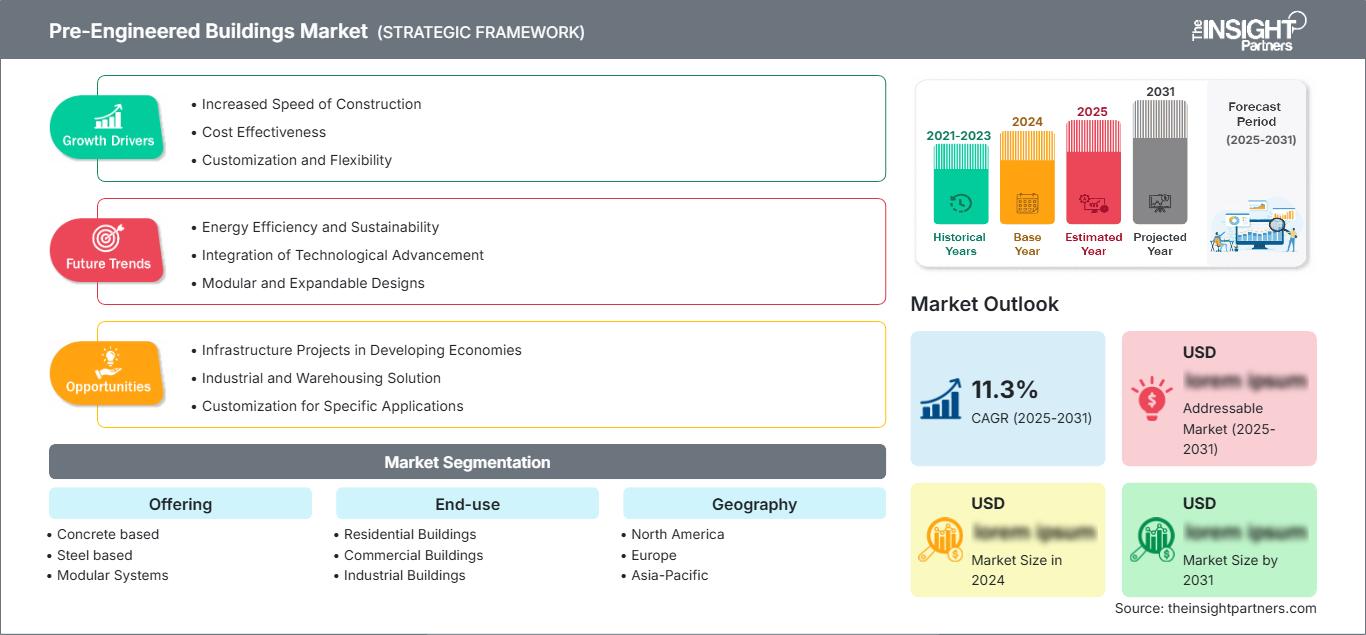
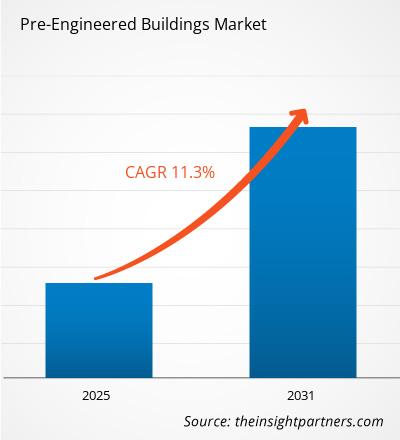
The global Pre-Engineered Buildings market was valued at US$ 29.57 billion in 2025 and is expected to reach US$ 63.35 billion by 2034; it is estimated to record a CAGR of 8.83% during 2026-2034.
Pre-Engineered Buildings Market Assessment and Insights
- North America: The region is estimated to account for a 22–26% share in 2025 and expand at a CAGR of 8.4–9.0% between 2026–2034, supported by logistics, manufacturing, data infrastructure, and industrial redevelopment.
- US: The US represents approximately 70–75% of North America's 2025 market and is expected to grow at a CAGR of 8.1–8.7%, driven by industrial construction and warehouse requirements.
- Europe: Europe is estimated at a 20–24% share in 2025, with a CAGR of 8.7–9.3% through 2034. Germany, the UK, France, Italy, and Spain support demand through industrial modernization, logistics, and energy-efficient construction.
- Asia Pacific: Asia Pacific is estimated to hold a 38–42% share in 2025 and grow at a CAGR of 10.8–11.5%, led by China, India, Japan, South Korea, and Southeast Asia's manufacturing and logistics expansion.
- Largest Segment: Steel based structures represent an estimated 62–66% market share in 2025 and are projected to grow at a CAGR of 10.2–10.8%, reflecting broad industrial and commercial adoption.
- High Growth Segment: Modular Systems represent approximately 16–20% in 2025 and are forecast to expand at a CAGR of 12.2–13.0%, supported by off-site fabrication and rapid deployment requirements.
- Key companies analyzed in detail: ATCO Ltd.; Astron Buildings S.A.; ATAD Steel Structure Corporation; Cornerstone Building Brands; Pennar Industries Limited; Everest Industries Limited; Kirby Building Systems; Norsteel Buildings; PEB Steel Buildings Co., Ltd.; Tata BlueScope Steel.
Source: The Insight Partners' analysis based on proprietary research, government publications, company annual reports, investor presentations, industry databases, and expert interviews.
Modern pre-fab buildings have transitioned from generic industrial sheds to engineered solutions that incorporate optimally designed steel sections, insulated panels, improved paint coatings, built-in services, and computer-coordinated structural design. The fabrication process takes place within a more controlled factory environment where variation due to site conditions is minimized, and dimension precision is assured. BIM design, detailing, and manufacturing are also assisting in enhancing coordination among architects, fabricators, contractors, and end users.
The next stage of development will see the market grow beyond traditional factories and warehouses to include data centers, logistics centers, commercial buildings, institutional structures, and selected residences. Growth opportunities for developing nations will become prominent because fast and efficient construction addresses issues of labor shortage and time scheduling. The increased focus on structural integrity, energy efficiency, fire safety, and low embodied carbon emissions is leading to better designs by suppliers.
Pre-Engineered Buildings Market Report Scope
| Report Attribute | Details |
|---|---|
| Market size in 2025 | US$ 29.57 Billion |
| Market Size by 2034 | US$ 63.35 Billion |
| Global CAGR (2026 - 2034) | 8.83% |
| Historical Data | 2021-2024 |
| Forecast period | 2026-2034 |
Pre-Engineered Buildings Market Analysis
Demand is increasingly connected to industrial expansion, warehousing, logistics networks, manufacturing relocation, and infrastructure modernization. In this environment, the pre-engineered buildings market growth is influenced by the ability of suppliers to integrate structural engineering, steel processing, roofing, cladding, insulation, transportation, and erection within coordinated project workflows. The ecosystem includes steel producers, component manufacturers, engineering firms, contractors, developers, and specialist installation teams.
Steel price levels, manufacturing capability, transportation costs, and availability of erection labor continue to influence the supply chain process. Standardized engineering drawings, automated manufacturing, and consistent component specifications may help with procurement planning and minimize mistakes. Companies that manufacture and install equipment have an advantage in dealing with project complexities when customers value schedule security and single sourcing.
Competitive positioning is increasingly based on engineering depth, manufacturing footprint, customization capability, delivery reliability, and geographic reach. The pre-engineered buildings market analysis indicates that companies such as ATCO Ltd., Astron Buildings S.A., ATAD Steel Structure Corporation, Cornerstone Building Brands, Pennar Industries Limited, and Everest Industries Limited compete through differentiated structural and building-system capabilities.
The competitiveness of Kirby Building Systems, Norsteel Buildings, PEB Steel Buildings Co., Ltd., and Tata BlueScope Steel is enhanced by regional manufacture, engineering capabilities, integration of buildings, and existing customer relationships. There is an increasing focus on investment in automation, fabricating skills, innovation, digital design, and manufacturing capability in proximity to expanding construction markets. Strategic alliances with contractors and developers will help increase visibility and completion of orders.
● REPORT CUSTOMIZATION
Tailor This Report To Align With Your Specific Business Requirements
This report can be customized to align precisely with your business objectives, scope, and target markets. Customization options include tailored segmentation, geography, competitive analysis, and strategic insights to support informed decision-making.
Customize This Report →WHAT YOU CAN ADJUST
- ● Segmentations
- ● Geography
- ● Competitive Analysis
- ● Language Preferences
Pre-Engineered Buildings Market: Strategic Insights
Regional Insights
North America pre-engineered buildings market
North America is estimated to represent 22–26% of the global pre-engineered buildings market in 2025 and is forecast to grow at a CAGR of 8.4–9.0% through 2034. The US remains the principal demand center, while Canada benefits from industrial, mining, logistics, and infrastructure projects requiring adaptable building systems.
Demand is supported by manufacturing reshoring, distribution-center development, energy infrastructure, and the replacement of aging industrial facilities. Construction schedules and labor availability remain important purchasing considerations, increasing interest in factory-fabricated structural systems. Local engineering standards, snow and wind-load requirements, fire protection, and energy-performance expectations encourage suppliers to maintain strong design and compliance capabilities.
U.S. pre-engineered buildings Market
The US accounts for approximately 70–75% of North America's 2025 market and is expected to expand at a CAGR of 8.1–8.7% during 2026–2034. Demand is concentrated in warehouses, manufacturing facilities, agricultural structures, distribution centers, and selected commercial applications.
Companies with established US capabilities include Cornerstone Building Brands and ATCO Ltd., while specialized suppliers support regional industrial and commercial projects. Increasing use of clear-span structures, insulated envelopes, high-bay configurations, and integrated loading areas is aligning building design with logistics and manufacturing requirements. Expansion of domestic industrial capacity also supports demand for scalable construction systems.
Europe pre-engineered buildings Market
Europe is estimated to hold a 20–24% of the pre-engineered buildings market share in 2025 and is forecast to grow at a CAGR of 8.7–9.3%. Germany is the leading market, supported by manufacturing modernization and logistics investment. The UK remains significant because of warehouse development, industrial refurbishment, and demand for faster construction methods.
Germany's industrial base supports applications requiring high structural precision and efficient project execution. France, Italy, and Spain contribute through logistics, manufacturing, commercial redevelopment, and infrastructure construction. European requirements concerning insulation, energy efficiency, fire safety, and sustainability are encouraging suppliers to integrate improved envelope systems and more efficient structural designs.
APAC pre-engineered buildings Market
APAC is estimated to account for 38–42% of 2025 pre-engineered buildings market demand and is projected to grow at a CAGR of 10.8–11.5%, making it the leading regional market. China remains the largest contributor, while India is a major growth center. Japan, South Korea, and Australia add demand through advanced industrial and infrastructure projects.
Industrial expansion, logistics development, manufacturing investments, and public infrastructure programs support adoption. Policy emphasis on industrialization and modern construction methods further strengthens demand, particularly in India and Southeast Asia. Suppliers are increasingly expanding fabrication capacity and regional distribution networks to reduce delivery times and serve large project pipelines.
Middle East & Africa pre-engineered buildings Market
The Middle East and Africa pre-engineered buildings market demand is supported by industrial diversification, logistics infrastructure, energy projects, mining, and urban development. Saudi Arabia is a leading market, while the UAE remains important for logistics, commercial construction, and large-scale infrastructure. South Africa provides a significant industrial and mining-oriented demand base.
The regional market is expected to grow at a CAGR of 8.0–8.8% during 2026–2034. Energy and infrastructure investment creates opportunities for rapidly deployable industrial buildings, warehouses, worker accommodation, and supporting facilities. Climate conditions also encourage the use of engineered envelopes, corrosion-resistant materials, insulation, and controlled ventilation.
Segmentation Analysis
Offering
Pre-engineered buildings market trends indicate that offering remains a major determinant of structural system selection, with steel-based solutions retaining the largest position. The segment is forecast to grow at a CAGR of 9.2–9.8% during 2026–2034, supported by strength-to-weight advantages, fabrication efficiency, and compatibility with industrial and commercial building designs.
- Concrete based: Concrete-based systems address projects requiring substantial mass, durability, or specialized structural characteristics. Their use remains relevant where local building practices, fire requirements, and foundation considerations influence material selection.
- Steel based: Steel-based structures dominate applications requiring long spans, rapid fabrication, modularity, and relatively lightweight structural systems. Their broad compatibility with warehouses, factories, and commercial buildings reinforces their strategic importance.
- Modular Systems: Modular systems support off-site fabrication and accelerated installation. Their strategic role is increasing where projects face constrained sites, labor shortages, tight schedules, or requirements for repeatable building configurations.
End-use
End-use segmentation reflects differences in structural loads, building configuration, occupancy, and project economics. The segment is forecast to expand at a CAGR of 9.5–10.1% during 2026–2034, with industrial applications remaining particularly important because of manufacturing, warehousing, and logistics requirements.
- Residential Buildings: Residential adoption remains selective but is supported by modular construction, workforce housing, affordable housing programs, and projects requiring standardized designs with controlled construction schedules.
- Commercial Buildings: Commercial applications include retail facilities, offices, institutional spaces, and mixed-use structures where flexible floor layouts and accelerated construction can improve development timelines.
- Industrial Buildings: Industrial buildings represent the core demand base, particularly for factories, warehouses, logistics centers, workshops, and processing facilities requiring clear spans and adaptable internal configurations.
Opportunity Snapshot
| End-use | Revenue Contribution (High/Medium/Low) | Trend Tag (MAX 2 words) | Adoption Stage (Emerging/Scaling/Mature) |
| Residential Buildings | Medium | Modular Housing | Scaling |
| Commercial Buildings | Medium | Flexible Spaces | Scaling |
| Industrial Buildings | High | Smart Warehousing | Mature |
Pre-Engineered Buildings Market Growth Drivers and Impact Analysis
Expansion of Warehousing and Industrial Logistics Capacity
The ongoing growth in distribution networks, fulfillment centers, cold chain infrastructure, and industrial estates will result in an ongoing need for large span buildings with adaptable interior layouts. Pre-engineering solutions have the capacity to accommodate high-ceiling warehouses, loading zones, mezzanine levels, and further expansion with relatively consistent structural elements. The solution is most applicable to those suppliers who can combine their structural frame with roofing, walls, insulation, doors, ventilation, and other accessory items. The significance of such developments is most obvious in the regions where industrial restructuring and expansion of e-commerce activities occur. A predictable construction process is highly valuable for the developers since even slight delays may affect the opening and leasing of such facilities. With the expansion of logistics networks to new geographic regions, the need for regional fabrication and installation will emerge.
Manufacturing Reshoring and Industrial Capacity Expansion
The rise in manufacturing investments is generating greater demand for factories, assembly shops, processing plants, workshops, and auxiliary buildings that must be ready to meet specific project timelines. Pre-engineered construction emerges as a solution because structural parts can be engineered, fabricated, transported, and assembled in a series of organized activities. This effect will benefit all from steel processors, engineering firms, fabricators, contractors, and equipment suppliers. The manufacture of new buildings will often need clear span production areas, high roof height, a material handling system, utilities, and expansion capacity. This creates an environment where building systems are needed that are flexible enough to adapt to any changes in production layout.
Pressure to Reduce Construction Time and Site Labor Requirements
Schedule pressures, shortages of skilled workers, site congestion, and high costs related to longer on-site activity periods have become more common concerns for construction parties. The factory process of fabrication enables a good part of structural activities to be moved off-site, where the site preparation and component fabrication can run at the same time. This may help improve scheduling and limit interference from weather conditions. The effect would be most felt in those projects that value earlier readiness to operate, such as warehouses, factories, commercial buildings, and support infrastructure buildings. Manufacturers that offer engineering, fabrication, logistics, and erection services can help limit coordination problems for their clients. With greater emphasis on construction productivity as an investment criterion, manufacturers will probably focus on automation, standard connection technologies, detailed design, and production planning.
Pre-Engineered Buildings Market Future Trends
Integration of Digital Engineering and Automated Fabrication
Digital engineering is expected to become more deeply embedded throughout the building lifecycle, from conceptual design and structural optimization to fabrication and site assembly. Three-dimensional modeling, automated detailing, digital quantity extraction, and production-linked engineering can reduce information gaps between project participants. The next stage will involve tighter integration between design platforms and fabrication equipment, enabling manufacturers to generate production-ready information with fewer manual interventions. This can improve material utilization, connection accuracy, and change management while supporting increasingly customized projects. Suppliers may also use digital project environments to provide customers with clearer visibility into engineering status, fabrication progress, logistics, and installation schedules. The resulting competitive advantage will increasingly depend on the ability to combine engineering intelligence with physical manufacturing capacity rather than relying solely on standardized building products.
Low-Carbon Structural Systems and Circular Material Strategies
Environmental performance is expected to influence structural specifications more strongly as developers, regulators, and corporate occupiers increase attention to embodied carbon and resource efficiency. Steel remains central to this transition because structural components can be designed for material efficiency, reused in suitable applications, and incorporated into recycling streams. Future systems are likely to combine optimized steel sections with improved insulation, reflective coatings, efficient roofing assemblies, and lower-impact material choices. Manufacturers may also provide greater transparency concerning material sourcing, recycled content, product durability, and end-of-life recovery. Digital material records could support future reuse by documenting component characteristics and structural information. These developments will encourage suppliers to treat sustainability as an engineering and lifecycle issue rather than simply an architectural specification.
Pre-Engineered Buildings Market Opportunities
Expansion into Data Centers and High-Specification Industrial Facilities
Data centers, semiconductor facilities, advanced manufacturing plants, and specialized logistics projects create opportunities for suppliers capable of meeting demanding structural, environmental, and schedule requirements. These projects require accurate engineering, high-quality envelopes, controlled installation processes, and integration with mechanical and electrical systems. Suppliers can capture greater value by developing specialized structural packages rather than competing solely on conventional warehouse applications. Investment in dedicated engineering teams, precision fabrication, corrosion protection, insulated panels, and integrated project management can strengthen participation in these projects. Partnerships with engineering consultants, general contractors, and equipment providers can also improve access to complex project pipelines. The strongest opportunity lies in combining the speed advantages of pre-engineered construction with the specification discipline expected in technically demanding facilities.
Localized Manufacturing Capacity in Emerging Construction Markets
Growing industrial corridors in India, Southeast Asia, the Middle East, Africa, and Latin America present opportunities for regional manufacturing expansion. Local fabrication plants can reduce transportation distances, improve responsiveness to customer specifications, and mitigate exposure to cross-border freight volatility. Investors and manufacturers can prioritize facilities near steel-processing clusters, logistics corridors, industrial parks, and large construction markets. Localized production also creates opportunities to adapt designs to regional wind, seismic, thermal, corrosion, and building-code requirements. Companies with established engineering standards can transfer production know-how while maintaining consistent quality across facilities. The pre-engineered buildings market Forecasts indicate that suppliers combining regional capacity with centralized engineering expertise can strengthen project coverage while reducing delivery risk and improving competitiveness in fast-growing construction economies.
Frequently Asked Questions

- Comprehensive Market Sizing and Forecast Analysis
- Detailed Segmentation Analysis
- In-Depth Market Dynamics Assessment
- Regional and Country-Level Insights
- Competitive Landscape and Company Benchmarking
- Strategic Business Intelligence
Recent Reports
Testimonials

The Insight Partners' SCADA System Market report is comprehensive, with valuable insights on current trends and future forecasts. The team was highly professional, responsive, and supportive throughout. We are very satisfied and highly recommend their services.
RAN KEDEM Partner, Reali Technologies LTDs
I requested a report on a very specific software market and the team produced the report in a few days. The information was very relevant and well presented. I then requested some changes and additions to the report. The team was again very responsive and I got the final report in less than a week.
JEAN-HERVE JENN Chairman, Future Analytica
We worked with The Insight Partners for an important market study and forecast. They gave us clear insights into opportunities and risks, which helped shape our plans. Their research was easy to use and based on solid data. It helped us make smart, confident decisions. We highly recommend them.
PIYUSH NAGPAL Sr. Vice President, High Beam Global
The Insight Partners delivered insightful, well-structured market research with strong domain expertise. Their team was professional and responsive throughout. The user-friendly website made accessing industry reports seamless. We highly recommend them for reliable, high-quality research services
YUKIHIKO ADACHI CEO, Deep Blue, LLC.
This is the first time I have purchased a market report from The Insight Partners.While I was unsure at first, I visited their web site and felt more comfortable to take the risk and purchase a market report.I am completely satisfied with the quality of the report and customer service. I had several questions and comments with the initial report, but after a couple of dialogs over email with their analyst I believe I have a report that I can use as input to our strategic planning process.Thank you so much for taking the extra time and making this a positive experience.I will definitely recommend your service to others and you will be my first call when we need further market data.
JOHN SUZUKI President and Chief Executive Officer, Board Director, BK Technologies
I wish to appreciate your support and the professionalism you displayed in the course of attending to my request for information regarding to infectious disease IVD market in Nigeria. I appreciate your patience, your guidance, and the fact that you were willing to offer a discount, which eventually made it possible for us to close a deal. I look forward to engaging The Insight Partners in the future, all thanks to the impression you have created in me as a result of this first encounter.
DR CHIJIOKE ONYIA MANAGING DIRECTOR, PineCrest Healthcare Ltd.Reason to Buy
- Informed Decision-Making
- Understanding Market Dynamics
- Competitive Analysis
- Identifying Emerging Markets
- Customer Insights
- Market Forecasts
- Risk Mitigation
- Boosting Operational Efficiency
- Strategic Planning
- Investment Justification
- Tracking Industry Innovations
- Aligning with Regulatory Trends





 Get Free Sample for