
Probiotic Infant and Child Formula Market Growth, Size & Forecast by 2034
Coverage: By Type [Infant Formula (0-1 Year) and Growing Up Formula (1-6 Years)] and Distribution Channel (Online and Offline)
- Status : Upcoming
- Report Code : TIPRE00029529
- Category : Consumer Goods
- No. of Pages : 150
- Available Report Formats :


- Last update date : March 12, 2026


2025 Market Size
US$ 17.23 Bn
Base year value
2034 Forecast
US$ 57.83 Bn
Projected by 2034
CAGR 2026-2034
14.4 %
Growth rate
Addressable Market
US$ 322.51 Bn
(2026-2034)
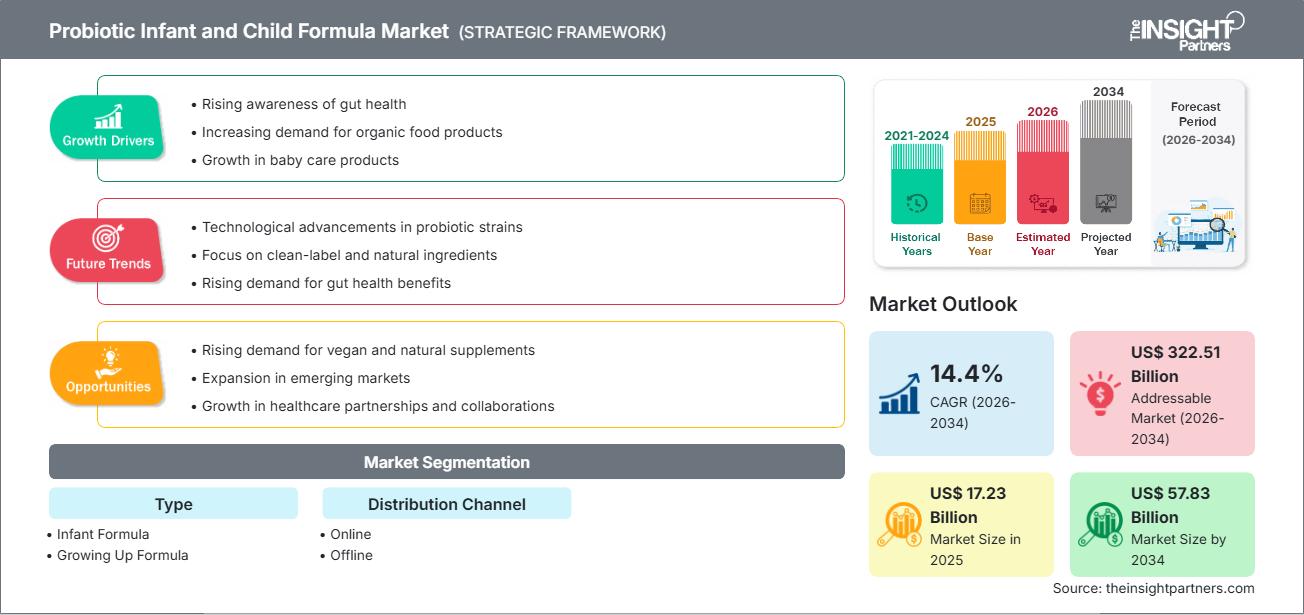
The global Probiotic Infant and Child Formula market size is projected to reach US$ 57.83 billion by 2034 from US$ 17.23 billion in 2025. The market is anticipated to register a CAGR of 14.4% during the forecast period 2026–2034.
Key market dynamics include an intensifying parental focus on the first 1,000 days of nutrition, the rising clinical validation of the gut-lung-brain axis, and a surge in pediatric cases of antibiotic-associated diarrhea and colic. Additionally, the market is expected to benefit from the mainstreaming of Human Milk Oligosaccharides (HMOs) combined with synbiotics, the expansion of high-end specialized retail in emerging economies, and the increasing preference for formulations that promote long-term immune resilience in early childhood.
Probiotic Infant and Child Formula Market Analysis
The probiotic infant and child formula market analysis indicates a fundamental shift from general calorie provision to precision nutrition designed to modulate the developing microbiome. Strategic opportunities are emerging in the medical-grade formula segment, where specific probiotic strains like L. rhamnosus GG and B. infantis are utilized to manage cow's milk protein allergy (CMPA) and eczema. Procurement trends show a distinct move toward microencapsulation technologies, which ensure the survival of live cultures through the shelf-life and gastric transit. Competitive differentiation is increasingly defined by evidence-based branding, where manufacturers leverage clinical trial data to substantiate health claims related to cognitive development and infection prevention. This scientific rigor allows established leaders to maintain a premium price index even as cost-conscious private labels enter the periphery of the market.
Probiotic Infant and Child Formula Market Overview
Probiotic infant and child formula is transitioning from a premium lifestyle choice to a standard of care in early pediatric nutrition. While historically centered on standard cow's milk bases, the market is now diversifying into goat milk and plant-based alternatives fortified with proprietary probiotic blends. Major industry players are focusing on mimicking the complex microbial environment of breast milk to cater to the growing population of working mothers who require nutritionally complete substitutes. The rise of personalized microbiomics is also influencing the market, as parents seek out formulas tailored to specific developmental milestones. While Europe remains a center for innovation, the Asia-Pacific region has emerged as the largest revenue contributor, driven by a massive birth rate and a rapid shift toward organized healthcare and premium baby food. For instance, the market in the US is defined by a highly regulated landscape where safety and clinical efficacy are paramount. Following recent supply chain recalibrations, American parents are prioritizing domestic, clean-label brands that offer transparency in sourcing. The market is witnessing a strong trend toward organic, non-GMO certifications and the rapid adoption of subscription-based e-commerce for specialized child formulas.
Market Research Highlights
- Global market for Probiotic Infant and Child Formula was valued at US$ 17.23 Billion in 2025
- Annual market size is expected to reach US$ 57.83 Billion by 2034
- Total addressable market (TAM) during 2026-2034 is projected to reach approximately US$ 322.51 Billion
- Market is anticipated to register a CAGR of 14.4% during the forecast period
- The United States represents a key market, supported by Rising awareness of gut health, Increasing demand for organic food products, Growth in baby care products, as well as evolving industry dynamics
- Market analysis covers North America, Europe, Asia-Pacific, South and Central America, Middle East and Africa, with growth evaluated across the forecast period
- Market opportunities such as Rising demand for vegan and natural supplements, Expansion in emerging markets, Growth in healthcare partnerships and collaborations are expected to influence market dynamics and addressable market
- Report profiles industry participants, including Nestl? S.A., HiPP GmbH & Company Vertrieb KG, Abbott Laboratories, Mead Johnson & Company, LLC., Bellamy's Organic, Aspen Pharmacare, Beech-Nut, Danone, The Hain Celestial Group, Inc., Gerber, while analyzing competitive strategies and innovation developments
-
Source: The Insight Partners' analysis based on proprietary research, government publications, company annual reports, investor presentations, industry databases, and expert interviews.
● REPORT CUSTOMIZATION
Tailor This Report To Align With Your Specific Business Requirements
This report can be customized to align precisely with your business objectives, scope, and target markets. Customization options include tailored segmentation, geography, competitive analysis, and strategic insights to support informed decision-making.
Customize This Report →WHAT YOU CAN ADJUST
- ● Segmentations
- ● Geography
- ● Competitive Analysis
- ● Language Preferences
Probiotic Infant and Child Formula Market: Strategic Insights
-
Get Top Key Market Trends of this report.This FREE sample will include data analysis, ranging from market trends to estimates and forecasts.
Probiotic Infant and Child Formula Market Drivers and Opportunities
Market Drivers:
- Increasing Awareness of Early-Life Gut Health: Parents are increasingly educated on the role of the microbiome in preventing long-term health issues. This awareness, supported by pediatric recommendations, is driving the transition toward formula enriched with probiotics that aid in digestion and nutrient absorption.
- Rising Prevalence of Pediatric Digestive Disorders: A global increase in infant colic, constipation, and functional gastrointestinal disorders has created a robust demand for therapeutic formulas. Probiotics are viewed as a natural, preventive solution to these common early-life ailments.
- Technological Innovations in Strain Stability: Advancements in cold-chain logistics and manufacturing processes have allowed for the inclusion of more diverse and potent probiotic strains in powdered and ready-to-feed formats, expanding the product's effectiveness and shelf-life.
Market Opportunities:
- Expansion into Growing-Up Formulas for Toddlers: There is a significant opportunity to target the 1-6 year age bracket with Growing-Up milks that focus on cognitive growth and immunity, bridging the gap between infant nutrition and adult wellness.
- Strategic Integration of HMOs and Synbiotics: Combining probiotics with Human Milk Oligosaccharides (HMOs) represents a high-margin opportunity to create next-generation formulas that closely replicate the immunological benefits of maternal milk.
- Focus on Developing Economies in APAC and MEA: Rapid urbanization and rising disposable incomes in countries like India, China, and Nigeria present a vast untapped market for an affordable yet nutritionally enhanced probiotic formula.
Probiotic Infant and Child Formula Market Report Segmentation Analysis
The Probiotic Infant and Child Formula Market share is analyzed across various segments to provide a clearer understanding of its structure, growth potential, and emerging trends. Below is the standard segmentation approach used in most industry reports:
By Type:
- Infant Formula (0-1 Year): This segment represents the largest market share, as it is the primary source of nutrition for non-breastfed infants. Focus remains on digestibility and mimicking the probiotic profile of breast milk to support the initial colonization of the gut.
- Growing-Up Formula (1-6 Years): A fast-growing category designed for toddlers and young children. These products often include specific probiotic strains aimed at supporting the immune system during the transition to a diverse solid-food diet.
By Distribution Channel:
- Offline: Currently the dominant channel, including supermarkets, hypermarkets, and specialty baby stores. This channel benefits from the trust factor, where parents can consult pharmacists or examine physical labels before purchase.
- Online: The fastest-rising distribution channel, driven by the convenience of home delivery, competitive pricing, and the ability to access niche or imported premium probiotic brands not available in local retail.
By Geography:
- North America
- Europe
- Asia Pacific
- South & Central America
- Middle East & Africa
Probiotic Infant and Child Formula Market Report Scope
| Report Attribute | Details |
|---|---|
| Market size in 2025 | US$ 17.23 Billion |
| Market Size by 2034 | US$ 57.83 Billion |
| Global CAGR (2026 - 2034) | 14.4% |
| Historical Data | 2021-2024 |
| Forecast period | 2026-2034 |
| Segments Covered |
By Type
|
| Regions and Countries Covered |
North America
|
| Market leaders and key company profiles |
|
Probiotic Infant and Child Formula Market Players Density: Understanding Its Impact on Business Dynamics
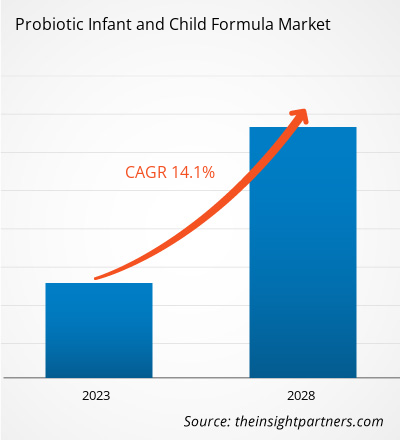
The Probiotic Infant and Child Formula Market is growing rapidly, driven by increasing end-user demand due to factors such as evolving consumer preferences, technological advancements, and greater awareness of the product's benefits. As demand rises, businesses are expanding their offerings, innovating to meet consumer needs, and capitalizing on emerging trends, which further fuels market growth.
Probiotic Infant and Child Formula Market Share Analysis by Geography
Asia-Pacific is expected to grow fastest in the coming years. Emerging markets in South & Central America, the Middle East, and Africa also have many untapped opportunities for premium dairy producers and infant formula manufacturers to expand.
The probiotic infant and child formula market is undergoing a significant transformation, moving from a niche digestive aid to a global standard in precision pediatric nutrition. Growth is driven by the rising prevalence of neonatal gut health concerns, a surge in the working-class parent demographic, and the expansion of the clinical-grade infant formula sector. Below is a summary of market share and trends by region:
North America
- Market Share: Holds a significant portion of the global market, anchored by the United States.
- Key Drivers:
- High Parental Health Literacy: Growing awareness regarding the gut-brain axis and the role of probiotics in cognitive development.
- Clinical Endorsement: Strong pediatrician advocacy for strain-specific probiotics to manage colic and antibiotic-associated diarrhea.
- Shift toward Specialty Dairy: Increasing consumer preference for clean-label, organic, and A2-protein bases in probiotic-fortified formulas.
- Trends: Scaling of subscription-based e-commerce models and the mainstreaming of synbiotics (probiotics and prebiotics) in retail.
Europe
- Market Share: A mature and influential market, with Germany and the UK leading the region.
- Key Drivers:
- Stringent Regulatory Frameworks: High consumer trust fueled by EFSA-compliant health claims and rigorous safety standards for infant nutrition.
- Preventive Healthcare Culture: A long-standing cultural affinity for fermented foods and functional dairy translates into early-life nutrition.
- Focus on Natural Fortification: Rising demand for minimally processed formulas that utilize natural probiotic fermentation over synthetic additives.
- Trends: A strategic shift toward sustainable and plastic-free packaging alongside the rapid growth of goat milk-based probiotic formulations.
Asia-Pacific
- Market Share: The dominant global region, commanding over a significant share of the market, with China and India serving as the primary drivers of growth.
- Key Drivers:
- Massive Birth Rate and Urbanization: A vast consumer base in Tier-1 and Tier-2 cities seeking high-quality, Western-standard infant nutrition.
- Rising Disposable Income: A burgeoning middle class willing to pay a premium for super-premium formulas that guarantee developmental benefits.
- Expansion of Digital Retail: Rapid adoption of e-commerce and social commerce platforms as the primary channel for purchasing imported probiotic formulas.
- Trends: Heavy reliance on B2B contracts for high-end probiotic ingredients and a focus on Growing-Up milks for children aged 1-6 years.
South and Central America
- Market Share: An emerging market with a projected robust valuation, led by Brazil and Chile.
- Key Drivers:
- Modernization of Baby Care: Increasing participation of women in the workforce is driving the transition from breastfeeding to fortified formula.
- Nutrition Labeling Awareness: New regional labeling laws are increasing parental scrutiny and demand for beneficial functional ingredients like probiotics.
- Middle-Class Premiumization: A growing segment of urban parents prioritizing gut health and immune support for infants.
- Trends: Growth of private-label probiotic formulas in supermarket chains and the introduction of clean-label artisanal baby food variants.
Middle East and Africa
- Market Share: A developing market with deep cultural roots in dairy, currently formalizing into a commercial hub for shelf-stable probiotic products.
- Key Drivers:
- Smart Agriculture Initiatives: Strategic investments in local production facilities to reduce reliance on imported probiotic ingredients.
- Focus on Nutrient Density: High demand for fortified milks to combat regional pediatric nutritional deficiencies and support immune health.
- Urban Retail Expansion: Rapid proliferation of specialty pharmacies and hypermarkets in the GCC countries offering premium global brands.
- Trends: Implementation of specialized refrigeration for live-culture storage and a focus on high-nutrient, shelf-stable powders for the pediatric segment in arid climates.
High Market Density and Competition
Competition is intensifying due to the presence of established leaders such as Nestlé S.A., Danone S.A. (Nutricia), and Abbott Laboratories. Regional experts and niche players like Bubs Australia and Bellamy's Organic, alongside innovators such as Else Nutrition, also contribute to a diverse and rapidly expanding market landscape.
This competitive environment pushes vendors to differentiate through:
- Strain-Specific Claims: Emphasizing proprietary, clinically-validated probiotic strains (e.g., B. infantis) to target specific health outcomes like reduced allergy risk or improved sleep.
- Synbiotic Formulations: Combining probiotics with Human Milk Oligosaccharides (HMOs) to more closely replicate the complex immunological profile of human breast milk.
- Transparency and Clean Labeling: Moving toward Farm-to-Formula traceability, ensuring products are free from GMOs, corn syrup, and synthetic thickeners to meet ethical standards.
Opportunities and Strategic Moves
- Partner with E-commerce Giants: Tapping into the surging demand in APAC by collaborating with platforms like JD.com or Tmall for direct consumer access.
- Incorporate Sustainable Practices: Utilizing regenerative agriculture and carbon-neutral manufacturing to appeal to environmentally conscious Gen Z parents.
Major Companies operating in the Probiotic Infant and Child Formula Market are:
- Nestlé S.A.
- HiPP GmbH & Company
- Vertrieb KG
- Abbott Laboratories
- Mead Johnson & Company, LLC.
- Bellamy's Organic
- Aspen Pharmacare
- Beech-Nut
- Danone
- The Hain Celestial Group, Inc.
Disclaimer: The companies listed above are not ranked in any particular order.
Probiotic Infant and Child Formula Market News and Recent Developments
- In November 2025, UNIFORM-Agri and Nedap deepened their long-standing collaboration through a new integration between the UNIFORM-Agri herd management system and Nedap Now. This enhanced connection allowed dairy farmers to access critical fertility and health insights directly within a single platform, ensuring the high-quality raw milk supply required for the production of premium Probiotic Infant and Child Formula.
- In July 2025, Danone announced that it had completed the acquisition of a majority stake in Kate Farms, a fast-growing US business and the top doctor-recommended plant-based brand in the country. This strategic move allowed Danone to significantly diversify its portfolio of plant-based and organic nutrition products, specifically enhancing its capabilities in the specialized Probiotic Infant and Child Formula segment to meet the rising demand for hypoallergenic medical and everyday pediatric solutions.
Probiotic Infant and Child Formula Market Report Coverage and Deliverables
The Probiotic Infant and Child Formula Market Size and Forecast (2021–2034) report provides a detailed analysis of the market covering below areas:
- Probiotic Infant and Child Formula Market size and forecast at global, regional, and country levels for all the key market segments covered under the scope
- Probiotic Infant and Child Formula Market trends, as well as market dynamics such as drivers, restraints, and key opportunities
- Detailed PEST and SWOT analysis
- Probiotic Infant and Child Formula Market analysis covering key market trends, global and regional framework, major players, regulations, and recent market developments
- Industry landscape and competition analysis covering market concentration, heat map analysis, prominent players, and recent developments in the Probiotic Infant and Child Formula Market.
- Detailed company profiles
Frequently Asked Questions

- Comprehensive Market Sizing and Forecast Analysis
- Detailed Segmentation Analysis
- In-Depth Market Dynamics Assessment
- Regional and Country-Level Insights
- Competitive Landscape and Company Benchmarking
- Strategic Business Intelligence
Testimonials

The Insight Partners' SCADA System Market report is comprehensive, with valuable insights on current trends and future forecasts. The team was highly professional, responsive, and supportive throughout. We are very satisfied and highly recommend their services.
RAN KEDEM Partner, Reali Technologies LTDs
I requested a report on a very specific software market and the team produced the report in a few days. The information was very relevant and well presented. I then requested some changes and additions to the report. The team was again very responsive and I got the final report in less than a week.
JEAN-HERVE JENN Chairman, Future Analytica
We worked with The Insight Partners for an important market study and forecast. They gave us clear insights into opportunities and risks, which helped shape our plans. Their research was easy to use and based on solid data. It helped us make smart, confident decisions. We highly recommend them.
PIYUSH NAGPAL Sr. Vice President, High Beam Global
The Insight Partners delivered insightful, well-structured market research with strong domain expertise. Their team was professional and responsive throughout. The user-friendly website made accessing industry reports seamless. We highly recommend them for reliable, high-quality research services
YUKIHIKO ADACHI CEO, Deep Blue, LLC.
This is the first time I have purchased a market report from The Insight Partners.While I was unsure at first, I visited their web site and felt more comfortable to take the risk and purchase a market report.I am completely satisfied with the quality of the report and customer service. I had several questions and comments with the initial report, but after a couple of dialogs over email with their analyst I believe I have a report that I can use as input to our strategic planning process.Thank you so much for taking the extra time and making this a positive experience.I will definitely recommend your service to others and you will be my first call when we need further market data.
JOHN SUZUKI President and Chief Executive Officer, Board Director, BK Technologies
I wish to appreciate your support and the professionalism you displayed in the course of attending to my request for information regarding to infectious disease IVD market in Nigeria. I appreciate your patience, your guidance, and the fact that you were willing to offer a discount, which eventually made it possible for us to close a deal. I look forward to engaging The Insight Partners in the future, all thanks to the impression you have created in me as a result of this first encounter.
DR CHIJIOKE ONYIA MANAGING DIRECTOR, PineCrest Healthcare Ltd.Reason to Buy
- Informed Decision-Making
- Understanding Market Dynamics
- Competitive Analysis
- Identifying Emerging Markets
- Customer Insights
- Market Forecasts
- Risk Mitigation
- Boosting Operational Efficiency
- Strategic Planning
- Investment Justification
- Tracking Industry Innovations
- Aligning with Regulatory Trends





 Get Free Sample for