
Retail Seasoning Blends Market Share, Growth & Demand by 2034
Coverage: By Type (BBQ Seasoning, Ranch Seasoning, Cajun Seasoning, Italian Seasoning, Five Spice Powder, Berbere Powder, Chili and Lime Seasoning, Fajita Seasoning, Chipotle Seasoning, Tacos Seasoning, All-Purpose, and Others) and Distribution Channel (Supermarkets and Hypermarkets, Convenience Stores, Online Retail, and Others)
- Status : Published
- Report Code : TIPRE00042700
- Category : Food and Beverages
- No. of Pages : 239
- Available Report Formats :


- Last update date : March 04, 2026


2025 Market Size
US$ 7.49 Bn
Base year value
2034 Forecast
US$ 12.31 Bn
Projected by 2034
CAGR 2026-2034
5.7 %
Growth rate
Addressable Market
US$ 89.85 Bn
(2026-2034)
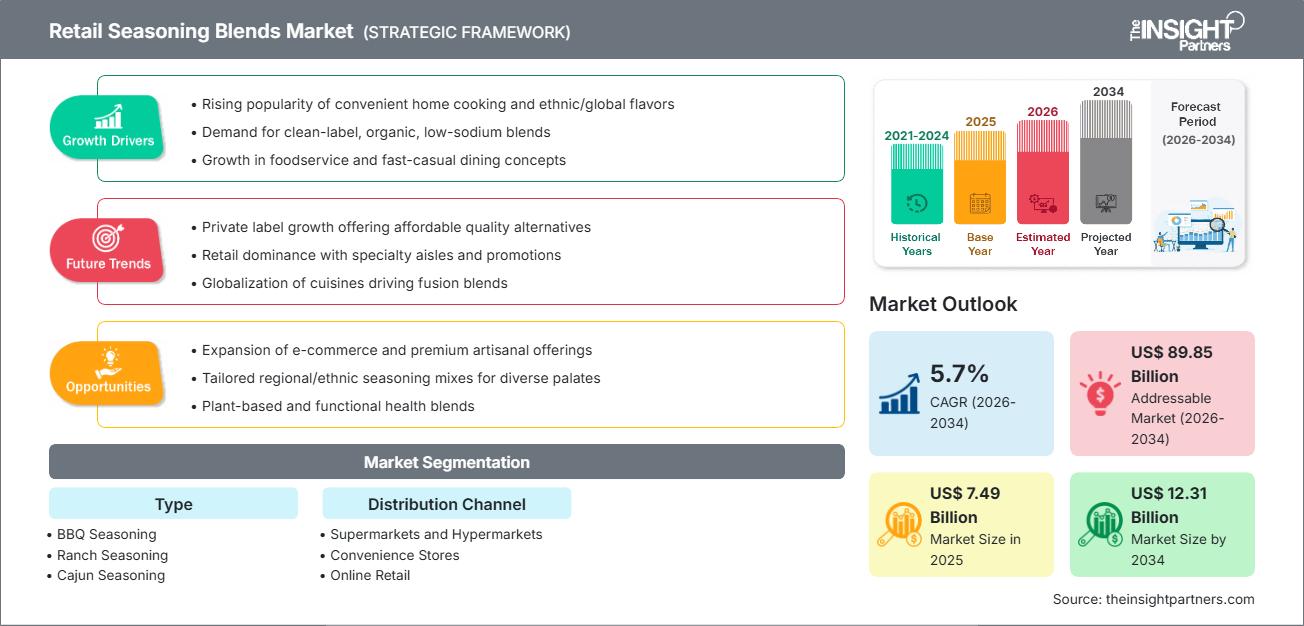
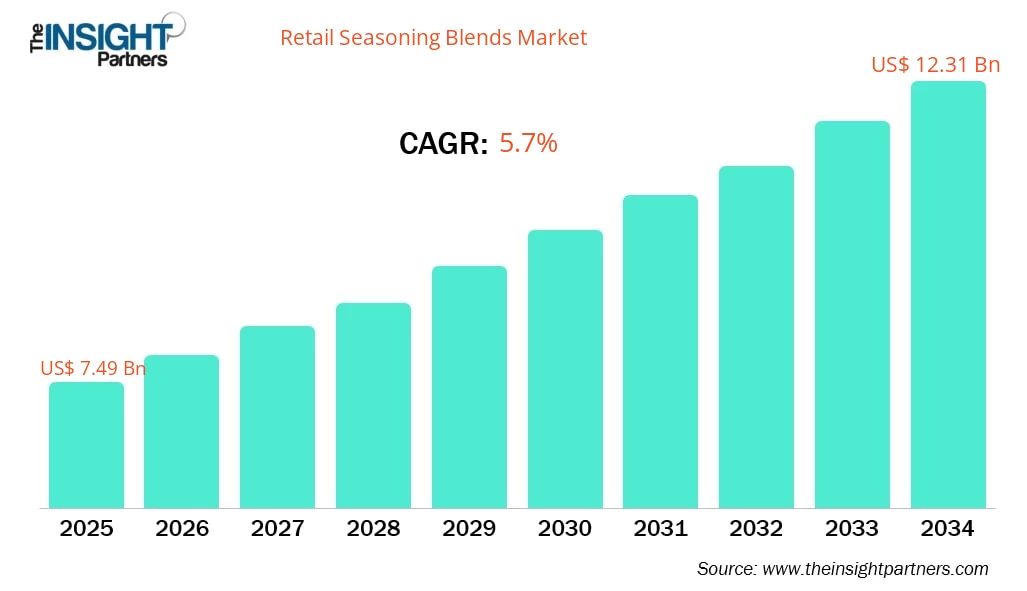
The retail seasoning blends market size is projected to reach US$ 12.31 billion by 2034 from US$ 7.49 billion in 2025. The market is expected to register a CAGR of 5.7% during 2026–2034.
Retail Seasoning Blends Market Analysis
The growing need for convenient, flavor-added food solutions in households has made the uptake of retail seasoning blends high. The large number of end-users of these blended spice formulations includes home cooks, quick-service restaurants, meal kit companies, food processors, and private-label retailers due to their capacity to produce balanced taste profiles, predictable quality, simplified meal preparation, and decreasing ingredient complexity. The development of modern retail chains, the intensive urbanization, the growth of disposable incomes, as well as the growing popularity of world dishes of cuisine and home cookery experimentation, contribute to the development of the market. Consumer engagement has been enhanced by the growth of the high-quality blends, organic/clean label, and low-sodium formulations, as well as regional flavors. Performance and attractiveness of products are not lost because manufacturers embrace new technology in grinding, automation of blending of products, better moisture retention, and sustainable packaging. Retail seasoning blends continue to be a favored in mainstream, specialty, and export-based food markets because of their contribution to flavor consistency, decreased preparation time, and the broadening of dietary preferences.
Retail Seasoning Blends Market Overview
The retail quality blends are carefully sourced spices, controlled processing factors, long shelf life, and formulation standards to preserve aroma, color, and flavor intensity across grills, baking, marinating, snacking, and ready-to-cook meals. The premium blends are becoming more based on natural ingredients, clear labeling, and sourced raw materials in a responsible manner in accordance with the sustainable brand positioning. The existing trends in e-commerce grocery, increased interest in ethnic and fusion food, the tendency to cook vegetarian meals, and the increased attention to the issues of health and wellness, including a decrease in sodium levels and the avoidance of adding substances, support growth. North America and Europe are mature markets where brand competition and penetration of private label are high. Asia Pacific is the fastest-growing area where modern trade is developing, urbanization is occurring, exposure to foreign cuisines is growing, and the distribution network of regional manufacturing and exports is developing.
Market Assessment and Insights
- Asia Pacific dominated the market with 42.1% share in 2025.
- Asia Pacific is poised to grow at a CAGR of 6.3% over the forecast period.
- United States market is projected to grow at a CAGR of 5.7% over the forecast period.
- By Types, the Others segment accounted for the largest market share of 33% in 2025.
- By Distribution Channel, the Online Retail segment is anticipated to witness the fastest growth, registering a CAGR of 6.4% over the forecast period
- The report profiles key industry players such as Goya Foods Inc, Ajinomoto Co Inc, McCormick & Co Inc, Badia Spices Inc, PK Kinder Co Inc, Chef Seasons, Magic Seasoning Blends LLC, Fire & Smoke Society LLC, Dan-O’s Seasoning LLC, Spice Kitchen, while also analyzing key developments in novel ideas, disruptive products, and innovative services that could reshape the future market and reveal emerging themes across the industry.
Source: The Insight Partners' analysis based on proprietary research, government publications, company annual reports, investor presentations, industry databases, and expert interviews.
● REPORT CUSTOMIZATION
Tailor This Report To Align With Your Specific Business Requirements
This report can be customized to align precisely with your business objectives, scope, and target markets. Customization options include tailored segmentation, geography, competitive analysis, and strategic insights to support informed decision-making.
Customize This Report →WHAT YOU CAN ADJUST
- ● Segmentations
- ● Geography
- ● Competitive Analysis
- ● Language Preferences
Retail Seasoning Blends Market: Strategic Insights
-
Get Top Key Market Trends of this report.This FREE sample will include data analysis, ranging from market trends to estimates and forecasts.
Retail Seasoning Blends Market Drivers and Opportunities
Market Drivers:
- Rising Demand for Convenient Home Cooking Solutions: Active lifestyles and growing urbanization are creating the need to have ready-made seasoning blends, allowing one to easily cook and still achieve the same taste and quality.
- Growing Popularity of Global and Ethnic Cuisines: The demand for a wide variety of seasoning blends to prepare at home is growing as the world gets exposed to flavors via travel and online platforms.
- Expansion of Organized Retail and E-Commerce Channels: The increasing number of supermarkets, hypermarkets, and online grocery competitors has elevated access to products, driving growth in the sales of products.
Market Opportunities:
- Development of Clean-Label and Health-Focused Variants: Low-sodium, organic, and preservative-free mixtures fulfil the increased health and transparency demands.
- Premiumization and Custom Flavor Innovations: Premium and localized blends open the prospects of appealing to niche consumers and higher profit margins.
- Sustainable Sourcing and Eco-Friendly Packaging: The sourcing of responsible ingredients, recyclable packaging solutions is in line with ESG objectives and attracts eco-friendly consumers.
Retail Seasoning Blends Market Report Segmentation Analysis
The retail seasoning blends market is divided into different segments to give a clearer view of its growth potential and the latest trends. Below is the standard segmentation approach used in industry reports:
By Type:
- BBQ Seasoning: A savory and smoky mix of paprika, garlic, onion, sugar, salt, and spices used to grill, roast, and marinate meats and vegetables to provide the flavor profiles sweet, spicy, and char-grilled.
- Ranch Seasoning: A creamy and herbaceous blend composed of dried parsley, dill, garlic, onion, and buttermilk flavoring, which is applied to dips, dressings, and snack flavoring applications.
- Cajun Seasoning: A spicy, bold Louisiana condiment, with paprika, cayenne, garlic, oregano, and thyme, which is created to add spiciness and smokiness to meat, seafood, and rice.
- Italian Seasoning: A combination of aromatic herbs made up of basil, oregano, rosemary, thyme, and marjoram, and widely used in pasta sauces, pizzas, soups, and dishes of the Mediterranean style.
- Five Spice Powder: A classic Chinese combination in the form of star anise, cloves, cinnamon, Sichuan pepper, and fennel seeds that provide a sweet, savory, and spicy flavor to be added to stir-fries and roasted meats.
- Berbere Powder: A diverse Ethiopian spice blend of chili peppers, garlic, ginger, fenugreek, and warm spices, which is famous because of its strong spiciness and deep, earthy flavors in stews and lentil meals.
- Chili and Lime Seasoning: A sour-sweet and slightly spicy blend of chili powder, lime zest or citric acid, and salt, which is applied to snacks, fruits, seafood, and grilled foods.
- Fajita Seasoning: A Tex-Mex combination using chili powder, cumin, paprika, garlic, and onion, which have been developed to add flavor to grilled meats and vegetables to prepare fajita-style dishes.
- Chipotle Seasoning: A smoke and medium spicy mash up focused on dry and smoked jalape pepper mixed frequently with garlic and cumin to add flavor to marinades and rubs.
- Tacos Seasoning: A spicy blend of ingredients consisting of chili powder, cumin, paprika, oregano, and garlic, meant to be prepared fast to serve as taco fillings and other foods inspired by Mexican cuisine.
- All-Purpose: A flexible combination of salt, pepper, garlic, onion, and mixed herbs or spices, which may be used for general cooking purposes in meat, vegetables, and soups.
- Others: This segment contains specialty, regional, and mixed blends based on particular cuisines, dietary inclinations, or restricted-time flavor novelties in the retail sector.
By Distribution Channel:
- Supermarkets and Hypermarkets
- Convenience Stores
- Online Retail
- Others
By Geography:
- North America
- Europe
- Asia Pacific
- Middle East & Africa
- South & Central America
Retail Seasoning Blends Market Report Scope
| Report Attribute | Details |
|---|---|
| Market size in 2025 | US$ 7.49 Billion |
| Market Size by 2034 | US$ 12.31 Billion |
| Global CAGR (2026 - 2034) | 5.7% |
| Historical Data | 2021-2024 |
| Forecast period | 2026-2034 |
| Segments Covered |
By Type
|
| Regions and Countries Covered |
North America
|
| Market leaders and key company profiles |
|
Retail Seasoning Blends Market Players Density: Understanding Its Impact on Business Dynamics
The Retail Seasoning Blends Market is growing rapidly, driven by increasing end-user demand due to factors such as evolving consumer preferences, technological advancements, and greater awareness of the product's benefits. As demand rises, businesses are expanding their offerings, innovating to meet consumer needs, and capitalizing on emerging trends, which further fuels market growth.
Retail Seasoning Blends Market Share Analysis by Geography
The rapid urbanization and the increase in the disposable income have been leading to substantial investment in the modern food processing, packaging, and retail distribution systems that have helped in the adoption of retail seasoning blends. The growth in the emerging markets of South and Central America, the Middle East, and Africa has potential as organized retail, rising urban infrastructure, and rising demand for convenient and packaged food products are rapidly accelerating.
The retail seasoning blends market growth differs in each region due to the rate of economic development and consumer preferences. Below is a summary of market share and trends by region:
1. North America
- Market Share: Holds a significant portion of the global market
- Key Drivers:
- Large consumer preference for convenience, ready-made cooking solutions, and packaged spice mixtures.
- Increasing use of different cuisines, such as ethnic and fusion flavors, at home and in foodservice.
- Established retail stores and online stores that improve the availability of products and in-house brands.
- Trends: Shifting toward more health-conscious and sustainability-conscious consumers and clean/organic and/or low-sodium blends
2. Europe
- Market Share: A major market with mature retail and culinary traditions
- Key Drivers:
- High demand for quality, premium, and regional blends of seasoning.
- Increasing consumer concern over natural ingredients and additive-free formulations.
- Specialty food stores and contemporary grocery retail encourage brand visibility and availability.
- Trends: Organic, gourmet, and sustainable packaged mixes are growing because health and environmental issues have become drivers of product innovations.
3. Asia Pacific
- Market Share: The largest and fastest-growing regional market in the world
- Key Drivers:
- The high rate of urbanization and growth in disposable incomes leads to a rise in the consumption of convenience foods and seasoning mixes.
- Increasing exposure to global cuisines increases the demand for varied and fusion tastes.
- Widespread availability is made through the expansion of supermarkets, hypermarkets, and online grocery channels of groceries..
- Trends: Manufacturers are investing in localized flavors, blends of premium products, and own-label products to meet the changing tastes of consumers.
4. Middle East and Africa
- Market Share: A steadily progressing market with strong growth potential
- Key Drivers:
- Increasing usage of prepared and packaged spices in urban households.
- Increased retail infrastructure and foodservice chain to support product adoption.
- Trends: Increasing demand for convenience-focused, shelf-stable, and regionally inspired blends.
5. South and Central America
- Market Share: A smaller but steadily expanding market
- Key Drivers:
- Retail supermarket chain proliferation and structured retailing are making seasoning mixtures more accessible to consumers.
- Growing interest in foreign cuisines and home cooking.
- Trends: The growth in the market is stable due to urbanization, increased disposable incomes, and slow integration of packaged and branded food products.
Retail Seasoning Blends Market Players Density: Understanding Its Impact on Business Dynamics
High Market Density and Competition
Competition is intense due to the presence of established players such as PK Kinder Co Inc, Ajinomoto Co Inc, McCormick & Co Inc, Badia Spices Inc, Goya Foods Inc, and Chef Seasons.
This high level of competition urges companies to stand out by:
- Providing high-quality, superior blends which incorporate herbs and spices of consistent flavor profiles, guaranteeing their freshness, aroma, and nutritional benefits to meet the requirements of highly discriminating customers.
- Improving the safety and transparency through the implementation of strict quality control practices, allergen-free certification, and traceable sourcing practices throughout the supply chain, minimizing the risk of contamination and gaining consumer confidence.
- Adopting sustainable and environmentally-friendly values, including biodegradable packaging, less water and energy use during production, regenerative growing of spices, and a limited carbon footprint in accordance with the changing environmental policies.
Opportunities and Strategic Moves
- Research upcycling and waste management opportunities, find out how to use residues of spices, packaging waste, or by-products in the production process, which would contribute to the circular economy and help cut costs on raw materials.
- Long-term partnership with food producers and restaurant chains to collaboratively develop new seasoning mixes, functional spices, and sustainable blends that address the changing consumer trends.
- Co-ordinate with the regulatory authorities, logistics, and retailers to standardize safe handle methods, sustainable packaging, and end-user training to assist in providing the best storage, use, and shelf-life management.
Major companies operating in the retail seasoning blends market are:
- PK Kinder Co Inc
- Ajinomoto Co Inc
- McCormick & Co Inc
- Badia Spices Inc
- Goya Foods Inc
- Chef Seasons
- Magic Seasoning Blends LLC
- Fire & Smoke Society LLC
- Dan-O's Seasoning LLC
- Spice Kitchen
Disclaimer: The companies listed above are not ranked in any particular order.
Other companies analyzed during research:
- Essiespice
- Harris Spice Co
- Midas Foods International
- Lee Kum Kee
- Lao Gan Ma
- Kewpie Corporation
Retail Seasoning Blends Market News and Recent Developments
- McCormick Unveils 2025 Flavor of the Year and Flavor Forecast 25th Edition.: In Jan 2025, McCormick unveiled its 2025 Flavor of the Year, Ají Amarillo. This bold addition to the spice brand's pantry features a sweet, fruity, and moderately spicy pepper. The brand predicts tropical ingredients will be at the forefront of food trends in 2025. The ají amarillo seasoning is designed to be easily sprinkled into various dishes, and McCormick has provided details and three recipes to showcase its versatility.
- McCormick Grill Mates and Max The Meat Guy Kick Off Summer Grilling with New Seasoning Blends. :McCormick Grill Mates introduced new Max The Meat Guy Seasoning Blends, which include Max's All Purpose, Xtra Coarse, and Chimichurri Seasonings. To celebrate, fans can taste these blends at a Father's Day event and through a special gift box from Crowd Cow.
Retail Seasoning Blends Market Report Coverage and Deliverables
The " Retail Seasoning Blends Market Size and Forecast (2021–2034)" report provides a detailed analysis of the market covering the following areas:
- Retail seasoning blends market size and forecast at global, regional, and country levels for all segments covered under the scope
- Retail seasoning blends market trends, as well as dynamics such as drivers, restraints, and key opportunities
- Detailed Porter's five forces analysis and SWOT analysis
- Retail seasoning blends market analysis covering market trends, global and regional framework, major players, regulations, and recent developments.
- Industry landscape and competition analysis covering market concentration, heat map analysis, prominent players, and recent developments for the retail seasoning blends market
- Detailed company profiles
Frequently Asked Questions

- Comprehensive Market Sizing and Forecast Analysis
- Detailed Segmentation Analysis
- In-Depth Market Dynamics Assessment
- Regional and Country-Level Insights
- Competitive Landscape and Company Benchmarking
- Strategic Business Intelligence
Recent Reports
Testimonials

The Insight Partners provided valuable market intelligence that supported our global go-to-market strategy. Their team was professional, responsive, and attentive to our feedback, providing thoughtful analysis and helpful methodological clarifications throughout the project.
Junmo Kim Chief Financial Officer (CFO), Enertech Co., Ltd.
The Insight Partners' SCADA System Market report is comprehensive, with valuable insights on current trends and future forecasts. The team was highly professional, responsive, and supportive throughout. We are very satisfied and highly recommend their services.
RAN KEDEM Partner, Reali Technologies LTDs
I requested a report on a very specific software market and the team produced the report in a few days. The information was very relevant and well presented. I then requested some changes and additions to the report. The team was again very responsive and I got the final report in less than a week.
JEAN-HERVE JENN Chairman, Future Analytica
We worked with The Insight Partners for an important market study and forecast. They gave us clear insights into opportunities and risks, which helped shape our plans. Their research was easy to use and based on solid data. It helped us make smart, confident decisions. We highly recommend them.
PIYUSH NAGPAL Sr. Vice President, High Beam Global
The Insight Partners delivered insightful, well-structured market research with strong domain expertise. Their team was professional and responsive throughout. The user-friendly website made accessing industry reports seamless. We highly recommend them for reliable, high-quality research services
YUKIHIKO ADACHI CEO, Deep Blue, LLC.
This is the first time I have purchased a market report from The Insight Partners.While I was unsure at first, I visited their web site and felt more comfortable to take the risk and purchase a market report.I am completely satisfied with the quality of the report and customer service. I had several questions and comments with the initial report, but after a couple of dialogs over email with their analyst I believe I have a report that I can use as input to our strategic planning process.Thank you so much for taking the extra time and making this a positive experience.I will definitely recommend your service to others and you will be my first call when we need further market data.
JOHN SUZUKI President and Chief Executive Officer, Board Director, BK Technologies
I wish to appreciate your support and the professionalism you displayed in the course of attending to my request for information regarding to infectious disease IVD market in Nigeria. I appreciate your patience, your guidance, and the fact that you were willing to offer a discount, which eventually made it possible for us to close a deal. I look forward to engaging The Insight Partners in the future, all thanks to the impression you have created in me as a result of this first encounter.
DR CHIJIOKE ONYIA MANAGING DIRECTOR, PineCrest Healthcare Ltd.Reason to Buy
- Informed Decision-Making
- Understanding Market Dynamics
- Competitive Analysis
- Identifying Emerging Markets
- Customer Insights
- Market Forecasts
- Risk Mitigation
- Boosting Operational Efficiency
- Strategic Planning
- Investment Justification
- Tracking Industry Innovations
- Aligning with Regulatory Trends





 Get Free Sample for