
Rhamnolipids Market Size, Share, Growth Opportunities, and Forecast to 2031
Coverage: By Type (Mono-rhamnolipids and Di-rhamnolipids), Application [Daily Chemicals (Laundry Detergents, Dishwashers, Surface Cleaners, and Others), Personal Care and Cosmetics, Agriculture, Food, Pharmaceuticals, Oilfield and Petroleum, Environmental Protection, and Others] and Geography (North America, Europe, Asia Pacific, Middle East and Africa, and South and Central America)
- Status : Published
- Report Code : TIPRE00042219
- Category : Chemicals and Materials
- No. of Pages : 346
- Available Report Formats :


- Last update date : January 21, 2026


2024 Market Size
US$ 2.30 Bn
Base year value
2031 Forecast
US$ 3.49 Bn
Projected by 2031
CAGR 2025-2031
6.1 %
Growth rate
Addressable Market
US$ 20.55 Bn
(2025-2031)
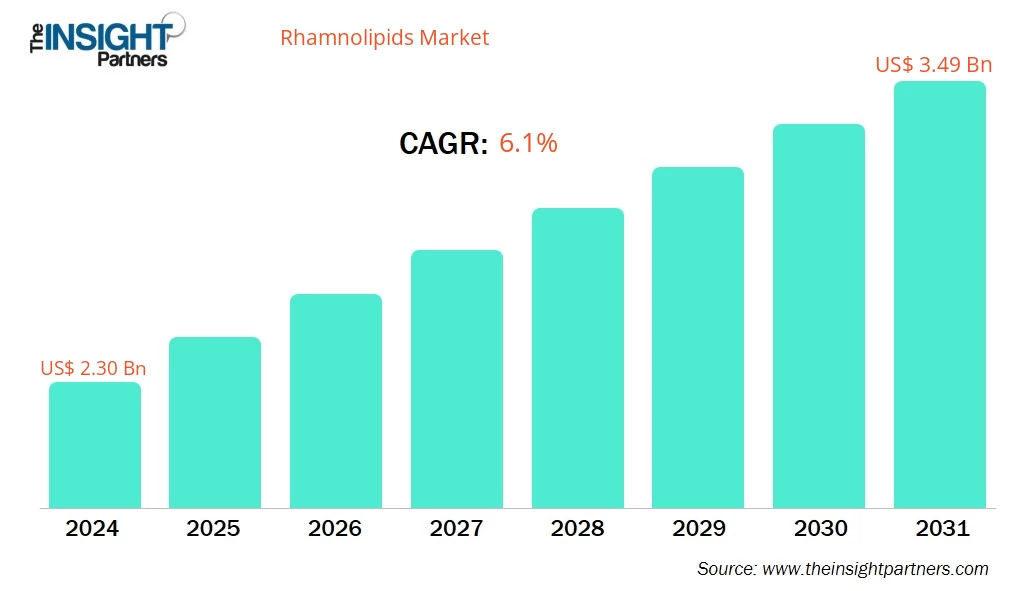
The rhamnolipids market size is projected to reach US$ 3.49 billion by 2031 from US$ 2.30 billion in 2024. The market is expected to register a CAGR of 6.1% from 2025 to 2031.
Rhamnolipids Market Analysis
Sustainability needs, regulatory pressures, and growing application opportunities in various industries drive the rhamnolipids market. The increasing awareness of environmental impact and the push to reduce reliance on petrochemical-based surfactants are important factors driving market growth. Rhamnolipids are biodegradable and low in toxicity, which fits well with global sustainability goals and companies' commitments to safer product formulations. Strict environmental regulations in Europe and North America are encouraging manufacturers to switch to bio-based alternatives. Compliance with chemical safety, emissions, and wastewater discharge requirements has sped up the shift toward biosurfactants in home care, personal care, and industrial uses. Meanwhile, rising consumer demand for natural, eco-friendly, and ethically produced products is pushing brands to reformulate with renewable ingredients such as rhamnolipids.
Rhamnolipids Market Overview
Rhamnolipids are natural biosurfactants from the glycolipid family. They are made through microbial fermentation with renewable materials. Rhamnolipids consist of one or two rhamnose sugar molecules connected to hydroxy fatty acid chains. This structure gives them strong surface-active properties. As they can lower surface and interfacial tension, rhamnolipids work well as emulsifiers, wetting agents, dispersants, and detergents. They are biodegradable, have low toxicity, and perform well across a range of temperatures, salinities, and pH levels. This makes them suitable for industrial settings. Rhamnolipids find applications in many sectors, including home care and personal care. They are used in detergents, cleaners, shampoos, and cosmetic products. In agriculture, they act as bio-based adjuvants and soil-conditioning agents. Industrial uses include oil recovery, bioremediation, and wastewater treatment. Their antimicrobial and biocompatible properties also support new applications in pharmaceuticals, food processing, and specialty chemicals.
Market Assessment and Insights
- Europe dominated the market with 31.9% share in 2024.
- Asia Pacific is poised to grow at a CAGR of 6.7% over the forecast period.
- United States market is projected to grow at a CAGR of 6.3% over the forecast period.
- By Type, the Mono-rhamnolipids segment accounted for the largest market share of 63.6% in 2024.
- By Application, the Personal Care and Cosmetics segment is anticipated to witness the fastest growth, registering a CAGR of 7% over the forecast period
- The report profiles key industry players such as Evonik Industries AG, Merck KGaA, Seebio Biotech (Shanghai) Co Ltd, Biosynth AG, Shaanxi Deguan Biotechnology Co., Ltd, Jeneil Biotech Inc, Alfa Chemistry, Starchem Enterprises Limited, Sihauli Chemicals Private Limited, AGAE Technologies LLC, while also analyzing key developments in novel ideas, disruptive products, and innovative services that could reshape the future market and reveal emerging themes across the industry.
Source: The Insight Partners' analysis based on proprietary research, government publications, company annual reports, investor presentations, industry databases, and expert interviews.
● REPORT CUSTOMIZATION
Tailor This Report To Align With Your Specific Business Requirements
This report can be customized to align precisely with your business objectives, scope, and target markets. Customization options include tailored segmentation, geography, competitive analysis, and strategic insights to support informed decision-making.
Customize This Report →WHAT YOU CAN ADJUST
- ● Segmentations
- ● Geography
- ● Competitive Analysis
- ● Language Preferences
Rhamnolipids Market: Strategic Insights
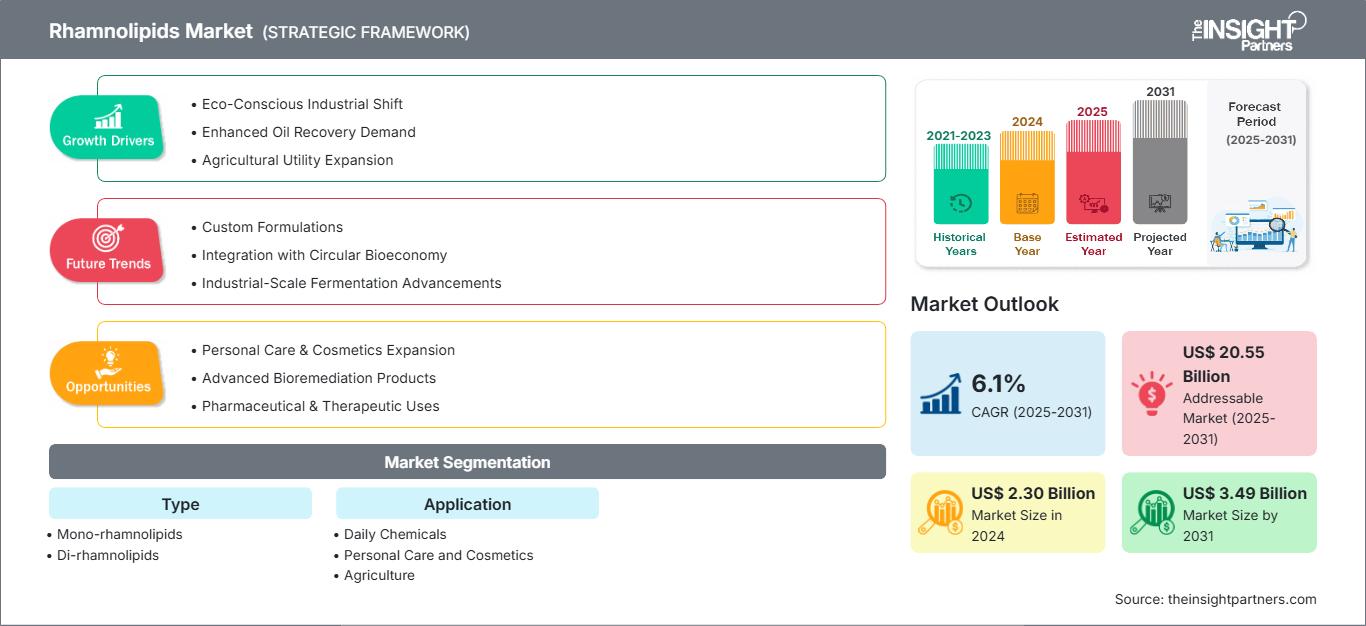
-
Get Top Key Market Trends of this report.This FREE sample will include data analysis, ranging from market trends to estimates and forecasts.
Rhamnolipids Market: Drivers and Opportunities
Market Drivers:
- Rising Demand for Eco-Friendly Products: More consumers are aware of and prefer biodegradable and low-toxicity ingredients in personal care, household, and industrial products. This trend drives the use of rhamnolipids.
- Stringent Environmental Regulations: Policies in Europe, North America, and Asia aim to cut down chemical pollution. They encourage replacing petrochemical surfactants with sustainable options such as rhamnolipids.
- Versatility Across Industries: Rhamnolipids have emulsifying, dispersing, and antimicrobial properties. These qualities make them useful in home care, agriculture, oil recovery, and wastewater treatment.
- Technological Advancements: Better microbial fermentation processes and purification methods boost production efficiency and lower costs, supporting wider commercialization.
- Growing Focus on Sustainable Agriculture: Using rhamnolipids as bio-based adjuvants and soil conditioners promotes sustainable farming practices. They can improve crop yield and environmental safety.
Market Opportunities:
- Expansion in Personal Care & Cosmetics: There is a rising demand for natural and organic formulations. This creates chances for including rhamnolipids in shampoos, skin care, and cosmetic products.
- Bioremediation & Environmental Applications: Using rhamnolipids for soil cleanup, oil spill response, and wastewater treatment shows untapped potential.
- Food Industry Applications: Rhamnolipids can work as natural emulsifiers, preservatives, and antimicrobial agents in food processing and packaging.
- Pharmaceutical & Medical Use: There are opportunities in drug delivery systems, antimicrobial formulations, and wound care products due to their biocompatibility.
- Emerging Markets in Asia & South and Central America: Increased industrialization, regulatory awareness, and sustainability efforts in developing regions offer new pathways for growth.
Rhamnolipids Market Report Segmentation Analysis
The rhamnolipids market is divided into different segments to give a clearer view of how they work, their growth potential, and the latest trends. Below is the standard segmentation approach used in industry reports:
By Type
- Epoxy: Mono-rhamnolipids have strong surface-active properties. They are commonly used for their excellent emulsifying and cleaning abilities. This makes them suitable for personal care and environmental applications.
- Di-rhamnolipids: Di-rhamnolipids offer better stability and foaming abilities. They are often chosen for products that need longer-lasting effects, such as cosmetics and industrial cleaning supplies.
By Application
- Daily Chemicals: Rhamnolipids are used as eco-friendly surfactants and emulsifiers in everyday cleaning products. These include detergents, laundry liquids, and household cleaners. They provide effective cleansing while reducing environmental impact.
- Personal Care and Cosmetics: Rhamnolipids are valued for being mild, biodegradable, and compatible with skin. This makes them ideal for shampoos, soaps, lotions, and other cosmetic products.
- Agriculture: As bio-based adjuvants and soil conditioners, rhamnolipids improve nutrient absorption and support sustainable farming practices.
- Food: hamnolipids act as natural emulsifiers and antimicrobial agents in food processing and packaging. This helps enhance product stability and safety.
- Pharmaceuticals: Their biocompatibility and antimicrobial properties support uses in drug delivery, wound care, and therapeutic formulations.
- Oilfield and Petroleum: Rhamnolipids are used for improved oil recovery, emulsification, and cleaning up hydrocarbon contaminants in the oil and gas industry.
- Environmental Protection: Rhamnolipids help with bioremediation and wastewater treatment by moving pollutants and promoting the breakdown of contaminants by microbes.
- Others: Rhamnolipids can also be found in specialty chemicals, detergents, and new industries that need sustainable surfactants.
By Geography:
- North America
- Europe
- Asia Pacific
- South and Central America
- Middle East & Africa
Rhamnolipids Market Report Scope
| Report Attribute | Details |
|---|---|
| Market size in 2024 | US$ 2.30 Billion |
| Market Size by 2031 | US$ 3.49 Billion |
| Global CAGR (2025 - 2031) | 6.1% |
| Historical Data | 2021-2023 |
| Forecast period | 2025-2031 |
| Segments Covered |
By Type
|
| Regions and Countries Covered |
North America
|
| Market leaders and key company profiles |
|
Rhamnolipids Market Players Density: Understanding Its Impact on Business Dynamics
The Rhamnolipids Market is growing rapidly, driven by increasing end-user demand due to factors such as evolving consumer preferences, technological advancements, and greater awareness of the product's benefits. As demand rises, businesses are expanding their offerings, innovating to meet consumer needs, and capitalizing on emerging trends, which further fuels market growth.
Rhamnolipids Market Share Analysis by Geography
Europe dominated the market due to growing demand from the various end-use industries across the region. Emerging markets in South and Central America, the Middle East, and Africa have untapped opportunities for rhamnolipid providers to expand.
The growth of the rhamnolipids market varies by region. The demand for biosurfactants continues to grow, positioning rhamnolipids in an evolving consumer landscape. Below is a summary of market share and trends by region:
1. North America
- Market Share: Holds a significant market share
- Key Drivers:
- Strong enforcement of regulations by agencies such as the EPA is pushing for a reduction of harmful chemicals in consumer and industrial products.
- Trends: Growing demand for biosurfactants in personal care and household cleaning products as consumers prefer natural and sustainable ingredients.
2. Europe
- Market Share: dominated the market, with a rising market share every year
- Key Drivers:
- Strict environmental policies, such as REACH and the European Green Deal, are encouraging the use of bio-based chemicals.
- Trends: Rapid industrial-scale production and commercialization of rhamnolipids.
3. Asia Pacific
- Market Share: Holds a significant market share
- Key Drivers:
- Expanding industrialization and increasing awareness about environmental pollution and sustainable alternatives in emerging economies.
- Trends: Growing investments in biotechnological infrastructure.
4. South and Central America
- Market Share: Rapidly growing market, with a rising market share every year
- Key Drivers:
- Growing demand for rhamnolipids from the agricultural sector.
- Trends: Government incentives and programs aimed at promoting sustainable agriculture and environmental protection.
5. Middle East and Africa
- Market Share: Although small, it is growing quickly
- Key Drivers:
- The growing demand in the oil and gas sector, along with stricter environmental regulations, is driving the need for greener technologies.
- Trends: Growing focus on biosurfactants for enhanced oil recovery and environmental remediation applications.
Rhamnolipids Market Players: Density: Understanding Its Impact on Business Dynamics
High Market Density and Competition
Competition is intense due to the presence of established players such as Zhejiang Seedling Bio Co., Ltd; Seebio Biotech (Shanghai) Co Ltd; GlycoSurf; Biotensidon GmbH, Jeneil Biotech Inc., and others.
This high level of competition urges companies to stand out by offering:
- Diverse product offering
- Sustainable and ethical sourcing
- Competitive pricing models
- Strong customer support and easy integration
Opportunities and Strategic Moves
- Focusing on research and development activities to distinguish themselves in the market
- Expanding global footprint and capabilities through acquisitions of biosurfactant companies.
- Expanding product portfolio with the launch of sustainable products
Other companies analyzed during the course of research:
- Zhejiang Silver-Elephant Bio-engineering Co., Ltd.
- Hangzhou Leap Chem Co., Ltd.
- Shaanxi Deguan Biotechnology Co., Ltd
- Biosynth AG
- Evonik Industries AG
- Starchem Enterprises Limited
- Sihauli Chemicals Private Limited
- AGAE Technologies LLC
- Merck KGaA
- Alfa Chemistry
Rhamnolipids Market: News and Recent Developments
- Evonik Industries AG – Expansion In 2024, Evonik opened the first industrial-scale manufacturing facility for rhamnolipid biosurfactants. Other sustainable cleaning solutions offered by Evonik include eco-friendly pet care and water-responsible cleaning products.
- Evonik Industries AG – Collaboration Evonik entered into an exclusive agreement with the Cleveland-based Sea-Land Chemical Company for the distribution of its cleaning solutions in the US. The agreement builds on a long-standing relationship with the distributor and expands the reach of Evonik's cleaning solutions to the entire US region.
Rhamnolipids Market Report Coverage and Deliverables
The "Rhamnolipids Market Size and Forecast (2021–2031)" report provides a detailed analysis of the market covering the following areas:
- Rhamnolipids market size and forecast at global, regional, and country levels for all the key market segments covered under the scope
- Rhamnolipids market trends, as well as market dynamics such as drivers, restraints, and key opportunities
- Detailed Porter's five forces and SWOT analysis
- Rhamnolipids market analysis covering key market trends, global and regional framework, major players, regulations, and recent market developments
- Industry landscape and competition analysis covering market concentration, heat map analysis, prominent players, and recent developments for the rhamnolipids market
- Detailed company profiles
Frequently Asked Questions

- Comprehensive Market Sizing and Forecast Analysis
- Detailed Segmentation Analysis
- In-Depth Market Dynamics Assessment
- Regional and Country-Level Insights
- Competitive Landscape and Company Benchmarking
- Strategic Business Intelligence
Recent Reports
Testimonials

The Insight Partners provided valuable market intelligence that supported our global go-to-market strategy. Their team was professional, responsive, and attentive to our feedback, providing thoughtful analysis and helpful methodological clarifications throughout the project.
Junmo Kim Chief Financial Officer (CFO), Enertech Co., Ltd.
The Insight Partners' SCADA System Market report is comprehensive, with valuable insights on current trends and future forecasts. The team was highly professional, responsive, and supportive throughout. We are very satisfied and highly recommend their services.
RAN KEDEM Partner, Reali Technologies LTDs
I requested a report on a very specific software market and the team produced the report in a few days. The information was very relevant and well presented. I then requested some changes and additions to the report. The team was again very responsive and I got the final report in less than a week.
JEAN-HERVE JENN Chairman, Future Analytica
We worked with The Insight Partners for an important market study and forecast. They gave us clear insights into opportunities and risks, which helped shape our plans. Their research was easy to use and based on solid data. It helped us make smart, confident decisions. We highly recommend them.
PIYUSH NAGPAL Sr. Vice President, High Beam Global
The Insight Partners delivered insightful, well-structured market research with strong domain expertise. Their team was professional and responsive throughout. The user-friendly website made accessing industry reports seamless. We highly recommend them for reliable, high-quality research services
YUKIHIKO ADACHI CEO, Deep Blue, LLC.
This is the first time I have purchased a market report from The Insight Partners.While I was unsure at first, I visited their web site and felt more comfortable to take the risk and purchase a market report.I am completely satisfied with the quality of the report and customer service. I had several questions and comments with the initial report, but after a couple of dialogs over email with their analyst I believe I have a report that I can use as input to our strategic planning process.Thank you so much for taking the extra time and making this a positive experience.I will definitely recommend your service to others and you will be my first call when we need further market data.
JOHN SUZUKI President and Chief Executive Officer, Board Director, BK Technologies
I wish to appreciate your support and the professionalism you displayed in the course of attending to my request for information regarding to infectious disease IVD market in Nigeria. I appreciate your patience, your guidance, and the fact that you were willing to offer a discount, which eventually made it possible for us to close a deal. I look forward to engaging The Insight Partners in the future, all thanks to the impression you have created in me as a result of this first encounter.
DR CHIJIOKE ONYIA MANAGING DIRECTOR, PineCrest Healthcare Ltd.Reason to Buy
- Informed Decision-Making
- Understanding Market Dynamics
- Competitive Analysis
- Identifying Emerging Markets
- Customer Insights
- Market Forecasts
- Risk Mitigation
- Boosting Operational Efficiency
- Strategic Planning
- Investment Justification
- Tracking Industry Innovations
- Aligning with Regulatory Trends





 Get Free Sample for