
Shadow Banking Market Trends, Demand & Growth by 2034
Coverage: By Type (Money Market Funds, Bond Funds, Finance Companies, Special Purpose Entities, and Others), Application (Securitization, Alternative Credit, High-Interest Savings, and Innovative Financial Products), and Geography
- Status : Data Released
- Report Code : TIPRE00039223
- Category : Banking, Financial Services, and Insurance
- No. of Pages : 150
- Available Report Formats :


- Last update date : April 17, 2026


2025 Market Size
US$ 65.55 Bn
Base year value
2034 Forecast
US$ 95.24 Bn
Projected by 2034
CAGR 2026-2034
4.24 %
Growth rate
Addressable Market
US$ 730.27 Bn
(2026-2034)
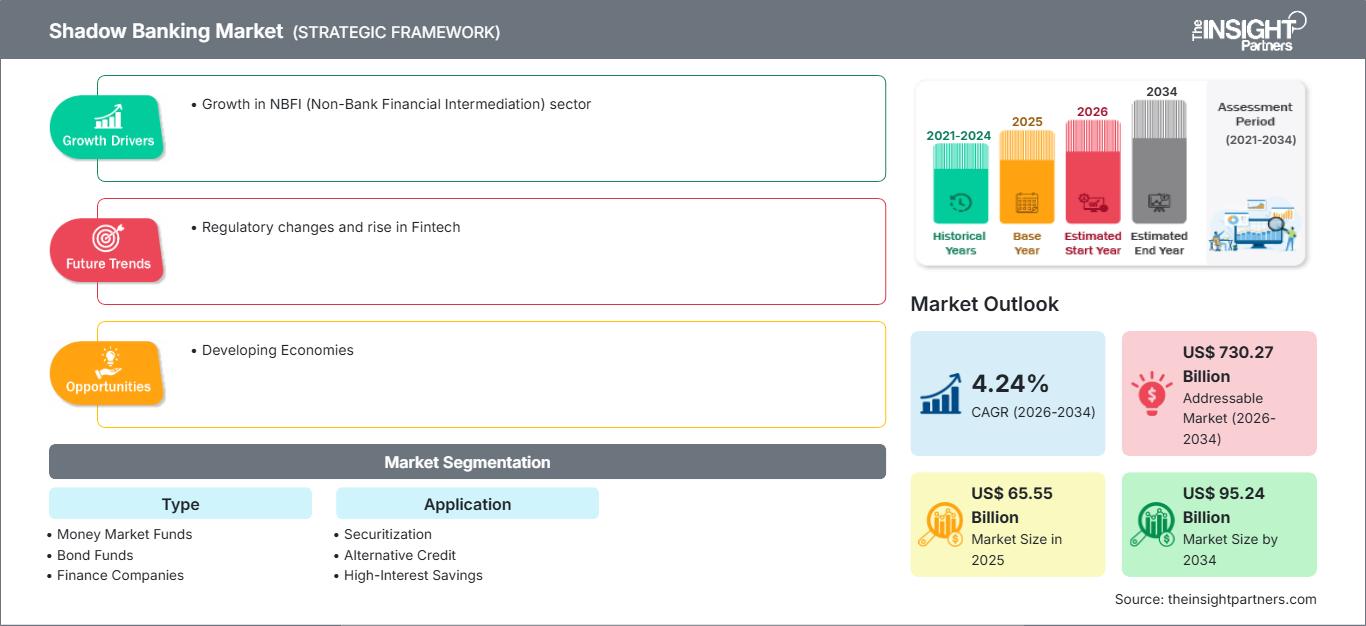
The global shadow banking market size is projected to reach US$ 95.24 billion by 2034 from US$ 65.55 billion in 2025. The market is anticipated to register a CAGR of 4.24% during the forecast period 2026-2034.
Shadow Banking Market Analysis
Banks are the key functional institutions in the economy. Shadow banking systems can be understood as intermediary institutions that function like banks but are not regulated as a bank is. This type of system consists of various components that fall outside the regulatory realm of traditional banking. These components are brokers, lenders, and other credit intermediaries.
Shadow Banking Market Overview
In the past decade or so, the shadow banking sector has grown manifolds. Advanced economies have the largest shadow banking networks, with narrower measures indicating stagnation and broader measures (including investment funds) showing expansion since the global financial crisis. In developing market nations, shadow banking has grown faster than traditional banks. Shadow banking can complement traditional banking by increasing lending access, improving market liquidity, transforming maturity, and sharing risk.
Market Assessment and Insights
- Global market for Shadow Banking was valued at US$ 65.55 Billion in 2025
- Annual market size is expected to reach US$ 95.24 Billion by 2034
- Total addressable market (TAM) during 2026-2034 is projected to reach approximately US$ 730.27 Billion
- Market is anticipated to register a CAGR of 4.24% during the forecast period
- The United States represents a key market, supported by Growth in NBFI (Non-Bank Financial Intermediation) sector, as well as evolving industry dynamics
- Market analysis covers North America, Europe, Asia-Pacific, South and Central America, Middle East and Africa, with growth evaluated across the forecast period
- Market opportunities such as Developing Economies are expected to influence market dynamics and addressable market
- Report profiles industry participants, including UBS Group AG, Standard Chartered PLC, JPMorgan Chase and Co., Bangkok Bank Public Company Limited, Financial Stability Board, Goldman Sachs Group, Inc., Morgan Stanley, Credit Suisse Group AG, HSBC Holdings PLC, Barclays Bank Plc, while analyzing competitive strategies and innovation developments
-
Source: The Insight Partners' analysis based on proprietary research, government publications, company annual reports, investor presentations, industry databases, and expert interviews.
● REPORT CUSTOMIZATION
Tailor This Report To Align With Your Specific Business Requirements
This report can be customized to align precisely with your business objectives, scope, and target markets. Customization options include tailored segmentation, geography, competitive analysis, and strategic insights to support informed decision-making.
Customize This Report →WHAT YOU CAN ADJUST
- ● Segmentations
- ● Geography
- ● Competitive Analysis
- ● Language Preferences
Shadow Banking Market: Strategic Insights
-
Get Top Key Market Trends of this report.This FREE sample will include data analysis, ranging from market trends to estimates and forecasts.
Shadow Banking Market Drivers and Opportunities
Growth in NBFI (Non-Bank Financial Intermediation) Sector to Favor Market
According to the 2021 FSB (Financial Stability Board) data, the NBFI industry had significant growth owing to increased investment fund values and inflows during the economic recovery period. The NBFI sector increased by 8.9%, exceeding the five-year average of 6.6%. Its percentage of total global financial assets remained unchanged at 49.2%. This drives the demand in the shadow banking market.
Developing Economies – An Opportunity in Shadow Banking
Shadow banking systems offer finance alternatives to underrepresented market niches in developing economies. Shadow banking in developing nations like China and India bridges the financing gap in the official financial system by offering alternative financing options to market segments underserved by established banks. This promotes economic growth.
Shadow Banking Market Report Segmentation Analysis
Key segments that contributed to the derivation of the shadow banking market analysis are type and application.
-
- Based on the type, the shadow banking market is divided into money market funds, bond funds, finance companies, special purpose entities, and others. The money market funds segment held the largest share of the market in 2023.
-
- By application, the market is segmented into securitization, alternative credit, high-interest savings, and innovative financial products.
-
Shadow Banking Market Share Analysis by Geography
The geographic scope of the shadow banking market report is mainly divided into five regions: North America, Asia Pacific, Europe, Middle East & Africa, and South America/South & Central America.
North America has dominated the shadow banking market. According to the 2023 Federal Reserve Data, the amount that US banks have lent to so-called shadow banks has crossed the $1 trillion mark. Thus, the shadow banking market is undergoing substantial development in North America.
Shadow Banking Market Report Scope
| Report Attribute | Details |
|---|---|
| Market size in 2025 | US$ 65.55 Billion |
| Market Size by 2034 | US$ 95.24 Billion |
| Global CAGR (2026 - 2034) | 4.24% |
| Historical Data | 2021-2024 |
| Forecast period | 2026-2034 |
| Segments Covered |
By Type
|
| Regions and Countries Covered |
North America
|
| Market leaders and key company profiles |
|
Shadow Banking Market Players Density: Understanding Its Impact on Business Dynamics
The Shadow Banking Market is growing rapidly, driven by increasing end-user demand due to factors such as evolving consumer preferences, technological advancements, and greater awareness of the product's benefits. As demand rises, businesses are expanding their offerings, innovating to meet consumer needs, and capitalizing on emerging trends, which further fuels market growth.
Shadow Banking Market News and Recent Developments
The shadow banking market is evaluated by gathering qualitative and quantitative data post-primary and secondary research, which includes important corporate publications, association data, and databases. The following is a list of developments in the market for shadow banking and strategies:
-
- JPMorgan Chase and Co. has accelerated the pace of securitizing billions of dollars of its loan portfolio in anticipation of proposed new US capital requirements for large banks. The bank has US$ 1.3 trillion in loans at the end of June 2023. Securitization helped the company to take the loan off its balance sheet. (Source: JPMorgan Chase and Co., Press Release, 2023)
-
Shadow Banking Market Report Coverage and Deliverables
The “Shadow Banking Market Size and Forecast (2021–2034)” report provides a detailed analysis of the market covering below areas:
-
- Market size and forecast at global, regional, and country levels for all the key market segments covered under the scope
-
- Market dynamics such as drivers, restraints, and key opportunities
-
- Key future trends
-
- Detailed PEST/Porter’s Five Forces and SWOT analysis
-
- Global and regional market analysis covering key market trends, major players, regulations, and recent market developments
-
- Industry landscape and competition analysis covering market concentration, heat map analysis, prominent players, and recent developments
-
- Detailed company profiles
-
Frequently Asked Questions

- Comprehensive Market Sizing and Forecast Analysis
- Detailed Segmentation Analysis
- In-Depth Market Dynamics Assessment
- Regional and Country-Level Insights
- Competitive Landscape and Company Benchmarking
- Strategic Business Intelligence
Recent Reports
Testimonials

The Insight Partners provided valuable market intelligence that supported our global go-to-market strategy. Their team was professional, responsive, and attentive to our feedback, providing thoughtful analysis and helpful methodological clarifications throughout the project.
Junmo Kim Chief Financial Officer (CFO), Enertech Co., Ltd.
The Insight Partners' SCADA System Market report is comprehensive, with valuable insights on current trends and future forecasts. The team was highly professional, responsive, and supportive throughout. We are very satisfied and highly recommend their services.
RAN KEDEM Partner, Reali Technologies LTDs
I requested a report on a very specific software market and the team produced the report in a few days. The information was very relevant and well presented. I then requested some changes and additions to the report. The team was again very responsive and I got the final report in less than a week.
JEAN-HERVE JENN Chairman, Future Analytica
We worked with The Insight Partners for an important market study and forecast. They gave us clear insights into opportunities and risks, which helped shape our plans. Their research was easy to use and based on solid data. It helped us make smart, confident decisions. We highly recommend them.
PIYUSH NAGPAL Sr. Vice President, High Beam Global
The Insight Partners delivered insightful, well-structured market research with strong domain expertise. Their team was professional and responsive throughout. The user-friendly website made accessing industry reports seamless. We highly recommend them for reliable, high-quality research services
YUKIHIKO ADACHI CEO, Deep Blue, LLC.
This is the first time I have purchased a market report from The Insight Partners.While I was unsure at first, I visited their web site and felt more comfortable to take the risk and purchase a market report.I am completely satisfied with the quality of the report and customer service. I had several questions and comments with the initial report, but after a couple of dialogs over email with their analyst I believe I have a report that I can use as input to our strategic planning process.Thank you so much for taking the extra time and making this a positive experience.I will definitely recommend your service to others and you will be my first call when we need further market data.
JOHN SUZUKI President and Chief Executive Officer, Board Director, BK Technologies
I wish to appreciate your support and the professionalism you displayed in the course of attending to my request for information regarding to infectious disease IVD market in Nigeria. I appreciate your patience, your guidance, and the fact that you were willing to offer a discount, which eventually made it possible for us to close a deal. I look forward to engaging The Insight Partners in the future, all thanks to the impression you have created in me as a result of this first encounter.
DR CHIJIOKE ONYIA MANAGING DIRECTOR, PineCrest Healthcare Ltd.Reason to Buy
- Informed Decision-Making
- Understanding Market Dynamics
- Competitive Analysis
- Identifying Emerging Markets
- Customer Insights
- Market Forecasts
- Risk Mitigation
- Boosting Operational Efficiency
- Strategic Planning
- Investment Justification
- Tracking Industry Innovations
- Aligning with Regulatory Trends





 Get Free Sample for