
Ship-To-Shore Cranes Market Size, Demand & Growth by 2034
Coverage: by Outreach (Below 40 Meters, 40-49 Meters, 50-60 Meters, Above 60 Meters); Power Supply (Diesel, Electric, Hybrid) , and Geography (North America, Europe, Asia Pacific, and South and Central America)
- Status : Data Released
- Report Code : TIPRE00008372
- Category : Manufacturing and Construction
- No. of Pages : 150
- Available Report Formats :


- Last update date : July 15, 2026


2025 Market Size
US$ 3.38 Bn
Base year value
2034 Forecast
US$ 4.63 Bn
Projected by 2034
CAGR 2026-2034
3.55 %
Growth rate
Addressable Market
US$ 36.36 Bn
(2026-2034)
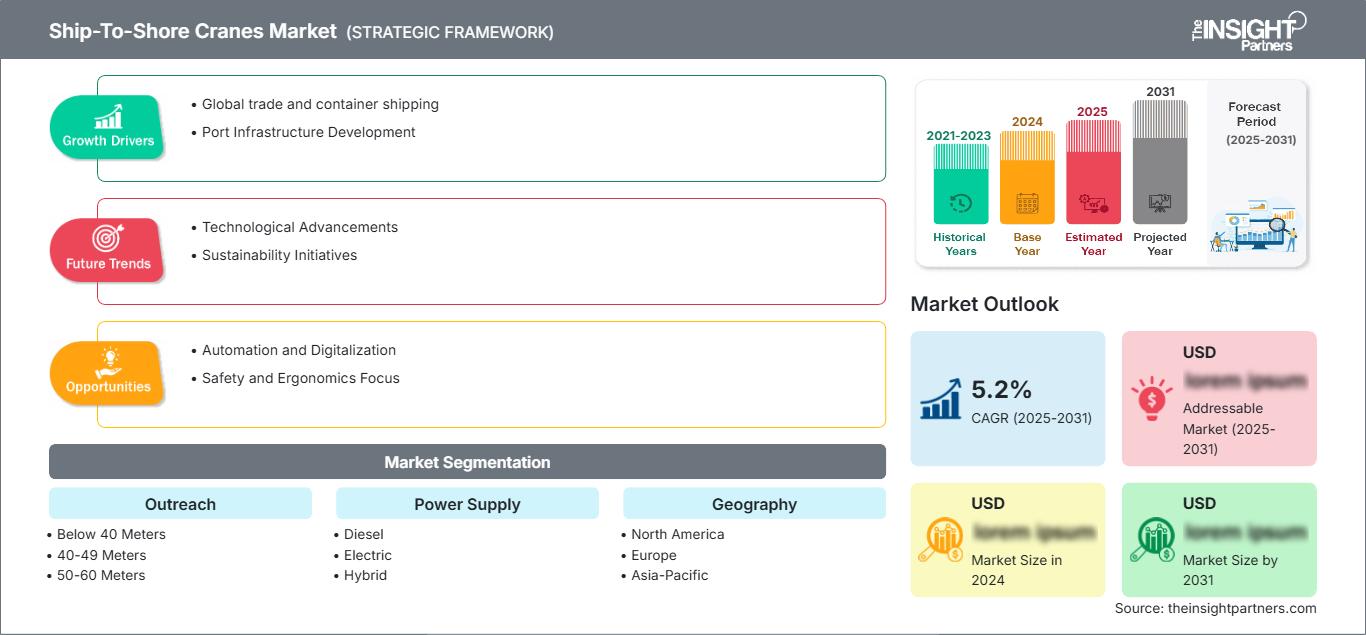
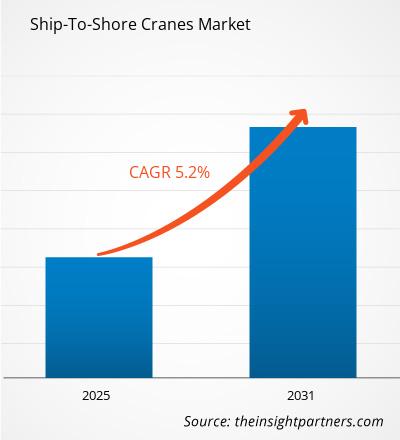
The Ship-to-Shore Cranes Market size reached a value of US$ 3.38 Billion in 2025, and it is anticipated to reach US$ 4.63 Billion in 2034. The CAGR of the market in the forecast period from 2026 to 2034 will be 3.55%, backed up by port infrastructure development, expansion of capacities of container terminals, and increasing demand for cranes with greater outreach that can accommodate larger container ships.
For the North American region, the priorities include the adoption of electric drives, efficiency on berths, and crane modernization. The growth rate of the Ship-to-Shore Cranes Market in North America will be within the range of 3.0 to 3.4% CAGR in 2026-2034.
Ship-To-Shore Cranes Market Assessment and Insights
- North America held a 22–24% Ship-to-Shore Cranes Market share in 2025 and is projected to grow at a 3.0–3.4% CAGR between 2026–2034, supported by terminal upgrades, electrification, and resilient container gateways.
- US accounted for 78–82% of North America in 2025 and is expected to grow at a 3.1–3.5% CAGR through 2034.
- Europe represented a 20–22% share in 2025 and is forecast to record a 2.7–3.1% CAGR, led by Germany, the UK, France, Spain, and Italy.
- Asia Pacific held a 42–45% share in 2025 and is projected to advance at a 3.9–4.4% CAGR, led by China, Japan, South Korea, India, and Australia.
- Largest Segment Electric power supply captured a 58–62% market share in 2025, with a 3.7–4.1% CAGR during 2026–2034.
- High Growth Segment Above 60 Meters outreach held a 24–28% market share in 2025 and is expected to grow at a 4.2–4.7% CAGR.
- Key companies analyzed in detail: Anupam Industries Limited, Cargotec Corporation, Henan Crane Co., Ltd., Konecranes Plc, Liebherr-International AG, Mac Port, Macchine Operatrici Portuali S.r.l., Noell Crane Systems (China) Limited, SANY Group Co., Ltd., Weihua Group Co., Ltd., Shanghai Zhenhua Heavy Industries Co., Ltd.
Source: The Insight Partners' analysis based on proprietary research, government publications, company annual reports, investor presentations, industry databases, and expert interviews.
The need for port equipment has shifted from capacity substitution to more digitally advanced and environmentally-friendly cranes. The Market development is characterized by increased height of booms, increased outreach of cranes, regenerative drives, anti-swaying mechanisms, and remote control interfaces. Changes have also occurred in the manufacturing landscape where Asian manufacturing capacity, European engineering capabilities, and localization services became the key drivers for success.
During the forecast period, newly developed port corridors in South Asia, Gulf countries, and Africa will provide additional demand. In already developed markets, retrofits will become important. Tailwinds associated with diesel substitution and safety in terminals will be favorable for electrification and hybrid fleets. Investments will depend on the increase of container traffic, dredging and upscaling of vessels.
Ship-To-Shore Cranes Market Report Scope
| Report Attribute | Details |
|---|---|
| Market size in 2025 | US$ 3.38 Billion |
| Market Size by 2034 | US$ 4.63 Billion |
| Global CAGR (2026 - 2034) | 3.55% |
| Historical Data | 2021-2024 |
| Forecast period | 2026-2034 |
Ship-To-Shore Cranes Market Analysis
The Ship-to-Shore Cranes Market is driven by a recovery in container throughput levels, increases in the size of vessels, and the need for efficiency. UNCTAD stated that there were 920 million TEUs transshipped worldwide in 2024, marking a 6.9% increase per annum and stressing the need for terminals to decrease their berthing times. Increased call volumes will necessitate cranes with extended outreach, dual-lift capacity, advanced digital location systems, and reliable electrical systems.
The value chain includes structural steel manufacturing, drive systems, control systems, installation, commissioning, and life cycle maintenance. Demand conditions continue to be influenced by the cost of steel, electronics, and large-scale shipping operations. Terminals have increasingly started considering the cost of ownership versus outright costs and prefer suppliers with advanced diagnostic capabilities and parts availability.
Ship-to-Shore Cranes Market competitive position is based on two strategic approaches: bulk manufacturing and full range of technological supplies. The first group includes Shanghai Zhenhua Heavy Industries Co., Ltd. and SANY Group Co., Ltd., while Konecranes Plc, Liebherr-International AG, and Cargotec Corporation focus on automation, electrification, and high-quality services.
Investments are expected to be aimed at increasing crane height, electrical supply, and production of super post Panamax cranes in cases when port berth can handle larger ships. Anupam Industries Limited, Henan Crane Co., Ltd., Weihua Group Co., Ltd., Macchine Operatrici Portuali S.r.l., Mac Port, and Noell Crane Systems (China) Limited are suppliers of regional or specialized products.
● REPORT CUSTOMIZATION
Tailor This Report To Align With Your Specific Business Requirements
This report can be customized to align precisely with your business objectives, scope, and target markets. Customization options include tailored segmentation, geography, competitive analysis, and strategic insights to support informed decision-making.
Customize This Report →WHAT YOU CAN ADJUST
- ● Segmentations
- ● Geography
- ● Competitive Analysis
- ● Language Preferences
Ship-To-Shore Cranes Market: Strategic Insights
Regional Insights
North America Ship-to-Shore Cranes Market
North America accounted for a market share of 22–24%, and was anticipated to grow at a 3.0–3.4% CAGR through 2034. This region includes gateways in the U.S., intermodal facilities in Canada, and port upgrading for trans-Pacific and trans-Atlantic services. In the Ship-to-Shore Cranes Market, factors impacting the regional market share include upgrade projects, electrification policies, and increases in vessel productivity.
The market share is driven by projects where there is a replacement of diesel or low outreach cranes with electric super-post Panamax cranes. Infrastructure funding from federal and state governments have hastened decisions regarding procurement, especially at competitive ports that attract discretionary cargo. The suppliers having experience in commissioning, remote control, and U.S.-based support will benefit.
U.S. Ship-to-Shore Cranes Market
In 2025, the United States was responsible for 78–82% of North America and has been projected to experience a 3.1–3.5% CAGR from 2026 to 2034. There are ongoing initiatives for investments in electric cranes, berth improvement, and port automation that can help facilitate ship turnaround. Public funding initiatives have enabled ports to coordinate their purchase of cranes with dredging, rail, and yard development projects.
Current applications include increased outreach for larger container vessels, regenerative power sources, and remote monitoring. Two key players that are named as providers of equipment include Konecranes Plc and Liebherr-International AG, although there are still other Asian firms that can provide equipment in bulk quantities.
Europe Ship-to-Shore Cranes Market
Europe has a market share of 20-22% and an expected CAGR of 2.7-3.1%. Germany takes the lead regionally due to logistics centers in the North Sea and the Baltic, which need efficient, automated, and eco-friendly machinery. UK ports are upgrading their facilities in a selective manner in order to retain high quality service in deep sea and feeder routes.
France, Italy, and Spain ensure consistent replacement needs through Mediterranean transhipment and Ro-Ro linked container traffic, terminal concessions. Environmental regulations have led to electric cranes becoming the top choice in new projects. European buyers consider automation-readiness, energy efficiency, speed of service and documentation more important than initial equipment costs.
APAC Ship-to-Shore Cranes Market
In 2025, APAC constituted 42–45% market share and is anticipated to expand with a CAGR of 3.9–4.4%. China holds the top position because of large container volumes, manufacturing capabilities for equipment and automation of terminals. Japan and South Korea focus on reliability, whereas India and Australia offer selective capacities.
Government initiatives toward industrial corridors, coastal shipping and resilient trade contribute to the demand. Price and delivery stability tend to be the priorities of regional customers. Shanghai Zhenhua Heavy Industries Co., Ltd., SANY Group Co., Ltd., Henan Crane Co., Ltd., and Weihua Group Co., Ltd. benefit from strong fabrication capabilities.
Middle East & Africa Ship-to-Shore Cranes Market
Middle East and Africa is projected to grow at a 3.6–4.1% CAGR, supported by port expansion in Saudi Arabia, the UAE, South Africa, and Rest of MEA corridors. Saudi Arabia is the leading country as logistics diversification and industrial port development remain strategic policy priorities.
Energy-related trade, free zone creation, and trans-shipment objectives increase the need for cranes. Demand from Africa tends to be more project related, involving concession-based finance and imports. Cranes which can run using electricity become relevant where power supply and emissions considerations affect lifecycle costs.
Segmentation Analysis
Outreach
Outreach is expected to grow at a 3.4–3.9% CAGR during 2026–2034 as vessel beam, berth configuration, and terminal productivity determine crane selection. The Ship-to-Shore Cranes Market scope within outreach is shifting toward taller, longer-reach units while smaller cranes remain relevant for feeder terminals, regional ports, and retrofit projects with physical constraints.
- Below 40 Meters serves feeder ports and older berths where vessel sizes, quay strength, and capital budgets limit adoption of larger crane structures.
- 40-49 Meters remains important for mid-sized container terminals needing balanced reach, lower structural load, and compatibility with regional shipping networks.
- 50-60 Meters supports post-Panamax operations, offering strong utility for terminals upgrading from legacy cranes without fully redesigning berth infrastructure.
- Above 60 Meters is strategically important for mega-vessel handling, transshipment hubs, and terminals seeking berth productivity gains from wider deck coverage.
Power Supply
Power Supply is projected to expand at a 3.5–4.0% CAGR during 2026–2034 as terminals shift from diesel reliance toward grid-connected and hybrid architectures. Electric cranes dominate new procurement because they reduce on-site emissions, improve energy recovery, and align with port decarbonization plans, while hybrid systems address sites with grid limitations.
- Diesel remains relevant in locations with limited grid reliability, temporary terminal operations, or constrained capital access, but replacement pressure is increasing.
- Electric leads adoption as ports prioritize lower operating emissions, regenerative braking, quieter operations, and compatibility with automation and energy monitoring systems.
- Hybrid addresses transitional requirements where terminals need fuel flexibility, peak-load support, and emissions reduction without depending entirely on grid capacity.
Opportunity Snapshot
| Segment Name | Revenue Contribution | Trend Tag | Adoption Stage |
| Below 40 Meters | Medium | Feeder Retrofit | Mature |
| 40-49 Meters | Medium | Berth Upgrade | Mature |
| 50-60 Meters | High | Post-Panamax | Scaling |
| Above 60 Meters | High | Mega-Vessel | Scaling |
| Diesel | Low | Backup Power | Mature |
| Electric | High | Grid Drive | Scaling |
| Hybrid | Medium | Fuel Flex | Emerging |
Ship-To-Shore Cranes Market Growth Drivers and Impact Analysis
Container Throughput Recovery and Larger Vessel Calls
Container volume recovery will directly influence crane purchasing due to the influence of berth efficiency on carrier schedule maintenance. The forecast by UNCTAD for 2024 of 920 million TEU throughput indicates the emergence of renewed strain on ports after slower growth during previous years. This is accentuated by bigger vessels through higher volume of container movements at each port call, requiring greater outreach, greater lift height and accurate spreader movement. Ports failing to match the performance capabilities of the vessels may lose their rotations to competing gateway ports.
Electrification Mandates and Lifecycle Cost Discipline
The port authorities are getting stringent with emission criteria regarding cargo handling operations, leading operators to switch from diesel-operated cranes to electric or hybrid ones. These cranes help in reducing on-site emissions and are quite noise-free in addition to offering regenerative brakes, thus making them efficient. Economic lifecycle analysis is becoming clearer as ports factor in issues of fuel availability, maintenance, carbon emissions, and downtime possibilities. This has made it viable for terminals to consider purchasing electrical cranes even at a higher capital expenditure. It is an advantage even for suppliers to offer such services.
Terminal Automation and Safety Performance Requirements
Automation is shifting the crane purchasing process from being about mere equipment replacement to terminal transformation. The remote operating rooms, collision prevention mechanisms, load weighing systems, and machine vision minimize operator involvement and ensure consistency between shifts. All of this is especially beneficial when the three aspects of labor availability, safety concerns, and productivity expectations for the berths meet. Automation processes produce operational information that enables predictive maintenance and performance comparison purposes. Ports that opt for such technology can minimize the number of unforeseen disruptions and enhance collaboration with yard machines.
Ship-To-Shore Cranes Market Future Trends
Data-Centric Crane Operations
The Ship-to-Shore Cranes Market trends will revolve more around information-based operations than just the physical ability of the machinery. The future ship-to-shore cranes will be able to provide constant data related to their motors, structural stability, spreader performance, power consumption, and operator’s performance. Using these data, terminal managers can plan maintenance, measure the productivity of cranes, and plan berthing according to the availability of yard. The vendors providing analytics tools, security system, and compatibility with the terminal operating systems will be considered as strategic partners.
Modular Retrofits for Existing Crane Fleets
Not all terminals will replace their crane fleets in one go, which means that retrofitting is going to be a key way forward. Upgrading by heightening, increasing boom length, replacing drive motors, installing advanced controls, and improving safety aspects can add value to existing cranes while complying with new ships and environmental standards. A retrofitting program can offer benefits over a total crane replacement in terms of cost and downtime. It suits well terminals facing limitations of space, uncertain growth potential, or phased investments.
Ship-To-Shore Cranes Market Opportunities
Electric Crane Packages for Medium-Sized Ports
There is an excellent chance in medium-sized ports since most of them require better equipment but lack justification for high-cost mega-port terminals with automation. Manufacturers may combine their products of cranes, which work from electricity, along with analysis of the local power grid, regeneration of drive system, training of personnel, and maintenance contracts to minimize the risks of adoption. Financial arrangements that distribute costs throughout the whole service period can assist port managers who have low starting budgets. The most attractive candidates would be such ports, which carry containers within regional lines, imports or feeding lines to bigger ports.
Lifecycle Service Contracts and Digital Maintenance
Aftermarket services are becoming a strategic revenue pool as crane fleets age and terminals demand higher availability. Vendors can expand beyond installation by offering condition monitoring, spare-parts planning, structural inspections, software updates, and operator performance analytics. Long-term service contracts create predictable supplier revenue and help terminals reduce downtime from critical components. This opportunity is strongest where ports operate mixed fleets from several manufacturers and need unified maintenance standards. Digital maintenance platforms can also support carbon reporting by tracking energy consumption, operating hours, and equipment efficiency across the terminal.
Recent Developments
- June 2026: Liebherr has secured an order for seven ship-to-shore (STS) gantry cranes from Tradepoint Atlantic / TiL Terminal LLC for the Sparrows Point Container Terminal (SPCT) in Baltimore, USA. The project represents a major milestone in the continued growth of Liebherr’s presence in the United States and further strengthens its position across the East Coast. The Sparrows Point Container Terminal is being developed by Tradepoint Atlantic in partnership with Terminal Investment Limited (TiL) at the Port of Baltimore. The 168-acre development marks a major step in the transformation of the former Bethlehem Steel site into a modern global logistics hub and is expected to increase the port’s container handling capacity by approximately 70 percent, while generating significant economic activity and employment in the region.
- March 2023: The first batch of two Ship to Shore cranes and 3 Rail Mounted Gantry Cranes set sail from China. Destined for APM Terminals Mumbai (Gateway Terminals India) they form part of a US$115 million investment to meet customer needs for larger vessel capability and increase container handling capacity at the terminal by 10% to 2.18 million TEUs.
- January 2025: The Port of Savannah received four new electric ship-to-shore cranes on January 25, 2025, bringing Ocean Terminal’s fleet to eight Super Post Panamax cranes, all designed by Finland-based, Konecranes. Once all cranes are commissioned and berth construction is completed, the eight ship-to-shore cranes at Ocean Terminal will have the capability to service two vessels simultaneously.
Frequently Asked Questions

- Comprehensive Market Sizing and Forecast Analysis
- Detailed Segmentation Analysis
- In-Depth Market Dynamics Assessment
- Regional and Country-Level Insights
- Competitive Landscape and Company Benchmarking
- Strategic Business Intelligence
Recent Reports
Testimonials

The Insight Partners' SCADA System Market report is comprehensive, with valuable insights on current trends and future forecasts. The team was highly professional, responsive, and supportive throughout. We are very satisfied and highly recommend their services.
RAN KEDEM Partner, Reali Technologies LTDs
I requested a report on a very specific software market and the team produced the report in a few days. The information was very relevant and well presented. I then requested some changes and additions to the report. The team was again very responsive and I got the final report in less than a week.
JEAN-HERVE JENN Chairman, Future Analytica
We worked with The Insight Partners for an important market study and forecast. They gave us clear insights into opportunities and risks, which helped shape our plans. Their research was easy to use and based on solid data. It helped us make smart, confident decisions. We highly recommend them.
PIYUSH NAGPAL Sr. Vice President, High Beam Global
The Insight Partners delivered insightful, well-structured market research with strong domain expertise. Their team was professional and responsive throughout. The user-friendly website made accessing industry reports seamless. We highly recommend them for reliable, high-quality research services
YUKIHIKO ADACHI CEO, Deep Blue, LLC.
This is the first time I have purchased a market report from The Insight Partners.While I was unsure at first, I visited their web site and felt more comfortable to take the risk and purchase a market report.I am completely satisfied with the quality of the report and customer service. I had several questions and comments with the initial report, but after a couple of dialogs over email with their analyst I believe I have a report that I can use as input to our strategic planning process.Thank you so much for taking the extra time and making this a positive experience.I will definitely recommend your service to others and you will be my first call when we need further market data.
JOHN SUZUKI President and Chief Executive Officer, Board Director, BK Technologies
I wish to appreciate your support and the professionalism you displayed in the course of attending to my request for information regarding to infectious disease IVD market in Nigeria. I appreciate your patience, your guidance, and the fact that you were willing to offer a discount, which eventually made it possible for us to close a deal. I look forward to engaging The Insight Partners in the future, all thanks to the impression you have created in me as a result of this first encounter.
DR CHIJIOKE ONYIA MANAGING DIRECTOR, PineCrest Healthcare Ltd.Reason to Buy
- Informed Decision-Making
- Understanding Market Dynamics
- Competitive Analysis
- Identifying Emerging Markets
- Customer Insights
- Market Forecasts
- Risk Mitigation
- Boosting Operational Efficiency
- Strategic Planning
- Investment Justification
- Tracking Industry Innovations
- Aligning with Regulatory Trends





 Get Free Sample for