South & Central America Ring Cross Belt Sorter Market Analysis and Forecast by Size, Share, Growth, Trends 2031
South & Central America Ring Cross Belt Sorter Market Size and Forecast (2021 - 2031), Regional Share, Trend, and Growth Opportunity Analysis Report Coverage: By Capacity (Below 5000 units or hr, 5000-15000 units or hr, and Above 15000 units or hr) and End-use Industry (Airports, E-commerce, Retail, and Fashion, Food and Beverages, Manufacturing, Automotive, Logistics, and Others)
Historic Data: 2021-2023 | Base Year: 2024 | Forecast Period: 2025-2031- Status : Published
- Report Code : TIPRE00042603
- Category : Manufacturing and Construction
- No. of Pages : 140
- Available Report Formats :


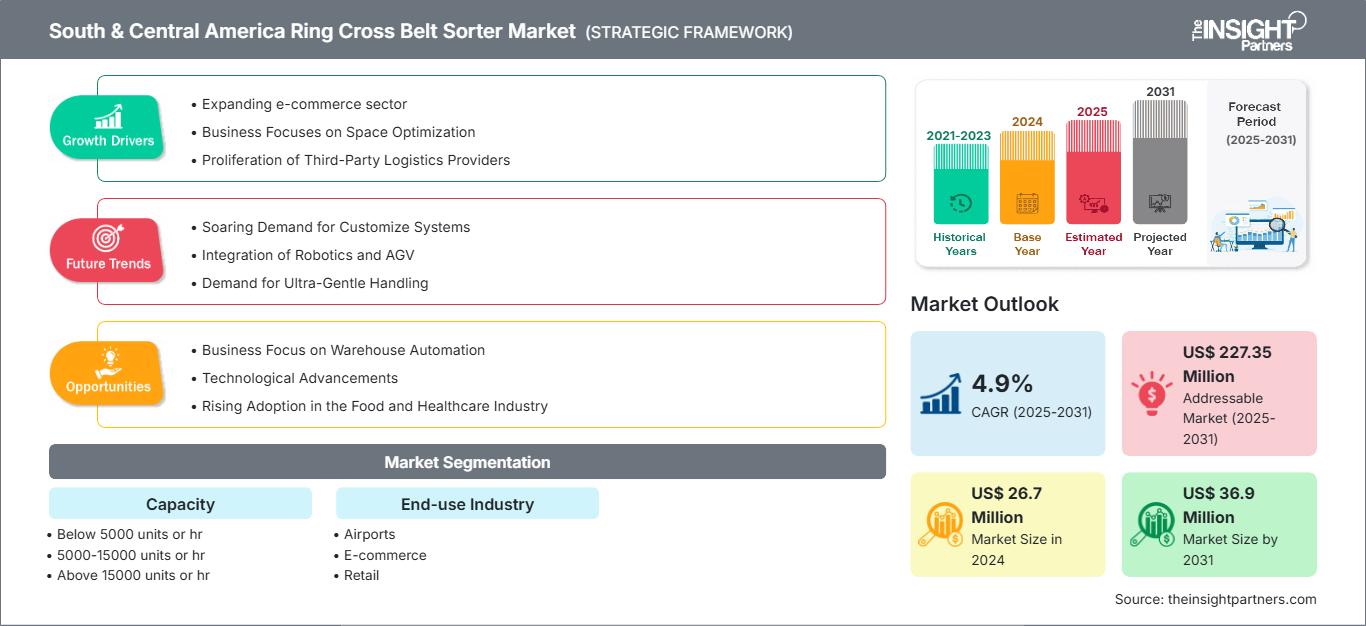
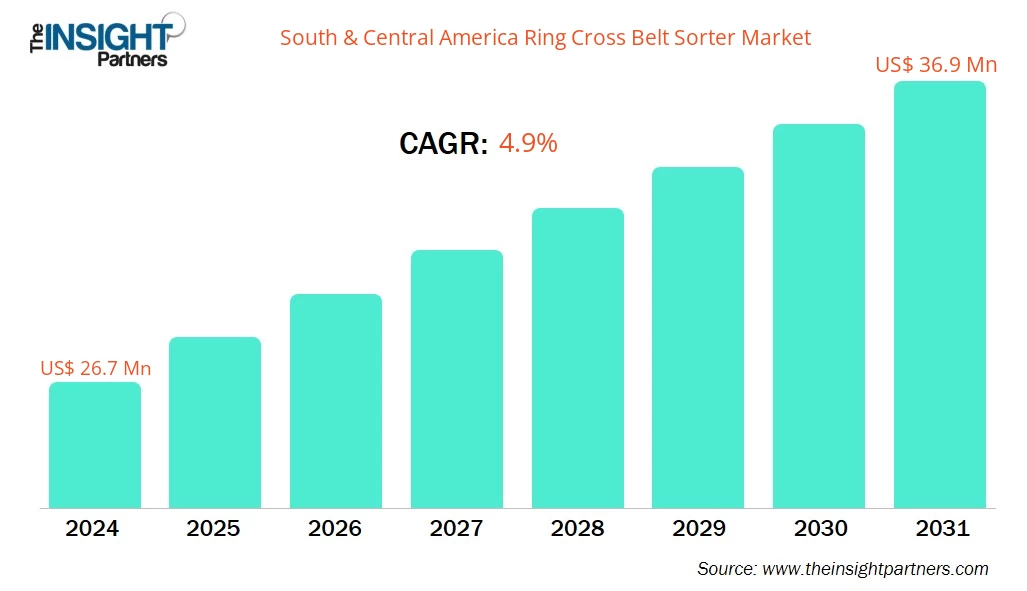
The South & Central America Ring Cross Belt Sorter Market size is expected to reach US$ 36.9 Million by 2031 from US$ 26.7 Million in 2024. The market is estimated to record a CAGR of 4.9% from 2025 to 2031.
Executive Summary and South & Central America Ring Cross Belt Sorter Market Analysis:
No government or major corporate disclosures could be found from 2023-2025 directly referencing ring cross belt sorter adoptions. However, regional governments and logistics companies invest in warehouse automation to support growing e-commerce demand. Brazil and Argentina are expanding infrastructure and modernizing logistics corridors to handle cross-border trade and urban parcel flows. This wave of modernization, while not always accompanied by public declarations of sorter deployments, includes warehouse upgrades featuring conveyor systems and automation-ready design. In 2023, the Brazilian government announced the "Routes for Integration" initiative, with nearly R$ 50 billion (US$10 billion) allocated for infrastructure development. This initiative aims at reducing distances, improving logistics, facilitating connections, and increasing productivity across South America. In 2024, a partnership with the BRICS Bank targeted BRL 2.7 billion (US$ 0.54 billion) for infrastructure and logistics projects, focusing on road concessions, railway terminals, waterways, and ports. These initiatives are expected to enhance the efficiency of logistics operations, increasing the demand for advanced sorting technologies.
Companies investing in low-maintenance, flexible sorting technologies benefit from ring cross belt sorter attributes in variable environmental conditions and energy contexts. As regional fulfillment networks expand-supported by trade alliances and infrastructure funding-the need for scalable sorter systems will likely grow. While formal ring cross belt sorter deployments remain unconfirmed, the region's trajectory toward automated supply chains and infrastructural enhancements positions it for future adoption.
Customize This Report To Suit Your Requirement
Get FREE CUSTOMIZATIONSouth & Central America Ring Cross Belt Sorter Market: Strategic Insights
-
Get Top Key Market Trends of this report.This FREE sample will include data analysis, ranging from market trends to estimates and forecasts.
South & Central America Ring Cross Belt Sorter Market Segmentation Analysis:
- By Capacity, the South & Central America Ring Cross Belt Sorter Market is segmented into Below 5000 units or hr, 5000-15000 units or hr, and Above 15000 units or hr. 5000-15000 units or hr held the largest share of the market in 2024.
- By End-use Industry, the South & Central America Ring Cross Belt Sorter Market is segmented into Airports, E-commerce, Retail, and Fashion, Food and Beverages, Manufacturing, Automotive, Logistics, and Others. Manufacturing held the largest share of the market in 2024.
South & Central America Ring Cross Belt Sorter Market Report Scope
| Report Attribute | Details |
|---|---|
| Market size in 2024 | US$ 26.7 Million |
| Market Size by 2031 | US$ 36.9 Million |
| CAGR (2025 - 2031) | 4.9% |
| Historical Data | 2021-2023 |
| Forecast period | 2025-2031 |
| Segments Covered |
By Capacity
|
| Regions and Countries Covered |
South and Central America
|
| Market leaders and key company profiles |
|
South & Central America Ring Cross Belt Sorter Market Players Density: Understanding Its Impact on Business Dynamics
The South & Central America Ring Cross Belt Sorter Market is growing rapidly, driven by increasing end-user demand due to factors such as evolving consumer preferences, technological advancements, and greater awareness of the product's benefits. As demand rises, businesses are expanding their offerings, innovating to meet consumer needs, and capitalizing on emerging trends, which further fuels market growth.
South & Central America Ring Cross Belt Sorter Market Outlook
The food and healthcare industries require high precision, hygiene, and efficiency in sorting delicate and diverse products, which cross-belt sorters are uniquely designed to handle. Their capability to manage various product sizes and shapes without damaging goods is crucial for sectors such as food processing and pharmaceutical distribution, where product integrity impacts safety and customer satisfaction. As consumer preferences shift toward fresher and safer products, and regulatory standards become more stringent, manufacturers and supply chain operators in the food and healthcare sectors are investing in advanced sorting technologies to improve operational efficiency and compliance.
Integrating machine learning, IoT sensors, and real-time analytics into ring cross-belt sorters enhances their appeal in these sectors by offering predictive maintenance, faster sorting speeds, and higher accuracy. In food processing, machine learning and smart IoT sensors are used for real-time inspection, product quality assurance, and anomaly detection, improving food safety and reducing spoilage. Predictive analytics leverage real-time sensor data to identify risks and trigger early interventions, safeguarding public health and preventing large-scale recalls. On the other hand, in healthcare, advanced sorters equipped with IoT and AI ensure accurate, traceable, and efficient delivery of medical supplies, pharmaceuticals, and laboratory samples, complying with strict regulatory requirements.
Ring cross-belt sorters are key in managing complex order fulfillment and distribution needs in the food and beverage industry. Similarly, the healthcare and medical industries leverage their precision and adaptability to ensure product safety and regulatory compliance.
South & Central America Ring Cross Belt Sorter Market Country Insights
By country, the South & Central America Ring Cross Belt Sorter Market is segmented into Brazil, Argentina, and the Rest of South & Central America. Brazil held the largest share in 2024.
In mid-2025, Wilson Sons' Tecon Rio Grande container terminal implemented an advanced automation platform. This system integrated electronically managed truck scheduling, optical character recognition (OCR)-based berthside automation, real-time tracking sensors, and centralized dashboards to streamline operations and reduce bottlenecks. Such initiatives illustrate the ecosystem needed to support sorter systems, including ring cross belt sorters. Supporting this corporate innovation, Brazil's federal government unveiled a new National Logistics Plan in 2024 aimed at reducing port bureaucracy and enhancing digital connectivity among agencies such as the Federal Revenue and national port authorities. This policy framework fosters an environment conducive to integrating advanced sorting systems, including modular ring-belt technologies.
South & Central America Ring Cross Belt Sorter Market Company Profiles
Some of the key players operating in the market include BEUMER Group GmbH & Co KG, Bastian Solutions LLC, Korber AG, Fives SAS, Okura Yusoki Co., Ltd, GINFON Group, Atmos Systems, Conveyco (Pty) Ltd, CIMC Pteris Global, and Jiangsu Bealead Software Co., Ltd.
These players are adopting various strategies such as expansion, product innovation, and mergers and acquisitions to provide innovative products to their consumers and increase their market share.
South & Central America Ring Cross Belt Sorter Market Research Methodology
The following methodology has been followed for the collection and analysis of data presented in this report:
Secondary Research
The research process begins with comprehensive secondary research, utilizing internal and external sources to gather qualitative and quantitative data for each market. Commonly referenced secondary research sources include, but are not limited to:
- Company websites, annual reports, financial statements, broker analyses, and investor presentations
- Industry trade journals and other relevant publications
- Government documents, statistical databases, and market reports
- News articles, press releases, and webcasts specific to companies operating in the market
Note:
All financial data included in the Company Profiles section has been standardized to US$. For companies reporting in other currencies, figures have been converted to US$ using the relevant exchange rates for the corresponding year.Primary Research
The Insight Partners conducts a significant number of primary interviews each year with industry stakeholders and experts to validate its data analysis and gain valuable insights. These research interviews are designed to:
- Validate and refine findings from secondary research
- Enhance the expertise and market understanding of the analysis team
- Gain insights into market size, trends, growth patterns, competitive dynamics, and future prospects
Primary research is conducted via email interactions and telephone interviews, encompassing various markets, categories, segments, and sub-segments across different regions. Participants typically include:
- Industry stakeholders: Vice Presidents, Business Development Managers, Market Intelligence Managers, and National Sales Managers
- External experts: Valuation specialists, research analysts, and key opinion leaders with industry-specific expertise

- Historical Analysis (2 Years), Base Year, Forecast (7 Years) with CAGR
- PEST and SWOT Analysis
- Market Size Value / Volume - Regional, Country
- Industry and Competitive Landscape
- Excel Dataset
Recent Reports
Testimonials

The Insight Partners' SCADA System Market report is comprehensive, with valuable insights on current trends and future forecasts. The team was highly professional, responsive, and supportive throughout. We are very satisfied and highly recommend their services.
RAN KEDEM Partner, Reali Technologies LTDs
I requested a report on a very specific software market and the team produced the report in a few days. The information was very relevant and well presented. I then requested some changes and additions to the report. The team was again very responsive and I got the final report in less than a week.
JEAN-HERVE JENN Chairman, Future Analytica
We worked with The Insight Partners for an important market study and forecast. They gave us clear insights into opportunities and risks, which helped shape our plans. Their research was easy to use and based on solid data. It helped us make smart, confident decisions. We highly recommend them.
PIYUSH NAGPAL Sr. Vice President, High Beam Global
The Insight Partners delivered insightful, well-structured market research with strong domain expertise. Their team was professional and responsive throughout. The user-friendly website made accessing industry reports seamless. We highly recommend them for reliable, high-quality research services
YUKIHIKO ADACHI CEO, Deep Blue, LLC.
This is the first time I have purchased a market report from The Insight Partners.While I was unsure at first, I visited their web site and felt more comfortable to take the risk and purchase a market report.I am completely satisfied with the quality of the report and customer service. I had several questions and comments with the initial report, but after a couple of dialogs over email with their analyst I believe I have a report that I can use as input to our strategic planning process.Thank you so much for taking the extra time and making this a positive experience.I will definitely recommend your service to others and you will be my first call when we need further market data.
JOHN SUZUKI President and Chief Executive Officer, Board Director, BK Technologies
I wish to appreciate your support and the professionalism you displayed in the course of attending to my request for information regarding to infectious disease IVD market in Nigeria. I appreciate your patience, your guidance, and the fact that you were willing to offer a discount, which eventually made it possible for us to close a deal. I look forward to engaging The Insight Partners in the future, all thanks to the impression you have created in me as a result of this first encounter.
DR CHIJIOKE ONYIA MANAGING DIRECTOR, PineCrest Healthcare Ltd.Reason to Buy
- Informed Decision-Making
- Understanding Market Dynamics
- Competitive Analysis
- Identifying Emerging Markets
- Customer Insights
- Market Forecasts
- Risk Mitigation
- Boosting Operational Efficiency
- Strategic Planning
- Investment Justification
- Tracking Industry Innovations
- Aligning with Regulatory Trends
Unlock Exclusive Report Discounts
Enquire Now



 Get Free Sample For