Square Chimney Caps Market Size & Overview
The Square Chimney Caps Market was valued at US$ 533.07 Million in 2025 and is projected to reach US$ 946.45 Million by 2034, expanding at a CAGR of 6.59% during 2026–2034. Demand is anchored in protection against precipitation, animal entry, debris, and downdrafts across masonry and prefabricated chimney systems. Square formats remain important because they align with common clay-tile flues, support straightforward fastening, and accommodate single-flue and multi-flue configurations.
Within North America, the Square Chimney Caps Market size is supported by an estimated ~6% CAGR through 2034. A large installed base of masonry chimneys sustains recurring replacement demand, while freeze-thaw exposure and wind-driven rain encourage owners to upgrade from painted galvanized products to longer-life stainless steel. Contractor-led inspections, home-improvement retail availability, and wildfire-conscious spark-control practices further support adoption without depending solely on new housing starts.
Drivers of Square Chimney Caps Growth include the protection of chimneys and masonry against water, animal nesting, leaves, and wind downdrafts. The demand for the product arises among home owners, facility managers, chimney sweepers, roofers, and fireplace sellers. The upstream side consists of steel suppliers who provide stainless steel, galvanized steel and copper materials. Fabricators then shape, bend, weld, paint, and pack units. Fasteners' quality, replacement cycle, and storm damages determine the frequency of inspections that plays an important role in growth besides the new construction. Standardized footprint sizes are advantageous from the supply perspective, because they simplify manufacturing process and decrease inventory costs. Custom-made square and multi-flue caps are still popular when crowning, offsets, aesthetics, or flue grouping complicate the use of standard products. Stainless steel wins with the life-cycle resistance to corrosion, galvanized steel with the cost, and copper with its aesthetic appeal. Manufacturers have to balance metal prices with the service performance during seasons.
The Square Chimney Caps Market Report suggests a fragmented market where manufacturing expertise, depth of offerings, and distribution partnerships are key. The manufacturing strategy of HY-C Company, LLC and National Chimney involves having many standardized products in their line and wide distribution reach, while Olympia Chimney Supply, Inc. integrates the chimney caps with a broader venting system offering. Artis Metals Company, Inc., Chim Cap Corp., and Chimney King, LLC focus on customized and fabricated needs, whereas Owens Chimney Systems, Inc. combines manufacturing ability with installation expertise. Capital investment will revolve around the use of laser cut machines, robotic fixture welding, powder coating systems, and order management system for custom orders. Gelco, Lyemance, Lock-Top, Fireplace Essentials, and Stromberg Architectural Products have varying levels of presence in caps, dampers, specialty pieces, and architectural metalwork. The advantage will come from the use of low-error measurement procedures, quick custom order time, corrosion resistance warranties, and channel training over price alone. Those companies offering cap selection together with inspections, liners, crowns, and water management will have increased attachment rates.
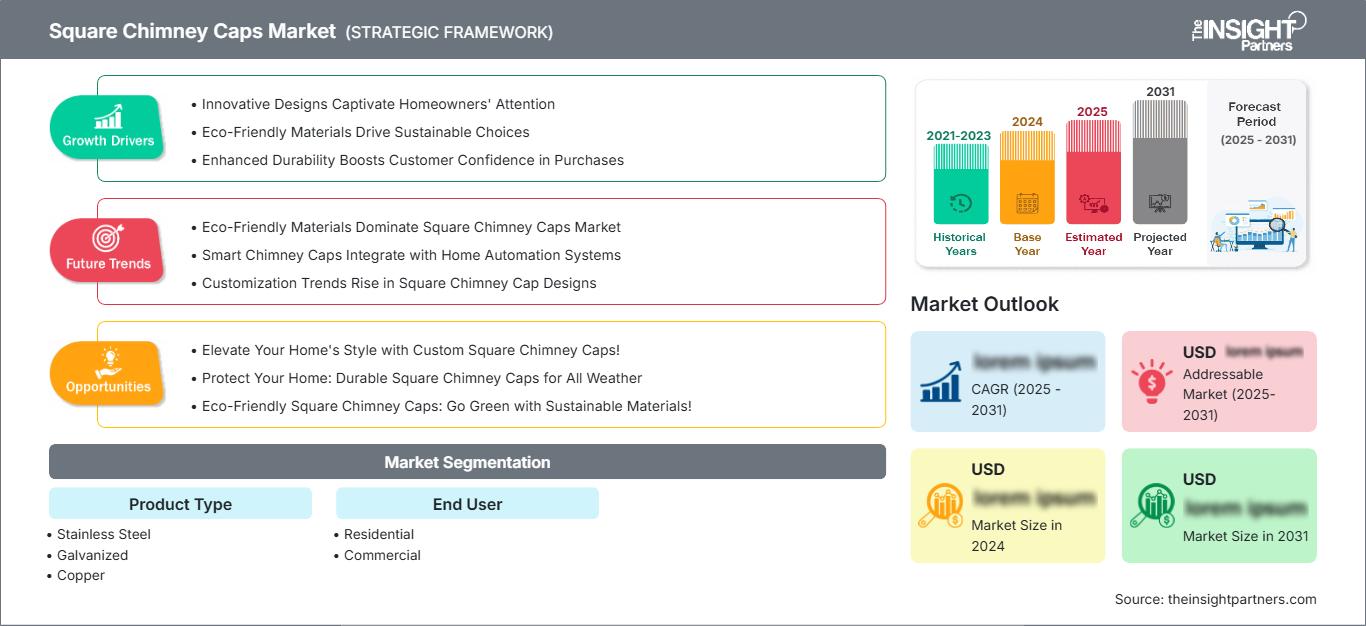
Square Chimney Caps Market Assessment and Insights
Regional Outlook
- North America: ~38% of the global market in 2025 | ~6% CAGR through 2034. Market position: The region ranks first, supported by extensive detached housing, mature hearth-service networks, harsh seasonal weather, and broad retail access to standardized square caps.
- US: ~82% of North American market revenue in 2025 | ~6% CAGR through 2034. Market position: The leading North American country combines a large installed chimney base, strong contractor coverage, replacement-led purchasing, and demand for stainless steel products suited to residential fireplaces.
- Europe: ~30% of the global market in 2025 | ~6% CAGR through 2034. Market position: A mature renovation market and persistent use of solid-fuel and decorative hearths sustain demand, led within Europe by the UK and followed by Germany, France, Italy, and Spain.
- Asia Pacific: ~20% of the global market in 2025 | ~8% CAGR through 2034. Market position: Asia Pacific is the fastest-growing region as premium housing, hospitality construction, locally fabricated stainless products, and modern venting upgrades expand in China, Japan, South Korea, India, and Australia.
Segment Outlook
- End User: ~72% Share in 2025 | ~7% CAGR through 2034. Market position: End User leads on demand concentration because residential properties contain most conventional fireplaces and square masonry flues, creating recurring inspection, reroofing, restoration, wildlife-exclusion, and moisture-control purchases.
- Product Type: ~100% Share in 2025 | ~7% CAGR through 2034. Market position: Material-led product innovation advances through corrosion resistance, lighter fabrication, modular sizing, improved mesh geometry, and visually differentiated copper finishes.
Competitive Coverage
Artis Metals Company, Inc., Chim Cap Corp., Chimney King, LLC, Fireplace Essentials, Gelco, Lyemance, Lock-Top, HY-C Company, LLC, National Chimney, Olympia Chimney Supply, Inc., Owens Chimney Systems, Inc., Stromberg Architectural Products
Methodology
The Insight Partners follows Data Collection & Secondary Research, Primary Research, Data Analysis, and Data Triangulation & Final Review to validate market estimates and insights.
Source: The Insight Partners' analysis based on proprietary research, government publications, company annual reports, investor presentations, industry databases, and expert interviews.
Square Chimney Caps Market Trends
Configurable Standardization and Digital Fit Validation
Square Chimney Caps Market trends will increasingly center on reducing measurement errors between the roof visit and fabrication. Suppliers are likely to expand guided configuration by flue outside dimensions, crown size, screen height, lid overhang, attachment method, and fuel compatibility. Photo-assisted quoting and structured measurement forms can move custom orders through production with fewer callbacks. At the factory, modular bases, repeatable mesh panels, and flexible cutting cells will allow a wider variety of dimensions without fully bespoke workflows. The commercial effect should be shorter lead times and lower remakes, particularly for multi-flue caps. Distributors that connect digital configuration to local inventory and fabrication slots can make custom work nearly as predictable as stock ordering.
Performance Documentation Becomes a Purchase Filter
Future procurement will place more weight on documented alloy, gauge, mesh opening, fastening, wind resistance, warranty, and appliance suitability. This shift is likely to be led by professional installers, commercial property managers, and owners in coastal or wildfire-exposed locations. Product pages that merely state dimensions will become less competitive than technical records that explain free area, service access, and installation limitations. Manufacturers may also differentiate through replaceable components and finish systems rather than treating the cap as disposable. Better documentation will not eliminate local code review or professional judgment, but it can narrow selection uncertainty. Over time, transparent specifications should support premiumization and make lifecycle value easier to compare across stainless steel, galvanized, and copper alternatives.
Square Chimney Caps Market Growth Factors
Aging Chimney Stock and Recurring Exterior Maintenance
Installed masonry chimneys create a durable replacement market because caps face continuous exposure to rain, snow, wind, animals, soot, and corrosive combustion by-products. Failures are often discovered during sweeping, roof replacement, crown repair, or property inspection, linking cap demand to several maintenance channels. Square clay flues are widespread in older detached housing, and standard cap dimensions allow contractors to complete many jobs without custom fabrication. The economic impact extends beyond the part itself: a functioning cap helps limit water entry that can damage liners, mortar, dampers, and fireboxes. This supports preventive replacement even when fireplace usage is intermittent. Suppliers with dependable stock, clear sizing guidance, and installer-ready hardware can convert inspection findings into same-visit or short-lead-time sales.
Material Upgrading Toward Stainless Steel
Lifecycle economics are shifting contractor recommendations from basic painted galvanized steel toward stainless steel, especially in coastal, wet, snowy, and freeze-thaw environments. A higher initial price can be justified by resistance to corrosion, stronger warranty positioning, and lower probability of repeat labor. This matters because roof access, setup, and professional installation may cost more than the cap itself. Welded seams, heavier mesh, removable lids, and secure bases also improve perceived quality. Galvanized products retain an important role in budget work, but their value proposition is strongest where exposure is moderate and planned ownership is shorter. For manufacturers, the upgrade cycle supports revenue mix and rewards consistent material specification, while distributors benefit from stocking good-better-best options rather than competing on a single price point.
Wildlife, Moisture, and Spark-Control Awareness
Homeowners increasingly understand that a cap is a functional safety and building-envelope component rather than a decorative accessory. Mesh helps deter birds, squirrels, raccoons, and nesting debris, while the hood limits direct precipitation and can reduce wind-driven downdrafts. In suitable designs, screening also assists with spark containment, an important consideration near combustible roofing or vegetation. These benefits create multiple purchase triggers across pest control, roofing, chimney service, and insurance-conscious maintenance. The impact on the Square Chimney Caps Market is broader conversion among properties with missing, damaged, or poorly fitted caps. Clear guidance remains essential because overly restrictive mesh, incorrect sizing, or incompatible installation can impair draft. Brands that combine product sales with fit, clearance, and maintenance education are better positioned to earn professional recommendation.
Square Chimney Caps Market Opportunities
Contractor-Centric Replacement Programs
A major commercial opportunity lies in helping chimney sweeps, roofers, masons, and hearth dealers identify and close replacement work efficiently. Square Chimney Caps Market Forecasts indicate that recurring installed-base demand will remain more dependable than new-construction demand in mature regions. Manufacturers can act by offering van-friendly multipacks, fast-moving size assortments, measurement templates, installation kits, and rapid custom quoting. Distributor loyalty programs should focus on availability and reduced jobsite risk rather than broad discounting. Training content can connect visible defects such as rusted mesh, lifted lids, and undersized covers to appropriate product choices. This approach raises attachment rates during existing service visits and creates a defensible channel advantage because contractors value confidence, speed, and fewer return trips.
Localized Premium Fabrication in Growth Markets
Square Chimney Caps Market Opportunities in Asia Pacific and selected Middle East markets include room for localized stainless steel and copper fabrication tied to luxury housing, resorts, restaurants, and architectural projects. The opportunity is not mass adoption across all urban construction; it is targeted service for buildings that use fireplaces, decorative chimneys, solid-fuel appliances, or exposed exhaust terminations. Investors should prioritize partnerships with roof-product distributors, fireplace installers, and architectural metal shops that already understand local dimensions and finishes. Regional cutting and finishing can shorten lead times, reduce freight on bulky assemblies, and accommodate nonstandard crowns. A premium-led entry strategy is more defensible than competing with low-cost generic imports, especially where corrosion resistance, visual integration, and installation support shape purchasing.
Segmentation Analysis
Product Type
The Product Type segment in the Square Chimney Caps Market is projected to grow at a ~7% CAGR during 2026–2034. The market scope covers stainless steel, galvanized, and copper products, each serving a distinct balance of durability, cost, fabrication, and appearance. Material choice is shaped by exposure, fuel type, expected service life, warranty, and architectural visibility. Stainless steel increasingly anchors professional recommendations, while galvanized products preserve entry-level accessibility and copper supports premium custom work.
- Stainless Steel: This sub-segment leads professional replacement demand because welded 304-grade construction resists rust, tolerates weather exposure, and supports long warranties. It is strategically important for coastal, freeze-thaw, and frequently used chimney applications.
- Galvanized: Galvanized caps serve price-sensitive homeowners, landlords, and routine replacements where lower initial cost outweighs maximum service life. Powder-coated finishes improve appearance, but cut edges and sustained moisture exposure can shorten useful life.
- Copper: Copper is concentrated in restoration, luxury residential, hospitality, and architect-specified projects. Its value stems from visual distinction, fabricated detailing, and natural patination, making it a margin-accretive rather than volume-led offering.
End User
End User in the Square Chimney Caps Market demand is forecast to advance at a ~7% CAGR during 2026–2034. Residential users account for ~72% of 2025 revenue because detached homes contain most conventional fireplaces and masonry flues. Commercial purchasing is less frequent but often specification-heavy, with property managers prioritizing access, maintenance, appearance, and liability reduction. Across both groups, contractor inspection converts latent issues such as failed mesh, missing caps, corrosion, and water intrusion into replacement orders.
- Residential: Homeowners drive recurring demand through chimney sweeping, roof replacement, fireplace restoration, storm repair, and wildlife exclusion. Standard square sizes enable efficient installation, while multi-flue and decorative crowns support custom fabrication.
- Commercial: Hotels, restaurants, heritage properties, multifamily estates, and institutional buildings require robust caps where chimney systems remain active. Procurement favors documented materials, maintainable lids, consistent appearance, and coordinated installation with roofing or masonry work.
Opportunity Snapshot
| End Users | Revenue Contribution | Trend Tag | Adoption Stage |
| Residential | High | Weatherproof Retrofit | Mature |
| Commercial | Medium | Portfolio Maintenance | Scaling |
Regional Insights
North America Square Chimney Caps Market
The North American region will contribute ~38% of the worldwide revenue by 2025 and register a ~6% CAGR till 2034. The share of Square Chimney Caps Market indicates a high number of detached houses with masonry fireplaces, developed chimney service infrastructure, and exposure to elements like snow, rain, wind, and freeze-thaw cycles. In this scenario, cap replacement is linked with overall maintenance of crown, flashing, liners, and roof.
The demand will be restricted to the United States, with the contribution of Canada through cold weather housing and remodeling needs. Stainless steel finds more preference in regions where the owner prefers long-lasting materials with low need for repeat services; on the other hand, galvanized steel has value when it comes to cost-effective replacement.
U.S. Square Chimney Caps Market
The US holds ~82% share of North American revenues in 2025 and is estimated to grow at ~6% CAGR. The country has a robust presence backed by existing stock of wood-burning fireplaces, traditional masonry chimneys, and businesses offering annual chimney cap inspections along with real estate transactions, re-roofing, and water infiltration remediation services. Traditional square single-flue chimneys are common, but larger square top-mount units are used in cases of clustered flues.
Key companies operating in this market include HY-C Company, LLC, National Chimney, Olympia Chimney Supply, Inc., Artis Metals Company, Inc., Chim Cap Corp. and regional specialty manufacturers. Market trends indicate usage of stainless steel welding, removable caps, animals-proof mesh, and secure installation in high wind regions. Copper chimneys are used as an architectural premium option in restoration and custom housing applications, whereas galvanized steel chimneys cater to cost-conscious applications.
Europe Square Chimney Caps Market
The European market accounts for ~30% of worldwide revenue in 2025, growing at a ~6% CAGR up to 2034. The geography is a combination of old building inventory, roof repairs, moisture management needs, and fireplace/stove usage. United Kingdom is the largest European market, based on masonry housing and long-standing chimney sweeping industry. Rains and bird exclusion ensure regular replacement and retrofits.
In Germany, engineering fit, longevity of metals, and compatibility with regulated combustion equipment are the priorities. Rural solid fuel burning and historic chimneys restoration define the French market, while Italy and Spain are significant because of villas, heritage buildings, hospitality and decorative design applications. In these geographies, different flue design, roofing practices, and ventilation requirements have to be considered. Stainless steel is preferred for lifecycle reliability, copper – for premium visibility applications.
Though the European producers face competition from imports of standard products, there is still great significance in local manufacture of non-standardized crowns and conservation-based projects. The energy efficiency regulations will eventually discourage use of some open fireplaces, but on the other hand they will encourage professional assessment and safe decommissioning of retained fireplaces. The commercial applications include hotels, restaurants, historic buildings, and estates needing waterproofing.
APAC Square Chimney Caps Market
The Asia Pacific region accounts for ~20% of worldwide revenue in 2025 and is the highest-growth region with a ~8% CAGR till 2034. The largest Square Chimney Caps Market in the region is China due to the presence of metal fabrication capability along with demand from luxury homes, hospitality, exports, and decorative vents.
Australia offers an additional source of replacement for wood-burning stoves and roofless installations. Japan and South Korea prefer small, tough, and high-quality components, while India offers a limited scope in resorts, luxurious houses, and institutional kitchens where there are compatible chimneys.
Urban construction does not always lead to a need for fireplaces; therefore, growth is determined by high-end buildings, tourism facilities, the use of solid fuel, and exports. Stainless steel, efficient metal fabrication, and better online distribution facilitate regional penetration.
Middle East & Africa Square Chimney Caps Market
The Middle East & Africa Square Chimney Caps Market is projected to expand at a ~7% CAGR through 2034. South Africa is the leading country in the Middle East & Africa where residential fireplaces, wood-burning stoves, and established home-improvement channels create a broader addressable base. Coastal corrosion and variable rainfall strengthen the case for stainless steel.
Saudi Arabia and the UAE generate selective demand from villas, luxury hospitality, outdoor-fire features, and architectural projects, although conventional heating chimneys are less common. Rest of MEA demand remains project-led and fragmented. Suppliers benefit from corrosion-resistant grades, custom fabrication, and distributor education, while growth is constrained by limited installed chimney stock and strong climatic differences across subregions.
Square Chimney Caps Market Report Scope
| Report Attribute | Details |
|---|---|
| Market size in 2025 | US$ 533.07 Million |
| Market Size by 2034 | US$ 946.45 Million |
| Global CAGR (2026 - 2034) | 6.59% |
| Historical Data | 2021-2024 |
| Forecast period | 2026-2034 |
| Segments Covered | Product Type, End User |
| Region scope | North America, Europe, Asia-Pacific, South and Central America, Middle East and Africa |
Recent Developments
- September 2026: Chimney Collective – Chimney Collective announced a partnership with Chimney Solutions, a chimney and fireplace services company serving Georgia, Tennessee, and Indiana. The partnership expands Chimney Collective’s network while providing Chimney Solutions with additional operational, training, technology, and growth resources.
- February 2026: Beyond Appliances – Beyond Appliances launched its “Engineered to Delight” campaign around its Plug ’N’ Play kitchen chimney, designed to eliminate ducting and invasive installation. The company positions the product around easier installation, flexibility, low-noise operation, and modern kitchen design.
- June 2025: Bay Cities Metal Products – Bay Cities introduced its Spark Arrestor Chimney Cap, designed to improve fire protection and safety while simplifying installation. The product uses durable materials and a quick-install design, addressing growing fire-readiness requirements in Western US communities.
Frequently Asked Questions

Recent Reports






