
Trifluralin Herbicide Market Share, Size & Demand by 2034
Coverage: By Type (Granular and Emulsifiable Concentrate), By Crop Type (Field or Row Crops, Fruits and Vegetables, and Others), By Application (Annual Grasses, Broadleaf Weeds, and Others), By End User (Agriculture and Horticulture, Turf, Municipal, and Others), and Geography (North America, Europe, Asia Pacific, the Middle East and Africa, and South and Central America)
- Status : Published
- Report Code : TIPRE00043660
- Category : Chemicals and Materials
- No. of Pages : 383
- Available Report Formats :


- Last update date : August 04, 2026


2025 Market Size
US$ 52.62 Mn
Base year value
2034 Forecast
US$ 77.63 Mn
Projected by 2034
CAGR 2026-2034
4.4 %
Growth rate
Addressable Market
US$ 590.99 Mn
(2026-2034)
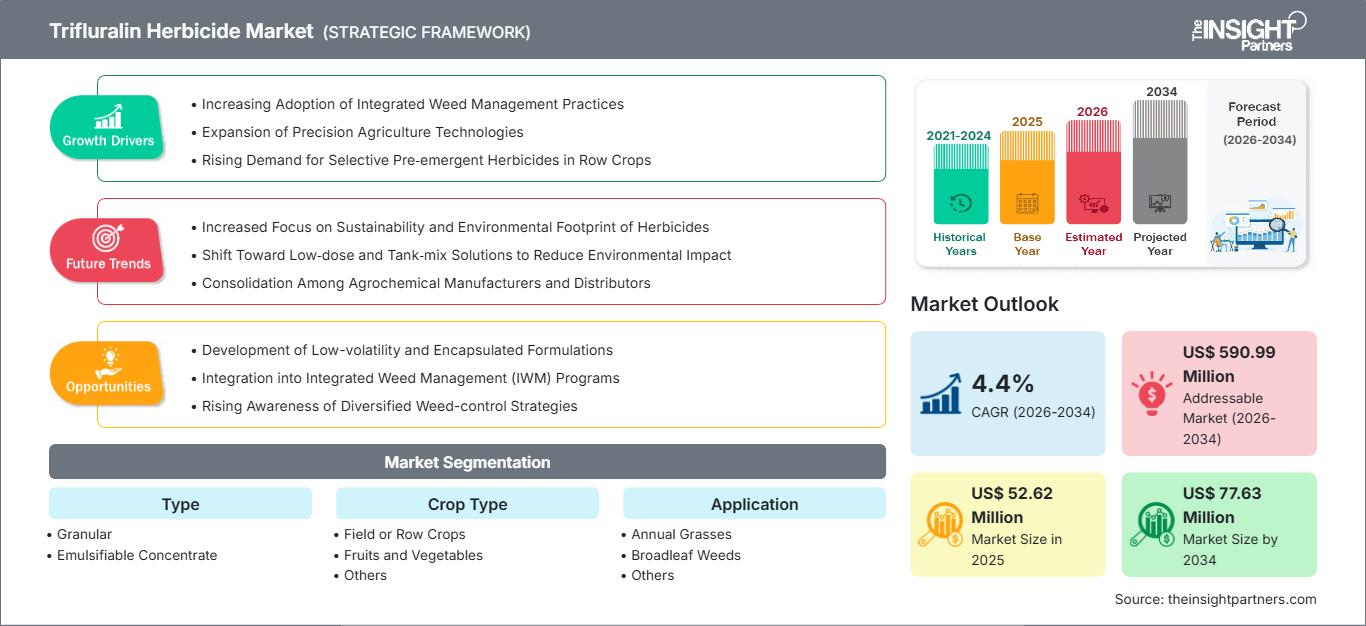
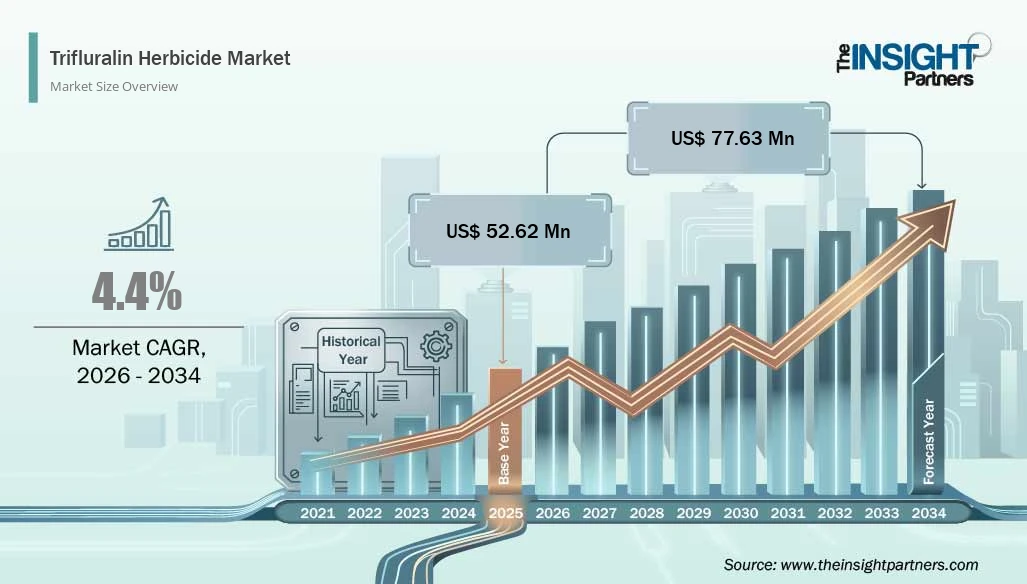
The trifluralin herbicide market size is projected to reach US$ 77.63 million by 2034 from US$ 52.62 million in 2025. The market is expected to register a CAGR of 4.4% during 2026–2034.
Trifluralin Herbicide Market Analysis
Trifluralin is a leading dinitroaniline herbicide widely utilized for pre-plant incorporated and pre-emergence weed control in commercial agriculture. Market growth is driven by the increasing requirement to manage annual grasses and selected broadleaf weeds that compete with crops for essential resources. Preventive weed control strategies are being prioritized to enhance crop establishment and reduce yield losses, particularly in large-scale farming operations. The heightened focus on herbicide resistance management has reinforced trifluralin’s role within herbicide rotation programs. Its unique mode of action supports diversification of weed control practices and reduces reliance on post-emergence herbicides. Demand is especially robust in soybean, cotton, canola, sunflower, peanut, vegetable, and pulse production, where early-season weed suppression is critical to optimizing crop productivity and profitability. The North America region represents a significant share of global demand, supported by extensive agricultural activity.
Trifluralin Herbicide Market Overview
Trifluralin is a selective pre-emergence herbicide from the dinitroaniline class that inhibits root development and cell division in germinating weed seedlings. It is primarily applied prior to planting or incorporated into the soil to control annual grasses and selected broadleaf weeds before crop emergence. Trifluralin is available in granular and emulsifiable concentrate formulations and is widely adopted in field crops, horticulture, turf management, and broader vegetation management. Its proven efficacy, compatibility with a wide range of crops, and established role in resistance management sustain its commercial relevance, even as newer herbicide chemistries enter the market.
The trifluralin herbicide market is defined by ongoing advancements in herbicide application technologies, expanded use of GPS-enabled precision agriculture equipment, and broader implementation of integrated weed management programs. Growers are combining chemical herbicides with crop rotation, mechanical cultivation, cover cropping, and biological control methods to achieve sustainable, long-term weed management. Within these integrated systems, trifluralin functions as a foundational herbicide, delivering early-season weed suppression that mitigates competition during key crop establishment phases.
● REPORT CUSTOMIZATION
Tailor This Report To Align With Your Specific Business Requirements
This report can be customized to align precisely with your business objectives, scope, and target markets. Customization options include tailored segmentation, geography, competitive analysis, and strategic insights to support informed decision-making.
Customize This Report →WHAT YOU CAN ADJUST
- ● Segmentations
- ● Geography
- ● Competitive Analysis
- ● Language Preferences
Trifluralin Herbicide Market: Strategic Insights
-
Get Top Key Market Trends of this report.This FREE sample will include data analysis, ranging from market trends to estimates and forecasts.
Trifluralin Herbicide Market: Drivers and Opportunities
Market Drivers:
Integrated weed management (IWM) is a key driver of the trifluralin herbicide market. Agricultural producers are increasingly adopting IWM by combining chemical, cultural, mechanical, and biological weed control methods to achieve sustainable suppression and reduce herbicide resistance. Trifluralin serves a critical function as a pre-emergence herbicide, providing effective control of annual grasses and selected broadleaf weeds prior to crop establishment. Its integration into crop rotation and diversified weed management programs supports improved weed control efficiency, yield preservation, and the sustained efficacy of herbicide chemistries. Industry recommendations from agricultural extension agencies and crop consultants further reinforce the use of herbicides with multiple modes of action, supporting stable demand for trifluralin-based solutions.
Market Opportunities:
Precision agriculture is creating substantial growth opportunities for the trifluralin herbicide market. Adoption of GPS-guided machinery, variable-rate application systems, automated sprayers, drones, and digital farm management platforms is enhancing input efficiency and crop outcomes. These technologies facilitate precise herbicide placement, reduce overlap, minimize chemical waste, and improve weed control. Trifluralin, which requires accurate soil incorporation, benefits from these precision techniques by achieving greater consistency and field performance. Collaboration between equipment manufacturers and crop protection companies is advancing integrated solutions that align precision technologies with agronomic best practices. As precision farming adoption expands in both developed and emerging markets, demand is expected to increase for herbicides that deliver reliable results within technology-enabled production systems.
Trifluralin Herbicide Market Report Segmentation Analysis
The trifluralin herbicide market is divided into different segments to give a clearer view of how they work, their growth potential, and the latest trends. Below is the standard segmentation approach used in industry reports:
By Type
- Granular: Granular formulations are primarily adopted in large-scale agricultural operations for their consistent soil distribution and proven efficacy in pre-emergence weed management.
- Emulsifiable Concentrate: Emulsifiable concentrate formulations are selected for their operational efficiency, compatibility with standard spraying equipment, and consistent performance in weed control programs.
By Crop Type
- Field/Row Crops: Field and row crops represent the leading segment, driven by the widespread application of trifluralin in soybean, cotton, cereal, canola, sunflower, and pulse production.
- Fruits and Vegetables: In fruit and vegetable production, trifluralin is utilized to suppress weed growth during early crop establishment, supporting optimal yield outcomes.
- Others: The others segment encompasses specialty crops, ornamentals, and nurseries, where pre-emergence weed management is essential for maintaining healthy crop development.
By Application
- Annual Grass: Annual grasses constitute the largest application segment, reflecting trifluralin's established efficacy in controlling grassy weed species prior to emergence.
- Broadleaf Weeds: Trifluralin is applied for the control of selected broadleaf weeds within integrated weed management strategies across multiple crop types.
- Others: The others segment addresses additional susceptible weed species managed through crop-specific trifluralin-based weed control protocols.
By End User
- Agriculture and Horticulture: Agriculture and horticulture collectively account for the largest market share, underpinned by the broad adoption of trifluralin in commercial crop production systems.
- Turf: Turf management applications include the use of trifluralin for weed control in golf courses, sports fields, parks, and landscaped environments.
- Municipal: Municipal authorities implement trifluralin for vegetation management in public spaces and other approved non-crop areas.
- Others: The others segment comprises industrial, institutional, and specialty land management applications that require pre-emergence weed control solutions.
By Geography:
- North America
- Europe
- Asia Pacific
- South and Central America
- Middle East and Africa
Trifluralin Herbicide Market Report Scope
| Report Attribute | Details |
|---|---|
| Market size in 2025 | US$ 52.62 Million |
| Market Size by 2034 | US$ 77.63 Million |
| Global CAGR (2026 - 2034) | 4.4% |
| Historical Data | 2021-2024 |
| Forecast period | 2026-2034 |
| Segments Covered |
By Type
|
| Regions and Countries Covered |
North America
|
| Market leaders and key company profiles |
|
Trifluralin Herbicide Market Players Density: Understanding Its Impact on Business Dynamics
The Trifluralin Herbicide Market is growing rapidly, driven by increasing end-user demand due to factors such as evolving consumer preferences, technological advancements, and greater awareness of the product's benefits. As demand rises, businesses are expanding their offerings, innovating to meet consumer needs, and capitalizing on emerging trends, which further fuels market growth.
Trifluralin Herbicide Market Share Analysis by Geography
North America dominates the trifluralin herbicide market, driven by growing agricultural activities across the region. Emerging markets in South and Central America, the Middle East, and Africa have untapped opportunities for trifluralin herbicide market providers to expand.
The growth of the trifluralin herbicide market varies by region. The rising demand for selective preemergent herbicides in row crops positions the trifluralin herbicide market in an evolving consumer landscape. Below is a summary of market share and trends by region:
1. North America
- Market Share: Dominates the market, with an annually rising market share
- Key Drivers:
- Rising adoption of integrated weed management and herbicide resistance management strategies.
- Trends: Increasing use of precision agriculture technologies and pre-emergence herbicides in large-scale row crop production.
2. Europe
- Market Share: Holds a significant market share
- Key Drivers:
- Demand for effective weed control solutions that comply with evolving agricultural regulations.
- Trends: Greater emphasis on sustainable crop protection practices and integrated pest management programs.
3. Asia Pacific
- Market Share: Holds a significant market share
- Key Drivers:
- Expanding cultivation of cereals, oilseeds, cotton, and pulses, coupled with increasing adoption of modern crop protection products.
- Trends: Rising mechanization of farming operations and growing adoption of precision weed management technologies.
4. South and Central America
- Market Share: A rapidly expanding market with consistent annual growth in market share
- Key Drivers:
- Increasing soybean and cotton cultivation is driving demand for pre-emergence herbicides.
- Trends: Greater adoption of herbicide rotation programs to combat herbicide-resistant weeds.
5. Middle East and Africa
- Market Share: Small market size expanding at a rapid pace
- Key Drivers:
- Growing investments in agricultural modernization and improved weed management practices.
- Trends: Rising use of herbicides to enhance crop productivity and reduce labor-intensive weed control methods.
High Market Density and Competition
Competition is intense due to the presence of established players such as UPL Ltd, Drexel Chemical Co, Zhejiang Rayfull Chemicals Co., Ltd, ADAMA, and Steve Regan Co
This high level of competition urges companies to stand out by offering:
- Diverse product offering
- Sustainable and ethical sourcing
- Competitive pricing models
- Strong customer support and easy integration
Opportunities and Strategic Moves
- Companies are focusing on research and development activities to distinguish themselves in the market.
- Leading trifluralin herbicide companies are expanding their global footprint and capabilities through strategic acquisitions of manufacturers in the sector.
- Key players are expanding their product portfolio by launching innovative products.
Other companies analyzed during the course of research:
- Gowan Co
- Van Diest Supply Co
- Kelly Seed Company LLC
- Changzhou Good-job Biochemical Co Ltd
- Evergreen FS Inc
- Loveland Products Inc
- Tenkoz
- Albaugh LLC
- Corteva Inc
- Nufarm
Trifluralin Herbicide Market: News and Recent Developments
- Vulpes Corp – Product News: In November 2026, Vulpes Corp. announced it would start offering US-made Trifluralin in the 2027 season. Using its own manufacturing process on US soil, the company aims to bring high-purity trifluralin back to the market, directly addressing supply chain constraints and quality concerns that have challenged the industry.
- ADAMA – Product Launch: In May 2025, ADAMA announced that its broad-spectrum herbicide Temper More received registration in the US. The new solution, powered by the company's proprietary Sesgama formulation technology, provides burndown and residual weed control while supporting herbicide resistance management in row crops. The launch reflects the industry's continued focus on innovative herbicide technologies that complement integrated weed management practices.
Trifluralin Herbicide Market Report Coverage and Deliverables
The "Trifluralin Herbicide Market Size and Forecast (2021–2034)" report provides a detailed analysis of the market covering the following areas:
- Trifluralin Herbicide Market size and forecast at global, regional, and country levels for all the key segments covered under the scope
- Trifluralin Herbicide Market trends, as well as dynamics such as drivers, restraints, and opportunities
- Detailed Porter's five forces and SWOT analysis
- Trifluralin Herbicide Market analysis covering key market trends, global and regional framework, major players, regulations, and recent market developments
- Industry landscape and competition analysis covering market concentration, heat map analysis, prominent players, and recent developments for the trifluralin herbicide market
- Detailed company profiles
Frequently Asked Questions

- Comprehensive Market Sizing and Forecast Analysis
- Detailed Segmentation Analysis
- In-Depth Market Dynamics Assessment
- Regional and Country-Level Insights
- Competitive Landscape and Company Benchmarking
- Strategic Business Intelligence
Recent Reports
Testimonials

The Insight Partners' SCADA System Market report is comprehensive, with valuable insights on current trends and future forecasts. The team was highly professional, responsive, and supportive throughout. We are very satisfied and highly recommend their services.
RAN KEDEM Partner, Reali Technologies LTDs
I requested a report on a very specific software market and the team produced the report in a few days. The information was very relevant and well presented. I then requested some changes and additions to the report. The team was again very responsive and I got the final report in less than a week.
JEAN-HERVE JENN Chairman, Future Analytica
We worked with The Insight Partners for an important market study and forecast. They gave us clear insights into opportunities and risks, which helped shape our plans. Their research was easy to use and based on solid data. It helped us make smart, confident decisions. We highly recommend them.
PIYUSH NAGPAL Sr. Vice President, High Beam Global
The Insight Partners delivered insightful, well-structured market research with strong domain expertise. Their team was professional and responsive throughout. The user-friendly website made accessing industry reports seamless. We highly recommend them for reliable, high-quality research services
YUKIHIKO ADACHI CEO, Deep Blue, LLC.
This is the first time I have purchased a market report from The Insight Partners.While I was unsure at first, I visited their web site and felt more comfortable to take the risk and purchase a market report.I am completely satisfied with the quality of the report and customer service. I had several questions and comments with the initial report, but after a couple of dialogs over email with their analyst I believe I have a report that I can use as input to our strategic planning process.Thank you so much for taking the extra time and making this a positive experience.I will definitely recommend your service to others and you will be my first call when we need further market data.
JOHN SUZUKI President and Chief Executive Officer, Board Director, BK Technologies
I wish to appreciate your support and the professionalism you displayed in the course of attending to my request for information regarding to infectious disease IVD market in Nigeria. I appreciate your patience, your guidance, and the fact that you were willing to offer a discount, which eventually made it possible for us to close a deal. I look forward to engaging The Insight Partners in the future, all thanks to the impression you have created in me as a result of this first encounter.
DR CHIJIOKE ONYIA MANAGING DIRECTOR, PineCrest Healthcare Ltd.Reason to Buy
- Informed Decision-Making
- Understanding Market Dynamics
- Competitive Analysis
- Identifying Emerging Markets
- Customer Insights
- Market Forecasts
- Risk Mitigation
- Boosting Operational Efficiency
- Strategic Planning
- Investment Justification
- Tracking Industry Innovations
- Aligning with Regulatory Trends





 Get Free Sample for