Aroma Ingredients Market Share, Growth & Forecast by 2034
Aroma Ingredients Market Size and Forecast (2021 - 2034), Global and Regional Share, Trend, and Growth Opportunity Analysis Report Coverage: By Product Type (Synthetic and Natural) and Application (Air Care, Cleaning and Sanitization, Personal Care and Cosmetics, Fine Fragrances and Perfumes, and Others)
Historic Data: 2021-2024 | Base Year: 2025 | Forecast Period: 2026-2034- Report Date : Apr 2026
- Report Code : TIPRE00018669
- Category : Chemicals and Materials
- Status : Upcoming
- Available Report Formats :


- No. of Pages : 150

The global aroma ingredients market size is projected to reach US$ 10.27 billion by 2034 from US$ 6.56 billion in 2025. The market is anticipated to register a CAGR of 5.1% during the forecast period 2026–2034. Key market dynamics include rising demand for natural and sustainable flavors in food & beverages, expanding personal care and cosmetics sectors driven by clean-label trends, and growth in fragrance applications for home care products. Additionally, the market is expected to benefit from innovation in bio-based aroma compounds, e-commerce expansion in emerging economies, and increasing use in pharmaceuticals for masking bitter tastes.
Aroma Ingredients Market Analysis
The aroma ingredients market analysis shows that there is a trend towards natural and synthetic-free fragrances. The procurement trend is divided into nature-identical synthetics for cost savings and premium botanicals for luxury fragrances. The differentiation opportunity is in functional fragrances for wellness products, where aroma ingredients are used for mood enhancement and aromatherapy. The market analysis shows that market growth is dependent on sustainable supply chains for essential oils and new extraction methods such as supercritical CO2 extraction. The differentiation strategy is in storytelling for sustainable sourcing, biotech fermentation, and traceability from farm to formula, which allows for premium pricing in a fragmented market.
Aroma Ingredients Market Overview
Aroma ingredients are evolving from commodity chemicals to specialized and sustainable actives. Traditionally led by synthetic musks and vanillin in the F&B sector, it is growing into bio-fermented esters, terpenes, and aldehydes for the fine fragrance and nutraceuticals industries. The market is led by large players in the global flavor industry and small botanical extract companies, utilizing green chemistry for nature-identical ingredients. Health-conscious consumers in North America and Asia-Pacific are driving the use of hypoallergenic and vegan aromas, acting as "clean scent" substitutes. Europe is at the forefront of innovation that is compliant with regulations, while India and Brazil are emerging as major producers of natural isolates through online B2B marketplaces.
For instance, the market in the US is fueled by a massive shift toward biotech-derived vanilla and citrus, "clean-label" transparency in beverages, and high demand for therapeutic essential oils in the wellness sector.
Customize This Report To Suit Your Requirement
Get FREE CUSTOMIZATIONAroma Ingredients Market: Strategic Insights
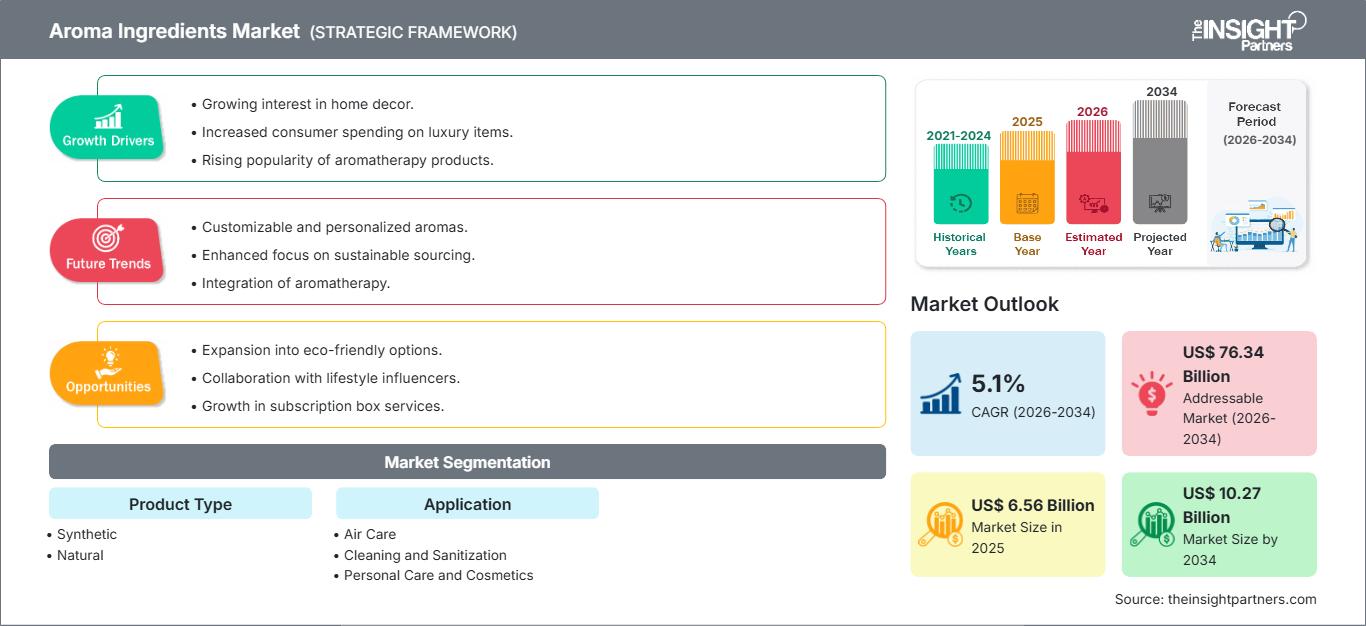
-
Get Top Key Market Trends of this report.This FREE sample will include data analysis, ranging from market trends to estimates and forecasts.
Aroma Ingredients Market Drivers and Opportunities
Market Drivers:
- Clean-Label and Natural Demand Surge: The growth of organic food and beverage and cosmetics can be attributed to increasingly smaller molecular structures found in natural aroma compounds such as citrus terpenes, which are more stable and allow those with allergies to use the products safely.
- Premiumization in Fragrance and Personal Care: The luxury retail market is continuing to grow, and the demand for rare perfumery ingredients, including oud and jasmine absolute, is increasing as consumers are looking to upgrade their fragrance experience to an artisanal level.
- Rapid E-commerce and Digital Penetration: The rise of e-commerce and the use of digital distribution channels has allowed for reduced barriers of entry for niche aromatherapy products, particularly in the Asia Pacific, where the use of essential oil blends and DIY home fragrance kits has experienced rapid growth since the introduction of e-commerce.
Market Opportunities:
- Expansion into Wellness and Nutraceuticals: The application of aroma ingredients in mood-enhancing supplements and functional beverages targets sports enthusiasts and the elderly.
- Growth in Emerging APAC and LATAM Corridors: Collaborations between European aroma ingredient suppliers and Asian distributors can capitalize on high-margin markets in China and India for halal-certified and sustainable aroma ingredients.
- Diversification into Specialty Certifications: Opportunities abound for organic, vegan, and cruelty-free labels, as seen in North American retail successes for eco-friendly aroma blends.
Aroma Ingredients Market Report Segmentation Analysis
The Aroma Ingredients Market share is analyzed across various segments to provide a clearer understanding of its structure, growth potential, and emerging trends. Below is the standard segmentation approach used in most industry reports:
By Product Type:
- Synthetic: The primary volume driver in high-throughput markets such as household cleaners and air care, offering cost-effectiveness, consistency, and scalability.
- Natural: A niche market that is rapidly emerging and aligns with the sustainability theme, popular in high-end skincare and fragrances for its authentic, clean-label positioning.
By Application:
- Air Care: Critical for home diffusers and candles, fueled by an increasing number of available fragrances in the market.
- Cleaning and Sanitizing: Fastest-growing in antimicrobial fragrance masks for household and institutional use.
- Personal Care and Cosmetic: Main application for body washes and lotions, fueled by natural oil integrations.
- Fine Fragrances and Perfumes: High-margin segment for complex accords, fueled by luxury e-commerce.
By Geography:
- North America
- Europe
- Asia Pacific
- South & Central America
- Middle East & Africa
Aroma Ingredients Market Report Scope
| Report Attribute | Details |
|---|---|
| Market size in 2025 | US$ 6.56 Billion |
| Market Size by 2034 | US$ 10.27 Billion |
| Global CAGR (2026 - 2034) | 5.1% |
| Historical Data | 2021-2024 |
| Forecast period | 2026-2034 |
| Segments Covered |
By Product Type
|
| Regions and Countries Covered |
North America
|
| Market leaders and key company profiles |
|
Aroma Ingredients Market Players Density: Understanding Its Impact on Business Dynamics
The Aroma Ingredients Market is growing rapidly, driven by increasing end-user demand due to factors such as evolving consumer preferences, technological advancements, and greater awareness of the product's benefits. As demand rises, businesses are expanding their offerings, innovating to meet consumer needs, and capitalizing on emerging trends, which further fuels market growth.
Aroma Ingredients Market Share Analysis by Geography
Asia-Pacific is expected to grow fastest in the coming years. Emerging markets in South & Central America, the Middle East, and Africa also have many untapped opportunities for premium flavor houses and fragrance manufacturers to expand.
The aroma ingredients market is undergoing a significant transformation, moving from synthetic dominance to natural, biotech-driven innovation. Growth is driven by clean-beauty regulations, rising veganism, and luxury scent personalization. Below is a summary of market share and trends by region:
North America
- Market Share: A niche but rapidly expanding segment driven by wellness trends and domestic botanical farming.
- Key Drivers:
- Consumer shift to natural terpenes for clean fragrances.
- Mainstreaming in high-end chains like Sephora and Whole Foods.
- Imports of European absolutes alongside U.S.-grown lavender oils.
- Trends: Scaling of e-commerce for custom blends and certifications like USDA Organic for health demographics.
Europe
- Market Share: Holds the largest share globally, anchored by IFRA-compliant ecosystems in France, Germany, and Switzerland.
- Key Drivers:
- High consumption of fine fragrances like Chanel and Dior accords.
- Robust R&D in green extraction tech.
- EU Green Deal support for sustainable sourcing.
- Trends: Focus on biotech fermentation for rare molecules and organic certifications for eco-consumers.
Asia-Pacific
- Market Share: The fastest-growing region, with India and China as production hubs for spices and synthetics.
- Key Drivers:
- Vast base in Indonesia and Vietnam for patchouli and vetiver oils.
- Urbanization boosting premium F&B flavors.
- Rising incomes favoring K-beauty scent innovations.
- Trends: E-commerce dominance for essential oils in aromatherapy and B2B for nutraceutical extracts.
South and Central America
- Market Share: Emerging with artisanal potential in Brazil.
- Key Drivers:
- Nutritional appeal of native citrus and vanilla for gut-friendly F&B.
- Farm modernization for export-grade isolates.
- Mediterranean diet influences in urban segments.
- Trends: "Farm-to-formula" brands and exotic fruit aromas differentiating from synthetics.
Middle East and Africa
- Market Share: Developing with cultural ties to oud and spices, shifting to commercial scales.
- Key Drivers:
- Regional demand for attars and halal fragrances.
- Shelf-stable aroma powders for arid logistics.
- Investments in precision agriculture.
- Trends: Modern distillation tech formalizing markets, with focus on pediatric nutraceuticals.
High Market Density and Competition
Competition is intensifying due to the presence of established leaders such as Givaudan, Firmenich, and International Flavors & Fragrances (IFF). Regional experts like Symrise and Takasago, alongside innovators such as Mane and Sensient Technologies, contribute to a diverse landscape.
This competitive environment pushes vendors to differentiate through:
- Premiumization positioning of fragrances as sustainable alternatives through the use of higher purity naturals and biotech-based origins.
- Product diversification through encapsulation technology for stable flavors in beverages and long-lasting fragrances.
- Vertically integrated chains from cultivation (for example, patchouli plantations) to formulation, allowing for traceability.
- Use of advanced technology, such as enzymatic synthesis for eco-friendly fragrance compounds in cosmetics.
Opportunities and Strategic Moves
- Partner with e-commerce and luxury retail to tap into the demand for bespoke, sustainable fragrances in Asia-Pacific and North America.
- Use regenerative sourcing and biotech credentials to appeal to Gen Z consumers looking for sustainable, responsible ingredients.
Major Companies operating in the Aroma Ingredients Market are:
- Takasago International Corporation
- BASF SE
- Firmenich S.A.
- Givaudan S.A.
- International Flavors & Fragrances Inc.
- Robertet Group
- Symrise
- Mane
- Zhejiang NHU Co., Ltd.
Disclaimer: The companies listed above are not ranked in any particular order.
Aroma Ingredients Market News and Recent Developments
- In September 2025, Givaudan, the world leader in Fragrance and Beauty, announced that it had successfully acquired a majority stake in Vollmens Fragrances Ltd, an award-winning Brazilian fragrance company based in Saltinho, in line with its strategy to increase its customer base among local and regional consumers. The company not only caters to the Latin American market but also to Central America, Africa, and North America.
- In April 2025, BASF Aroma Ingredients launched L-Menthol FCC rPCF as the first product with a reduced Product Carbon Footprint (rPCF). More products with rPCF are also scheduled to be launched to support customers in achieving their ambitious Scope 3 greenhouse gas reduction targets. BASF's rPCF aroma ingredients offer a PCF reduction of 10–15% relative to conventional BASF products. The product carbon footprints of BASF's rPCF products are calculated in line with the 'Together for Sustainability' (TfS) initiative guidelines.
Aroma Ingredients Market Report Coverage and Deliverables
The "Aroma Ingredients Market Size and Forecast (2021–2034)" report provides a detailed analysis of the market covering below areas:
- Aroma Ingredients Market size and forecast at global, regional, and country levels for all the key market segments covered under the scope
- Aroma Ingredients Market trends, as well as market dynamics such as drivers, restraints, and key opportunities
- Detailed PEST and SWOT analysis
- Aroma Ingredients Market analysis covering key market trends, global and regional framework, major players, regulations, and recent market developments
- Industry landscape and competition analysis covering market concentration, heat map analysis, prominent players, and recent developments in the Aroma Ingredients Market.
- Detailed company profiles
Frequently Asked Questions

- Historical Analysis (2 Years), Base Year, Forecast (7 Years) with CAGR
- PEST and SWOT Analysis
- Market Size Value / Volume - Global, Regional, Country
- Industry and Competitive Landscape
- Excel Dataset
Recent Reports
Testimonials

The Insight Partners' SCADA System Market report is comprehensive, with valuable insights on current trends and future forecasts. The team was highly professional, responsive, and supportive throughout. We are very satisfied and highly recommend their services.
RAN KEDEM Partner, Reali Technologies LTDs
I requested a report on a very specific software market and the team produced the report in a few days. The information was very relevant and well presented. I then requested some changes and additions to the report. The team was again very responsive and I got the final report in less than a week.
JEAN-HERVE JENN Chairman, Future Analytica
We worked with The Insight Partners for an important market study and forecast. They gave us clear insights into opportunities and risks, which helped shape our plans. Their research was easy to use and based on solid data. It helped us make smart, confident decisions. We highly recommend them.
PIYUSH NAGPAL Sr. Vice President, High Beam Global
The Insight Partners delivered insightful, well-structured market research with strong domain expertise. Their team was professional and responsive throughout. The user-friendly website made accessing industry reports seamless. We highly recommend them for reliable, high-quality research services
YUKIHIKO ADACHI CEO, Deep Blue, LLC.
This is the first time I have purchased a market report from The Insight Partners.While I was unsure at first, I visited their web site and felt more comfortable to take the risk and purchase a market report.I am completely satisfied with the quality of the report and customer service. I had several questions and comments with the initial report, but after a couple of dialogs over email with their analyst I believe I have a report that I can use as input to our strategic planning process.Thank you so much for taking the extra time and making this a positive experience.I will definitely recommend your service to others and you will be my first call when we need further market data.
JOHN SUZUKI President and Chief Executive Officer, Board Director, BK Technologies
I wish to appreciate your support and the professionalism you displayed in the course of attending to my request for information regarding to infectious disease IVD market in Nigeria. I appreciate your patience, your guidance, and the fact that you were willing to offer a discount, which eventually made it possible for us to close a deal. I look forward to engaging The Insight Partners in the future, all thanks to the impression you have created in me as a result of this first encounter.
DR CHIJIOKE ONYIA MANAGING DIRECTOR, PineCrest Healthcare Ltd.Reason to Buy
- Informed Decision-Making
- Understanding Market Dynamics
- Competitive Analysis
- Identifying Emerging Markets
- Customer Insights
- Market Forecasts
- Risk Mitigation
- Boosting Operational Efficiency
- Strategic Planning
- Investment Justification
- Tracking Industry Innovations
- Aligning with Regulatory Trends




 Get Free Sample For