Bioresorbable Polymers Market Size, Share & Trends by 2034
Bioresorbable Polymers Market Size and Forecast (2021 - 2034), Global and Regional Share, Trend, and Growth Opportunity Analysis Report Coverage: By Type (Polylactic Acid (PLA), Polyglycolic Acid (PGA), Polydioxanone, Polycaprolactone (PCL), and Others) and Application (Orthopedic Devices, Drug Delivery, and Others)
Historic Data: 2021-2024 | Base Year: 2025 | Forecast Period: 2026-2034- Report Date : Apr 2026
- Report Code : TIPRE00026862
- Category : Chemicals and Materials
- Status : Upcoming
- Available Report Formats :


- No. of Pages : 150

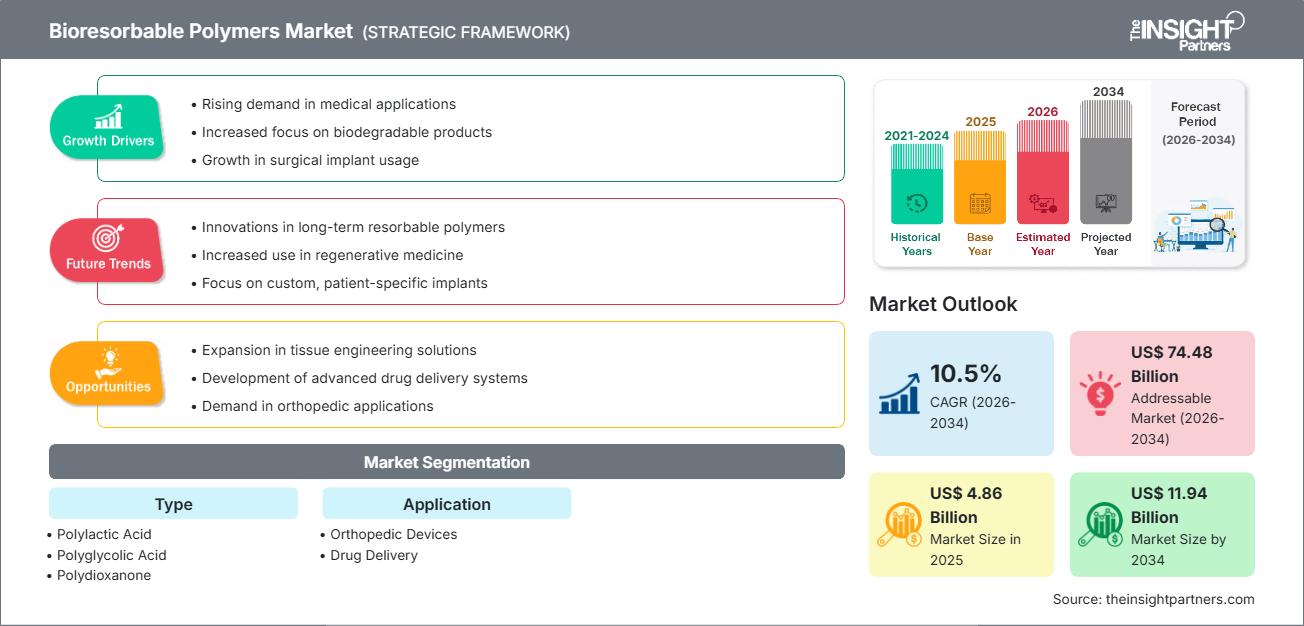
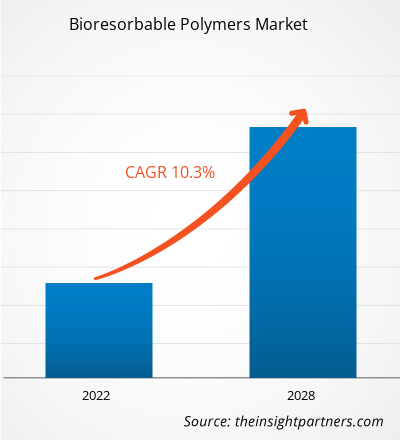
The global bioresorbable polymers market size is projected to reach US$ 11.94 billion by 2034 from US$ 4.86 billion in 2025. The market is anticipated to register a CAGR of 10.5% during the forecast period 2026–2034. Key market dynamics include a heightening global focus on eliminating secondary revision surgeries, rising demand for advanced drug delivery systems that offer controlled release, and a significant shift toward biocompatible materials in orthopedic and cardiovascular treatments. Additionally, the market is expected to benefit from the growing popularity of 3D-printed personalized implants, expansion in healthcare infrastructure across emerging economies, and the increasing inclusion of bioresorbable scaffolds in high-value medical segments like tissue engineering and regenerative medicine.
Bioresorbable Polymers Market Analysis
The bioresorbable polymers market analysis shows a shift toward high-performance materials as clinicians prioritize disappearing implants that reduce long-term complications. Procurement trends indicate high-volume conventional applications like sutures and high-growth, high-margin sectors like bioresorbable vascular scaffolds (BVS). Strategic opportunities are emerging in specialty pediatric and geriatric orthopedics, where the ability of polymers to be absorbed by the body, negating the need for implant removal, offers a clear competitive advantage. The analysis also notes that market expansion depends on the precise control of degradation rates and mechanical strength. Competitive differentiation now stands out depending on R&D capabilities that allow for customized polymer blending and the ability to navigate complex FDA and CE regulatory pathways. This approach helps established chemical giants maintain higher margins in a market with rigorous quality standards.
Bioresorbable Polymers Market Overview
Bioresorbable polymers have evolved from simple suture materials to sophisticated building blocks for modern medical technology. Bioresorbable polymers now include functional bio-polyesters, specialized drug-eluting coatings, and scaffolds for tissue regeneration. Both global chemical companies and specialized med-tech startups compete in this market, using polymer sources such as lactic acid, glycolic acid, and caprolactone. Growing demand for convenient, minimally invasive options among health-conscious aging populations in North America and Europe has increased the popularity of bioresorbable polymers as a preferred clinical solution. North America leads in revenue due to its established surgical culture, while Asia-Pacific is advancing in material innovation and clinical adoption.
The US market is the most developed, driven by health-focused innovation and the broad availability of functional medical devices. Competition among brands is fueling greater material variety and the inclusion of advanced properties like antimicrobial coatings and high-tensile strength.
Customize This Report To Suit Your Requirement
Get FREE CUSTOMIZATIONBioresorbable Polymers Market: Strategic Insights
-
Get Top Key Market Trends of this report.This FREE sample will include data analysis, ranging from market trends to estimates and forecasts.
Bioresorbable Polymers Market Drivers and Opportunities
Market Drivers:
- Superior Biocompatibility and Elimination of Revision Surgeries: Bioresorbable polymers break down naturally into non-toxic byproducts like CO2 and H2O, which the body absorbs. This eliminates the need for follow-up surgeries to remove hardware, reducing patient trauma and healthcare costs.
- Advancement in Minimally Invasive Surgeries: The expansion of specialized surgical centers and dedicated orthopedic clinics has sustained high demand for bioresorbable inputs. As surgeons trade up to advanced procedural experiences, bio-certified implants continue to see stable volume gains.
- Rapid Expansion of Targeted Drug Delivery: Advanced polymer science has removed traditional barriers for localized therapy. This is particularly evident in the rapid adoption of bioresorbable microspheres and parenteral release systems in oncology and chronic disease management.
Market Opportunities:
- Expansion into 3D Printing and Personalized Implants: Beyond standard sutures, bioresorbable polymers offer significant opportunities in 3D-printed scaffolds tailored to a patient's unique anatomy for faster bone and tissue recovery.
- Growth in Emerging APAC Corridors: Forming strategic partnerships between Western chemical suppliers and Asian medical distributors may facilitate access to high-margin market segments in China and India, where demand for premium, biocompatible medical devices is increasing.
- Diversification into Tissue Engineering: There is a growing opportunity for producers to target specific demographics through specialized certifications and smart polymers that promote cell growth, as seen in recent successful clinical trials in the North American market.
Bioresorbable Polymers Market Report Segmentation Analysis
The Bioresorbable Polymers Market share is analyzed across various segments to provide a clearer understanding of its structure, growth potential, and emerging trends. Below is the standard segmentation approach used in most industry reports:
By Type:
- Polylactic Acid (PLA): The dominant segment due to its versatile mechanical properties and widespread use in bone plates, screws, and 3D printing filaments.
- Polyglycolic Acid (PGA): A high-growth segment preferred for applications requiring rapid degradation and high initial tensile strength, such as specialized surgical sutures.
- Polydioxanone (PDS): Increasingly used in cardiovascular and soft tissue applications where longer-term structural support is required before absorption.
- Polycaprolactone (PCL): A specialized niche used extensively in long-term drug delivery systems and tissue engineering due to its slow degradation rate.
By Application:
- Orthopedic Devices: Remains the primary channel for bioresorbable materials, benefiting from the expansion of trauma care and sports medicine, where temporary fixation is ideal for healing.
- Drug Delivery: The fastest-rising application, enabling controlled-release formulations and biodegradable implants that provide constant therapeutic dosages without device removal.
By Geography:
- North America
- Europe
- Asia Pacific
- South & Central America
- Middle East & Africa
Bioresorbable Polymers Market Report Scope
| Report Attribute | Details |
|---|---|
| Market size in 2025 | US$ 4.86 Billion |
| Market Size by 2034 | US$ 11.94 Billion |
| Global CAGR (2026 - 2034) | 10.5% |
| Historical Data | 2021-2024 |
| Forecast period | 2026-2034 |
| Segments Covered |
By Type
|
| Regions and Countries Covered |
North America
|
| Market leaders and key company profiles |
|
Bioresorbable Polymers Market Players Density: Understanding Its Impact on Business Dynamics
The Bioresorbable Polymers Market is growing rapidly, driven by increasing end-user demand due to factors such as evolving consumer preferences, technological advancements, and greater awareness of the product's benefits. As demand rises, businesses are expanding their offerings, innovating to meet consumer needs, and capitalizing on emerging trends, which further fuels market growth.
Bioresorbable Polymers Market Share Analysis by Geography
Asia-Pacific is expected to grow fastest in the coming years. Emerging markets in South & Central America, the Middle East, and Africa also have many untapped opportunities for premium medical device manufacturers and pharmaceutical suppliers to expand.
The bioresorbable polymers market is undergoing a significant transformation, moving from simple wound closure to a global high-value medical material. Growth is driven by the rising prevalence of chronic diseases, a surge in minimally invasive surgical demand, and the expansion of the regenerative medicine sector. Below is a summary of market share and trends by region:
North America
- Market Share: Holds the largest global share, driven by advanced healthcare infrastructure and high surgical volumes.
- Key Drivers:
- Rising consumer preference for disappearing implants
- Mainstreaming of specialty medical materials in high-end hospital chains
- High concentration of R&D hubs.
- Trends: Scaling of 3D-printed implant distribution and the successful adoption of specialty certifications (e.g., FDA PMA) to appeal to quality-focused healthcare providers.
Europe
- Market Share: Anchored by deep-seated medical technology ecosystems in Germany, France, the UK, and Switzerland.
- Key Drivers:
- High domestic demand for advanced orthopedic solutions
- Established processing infrastructure
- Strict regulatory frameworks for biocompatible materials.
- Trends: A strategic shift toward prioritizing polymer research for high-margin, specialized tissue engineering scaffolds over bulk manufacturing.
Asia-Pacific
- Market Share: The fastest-growing region, with China and India acting as the primary engines for both manufacturing and clinical adoption.
- Key Drivers:
- Massive consumer base seeking premium
- Hypoallergenic medical treatments
- Government-supported agricultural initiatives for bio-based feedstock.
- Trends: Heavy reliance on B2B contracts for high-end medical-grade powders used in the pharmaceutical and nutraceutical industries.
South and Central America
- Market Share: Emerging market with a growing artisanal surgical sector in countries like Brazil and Argentina.
- Key Drivers:
- Increasing awareness of the clinical superiority of bioresorbable materials
- Modernization of small-scale clinics into commercial-grade surgical centers.
- Trends: Growth of boutique medical device brands and the introduction of bioresorbable dental and cosmetic fillers to differentiate from traditional metallic products.
Middle East and Africa
- Market Share: Developing market transitioning toward formalized commercial production and specialized healthcare delivery.
- Key Drivers:
- Traditional presence of orthopedic trauma cases
- High demand for shelf-stable medical components in arid climates
- Strategic investments in Smart Healthcare.
- Trends: Implementation of modern surgical and refrigeration technologies to formalize the local implant market, coupled with a focus on high-nutrient polymers for pediatric applications.
High Market Density and Competition
Competition is intensifying due to the presence of established leaders such as Corbion N.V., Evonik Industries AG, and DSM Biomedical. Regional experts and niche players like Poly-Med, Inc. and Foster Corporation, alongside innovators such as KLS Martin Group and NatureWorks LLC, also contribute to a diverse and rapidly expanding market landscape.
This competitive environment pushes vendors to differentiate through:
- Premiumization and Functional Branding: Positioning bioresorbable polymers as a superior clinical alternative by emphasizing their ability to degrade into harmless substances like lactic acid and glycolic acid.
- Diversified Product Portfolios: Companies offer more than just raw resin; they provide 3D printing filaments, drug-eluting coatings, and pre-fabricated orthopedic pins.
- Full Supply Chain Management: Producers manage everything from raw material fermentation (e.g., corn/sugarcane) to medical-grade extrusion.
- Advanced Processing Technologies: Utilizing spray-drying and additive manufacturing to create high-purity polymer scaffolds for tissue regeneration.
Opportunities and Strategic Moves
- Partner with high-end surgical centers and e-commerce medical platforms to tap into the surging demand for bio-absorbable implants in the Asia-Pacific and North American markets.
- Incorporate sustainable manufacturing practices and non-food biomass feedstock to appeal to environmentally conscious regulators and healthcare networks.
Major Companies operating in the Bioresorbable Polymers Market are:
- BMG Incorporated
- Evonik Industries AG
- Foster Corporation
- Ashland Global Holdings Inc.
- Poly-Med Incorporated
- REVA Medical, LLC
- Musashino Chemical Laboratory, Ltd
- Huizhou Foryou Medical Devices Co., Ltd.
- Polysciences Inc
- Bezwada Biomedical LLC
Disclaimer: The companies listed above are not ranked in any particular order.
Bioresorbable Polymers Market News and Recent Developments
- In July 2025, Evonik entered into a strategic distribution agreement with IMCD, a leading partner for the distribution and formulation of specialty chemicals and ingredients. Under this agreement, IMCD will serve as Evonik’s exclusive European distributor for its RESOMER® bioresorbable polymers used in implantable medical device applications.
- In June 2025, Ashland expands its viatel™ bioresorbable polymers offering with additional grades for medical devices and aesthetic medicine. Viatel™ bioresorbable polymers are increasingly used in dental and orthopedic implants, tissue engineering scaffolds, wound healing, and fixation devices. They have also become a pillar of the aesthetic medicine industry, particularly in dermal fillers, where they enhance skin volume and texture by filling wrinkles and stimulating collagen production.
Bioresorbable Polymers Market Report Coverage and Deliverables
The Bioresorbable Polymers Market Size and Forecast (2021–2034) report provides a detailed analysis of the market covering below areas:
- Bioresorbable Polymers Market size and forecast at global, regional, and country levels for all the key market segments covered under the scope
- Bioresorbable Polymers Market trends, as well as market dynamics such as drivers, restraints, and key opportunities
- Detailed PEST and SWOT analysis
- Bioresorbable Polymers Market analysis covering key market trends, global and regional framework, major players, regulations, and recent market developments
- Industry landscape and competition analysis covering market concentration, heat map analysis, prominent players, and recent developments in the Bioresorbable Polymers Market.
- Detailed company profiles
Frequently Asked Questions

- Historical Analysis (2 Years), Base Year, Forecast (7 Years) with CAGR
- PEST and SWOT Analysis
- Market Size Value / Volume - Global, Regional, Country
- Industry and Competitive Landscape
- Excel Dataset
Recent Reports
Testimonials

The Insight Partners' SCADA System Market report is comprehensive, with valuable insights on current trends and future forecasts. The team was highly professional, responsive, and supportive throughout. We are very satisfied and highly recommend their services.
RAN KEDEM Partner, Reali Technologies LTDs
I requested a report on a very specific software market and the team produced the report in a few days. The information was very relevant and well presented. I then requested some changes and additions to the report. The team was again very responsive and I got the final report in less than a week.
JEAN-HERVE JENN Chairman, Future Analytica
We worked with The Insight Partners for an important market study and forecast. They gave us clear insights into opportunities and risks, which helped shape our plans. Their research was easy to use and based on solid data. It helped us make smart, confident decisions. We highly recommend them.
PIYUSH NAGPAL Sr. Vice President, High Beam Global
The Insight Partners delivered insightful, well-structured market research with strong domain expertise. Their team was professional and responsive throughout. The user-friendly website made accessing industry reports seamless. We highly recommend them for reliable, high-quality research services
YUKIHIKO ADACHI CEO, Deep Blue, LLC.
This is the first time I have purchased a market report from The Insight Partners.While I was unsure at first, I visited their web site and felt more comfortable to take the risk and purchase a market report.I am completely satisfied with the quality of the report and customer service. I had several questions and comments with the initial report, but after a couple of dialogs over email with their analyst I believe I have a report that I can use as input to our strategic planning process.Thank you so much for taking the extra time and making this a positive experience.I will definitely recommend your service to others and you will be my first call when we need further market data.
JOHN SUZUKI President and Chief Executive Officer, Board Director, BK Technologies
I wish to appreciate your support and the professionalism you displayed in the course of attending to my request for information regarding to infectious disease IVD market in Nigeria. I appreciate your patience, your guidance, and the fact that you were willing to offer a discount, which eventually made it possible for us to close a deal. I look forward to engaging The Insight Partners in the future, all thanks to the impression you have created in me as a result of this first encounter.
DR CHIJIOKE ONYIA MANAGING DIRECTOR, PineCrest Healthcare Ltd.Reason to Buy
- Informed Decision-Making
- Understanding Market Dynamics
- Competitive Analysis
- Identifying Emerging Markets
- Customer Insights
- Market Forecasts
- Risk Mitigation
- Boosting Operational Efficiency
- Strategic Planning
- Investment Justification
- Tracking Industry Innovations
- Aligning with Regulatory Trends




 Get Free Sample For