Polypropylene Compounds Market Size, Share & Demand by 2034
Polypropylene Compounds Market Size and Forecast (2021 - 2034), Global and Regional Share, Trend, and Growth Opportunity Analysis Report Coverage: By Type (Mineral Filled PP Compounds, Compounded TPO, Compounded TPV, Glass Reinforced, and Others) and End User (Automotive, Electricals and Electronics, Packaging, Building and Construction, Textiles, and Others)
Historic Data: 2021-2024 | Base Year: 2025 | Forecast Period: 2026-2034- Report Date : Apr 2026
- Report Code : TIPRE00016556
- Category : Chemicals and Materials
- Status : Upcoming
- Available Report Formats :


- No. of Pages : 150

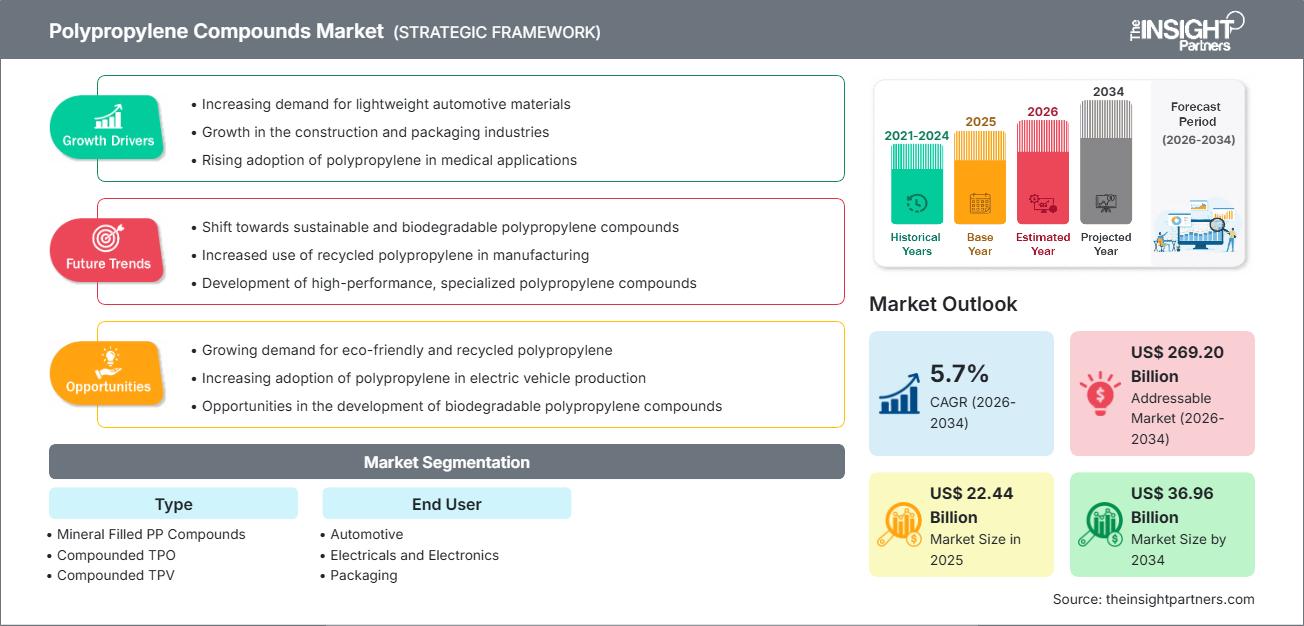
The global Polypropylene Compounds market size is projected to reach US$ 36.96 billion by 2034 from US$ 22.44 billion in 2025. The market is anticipated to register a CAGR of 5.7% during the forecast period 2026–2034. Key market dynamics include a heightening global focus on automotive lightweighting to improve fuel efficiency, rising demand for high-performance thermoplastics in the consumer electronics sector, and a significant shift toward sustainable, recyclable materials in industrial applications. Additionally, the market is expected to benefit from the rapid expansion of the electric vehicle (EV) infrastructure, increasing infrastructure investments in emerging economies, and the growing replacement of traditional engineering plastics with cost-effective, reinforced polypropylene solutions.
Polypropylene Compounds Market Analysis
The polypropylene compounds market analysis indicates a strategic pivot toward high-performance, customized grades that address specific mechanical and thermal requirements. Procurement trends show a distinct movement toward long-glass-fiber reinforced (LGFPP) materials and mineral-filled grades that offer a superior strength-to-weight ratio. Strategic opportunities are emerging in the electric vehicle sector, where flame-retardant and battery-shielding PP compounds provide a clear competitive advantage over traditional metals. The analysis also notes that market success depends on the integration of post-consumer recycled (PCR) content into compounding processes without compromising structural integrity. Competitive differentiation now stands out through the development of "circular" product lines and the ability to offer localized technical support, helping large-scale compounders secure long-term contracts in a market increasingly focused on supply chain resilience and carbon footprint reduction.
Polypropylene Compounds Market Overview
Polypropylene compounds are shifting from a standard industrial commodity to a sophisticated engineering solution. While historically dominated by simple mineral-filled grades for household goods, polypropylene compounds are expanding into high-value segments like thermoplastic polyolefins (TPO) and thermoplastic vulcanizates (TPV). Both global chemical giants and specialized regional compounders are part of this market, leveraging innovations in coupling agents and impact modifiers. Growing environmental regulations in Europe and North America are pushing the market toward bio-based fillers and recyclable composites. Asia-Pacific remains the largest production hub, driven by the concentration of automotive and electronic manufacturing bases, while the West is focusing on high-tech specialty applications. For instance, the market in the US is characterized by a mature automotive manufacturing base and a robust demand for advanced packaging solutions. Growth is driven by the domestic push for sustainable manufacturing and the revitalization of local industrial supply chains. The region emphasizes high-purity compounds for medical devices and specialized building materials.
Customize This Report To Suit Your Requirement
Get FREE CUSTOMIZATIONPolypropylene Compounds Market: Strategic Insights
-
Get Top Key Market Trends of this report.This FREE sample will include data analysis, ranging from market trends to estimates and forecasts.
Polypropylene Compounds Market Drivers and Opportunities
Market Drivers:
- Advancements in Automotive Lightweighting: The continuous pressure to reduce vehicle emissions and enhance EV range is driving the adoption of reinforced PP compounds as replacements for heavier metal components in interior, exterior, and under-the-hood applications.
- Rising Demand in Electrical and Electronics: The expansion of smart home devices and 5G infrastructure has sustained high demand for flame-retardant and heat-stabilized PP compounds. As consumer electronics become more compact, the need for high-flow, dimensionally stable compounds continues to grow.
- Urbanization and Infrastructure Development: The rapid growth of urban centers in emerging economies has increased the demand for durable, corrosion-resistant PP compounds in piping, insulation, and construction profiles.
Market Opportunities:
- Integration of Post-Consumer Recycled (PCR) Resins: Beyond virgin materials, there is a significant opportunity for compounders to develop high-quality recycled PP blends that meet the stringent performance standards of the automotive and packaging industries.
- Expansion into Medical and Healthcare Applications: Developing USP Class VI-compliant PP compounds offers access to the high-margin medical device market, where chemical resistance and sterilization stability are paramount.
- Growth in Renewable Energy Components: Forming strategic partnerships with solar and wind energy equipment manufacturers may facilitate access to specialized segments requiring UV-stabilized and weather-resistant compounding solutions.
Polypropylene Compounds Market Report Segmentation Analysis
The Polypropylene Compounds Market share is analyzed across various segments to provide a clearer understanding of its structure, growth potential, and emerging trends. Below is the standard segmentation approach used in most industry reports:
By Type:
- Mineral-filled PP Compounds: A dominant volume driver used extensively in automotive interiors and appliances due to improved stiffness and heat resistance.
- Compounded TPO (Thermoplastic Polyolefins): A high-growth segment favored for automotive bumpers and roofing membranes owing to its superior impact resistance and weatherability.
- Compounded TPV (Thermoplastic Vulcanizates): Increasingly utilized for seals and gaskets where rubber-like elasticity and thermoplastic processability are required.
- Glass Reinforced: A fast-growing niche that provides high mechanical strength for structural components, particularly in the lightweighting of industrial machinery.
- Others: Includes flame-retardant, anti-static, and bio-filled grades tailored for specialized niche applications.
By End User:
- Automotive: Remains the primary channel, utilizing compounds for both structural parts and aesthetic interior trims to meet weight reduction targets.
- Electricals and Electronics: Benefits from the rising need for insulating and flame-retardant housings for household appliances and mobile devices.
- Packaging: Focuses on high-clarity and impact-resistant compounds for thin-wall containers and durable caps and closures.
- Building and Construction: Offers a growing range of applications in piping, fittings, and moisture-resistant building profiles.
- Textiles: Utilized for high-tenacity fibers and non-woven fabrics in industrial and medical protective gear.
- Others: Includes medical devices, sports equipment, and consumer furniture.
By Geography:
- North America
- Europe
- Asia Pacific
- South & Central America
- Middle East & Africa
Polypropylene Compounds Market Report Scope
| Report Attribute | Details |
|---|---|
| Market size in 2025 | US$ 22.44 Billion |
| Market Size by 2034 | US$ 36.96 Billion |
| Global CAGR (2026 - 2034) | 5.7% |
| Historical Data | 2021-2024 |
| Forecast period | 2026-2034 |
| Segments Covered |
By Type
|
| Regions and Countries Covered |
North America
|
| Market leaders and key company profiles |
|
Polypropylene Compounds Market Players Density: Understanding Its Impact on Business Dynamics
The Polypropylene Compounds Market is growing rapidly, driven by increasing end-user demand due to factors such as evolving consumer preferences, technological advancements, and greater awareness of the product's benefits. As demand rises, businesses are expanding their offerings, innovating to meet consumer needs, and capitalizing on emerging trends, which further fuels market growth.
Polypropylene Compounds Market Share Analysis by Geography
Asia-Pacific is expected to grow fastest in the coming years. Emerging markets in South & Central America, the Middle East, and Africa also have many untapped opportunities for advanced polymer producers and automotive component manufacturers to expand.
The polypropylene compounds market is undergoing a significant transformation, transitioning from a high-volume commodity resin to a sophisticated, value-added engineering solution. Growth is driven by the intensive industry-wide shift toward automotive lightweighting to enhance fuel efficiency and electric vehicle range, a surge in demand for high-performance flame-retardant materials in the electronics sector, and the rapid expansion of the sustainable and circular economy through the integration of recycled resins. Below is a summary of market share and trends by region:
North America
- Market Share: A mature yet evolving segment driven by the resurgence of domestic manufacturing and the rapid adoption of EVs.
- Key Drivers:
- Strict CAFE standards are driving the need for lightweight automotive materials.
- High consumer demand for sustainable and recyclable consumer goods packaging.
- Expansion of the aerospace and defense sectors requires high-performance polymers.
- Trends: Scaling of "circular economy" initiatives and the successful integration of advanced compounding technologies to produce high-value specialty grades.
Europe
- Market Share: Holds a significant share globally, anchored by a strong automotive engineering heritage in Germany, France, and Italy.
- Key Drivers:
- Implementation of the European Green Deal and circular economy action plans.
- Established presence of leading chemical and polymer processing companies.
- Robust R&D investment in bio-based fillers and natural fiber-reinforced composites.
- Trends: A strategic shift toward prioritizing recycled content in automotive supply chains and an increasing focus on achieving carbon neutrality in production facilities.
Asia-Pacific
- Market Share: The fastest-growing region and the global leader in production volume, driven by China, India, and Southeast Asia.
- Key Drivers:
- Massive consumer electronics manufacturing ecosystem.
- Government-supported industrialization and "Make in India" or similar initiatives.
- Rapid urbanization is leading to increased demand for automotive and construction materials.
- Trends: Heavy reliance on B2B contracts with global OEMs and a rapid increase in domestic compounding capacity to reduce reliance on imported specialty resins.
South and Central America
- Market Share: Emerging market with a growing manufacturing sector in countries like Brazil and Chile.
- Key Drivers:
- Increasing foreign direct investment in the regional automotive assembly hubs.
- Modernization of the agricultural sector requires durable irrigation and storage solutions.
- Rising middle-class demand for durable consumer appliances.
- Trends: Growth of localized compounding plants to serve regional automotive clusters and the introduction of cost-effective mineral-filled grades for domestic markets.
Middle East and Africa
- Market Share: Developing market with a focus on diversifying economies through downstream petrochemical expansion.
- Key Drivers:
- Strategic investments in regional programs to boost non-oil GDP.
- High demand for durable building materials in large-scale infrastructure projects.
- Growing importance as a hub for polymer exports to Europe and Asia.
- Trends: Implementation of modern polymer processing technologies and a focus on high-performance compounds for the water management and energy sectors.
High Market Density and Competition
Competition is intensifying due to the presence of established leaders such as LyondellBasell Industries Holdings B.V., Exxon Mobil Corporation, Sumitomo Chemical Co., Ltd, Borealis AG, Rialti S.p.A., Trinseo, SABIC, Total, also contribute to a diverse and rapidly expanding market landscape.
This competitive environment pushes vendors to differentiate through:
- Functional Customization: Positioning PP compounds as superior alternatives to engineering plastics by tailoring melt flow, UV resistance, and thermal stability.
- Sustainable Portfolio Expansion: Companies are launching dedicated product lines featuring mechanically and chemically recycled polypropylene.
- Vertical Integration: Producers are increasingly controlling the value chain from monomer production to final compounding to ensure quality and cost-efficiency.
- Strategic Partnerships: Collaborating with automotive OEMs at the design stage to create bespoke material solutions for next-generation vehicle platforms.
Opportunities and Strategic Moves
- Growth in Renewable Energy Components: Forming strategic partnerships with solar and wind energy equipment manufacturers may facilitate access to specialized segments requiring UV-stabilized and weather-resistant compounding solutions for outdoor infrastructure.
- Vertical Integration and Supply Chain Resilience: Companies are increasingly investing in domestic manufacturing capabilities and on-purpose propylene production (such as Propane Dehydrogenation - PDH units) to hedge against raw material price volatility and ensure a consistent supply of feedstock for specialized compounding.
Major Companies operating in the Polypropylene Compounds Market are:
- LyondellBasell Industries Holdings B.V.
- Exxon Mobil Corporation
- Sumitomo Chemical Co., Ltd
- Borealis AG
- Rialti S.p.A.
- Trinseo
- SABIC
- Total
Disclaimer: The companies listed above are not ranked in any particular order.
Polypropylene Compounds Market News and Recent Developments
- In June 2025, LyondellBasell (LYB) announced that it had entered into an agreement and exclusive negotiations with AEQUITA for the sale of select olefins and polyolefins assets in Europe. The transaction included the divestment of dedicated production sites in Berre (France), Münchsmünster (Germany), Carrington (UK), and Tarragona (Spain), as part of a strategic assessment to optimize their portfolio. This move allowed the company to streamline its European operations and refocus on high-value polypropylene compounds and circular solutions.
- In June 2024, Borealis announced a major investment of over EUR 100 million to expand and modernize its polypropylene compounds production facilities in Schwechat, Austria. The new production line, expected to be operational by mid-2026, was designed to meet the surging demand for high-performance materials in the mobility and infrastructure sectors.
Polypropylene Compounds Market Report Coverage and Deliverables
The "Polypropylene Compounds Market Size and Forecast (2021–2034)" report provides a detailed analysis of the market covering below areas:
- Polypropylene Compounds Market size and forecast at global, regional, and country levels for all the key market segments covered under the scope
- Polypropylene Compounds Market trends, as well as market dynamics such as drivers, restraints, and key opportunities
- Detailed PEST and SWOT analysis
- Polypropylene Compounds Market analysis covering key market trends, global and regional framework, major players, regulations, and recent market developments.
- Industry landscape and competition analysis covering market concentration, heat map analysis, prominent players, and recent developments in the Polypropylene Compounds Market.
- Detailed company profiles
Frequently Asked Questions

- Historical Analysis (2 Years), Base Year, Forecast (7 Years) with CAGR
- PEST and SWOT Analysis
- Market Size Value / Volume - Global, Regional, Country
- Industry and Competitive Landscape
- Excel Dataset
Recent Reports
Testimonials

The Insight Partners' SCADA System Market report is comprehensive, with valuable insights on current trends and future forecasts. The team was highly professional, responsive, and supportive throughout. We are very satisfied and highly recommend their services.
RAN KEDEM Partner, Reali Technologies LTDs
I requested a report on a very specific software market and the team produced the report in a few days. The information was very relevant and well presented. I then requested some changes and additions to the report. The team was again very responsive and I got the final report in less than a week.
JEAN-HERVE JENN Chairman, Future Analytica
We worked with The Insight Partners for an important market study and forecast. They gave us clear insights into opportunities and risks, which helped shape our plans. Their research was easy to use and based on solid data. It helped us make smart, confident decisions. We highly recommend them.
PIYUSH NAGPAL Sr. Vice President, High Beam Global
The Insight Partners delivered insightful, well-structured market research with strong domain expertise. Their team was professional and responsive throughout. The user-friendly website made accessing industry reports seamless. We highly recommend them for reliable, high-quality research services
YUKIHIKO ADACHI CEO, Deep Blue, LLC.
This is the first time I have purchased a market report from The Insight Partners.While I was unsure at first, I visited their web site and felt more comfortable to take the risk and purchase a market report.I am completely satisfied with the quality of the report and customer service. I had several questions and comments with the initial report, but after a couple of dialogs over email with their analyst I believe I have a report that I can use as input to our strategic planning process.Thank you so much for taking the extra time and making this a positive experience.I will definitely recommend your service to others and you will be my first call when we need further market data.
JOHN SUZUKI President and Chief Executive Officer, Board Director, BK Technologies
I wish to appreciate your support and the professionalism you displayed in the course of attending to my request for information regarding to infectious disease IVD market in Nigeria. I appreciate your patience, your guidance, and the fact that you were willing to offer a discount, which eventually made it possible for us to close a deal. I look forward to engaging The Insight Partners in the future, all thanks to the impression you have created in me as a result of this first encounter.
DR CHIJIOKE ONYIA MANAGING DIRECTOR, PineCrest Healthcare Ltd.Reason to Buy
- Informed Decision-Making
- Understanding Market Dynamics
- Competitive Analysis
- Identifying Emerging Markets
- Customer Insights
- Market Forecasts
- Risk Mitigation
- Boosting Operational Efficiency
- Strategic Planning
- Investment Justification
- Tracking Industry Innovations
- Aligning with Regulatory Trends




 Get Free Sample For