School Furniture Market Size, Share & Forecast by 2034
School Furniture Market Size and Forecast (2021 - 2034), Global and Regional Share, Trend, and Growth Opportunity Analysis Report Coverage: By Material Type (Wood, Metal, Plastic, and Others), Product Type (Benches and Chairs, Desks and Tables, Storage Units, and Others), and Distribution Channel (Specialty Stores, Online Retail, and Contracts/Bids)
Historic Data: 2021-2024 | Base Year: 2025 | Forecast Period: 2026-2034- Report Date : Apr 2026
- Report Code : TIPRE00023177
- Category : Consumer Goods
- Status : Upcoming
- Available Report Formats :


- No. of Pages : 150

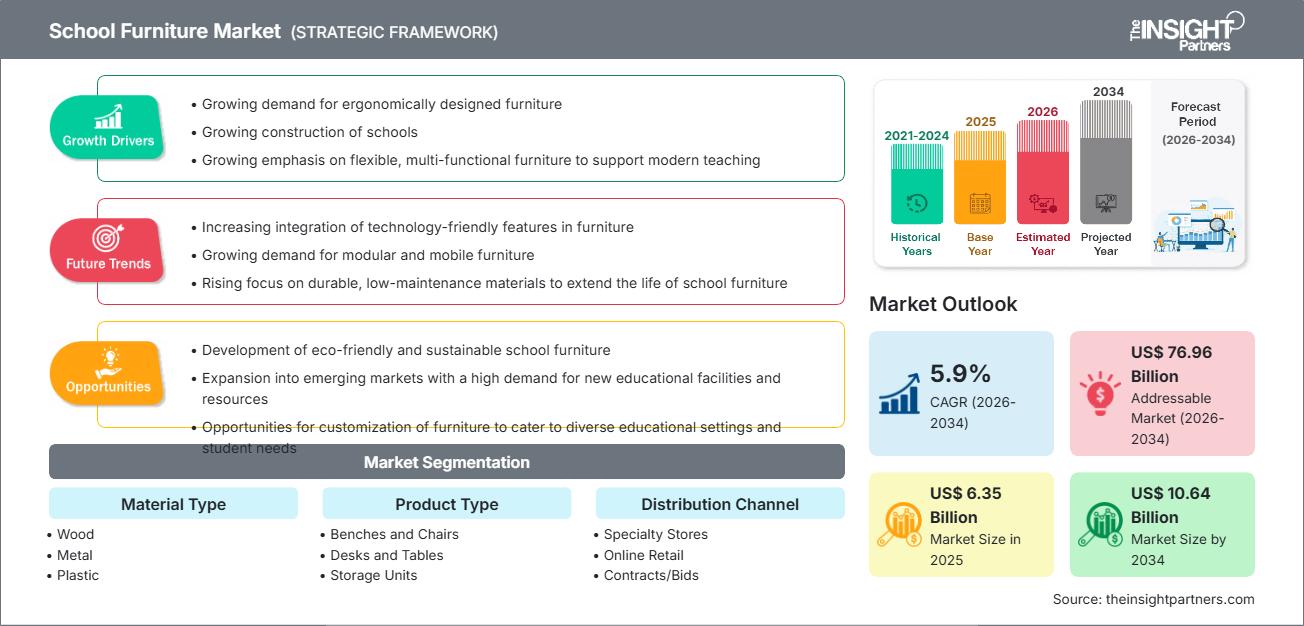
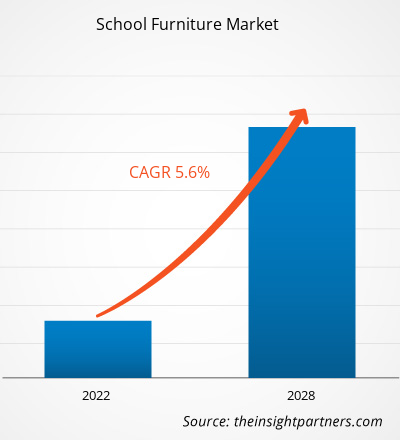
The global school furniture market size is projected to reach US$ 10.64 billion by 2034 from US$ 6.35 billion in 2025. The market is anticipated to register a CAGR of 5.9% during the forecast period 2026–2034. Key market dynamics include a heightening global focus on ergonomic learning environments, rising consumer awareness regarding the impact of physical classroom comfort on student performance, and a significant shift toward modular, flexible furniture solutions. Additionally, the market is expected to benefit from the growing popularity of collaborative learning models, expansion in organized educational infrastructure across emerging economies, and the increasing inclusion of sustainable, non-toxic materials in high-value institutional segments.
School Furniture Market Analysis
The school furniture market analysis shows a shift toward high-value ergonomic designs as educational institutions prioritize student well-being and long-term spinal health. Procurement trends indicate the market is splitting into traditional bulk-contract wooden desks and high-growth modular furniture sectors that allow for quick classroom reconfiguration. Strategic opportunities are emerging in technology-integrated furniture, where desks equipped with charging ports and tablet mounts offer a clear competitive advantage in the digitalization of global education. The analysis also notes that market expansion depends on material durability for high-frequency use and the efficiency of flat-pack shipping for global distribution. Competitive differentiation now stands out depending on branding that tells a story of pedagogical innovation, sustainability, and the ability to track the lifecycle of recycled plastic components.
School Furniture Market Overview
School furniture is evolving from standardized, rigid designs to a global premium market centered on active learning. The school furniture industry now offers value-added products such as height-adjustable tables, mobile storage units, and soft-seating breakout zones, moving beyond traditional wooden benches and heavy metal desks. Both established manufacturers and specialized design firms are adopting lightweight, eco-friendly materials. Increasing health awareness among school boards in North America and Asia-Pacific has driven demand for ergonomic chairs, which are seen as focus-enhancing alternatives to conventional seating. In North America, rapid modernization of K-12 facilities and increased private school funding are key market drivers. In the U.S., there is a strong emphasis on flexible, multi-purpose spaces that can quickly adapt from individual testing to group projects. High replacement rates in aging public schools and the adoption of ergonomic standards requiring adjustable features further support this segment.
Customize This Report To Suit Your Requirement
Get FREE CUSTOMIZATIONSchool Furniture Market: Strategic Insights
-
Get Top Key Market Trends of this report.This FREE sample will include data analysis, ranging from market trends to estimates and forecasts.
School Furniture Market Drivers and Opportunities
Market Drivers:
- Shift to Flexible and Ergonomic Layouts: Schools are moving away from traditional rows toward modular desks and chairs that support movement and collaboration. This ergonomic benefit, along with the growing interest in student-centered learning, is driving market growth.
- Modernization of Educational Infrastructure: The expansion of high-end private institutions and international schools has sustained high demand for premium furniture. As schools trade up to modern aesthetics, ergonomic-certified furniture continues to see stable volume gains.
- Increased Government Spending on Education: Online procurement portals and large-scale government contracts have removed traditional barriers for regional suppliers. This is particularly evident in the rapid adoption of standardized, durable furniture in emerging economies.
Market Opportunities:
- Expansion into Digital and Blended Learning: Beyond basic desks, furniture that accommodates laptops and tablets offers significant opportunities for specialized tech-enabled classroom suites.
- Growth in Emerging APAC Corridors: Forming strategic partnerships between international furniture brands and Asian educational developers may facilitate access to high-margin market segments in China and India.
- Diversification into Sustainable Certifications: There is a growing opportunity for producers to target eco-conscious institutions through certifications such as FSC-certified wood and GREENGUARD-certified low-emission materials.
School Furniture Market Report Segmentation Analysis
The School Furniture Market share is analyzed across various segments to provide a clearer understanding of its structure, growth potential, and emerging trends. Below is the standard segmentation approach used in most industry reports:
By Material Type:
- Wood: The traditional dominant volume driver, particularly within the artisanal and standard institutional sectors, due to its perceived warmth and durability.
- Metal: Preferred for high-traffic environments and heavy-duty storage, often used in combination with plastic for modern chair frames.
- Plastic: A fast-growing niche that aligns with lightweight and colorful design trends, increasingly preferred for its ease of cleaning and portability.
By Product Type:
- Benches and Chairs: Remains the primary segment, benefiting from the global expansion of elementary and secondary schooling.
- Desks and Tables: The fastest-rising channel for innovation, especially with the introduction of flip-top and nesting tables for multi-use spaces.
- Storage Units: Offers a select but growing range of student lockers, mobile carts, and library shelving in modern urban schools.
By Distribution Channel:
- Contracts/Bids: The primary channel for large-scale public school deployments, characterized by bulk orders and long-term supply agreements.
- Specialty Stores: Serves the private school and home-schooling segments, offering curated, high-end ergonomic selections.
- Online Retail: The fastest-growing channel for D2C sales of study furniture and rapid replenishment for small educational centers.
By Geography:
- North America
- Europe
- Asia Pacific
- South & Central America
- Middle East & Africa
School Furniture Market Report Scope
| Report Attribute | Details |
|---|---|
| Market size in 2025 | US$ 6.35 Billion |
| Market Size by 2034 | US$ 10.64 Billion |
| Global CAGR (2026 - 2034) | 5.9% |
| Historical Data | 2021-2024 |
| Forecast period | 2026-2034 |
| Segments Covered |
By Material Type
|
| Regions and Countries Covered |
North America
|
| Market leaders and key company profiles |
|
School Furniture Market Players Density: Understanding Its Impact on Business Dynamics
The School Furniture Market is growing rapidly, driven by increasing end-user demand due to factors such as evolving consumer preferences, technological advancements, and greater awareness of the product's benefits. As demand rises, businesses are expanding their offerings, innovating to meet consumer needs, and capitalizing on emerging trends, which further fuels market growth.
School Furniture Market Share Analysis by Geography
Asia-Pacific acts as the primary engine for new volume due to massive urban school construction, while North America and Europe lead in the transition toward high-tech, ergonomic active learning environments.
1. North America
- Market Share: Holds a significant share driven by the early adoption of Active Learning environments and high per-student furniture expenditure in both public and private sectors.
- Key Drivers:
- Mainstreaming of Flexible Classrooms: Widespread implementation of 21st-century classroom designs in major public school renovation projects across the U.S. and Canada.
- Investment in Lifestyle Academies: Rising consumer preference for premium, height-adjustable, and ergonomic furniture in the expanding private and charter school sectors.
- Safety and Emissions Regulations: Stringent fire-safety ratings and chemical emission standards (like Greenguard Gold) that mandate high-quality, non-toxic materials.
- Trends: Growth in smart furniture with integrated power and a shift toward mobile nesting tables that support rapid classroom reconfiguration.
2. Europe
- Market Share: Anchored by deep-seated design traditions in Scandinavia and Germany, the market focuses on functional minimalism, ergonomics, and industry-leading sustainability standards.
- Key Drivers:
- Circular Economy Mandates: High demand for sustainably sourced, FSC-certified wood and recyclable metal components to comply with EU Green Procurement policies.
- Vocational Training Modernization: Robust government funding for the digital and physical upgrading of vocational schools and apprenticeship centers to meet new industrial labor needs.
- Ergonomic Certification Culture: Strict regulatory frameworks and institutional norms that prioritize student posture and spinal health through certified ergonomic chairs.
- Trends: Strategic focus on clean-label furniture using bio-based resins and the adoption of biophilic design elements in primary school classrooms.
3. Asia-Pacific
- Market Share: The fastest-growing region globally, with China and India acting as the primary volume drivers for new K-12 and higher-education school construction.
- Key Drivers:
- International School Proliferation: A massive and growing middle-class consumer base seeking premium, Western-style educational furniture for high-end international schools.
- National Infrastructure Upgrades: Large-scale government-supported initiatives aimed at improving literacy rates and standardizing public school facilities in rural and Tier 2 cities.
- Urban Space Optimization: Rapid urbanization leading to high demand for compact, stackable, and modular furniture designed for high-density urban learning centers.
- Trends: Dominance of large-scale B2G (Business-to-Government) tenders for basic classroom sets and a rapid shift toward e-commerce for private school procurement.
4. South and Central America
- Market Share: An emerging market with a growing artisanal sector and rising private investment in countries like Brazil, Argentina, and Chile.
- Key Drivers:
- Awareness of Comfort-Learning Link: Growing educator and parental recognition that physical classroom comfort is a primary factor in improving student focus and educational outcomes.
- Modernization of Rural Education: Targeted government and NGO-led programs to transform basic rural schools into modernized, commercial-grade learning environments.
- Preference for Local Craftsmanship: Rising interest in sustainably sourced, locally manufactured wooden furniture to differentiate private schools from those using mass-produced metal imports.
- Trends: A gradual transition from low-cost, fixed-metal desks toward more durable, modular wooden furniture with improved ergonomic profiles.
5. Middle East and Africa
- Market Share: A developing market characterized by strategic investments in education cities and high-tech campus infrastructure in the GCC and urban African hubs.
- Key Drivers:
- Mega-Project Procurement: Large-scale public tenders for university and school furniture associated with national Vision projects (e.g., Saudi Vision 2030 and UAE Centennial 2071).
- Climate-Resilient Material Demand: High demand for heat-resistant, UV-stabilized, and durable materials that can maintain structural integrity in diverse and often harsh climatic conditions.
- Smart Classroom Digitalization: Strategic investments in smart classrooms require tech-ready desks and specialized lab furniture to elevate regional educational rankings.
- Trends: Focus on high-durability, low-maintenance models and a rising demand for specialized furniture for vocational and technical training institutes.
High Market Density and Competition
Competition is intensifying due to the presence of established leaders such as Steelcase Inc., Herman Miller, and KI. Regional innovators and niche players also contribute to a diverse and rapidly expanding market landscape. This competitive environment pushes vendors to differentiate through:
- Ergonomics and Health: Positioning school furniture as a superior educational tool by emphasizing improved posture and reduced fatigue.
- Modular Versatility: Companies now offer more than just fixed desks, providing agile furniture that supports collaborative and individual study modes.
- Vertical Integration: Producers manage the entire supply chain from raw material sourcing to assembly, ensuring quality and transparency.
Opportunities and Strategic Moves
- STEM and Lab Modernization: Capitalize on the global push for STEM education by providing specialized, chemical-resistant laboratory furniture and mobile maker-space stations.
- Direct-to-Institution E-commerce: Optimize digital sales channels for private and charter schools, focusing on online distribution to streamline the procurement process.
Major Companies operating in the School Furniture Market are:
- Fleetwood Furniture
- Herman Miller, Inc.
- KI
- Steelcase Inc.
- Virco, Inc.
- Scholar Craft
- Global Furniture Group
- Educan
- Ven-Rez
- Mitybilt
Disclaimer: The companies listed above are not ranked in any particular order.
School Furniture Market News and Recent Developments
- In February 2026, School Specialty launched its Childcraft Out2Grow Outdoor Furniture line, offering durable, sustainable, and versatile furniture for PreK–2 schools. The collection supports outdoor learning, STEM exploration, social-emotional development, and wellness, providing modern, hands-on educational environments.
- In December 2025, School Specialty acquired Nasco Education U.S., expanding its offerings of preK–12 learning environment solutions nationwide. The acquisition enhances the company’s ability to provide comprehensive classroom resources, including furniture, STEM materials, and hands-on instructional tools, strengthening support for educators and students.
School Furniture Market Report Coverage and Deliverables
The School Furniture Market Size and Forecast (2021–2034) report provides a detailed analysis of the market covering below areas:
- School Furniture Market size and forecast at global, regional, and country levels for all the key market segments covered under the scope
- School Furniture Market trends, as well as market dynamics such as drivers, restraints, and key opportunities
- Detailed PEST and SWOT analysis
- School Furniture Market analysis covering key market trends, global and regional framework, major players, regulations, and recent market developments
- Industry landscape and competition analysis covering market concentration, heat map analysis, prominent players, and recent developments in the School Furniture Market.
- Detailed company profiles
Frequently Asked Questions

- Historical Analysis (2 Years), Base Year, Forecast (7 Years) with CAGR
- PEST and SWOT Analysis
- Market Size Value / Volume - Global, Regional, Country
- Industry and Competitive Landscape
- Excel Dataset
Recent Reports
Testimonials

The Insight Partners' SCADA System Market report is comprehensive, with valuable insights on current trends and future forecasts. The team was highly professional, responsive, and supportive throughout. We are very satisfied and highly recommend their services.
RAN KEDEM Partner, Reali Technologies LTDs
I requested a report on a very specific software market and the team produced the report in a few days. The information was very relevant and well presented. I then requested some changes and additions to the report. The team was again very responsive and I got the final report in less than a week.
JEAN-HERVE JENN Chairman, Future Analytica
We worked with The Insight Partners for an important market study and forecast. They gave us clear insights into opportunities and risks, which helped shape our plans. Their research was easy to use and based on solid data. It helped us make smart, confident decisions. We highly recommend them.
PIYUSH NAGPAL Sr. Vice President, High Beam Global
The Insight Partners delivered insightful, well-structured market research with strong domain expertise. Their team was professional and responsive throughout. The user-friendly website made accessing industry reports seamless. We highly recommend them for reliable, high-quality research services
YUKIHIKO ADACHI CEO, Deep Blue, LLC.
This is the first time I have purchased a market report from The Insight Partners.While I was unsure at first, I visited their web site and felt more comfortable to take the risk and purchase a market report.I am completely satisfied with the quality of the report and customer service. I had several questions and comments with the initial report, but after a couple of dialogs over email with their analyst I believe I have a report that I can use as input to our strategic planning process.Thank you so much for taking the extra time and making this a positive experience.I will definitely recommend your service to others and you will be my first call when we need further market data.
JOHN SUZUKI President and Chief Executive Officer, Board Director, BK Technologies
I wish to appreciate your support and the professionalism you displayed in the course of attending to my request for information regarding to infectious disease IVD market in Nigeria. I appreciate your patience, your guidance, and the fact that you were willing to offer a discount, which eventually made it possible for us to close a deal. I look forward to engaging The Insight Partners in the future, all thanks to the impression you have created in me as a result of this first encounter.
DR CHIJIOKE ONYIA MANAGING DIRECTOR, PineCrest Healthcare Ltd.Reason to Buy
- Informed Decision-Making
- Understanding Market Dynamics
- Competitive Analysis
- Identifying Emerging Markets
- Customer Insights
- Market Forecasts
- Risk Mitigation
- Boosting Operational Efficiency
- Strategic Planning
- Investment Justification
- Tracking Industry Innovations
- Aligning with Regulatory Trends




 Get Free Sample For