
自动乘客计数系统市场预测及份额(2034年)
自动旅客计数系统市场规模及预测(2021-2034)、全球及区域份额、趋势和增长机会分析报告涵盖范围:按类型(旅客信息显示系统、旅客信息广播系统、信息娱乐系统、应急通信系统、旅客信息移动应用);应用(公路、铁路、航空);组件(多媒体显示器、网络和通信设备、公共广播系统、传感器);技术(飞行时间、立体视觉、红外、其他);以及地域(北美、欧洲、亚太地区以及南美和中美洲)。
- 状态 : 数据发布
- 报告代码 : TIPRE00007227
- 类别 : 汽车和运输
- 页数 : 150
- 可用报告格式 :


- 最后更新日期 : August 19, 2026


2025 Market Size
US$ 251.66 Mn
Base year value
2034 Forecast
US$ 585.47 Mn
Projected by 2034
CAGR 2026-2034
9.84 %
Growth rate
Addressable Market
US$ 3,728.51 Mn
(2026-2034)
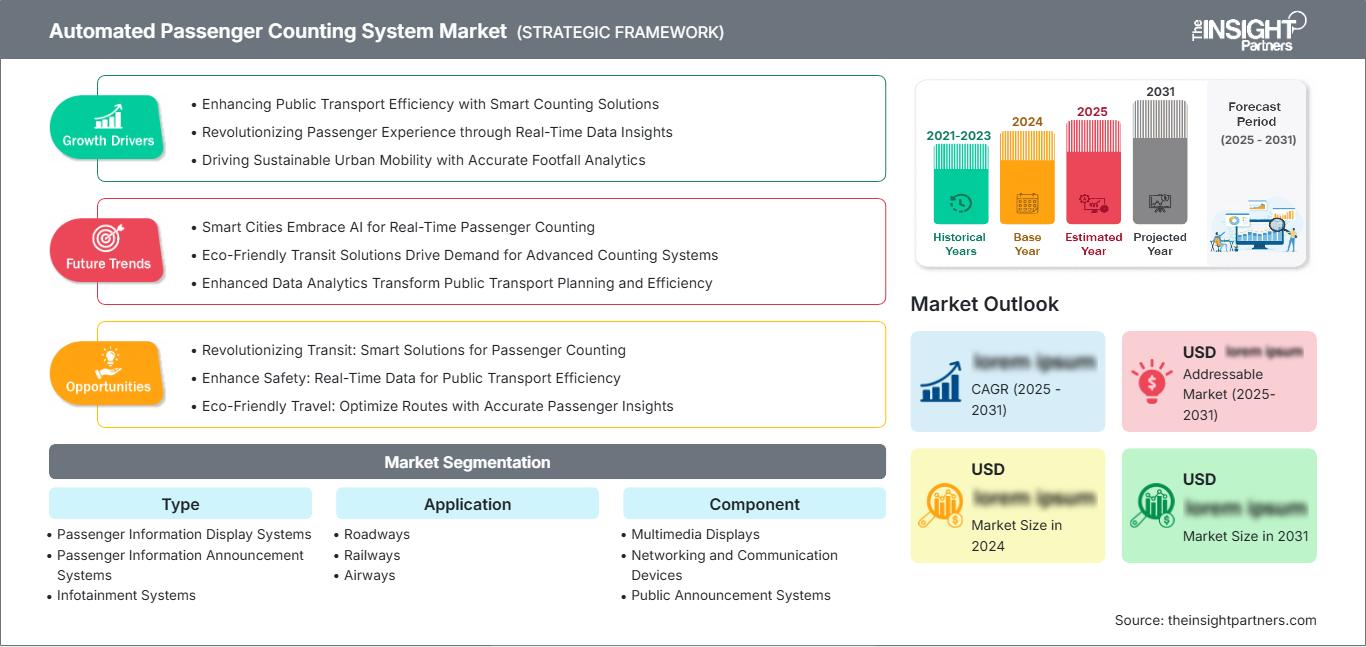
The global Automated Passenger Counting System market was valued at US$ 251.66 million in 2025 and is expected to reach US$ 585.47 million by 2034; it is estimated to record a CAGR of 9.84% during 2026-2034.
Automated Passenger Counting System Market Assessment and Insights
- North America: Accounted for 34–38% share in 2025 and is anticipated to grow at a CAGR of 10.4–11.0% during 2026–2034, supported by smart transit modernization, intelligent transportation infrastructure, and high adoption of connected fleet management technologies.
- U.S.: Represented 76–80% of the North American market in 2025 and is projected to register a CAGR of 10.6–11.2% through expanding investments in urban mobility, AI-powered public transportation, and integrated passenger analytics.
- Europe: Held 27–31% market share in 2025 and is expected to expand at a CAGR of 10.2–10.8%, led by Germany, the United Kingdom, France, Italy, and Spain through continuous investments in sustainable public transportation infrastructure.
- Asia Pacific: Captured 24–28% share in 2025 while recording the fastest regional expansion with a CAGR of 12.5–13.3%, driven by rapid urbanization across China, India, Japan, and South Korea alongside large-scale metro development projects.
- Largest Segment: Roadways: dominated with a market share of 50–54% in 2025 and is projected to grow at a CAGR of 10.8–11.5%, supported by expanding smart bus networks and intelligent fleet management initiatives.
- High Growth Segment: Time-Of-Flight technology accounted for approximately 34–38% share in 2025 and is forecast to register a CAGR of 13.2–14.0%, benefiting from superior counting accuracy and growing AI-enabled analytics integration.
- Key companies analyzed in detail: Cisco Systems, Inc.; Clever Devices Ltd.; Dilax Intelcom GmbH; Eurotech S.p.A.; Hella Aglaia Mobile Vision GmbH; Hitachi, Ltd.; Huawei Technologies Co., Ltd.; Infodev Electronic Designers International Inc.; Siemens AG; Trapeze Group.
Source: The Insight Partners' analysis based on proprietary research, government publications, company annual reports, investor presentations, industry databases, and expert interviews.
Innovations in passenger counting technology range from simple infrared devices to the more advanced artificial intelligence, three-dimensional imagery, and edge computing that is able to provide precise occupancy data regardless of weather changes. The integration of such innovations into automated fare collection, predictive maintenance, and scheduling systems is gradually becoming a reality for transit authorities seeking to gain better control of operations and manage transport resources efficiently.
The growth of the industry in the future is likely to depend on investment into smart cities, intelligent transportation systems, and cloud-based mobility ecosystems in emerging economies. The regulations that encourage the implementation of digital transport management services, along with the widespread use of Mobility as a Service platforms, are likely to stimulate investments in intelligent passenger analytics.
Automated Passenger Counting System Market Report Scope
| Report Attribute | Details |
|---|---|
| Market size in 2025 | US$ 251.66 Million |
| Market Size by 2034 | US$ 585.47 Million |
| Global CAGR (2026 - 2034) | 9.84% |
| Historical Data | 2021-2024 |
| Forecast period | 2026-2034 |
Automated Passenger Counting System Market Analysis
Growing investments in intelligent public transportation infrastructure continue to strengthen the automated passenger counting system market growth across urban mobility ecosystems. Passenger counting solutions are being increasingly used by transit companies for better route optimization, efficient fleet management, and effective occupancy management. The sector receives an additional boost from increasing investments in smart cities, digital ticketing solutions, and mobility solutions that need passenger analytics. Advancements in the field of artificial intelligence, machine vision, and sensor technology have allowed for greater accuracy of counting solutions and reduced the costs of operation for transport companies.
The value chain in the passenger counting market includes sensor suppliers, software companies, communication network suppliers, system integration companies for transportation systems, vehicle manufacturers, and public transit authorities. Increasing cloud connectivity and edge computing have made it possible to perform real-time passenger analytics for buses, railway transportation systems, and airport transportation solutions. Increasing cooperation between hardware suppliers and intelligent transportation software solutions providers is speeding up the deployment of integrated monitoring solutions.
The competitive landscape within the automated passenger counting system market analysis is characterized by continuous investments in artificial intelligence, computer vision, cloud platforms, and digital transportation software. Leading companies, including Cisco Systems, Inc., Siemens AG, Huawei Technologies Co., Ltd., Hitachi, Ltd., Clever Devices Ltd., Dilax Intelcom GmbH, Eurotech S.p.A., Hella Aglaia Mobile Vision GmbH, Infodev Electronic Designers International Inc., and Trapeze Group, continue to expand intelligent transportation capabilities through strategic collaborations, product innovation, and software integration.
The industry is placing greater emphasis on scalable cloud architecture, cybersecurity, predictive analysis, and interoperability with automatic fare collection and fleet management solutions. The strategic allocation of resources towards research and development will allow for innovations in three-dimensional sensing technology, AI-based occupancy analytics, and a mobility platform that can cater to growing intelligent transportation systems in developed and developing nations.
● REPORT CUSTOMIZATION
Tailor This Report To Align With Your Specific Business Requirements
This report can be customized to align precisely with your business objectives, scope, and target markets. Customization options include tailored segmentation, geography, competitive analysis, and strategic insights to support informed decision-making.
Customize This Report →WHAT YOU CAN ADJUST
- ● Segmentations
- ● Geography
- ● Competitive Analysis
- ● Language Preferences
Automated Passenger Counting System Market:
自定义此报告以满足您的要求
您将免费获得任何报告的定制,包括本报告的部分内容,或国家级分析、Excel 数据包,以及为初创企业和大学提供超值优惠和折扣
自动乘客计数系统市场: 战略洞察
-
获取本报告的主要市场趋势。这个免费样本将包括数据分析,从市场趋势到估计和预测。
Regional Insights
North America Automated Passenger Counting System Market
North America accounted for 34–38% of the global automated passenger counting system market share in 2025 and is projected to expand at a CAGR of 10.4–11.0% through 2034. Strong government investments in intelligent transportation systems, widespread digital transformation across transit agencies, and modernization of urban mobility infrastructure continue to support regional demand. Transit operators increasingly utilize passenger analytics to optimize scheduling, improve service quality, and enhance operational efficiency while complying with accessibility and transportation planning requirements.
The growing deployment of connected buses, smart rail systems, and integrated mobility platforms continues to strengthen market expansion throughout the region. Artificial intelligence-enabled passenger monitoring, cloud-based transportation analytics, and advanced communication infrastructure are improving occupancy management while enabling predictive operational planning. Continuous investment in smart city initiatives further supports long-term adoption of intelligent passenger counting technologies.
U.S. Automated Passenger Counting System Market
The United States represented approximately 76–80% of the North American market in 2025 and is forecast to register a CAGR of 10.6–11.2% during the forecast period. Federal transportation modernization programs, digital transit initiatives, and growing investments in connected public transportation systems continue to stimulate deployment across metropolitan transit agencies. Demand remains particularly strong among municipal bus operators, commuter rail systems, and airport transportation authorities seeking accurate passenger analytics.
Major technology providers maintain extensive research, software development, and transportation integration capabilities throughout the country. Increasing adoption of artificial intelligence, edge computing, and cloud-enabled fleet management platforms supports higher operational efficiency while enabling transportation agencies to optimize vehicle utilization, improve passenger experiences, and strengthen long-term infrastructure planning.
Europe Automated Passenger Counting System Market
Europe held 27–31% of the global market in 2025 and is expected to register a CAGR of 10.2–10.8% through 2034. The region continues to benefit from strong investments in sustainable mobility, railway modernization, and intelligent public transportation infrastructure. Germany remains the leading country owing to its advanced rail ecosystem and smart mobility initiatives, while the United Kingdom, France, Italy, and Spain continue expanding digital transit capabilities through public transportation modernization programs.
The United Kingdom continues investing in intelligent bus fleets, connected rail operations, and integrated passenger information systems that improve commuter experiences and operational efficiency. Government support for digital mobility infrastructure and sustainable transport initiatives is encouraging wider deployment of automated passenger analytics across metropolitan transportation networks.
Germany remains Europe's largest market due to extensive railway infrastructure, advanced manufacturing capabilities, and widespread implementation of intelligent transportation technologies. Continuous investments by public transportation operators in AI-enabled monitoring systems, predictive analytics, and smart mobility platforms support long-term adoption across buses, metros, and regional rail services.
France, Italy, and Spain are steadily expanding deployments through investments in urban transit modernization, smart ticketing, and integrated passenger management systems. Growing focus on improving operational efficiency, reducing congestion, and enhancing passenger safety continues to encourage implementation of intelligent counting technologies across multiple transportation modes.
APAC Automated Passenger Counting System Market
Asia Pacific accounted for approximately 24–28% of the global Automated Passenger Counting System Market in 2025 and is projected to record the fastest regional expansion with a CAGR of 12.5–13.3%. China leads regional adoption owing to extensive metro construction, high-speed railway expansion, and smart city investments. Japan, South Korea, India, and Australia continue to strengthen intelligent transportation infrastructure through digital mobility initiatives and the modernization of public transit systems.
Rapid urbanization, increasing commuter volumes, and substantial government investments in intelligent transportation networks continue to accelerate adoption throughout the region. Large-scale deployment of AI-enabled mobility platforms, integrated ticketing systems, and smart public transportation projects supports sustained demand for advanced passenger counting technologies.
Middle East & Africa Automated Passenger Counting System Market
The Middle East & Africa Automated Passenger Counting System Market is anticipated to expand at a CAGR of 10.8–11.6% during 2026–2034. Saudi Arabia and the United Arab Emirates continue investing heavily in smart city developments, intelligent transportation systems, and metro expansion projects. South Africa remains an important market for public transportation modernization, while additional opportunities are emerging across the Rest of MEA through infrastructure development initiatives.
Growing urban mobility projects, airport modernization, and government investments in digital infrastructure continue supporting long-term market expansion. Increasing adoption of intelligent fleet management, integrated transportation platforms, and smart public transit technologies is expected to enhance passenger flow management while improving operational efficiency throughout the region.
Segmentation Analysis
Type
The Type segment of the Automated Passenger Counting System Market is expected to register a CAGR of 11.0–11.7% during the forecast period. Growing investments in intelligent passenger communication, real-time travel information, and integrated mobility services continue driving adoption across public transportation networks. The automated passenger counting system market scope continues expanding as transportation operators increasingly integrate passenger information technologies with occupancy monitoring platforms to improve operational efficiency and passenger experiences.
- Passenger Information Display Systems provide real-time journey updates, occupancy information, and route guidance, supporting improved passenger satisfaction while enhancing transportation management capabilities across bus, railway, and airport environments.
- Passenger Information Announcement Systems enable automated multilingual communication for transit operators, improving passenger awareness, operational coordination, and emergency response across increasingly connected transportation networks.
- Infotainment Systems combine travel information, commercial content, and passenger engagement capabilities, creating additional value for transportation operators while improving commuter experiences throughout urban mobility ecosystems.
- Emergency Communication Systems strengthen passenger safety through rapid incident notification, evacuation guidance, and integrated emergency response capabilities that complement intelligent transportation management platforms.
- Passenger Information Mobile Application solutions extend real-time occupancy information, journey planning, and service notifications directly to passengers, supporting digital mobility strategies and improved commuter convenience.
Application
The Application segment is projected to expand at a CAGR of 11.4–12.1% between 2026 and 2034 as transportation authorities continue deploying intelligent monitoring solutions across multiple transit environments.
- Roadways remain the dominant application owing to widespread deployment across urban bus fleets, bus rapid transit systems, and municipal transportation networks requiring accurate occupancy monitoring for route optimization and scheduling efficiency.
- Railways continue generating substantial demand through investments in metro modernization, commuter rail expansion, and intelligent station management systems supporting passenger safety and operational planning.
- Airways increasingly utilize passenger counting technologies to optimize terminal operations, shuttle transportation, boarding processes, and airport resource allocation while improving overall passenger flow management.
Component
The Component segment is forecast to grow at a CAGR of 11.5–12.2% during the forecast period. Continuous advances in intelligent sensing technologies, edge computing, and digital communication infrastructure are increasing the demand for integrated hardware platforms capable of supporting accurate passenger analytics, real-time monitoring, and seamless interoperability with modern transportation management systems.
- Multimedia Displays deliver real-time travel information, occupancy updates, route guidance, and emergency notifications while improving passenger engagement across buses, railway stations, airports, and integrated mobility hubs.
- Networking and Communication Devices provide secure data transmission between sensors, onboard computing systems, and cloud platforms, enabling real-time passenger analytics and centralized fleet management capabilities.
- Public Announcement Systems remain essential for delivering automated travel information, operational updates, emergency alerts, and multilingual communication across increasingly digitized transportation networks.
- Sensors represent the core hardware element responsible for capturing passenger movement data with high precision, supporting intelligent occupancy analysis and operational decision-making across public transportation systems.
Technology
The Technology segment is anticipated to register a CAGR of 12.1–12.9% between 2026 and 2034 as transportation operators increasingly adopt advanced sensing platforms offering improved accuracy and reduced maintenance requirements.
- Time-Of-Flight technology is witnessing rapid adoption because of its superior depth perception, high counting accuracy, and consistent performance under varying lighting conditions, making it highly suitable for modern intelligent transportation applications.
- Stereoscopic Vision technologies improve passenger detection by utilizing dual-camera imaging to accurately distinguish passenger movement, supporting reliable occupancy monitoring in high-density transportation environments.
- Infrared technology continues to maintain widespread adoption owing to its cost-effectiveness, stable performance, and suitability for conventional passenger counting applications across buses and railway vehicles.
Opportunity Snapshot
|
Application |
Revenue Contribution |
Trend Tag |
Adoption Stage |
|---|---|---|---|
|
Roadways |
High |
Smart Transit |
Mature |
|
Railways |
High |
Metro Digitalization |
Scaling |
|
Airways |
Medium |
Airport Analytics |
Emerging |
Automated Passenger Counting System Market Growth Drivers and Impact Analysis
Increasing Investments in Intelligent Public Transportation Infrastructure
Countries around the world are continually making more investments in the intelligent transport infrastructure to enhance mobility efficiency, minimize congestion, and bolster sustainability efforts. Intelligent buses, metro rail networks, and transit management systems now need reliable information on passengers’ occupancy to schedule operations and optimize fleet size. Automated passenger counting systems help achieve real-time insights while enabling predictive maintenance and scheduling. Increased investments in smart city programs in North America, Europe, and Asia Pacific are driving the need for public transport organizations to adopt sensor-based technologies with cloud mobility solutions. The rising level of connectivity in transport networks means an increasing need for passenger analytics.
Expansion of Smart City and Digital Mobility Programs
Intensification of urbanization and increasing volumes of commuter transport will drive the implementation of technologies associated with intelligent transportation systems on a global level. Modern municipalities tend to implement connected transportation systems that use passenger counts together with traffic control, ticketing, and mobility applications. It will not only increase the effectiveness of operations but also improve passenger experience by providing an efficient schedule and real-time monitoring of occupancy. Digital transformation programs will also promote the use of artificial intelligence, cloud computing, and edge analytics, thus allowing transportation operators to make effective decisions based on data analysis.
Growing Adoption of Artificial Intelligence and Computer Vision
AI and computer vision-based passenger counting devices are constantly evolving to become much more accurate and versatile in their functioning. Sophisticated image recognition algorithms, AI models, and 3D sensing technologies make it possible to detect passengers with extreme precision regardless of the environment. The importance of intelligent solutions that allow not only collecting data but also generating predictive analysis, automatic reports, and integration with fleet management systems is rising. Further development of the processing speed, cloud connection, and cybersecurity capabilities opens new prospects for implementing such devices without maintenance.
Automated Passenger Counting System Market Future Trends
AI-Powered Predictive Passenger Analytics
Artificial intelligence is transforming passenger counting systems from simple monitoring tools into predictive operational intelligence platforms. Transit operators increasingly utilize machine learning models to forecast passenger volumes, optimize fleet deployment, and improve scheduling efficiency based on historical and real-time occupancy data. These automated passenger counting system market trends are encouraging greater integration of cloud analytics, digital twins, and edge computing technologies. Future deployments will emphasize autonomous decision support, predictive congestion management, and dynamic route optimization while enabling transportation agencies to improve passenger experiences, reduce operational costs, and maximize utilization of public transportation infrastructure.
Expansion of Cloud-Native Mobility Management Platforms
The future of intelligent mobility is in transportation management systems that are cloud-native. The integration of passenger counting technology into automated fare collection, fleet management, passenger information, and predictive maintenance systems is taking place within a secure cloud-based infrastructure. This integration makes it possible to monitor distributed transportation assets centrally. In addition, these cloud-based platforms are scalable and provide remote software updating possibilities. Further development of interconnected transportation ecosystems will promote the use of such systems by metropolitan transit authorities.
Automated Passenger Counting System Market Opportunities
Expansion of AI-Enabled Public Transit Modernization Programs
Large-scale modernization of public transportation systems across Asia Pacific, Europe, and the Middle East is creating significant opportunities for intelligent passenger monitoring technologies. Governments are investing in smart buses, metro rail projects, and integrated mobility platforms that require accurate occupancy information for scheduling, safety, and operational optimization. Automated passenger counting solutions equipped with artificial intelligence and edge analytics enable predictive fleet deployment while improving commuter experiences. Automated Passenger Counting System Market Forecasts indicate that suppliers offering cloud-connected platforms, cybersecurity features, and interoperable software architectures are well-positioned to benefit from long-term infrastructure programs funded through national digital mobility initiatives.
Integration with Mobility-as-a-Service Platforms
The increasing popularity of Mobility as a Service ecosystems offers room for passenger counting companies to provide real-time occupancy intelligence services for different transportation modes. There is a need for transit agencies to have integrated operation panels that combine ticketing, fleet management, passenger information, and occupancy intelligence services. Software vendors that develop APIs, cloud-based software architecture, and advanced analytics engines can earn more software revenue in addition to building better relationships with their customers. In addition, integration with multimodal transport planning systems will help transportation providers optimize their services and enhance asset utilization.
Frequently Asked Questions

Naveen 是一位经验丰富的市场研究和咨询专业人士,在定制项目、联合项目和咨询项目方面拥有超过 9 年的专业经验。他目前担任副总裁,成功管理了项目价值链中的利益相关者,撰写了 100 多份研究报告和 30 多项咨询项目。他的工作涵盖工业和政府项目,为客户的成功和数据驱动的决策做出了重要贡献。
Naveen 拥有卡纳塔克邦 VTU 的电子与通信工程学位,以及马尼帕尔大学的市场营销与运营 MBA 学位。他已担任 IEEE 会员 9 年,积极参与各种会议、技术研讨会,并在分部和地区层面担任志愿者。在此之前,他曾担任 IndustryARC 的助理战略顾问和惠普(惠普全球)的工业服务器顾问。
- 全面的市场规模与预测分析
- 详细的细分市场分析
- 深入的市场动态评估
- 区域及国家级洞察
- 竞争格局与企业对标分析
- 战略性商业情报
客户评价

The Insight Partners 提供了有价值的市场情报,帮助我们制定并推进全球市场进入战略。他们的团队专业、响应及时,并认真听取我们的反馈,在整个项目过程中提供了深入的分析和有帮助的方法论说明。
Junmo Kim 首席财务官(CFO), Enertech Co., Ltd.
Insight Partners 的 SCADA 系统市场报告内容全面,对当前趋势和未来预测提供了宝贵的见解。该团队始终高度专业、响应迅速且乐于助人。我们非常满意,强烈推荐他们的服务。
兰·凯德姆 伙伴, Reali Technologies LTD
我请求一份关于特定软件市场的报告,团队在几天内就完成了。报告信息非常相关,而且呈现得非常出色。之后,我请求对报告进行一些修改和补充。团队再次迅速响应,不到一周我就收到了最终报告。
让-埃尔韦·詹恩 主席, 未来分析公司
我们与 Insight Partners 合作进行了一项重要的市场研究和预测。他们清晰地洞察了机遇和风险,帮助我们制定了计划。他们的研究简单易用,数据可靠,帮助我们做出了明智而自信的决策。我们强烈推荐他们。
皮尤什·纳格帕尔 高级副总裁, 远光全球
Insight Partners 凭借其深厚的行业专业知识,提供了富有洞察力、结构合理的市场研究。他们的团队始终专业且响应迅速。用户友好的网站让访问行业报告变得顺畅无阻。我们强烈推荐他们可靠、高质量的研究服务。
安达幸彦 首席执行官, 深蓝有限责任公司
这是我第一次从The Insight Partners购买市场报告。起初我有些犹豫,但访问了他们的网站后,我更放心地冒险购买市场报告。我对报告的质量和客户服务非常满意。我对最初的报告有一些疑问和意见,但在与他们的分析师通过电子邮件沟通了几次后,我相信这份报告可以作为我们战略规划流程的参考。非常感谢您抽出宝贵的时间,让这次体验如此愉快。我一定会向其他人推荐你们的服务,当我们需要更多市场数据时,你们将是我的首选。
约翰·铃木 总裁兼首席执行官、董事会董事, BK科技
感谢您在处理我关于尼日利亚传染病体外诊断市场信息请求的过程中所展现的支持和专业精神。感谢您的耐心、指导,以及您愿意提供的折扣,最终促成了这笔交易。我期待未来与 Insight Partners 继续合作,这一切都要归功于您与我初次接触后留下的良好印象。
奇吉奥克博士 ONYIA 董事总经理, PineCrest 医疗保健有限公司购买理由
- 明智的决策
- 了解市场动态
- 竞争分析
- 客户洞察
- 市场预测
- 风险规避
- 战略规划
- 投资论证
- 识别新兴市场
- 优化营销策略
- 提升运营效率
- 顺应监管趋势




















 获取免费样品 -