
水管工业锅炉市场驱动因素及范围展望(2034 年)
水管工业锅炉市场规模及预测(2021-2034年)、全球及区域份额、趋势和增长机会分析报告涵盖范围:按类型(巴布科克-威尔科克斯锅炉、斯特林锅炉、简易立式锅炉);燃料(煤、油、天然气、其他);容量(< 10 MMbtu/hr、10-25 MMbtu/hr、25-50 MMbtu/hr、50-75 MMbtu/hr、75-100 MMbtu/hr、100-175 MMbtu/hr、175-250 MMbtu/hr、> 250 MMbtu/hr);应用(医院和医疗保健、电力和公用事业、炼油厂、石油化工、纸浆和造纸、食品加工);以及地域(北美、欧洲、亚太地区以及南美和中美洲)。
- 状态 : 数据发布
- 报告代码 : TIPRE00027574
- 类别 : 制造和建筑
- 页数 : 150
- 可用报告格式 :


- 最后更新日期 : September 28, 2026


2025 Market Size
US$ 10.62 Bn
Base year value
2034 Forecast
US$ 19.6 Bn
Projected by 2034
CAGR 2026-2034
7.05 %
Growth rate
Addressable Market
US$ 136.46 Bn
(2026-2034)
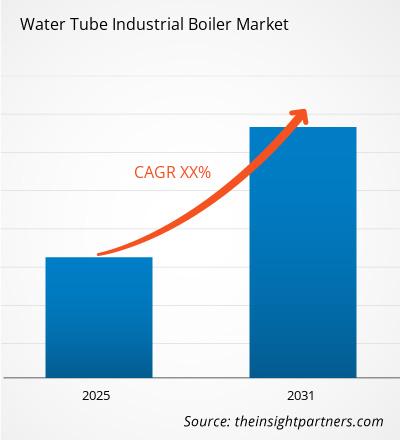
The Water Tube Industrial Boiler market was valued at US$ 10.62 billion in 2025 and is expected to reach US$ 19.6 billion by 2034; it is estimated to record a CAGR of 7.05% during 2026-2034.
Water Tube Industrial Boiler Market Assessment and Insights
- North America: North America is projected to account for a 25–29% share in 2025 and expand at a CAGR of 6.5–7.5% during 2026–2034, supported by replacement demand, refinery investment, natural gas availability, and boiler modernization.
- US: The US is estimated to represent 20–23% of the global market in 2025 and grow at a CAGR of 6.3–7.3% through 2034, led by industrial retrofits and process-heat demand.
- Europe: Europe is estimated to hold a 20–24% share in 2025 and grow at 5.8–6.8%, with Germany, the UK, France, Italy, and Spain supporting demand through efficiency upgrades and industrial decarbonization.
- Asia Pacific: Asia Pacific is estimated at 31–35% in 2025 and is expected to grow at 8.5–9.5%, led by China and India, followed by Japan and South Korea, as manufacturing and process industries expand.
- Largest Segment: Power and Utilities is estimated to hold a 25–29% market share in 2025 and expand at a 7.2–8.2% CAGR during 2026–2034, reflecting sustained steam-cycle investment.
- High Growth Segment: Natural Gas is estimated to represent 36–40% of 2025 demand and grow at a 8.4–9.4% CAGR as operators prioritize flexible, lower-emission combustion.
- Key companies analyzed in detail: Forbes Marshall, Mitsubishi Heavy Industries, Ltd., Thermax Limited, Bharat Heavy Electricals Limited, The Babcock & Wilcox Company, Doosan Enerbility Co., Ltd., Fulton Companies, John Wood Group PLC, Siemens Energy AG, Hurst Boiler & Welding Company, Inc., and Kawasaki Thermal Engineering Co., Ltd.
Source: The Insight Partners' analysis based on proprietary research, government publications, company annual reports, investor presentations, industry databases, and expert interviews.
The water tube industrial boiler market has evolved toward higher-pressure, higher-efficiency systems capable of supporting continuous industrial operations and variable fuel strategies. Modern boiler packages increasingly integrate advanced combustion controls, economizers, air-preheating equipment, emissions controls, and digital monitoring. Production dynamics have also shifted toward engineered-to-order systems, refurbishment, modular auxiliaries, and lifecycle services, allowing operators to improve existing assets without replacing complete boiler houses.
Looking ahead, demand is likely to broaden across emerging manufacturing centers, particularly India, Southeast Asia, the Middle East, and selected African economies. Regulatory pressure on particulate matter, nitrogen oxides, carbon intensity, and energy efficiency is encouraging investment in cleaner combustion and heat-recovery technologies. The water tube industrial boiler market is therefore moving from simple capacity additions toward efficiency-led replacement, fuel conversion, automation, and lifecycle optimization.
Water Tube Industrial Boiler Market Report Scope
| Report Attribute | Details |
|---|---|
| Market size in 2025 | US$ 10.62 Billion |
| Market Size by 2034 | US$ 19.6 Billion |
| Global CAGR (2026 - 2034) | 7.05% |
| Historical Data | 2021-2024 |
| Forecast period | 2026-2034 |
Water Tube Industrial Boiler Market Analysis
The water tube industrial boiler market growth is closely connected with demand for dependable process steam across refineries, petrochemical plants, food-processing facilities, pulp and paper mills, hospitals, and utilities. The attractiveness of the water-tube design in terms of large-scale capacity stems from the fact that the circulating water is placed in the tubes heated by the combustion gases. Therefore, quick generation of steam and relatively high pressure are possible. The supply chain involves producers of boilers, companies producing combustion equipment, controls, engineering companies, fuel suppliers, maintenance companies, and industrial end-users.
Fuel flexibility and efficiency of equipment become more and more significant in supply dynamics. While natural gas continues to be used where the pipeline system is in place, the coal-fired plants continue to feed the needs of large industrial and power facilities in several Asian countries. According to the IEA, industries were responsible for almost 40% of the global consumption of final energy in 2024.
The water tube industrial boiler market analysis indicates a competitive environment shaped by engineering capability, installed base, project execution, fuel flexibility, and service coverage. The Babcock & Wilcox Company retains strong expertise in water-tube and refurbishment solutions, while Mitsubishi Heavy Industries, Ltd. competes through large-scale steam-generation and fuel-conversion technologies. Thermax Limited and Bharat Heavy Electricals Limited benefit from established Indian industrial and utility relationships.
Strategic positioning increasingly depends on lifecycle economics rather than boiler price alone. Forbes Marshall emphasizes digital boiler monitoring and process optimization, while Siemens Energy AG combines steam-generation ecosystems with turbine and power-cycle capabilities. Doosan Enerbility Co., Ltd., Kawasaki Thermal Engineering Co., Ltd., Fulton Companies, and Hurst Boiler & Welding Company, Inc. strengthen competitive diversity across applications and geographies. Investment is consequently shifting toward modernization, controls, emissions reduction, and fuel conversion alongside new capacity, according to the Water Tube Industrial Boiler Market report.
● REPORT CUSTOMIZATION
Tailor This Report To Align With Your Specific Business Requirements
This report can be customized to align precisely with your business objectives, scope, and target markets. Customization options include tailored segmentation, geography, competitive analysis, and strategic insights to support informed decision-making.
Customize This Report →WHAT YOU CAN ADJUST
- ● Segmentations
- ● Geography
- ● Competitive Analysis
- ● Language Preferences
Water Tube Industrial Boiler Market:
自定义此报告以满足您的要求
您将免费获得任何报告的定制,包括本报告的部分内容,或国家级分析、Excel 数据包,以及为初创企业和大学提供超值优惠和折扣
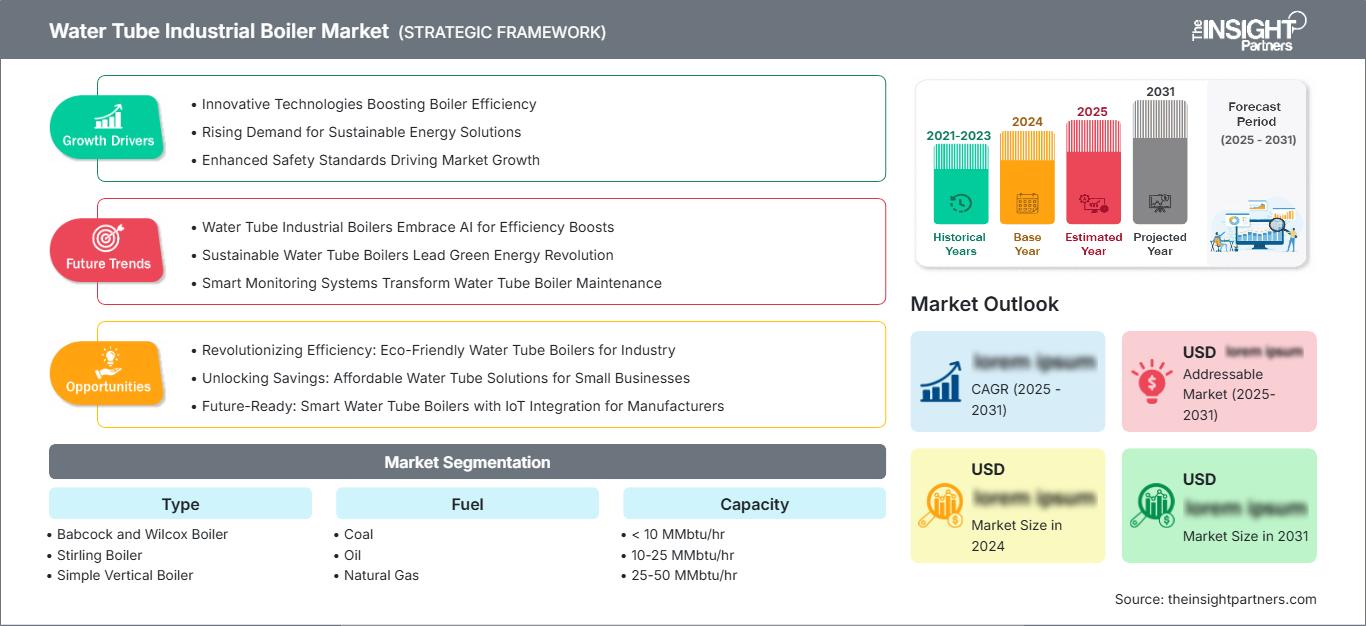
水管工业锅炉市场: 战略洞察
-
获取本报告的主要市场趋势。这个免费样本将包括数据分析,从市场趋势到估计和预测。
Regional Insights
North America Water Tube Industrial Boiler Market
North America is estimated to represent 25–29% of the global water tube industrial boiler market in 2025 and is projected to expand at a CAGR of 6.5–7.5% through 2034. The US is the major consumer in the region, backed by refinery upgrade, chemicals manufacturing, food processing, healthcare facilities, and the upgrading of aged steam generation equipment. Canada brings in its own demands for pulp and paper, mining and process industries, whereas Mexico sees gains in its manufacturing and industrial investments.
The purchases in the region continue to favor more effective retrofits, combustion control, economizers, emission treatment systems, and digital monitoring systems. Availability of natural gas helps in the conversion of existing fuel from oil or coal-based boilers, whereas high reliability needs push the need for lifecycle service contracts. The industrial users also compare their boilers for efficiency relative to their overall cost of operations, thus making heat recovery and control more important than ever before.
U.S. Water Tube Industrial Boiler Market
The US is estimated to represent 20–23% of global Water Tube Industrial Boiler Market demand in 2025, equivalent to roughly 79–82% of North America's regional market, and is expected to grow at a CAGR of 6.3–7.3%. Industrial uses include refineries, chemicals, pulp and paper, food processing, hospitals, and utilities. Equipment running on natural gas is especially applicable where customers require reliable steam generation with reduced local emissions compared to old coal or oil plants.
Firm presence covers boiler makers worldwide, engineering firms, control equipment suppliers, and maintenance companies. The Babcock & Wilcox Company holds a leading installed base position, while Hurst Boiler & Welding Company, Inc. and Fulton Companies cater to industries and institutions. Demand will increasingly be driven by retrofits, emissions requirements, automation, and process integration. Facilities with heavy loads will also value redundancy, fast response, and reliability, since failure of steam production may impact operations and product quality.
Europe Water Tube Industrial Boiler Market
Europe is estimated to hold a 20–24% of the Water Tube Industrial Boiler Market share in 2025 and is projected to grow at a CAGR of 5.8–6.8%. Demand is driven by Germany, then the UK, followed by France, Italy, and Spain. Decarbonization of industry, energy efficiency, and replacement of outdated equipment are influencing purchase decisions. Natural gas still plays an important role, while biomass, electrification interfaces, heat recovery, and low-carbon fuels will be increasingly important drivers.
In the UK, emphasis on energy efficiency and heat decarbonization in industry is opening up opportunities for boiler replacement and process optimization. Germany has its advantage due to a strong chemical, manufacturing, food, and industrial engineering base. France has process industry applications, plus its large utilities and district heating systems. Italy and Spain have their share of food processing, chemicals, manufacturing, and high-energy-consuming industries. Here, vendors find themselves competing more and more on the basis of emissions, controls, heat recovery, and services.
APAC Water Tube Industrial Boiler Market
APAC is estimated to represent 31–35% of the global Water Tube Industrial Boiler Market demand in 2025 and is projected to grow at a CAGR of 8.5–9.5%, making it the leading regional market. China remains the largest country market, followed by India, Japan, South Korea, and Australia. Manufacturing expansion, power investment, refinery capacity, and process industries underpin demand.
China and India provide the strongest industrial base, while Japan and South Korea emphasize efficiency and advanced controls. Australia presents opportunities in the mining and process industries. Regional policy increasingly encourages cleaner combustion, efficiency improvement, and industrial modernization. The water tube industrial boiler market benefits from large installed fleets requiring replacement and upgrades, alongside new facilities serving chemicals, food, pulp and paper, and power applications.
Middle East & Africa Water Tube Industrial Boiler Market
The Middle East & Africa Water Tube Industrial Boiler Market is expected to expand at a CAGR of 5.0–6.0%, with Saudi Arabia leading regional demand, followed by the UAE and South Africa. There is a constant need for steam generation due to refining processes, petrochemicals, utilities associated with desalination plants, food manufacturing, and industries requiring large boilers.
Saudi Arabia has a diversified refinery and industry sector, while the UAE has diversified its investments in energy, chemicals, utilities, and manufacturing. South Africa maintains needs in its mining, manufacturing, food processing, and utility sectors. Opportunities exist in other parts of MEA in relation to industrialization and infrastructure development. Availability of fuel sources continues to be the most important factor in project economics, but more efficient use of fuel sources is being considered.
Segmentation Analysis
Type
The Type segment is expected to grow at a CAGR of 7.3–8.3% during 2026–2034. Water-tube designs remain important where plants require continuous steam, high pressure, large thermal output, and strong load-following capability. Babcock and Wilcox Boiler and Stirling Boiler technologies retain relevance in industrial and utility applications, while Simple Vertical Boiler systems serve more specialized lower-capacity requirements, as outlined in the Water Tube Industrial Boiler Market forecast.
- Babcock and Wilcox Boiler: Babcock and Wilcox Boiler systems maintain strong relevance in utility and heavy-industrial environments because established designs support high-pressure steam generation, refurbishment, and long operating lifecycles.
- Stirling Boiler: Stirling Boiler configurations remain strategically important for large industrial installations requiring reliable circulation, flexible furnace arrangements, and integration with modern combustion and heat-recovery equipment.
- Simple Vertical Boiler: Simple Vertical Boiler systems address compact installations where footprint, straightforward operation, and lower equipment complexity are more important than very high steam capacity.
Fuel
The Fuel segment is forecast to expand at a CAGR of 7.8–8.8% during 2026–2034. Fuel selection is increasingly determined by availability, delivered energy cost, emissions requirements, and conversion flexibility. Natural gas benefits from cleaner combustion characteristics, while coal and oil remain important where existing infrastructure and local economics support continued operation, reflecting evolving Water Tube Industrial Boiler Market trends.
- Coal: Coal remains strategically relevant in regions with established coal supply chains and power infrastructure, although emissions controls, efficiency requirements, and diversification toward lower-carbon fuels influence investment decisions.
- Oil: Oil continues serving facilities where liquid-fuel infrastructure provides operational resilience or where gas availability is constrained, with replacement projects increasingly considering dual-fuel capability.
- Natural Gas: Natural Gas is increasingly preferred for new and converted installations where pipeline access, emissions performance, rapid load response, and fuel flexibility support favorable lifecycle economics.
Capacity
The Capacity segment is projected to grow at a CAGR of 7.7–8.7%. Capacity requirements vary substantially by process intensity, steam pressure, operating hours, and integration with combined heat and power systems. Larger systems are particularly important for utilities, refineries, petrochemicals, and large manufacturing facilities.
- < 10 MMbtu/hr: < 10 MMbtu/hr systems address smaller industrial facilities requiring dependable steam without the capital intensity associated with large utility-scale equipment.
- 10-25 MMbtu/hr: 10-25 MMbtu/hr systems support medium-scale production sites where steam demand is consistent and modular capacity provides operational flexibility.
- 25-50 MMbtu/hr: 25-50 MMbtu/hr systems serve expanding process facilities requiring greater steam throughput and improved combustion efficiency.
- 50-75 MMbtu/hr: 50-75 MMbtu/hr systems are suited to medium-to-large industrial plants with continuous process heating and substantial utility requirements.
- 75-100 MMbtu/hr: 75-100 MMbtu/hr equipment supports large process operations where reliability, redundancy, and advanced controls become important procurement criteria.
- 100-175 MMbtu/hr: 100-175 MMbtu/hr systems are prominent in energy-intensive industrial complexes requiring high steam volumes and stable pressure conditions.
- 175-250 MMbtu/hr: 175-250 MMbtu/hr configurations support major utility and process facilities with significant continuous thermal loads and integrated auxiliary systems.
- > 250 MMbtu/hr: > 250 MMbtu/hr systems serve the largest installations, particularly utilities and major industrial complexes requiring high-output steam generation and extensive emissions management.
Application
The Application segment is anticipated to grow at a CAGR of 7.2–8.2%, reflecting broad industrial dependence on steam for heating, power generation, drying, sterilization, separation, and chemical processing. Power and Utilities remains the largest application category because of high capacity requirements and continuing investment in thermal and cogeneration infrastructure.
- Hospital and Healthcare: Hospital and Healthcare facilities prioritize dependable steam for sterilization, heating, laundry, and hot-water services, with equipment selection emphasizing redundancy, compactness, safety, and operational continuity.
- Power and Utilities: Power and Utilities applications require high-pressure steam generation, strong availability, and sophisticated controls, supporting sustained demand for large water-tube installations and refurbishment programs.
- Refineries: Refineries use steam extensively for process heating, stripping, utilities, and power integration, creating demand for high-reliability boilers and fuel-conversion technologies.
- Petrochemical: Petrochemical facilities require continuous process steam and precise operating conditions, making efficiency, emissions management, and lifecycle support central purchasing considerations.
- Pulp and Paper: Pulp and Paper facilities depend on steam for drying and process integration, supporting boiler modernization, biomass integration, heat recovery, and reliability investments.
- Food Processing: Food Processing plants use steam for cooking, sterilization, cleaning, drying, and utilities, with demand increasingly linked to efficient gas-fired systems and automated controls.
Opportunity Snapshot
|
Application |
Revenue Contribution (High/Medium/Low) |
Trend Tag (MAX 2 words) |
Adoption Stage (Emerging/Scaling/Mature) |
|
Hospital and Healthcare |
Low |
Sterile Steam |
Mature |
|
Power and Utilities |
High |
Grid Reliability |
Mature |
|
Refineries |
High |
Fuel Conversion |
Scaling |
|
Petrochemical |
High |
Process Steam |
Mature |
|
Pulp and Paper |
Medium |
Heat Recovery |
Scaling |
|
Food Processing |
Medium |
Steam Efficiency |
Mature |
Water Tube Industrial Boiler Market Growth Drivers and Impact Analysis
Industrial energy-efficiency requirements are accelerating boiler modernization
Instead of calculating based on cost, industrial users are shifting towards considering lifecycle energy use when assessing their boilers. According to the IEA, in 2024, industry made up close to 40% of the world's total final energy consumption and accounted for two-thirds of the growth in global energy use since 2019. This is why enhancements in combustion, feedwater heating, steam delivery, and heat recovery are of financial value. Today's water tube boiler technology can utilize economizers, air heaters, oxygen regulation, automatic blowdown, and digital monitoring to cut down unnecessary energy loss. In turn, this creates a buying pattern favoring the replacement of obsolete pressure parts and control systems, but not ruling out retrofitting when the furnace and major pressure equipment still have some life left in them.
Fuel conversion is creating demand for flexible combustion architectures
The changing dynamics of fuel economy and environmental considerations have altered the way that industrial consumers value boiler assets. Natural gas boilers offer a more rapid response to changes in combustion rates and tend to produce fewer pollutants at the local level than either coal or heavy fuel oil, while dual fuel systems allow flexibility in situations when fuel availability is volatile. The IEA stated that worldwide demand for natural gas rose by 2.7% in 2024, with notable increases seen in China and emerging economies of Asia. Coal still plays an important role in energy production, especially in Asia. Together, these factors mean that there is a demand for boilers that will be able to handle fuel switching without extensive modification of plant facilities.
Industrial capacity additions are sustaining high-pressure steam demand
The continued investment in the sectors of refining, petrochemicals, food processing, pulp and paper, chemical and utilities will continue to provide for demand for reliable steam generation. Water tube boiler technology is particularly favorable for large steam loads owing to its design that makes possible the rapid generation of steam along with heat exchange. Modern industrial plant construction will require boilers within integrated boiler islands, which include water treatment, boiler feed, fuel and combustion management, emissions reduction technologies and heat recovery technologies. The current industrial plant operations will require additional steam generation capacity owing to an increase in the manufacturing process as well as the production schedule.
Water Tube Industrial Boiler Market Future Trends
Digital boiler optimization will become embedded in lifecycle management
The digitization is anticipated to move from monitoring to optimizing the combustion process, steam generation, water quality, and maintenance activities. The installation of sensors for oxygen, stack temperature, furnace pressure, steam flow and feedwater would give an insight into all parameters of operation. The analytics solutions enable operators to find out about changes in loads, inefficiencies in the combustion process, losses in the heat transfer process and any problems with equipment occurring prior to them having an effect on the process of operation. Therefore, the evaluation of the boiler performance is increasingly based on the efficiency of the entire plant rather than only its boiler performance.
Low-carbon fuels will reshape long-life boiler investment decisions
Fuel types, which could become available in the future during the lifetime of a boiler, have started gaining importance in the future procurement of boilers. Natural gas can be considered as a bridge fuel in places that are shifting from using heavy fuel, while biogas, hydrogen mixes, renewable gases, and other lower-carbon fuel sources have gained interest for some industries. Boiler conversion into a hydrogen-ready boiler has also been demonstrated to show how important it is for fuel readiness for the future. This means that buyers are valuing burner interchangeability, flexible burners, emission controls, and upgradeable control system architectures more.
Water Tube Industrial Boiler Market Opportunities
Retrofit programs offer attractive opportunities across aging industrial fleets
A large installed base of industrial boilers creates opportunities for suppliers that can extend equipment life while improving efficiency and compliance. Retrofit scopes can include burners, economizers, superheaters, air heaters, control systems, pressure parts, emissions equipment, and water-treatment interfaces. Such projects generally require less site disruption than complete boiler replacement and can be prioritized around maintenance shutdowns. Operators can therefore address fuel consumption, reliability, emissions, and capacity constraints through staged investment. Vendors with engineering records for specific boiler designs can use installed-base knowledge to develop standardized retrofit packages while retaining project customization. The opportunity is particularly relevant in North America, Europe, India, and established industrial centers across Asia where mature facilities require modernization but remain economically valuable.
Fuel-conversion projects can unlock new demand in emerging industrial hubs
Fuel-conversion programs provide a second opportunity because industrial operators can upgrade existing boilers rather than retire productive assets. Projects involving oil-to-gas, coal-to-gas, biomass integration, or alternative-fuel blending can require new burners, combustion controls, safety systems, emissions equipment, and boiler modifications. Emerging industrial hubs in India, Southeast Asia, the Middle East, and parts of Africa offer particularly strong potential because manufacturing and refining capacity is expanding while energy systems are changing. Suppliers can strengthen project economics by combining conversion engineering with digital monitoring and long-term maintenance. Strategic partnerships with utilities, EPC contractors, fuel suppliers, and industrial operators can reduce execution risk and create repeat opportunities across multiple facilities within the same industrial group.
Frequently Asked Questions

Nivedita 是一位经验丰富的市场研究与商业咨询专业人士,拥有超过十年的行业经验,专业领域涵盖能源与电力、汽车、制造业以及航空航天与国防等多个行业。作为 The Insight Partners 的项目经理,她在管理综合性市场研究、定制化研究、订阅式研究服务及专业咨询项目方面具备丰富的经验与专业能力,能够为不同行业的客户提供全面的市场洞察和战略咨询支持。
她的工作涵盖市场研究项目的完整生命周期,从深入理解客户的业务目标、分析市场趋势与行业发展动态,到制定具有针对性和可执行性的战略建议。她曾与上述多个行业的领先企业开展合作,通过深入的数据分析和市场研究,为客户提供以数据为驱动的商业洞察,帮助企业识别和评估增长机会、了解竞争格局及行业发展变化,并有效应对不断变化的市场环境,从而支持企业制定科学、明智的商业决策。
Nivedita 拥有印度德拉敦管理研究学院(Institute of Management Studies,IMS)的工商管理硕士(MBA)学位。在加入 The Insight Partners 之前,她曾在位于印度浦那的 MarketsandMarkets 和 Future Market Insights 担任市场研究相关职务,积累了扎实的行业分析、项目执行及客户关系管理经验。凭借深厚的行业专业知识、丰富的研究实践经验和出色的项目管理能力,她能够将复杂的市场信息转化为具有实际商业价值的战略洞察,为客户的业务增长、市场竞争力提升及长期战略规划提供有力支持。
- 全面的市场规模与预测分析
- 详细的细分市场分析
- 深入的市场动态评估
- 区域及国家级洞察
- 竞争格局与企业对标分析
- 战略性商业情报
客户评价

The Insight Partners 提供了有价值的市场情报,帮助我们制定并推进全球市场进入战略。他们的团队专业、响应及时,并认真听取我们的反馈,在整个项目过程中提供了深入的分析和有帮助的方法论说明。
Junmo Kim 首席财务官(CFO), Enertech Co., Ltd.
Insight Partners 的 SCADA 系统市场报告内容全面,对当前趋势和未来预测提供了宝贵的见解。该团队始终高度专业、响应迅速且乐于助人。我们非常满意,强烈推荐他们的服务。
兰·凯德姆 伙伴, Reali Technologies LTD
我请求一份关于特定软件市场的报告,团队在几天内就完成了。报告信息非常相关,而且呈现得非常出色。之后,我请求对报告进行一些修改和补充。团队再次迅速响应,不到一周我就收到了最终报告。
让-埃尔韦·詹恩 主席, 未来分析公司
我们与 Insight Partners 合作进行了一项重要的市场研究和预测。他们清晰地洞察了机遇和风险,帮助我们制定了计划。他们的研究简单易用,数据可靠,帮助我们做出了明智而自信的决策。我们强烈推荐他们。
皮尤什·纳格帕尔 高级副总裁, 远光全球
Insight Partners 凭借其深厚的行业专业知识,提供了富有洞察力、结构合理的市场研究。他们的团队始终专业且响应迅速。用户友好的网站让访问行业报告变得顺畅无阻。我们强烈推荐他们可靠、高质量的研究服务。
安达幸彦 首席执行官, 深蓝有限责任公司
这是我第一次从The Insight Partners购买市场报告。起初我有些犹豫,但访问了他们的网站后,我更放心地冒险购买市场报告。我对报告的质量和客户服务非常满意。我对最初的报告有一些疑问和意见,但在与他们的分析师通过电子邮件沟通了几次后,我相信这份报告可以作为我们战略规划流程的参考。非常感谢您抽出宝贵的时间,让这次体验如此愉快。我一定会向其他人推荐你们的服务,当我们需要更多市场数据时,你们将是我的首选。
约翰·铃木 总裁兼首席执行官、董事会董事, BK科技
感谢您在处理我关于尼日利亚传染病体外诊断市场信息请求的过程中所展现的支持和专业精神。感谢您的耐心、指导,以及您愿意提供的折扣,最终促成了这笔交易。我期待未来与 Insight Partners 继续合作,这一切都要归功于您与我初次接触后留下的良好印象。
奇吉奥克博士 ONYIA 董事总经理, PineCrest 医疗保健有限公司购买理由
- 明智的决策
- 了解市场动态
- 竞争分析
- 客户洞察
- 市场预测
- 风险规避
- 战略规划
- 投资论证
- 识别新兴市场
- 优化营销策略
- 提升运营效率
- 顺应监管趋势




















 获取免费样品 -