
Speed Sensors Market Size, Trends & Growth by 2034
Coverage: By Technology (Magneto-Resistive, Hall Effect, and Variable Reluctance), By Application (Automotive, Industrial, Aerospace & Defense, and Consumer Electronics), and Geography (North America, Europe, Asia Pacific, and South and Central America)
- Status : Data Released
- Report Code : TIPTE100000150
- Category : Electronics and Semiconductor
- No. of Pages : 150
- Available Report Formats :


- Last update date : June 12, 2026


2025 Market Size
US$ 6.82 Bn
Base year value
2034 Forecast
US$ 9.36 Bn
Projected by 2034
CAGR 2026-2034
3.57 %
Growth rate
Addressable Market
US$ 73.45 Bn
(2026-2034)
The global speed sensors market size is projected to reach US$ 9.36 billion by 2034 from US$ 6.82 billion in 2025. The market is anticipated to register a CAGR of 3.57% during the forecast period 2026–2034.
Key market dynamics include the rapid electrification of the automotive industry, the increasing integration of Advanced Driver Assistance Systems (ADAS), and the rising demand for high-precision motion control in industrial automation. Additionally, the market is expected to benefit from the expansion of the Internet of Things (IoT) in predictive maintenance, the growth of the aerospace and defense industries, and the increasing adoption of Hall-effect and magnetoresistive technologies for contactless sensing.
Speed Sensors Market Analysis
The speed sensors market analysis shows a shift toward intelligent, non-contact sensing solutions as industries prioritize reliability and longevity. The market is diversifying into high-performance automotive sensors for electric drivetrains and ruggedized sensors for harsh industrial environments. Strategic opportunities are emerging in the development of smart sensors that integrate edge computing for real-time data processing, offering a clear competitive advantage in autonomous vehicle applications. The market expansion depends on the miniaturization of sensor components and the ability to operate across extreme temperature ranges. Competitive differentiation now stands out depending on technical accuracy, electromagnetic compatibility (EMC), and the ability to provide multi-functional sensors that measure both speed and direction.
Speed Sensors Market Overview
Speed sensors have advanced from basic mechanical tachometers to sophisticated digital components essential for modern machinery. The market includes wheel speed sensors, transmission speed sensors, and rotary encoders used in robotics and renewable energy. Both global semiconductor giants and specialized sensor manufacturers compete in this market, utilizing technologies such as Hall-effect, inductive, and optical sensing. Growing demand for fuel efficiency and safety regulations in North America and Europe has increased the popularity of high-resolution speed sensors. North America leads in revenue due to its advanced aerospace industry, while Asia-Pacific is advancing rapidly due to being a global hub for automotive and consumer electronics manufacturing. The US market is characterized by robust adoption of advanced driver assistance systems and the rapid electrification of passenger vehicles. Federal incentives and safety mandates drive innovation in high-precision sensing. Furthermore, the flourishing aerospace and industrial automation projects reinforce the country's position as a primary innovation hub.
Market Assessment and Insights
- Global market for Speed Sensors was valued at US$ 6.82 Billion in 2025
- Annual market size is expected to reach US$ 9.36 Billion by 2034
- Total addressable market (TAM) during 2026-2034 is projected to reach approximately US$ 73.45 Billion
- Market is anticipated to register a CAGR of 3.57% during the forecast period
- The United States represents a key market, supported by Unlocking Innovation: Speed Sensors Drive Automotive Evolution, Precision Performance: How Speed Sensors Enhance Vehicle Safety, Future Forward: The Role of Speed Sensors in Smart Mobility Solutions, as well as evolving industry dynamics
- Market analysis covers North America, Europe, Asia-Pacific, South and Central America, Middle East and Africa, with growth evaluated across the forecast period
- Market opportunities such as Speed Sensors Revolutionize Automotive Safety and Efficiency, Smart Speed Sensors Drive Future of Connected Vehicles, Eco-Friendly Speed Sensors Enhance Sustainability in Transportation are expected to influence market dynamics and addressable market
- Report profiles industry participants, including Robert Bosch GmbH, Sensata Technologies Inc., Infineon Technologies AG, Standex Electronics, Freescale Semiconductor Inc., Denso Corporation, Asahi Kasei Corporation, Continental AG, Analog Devices Inc., AMETEK Inc., Honeywell, Sensata, Ford Corporation, Delphi Automotive, General Electric, while analyzing competitive strategies and innovation developments
-
Source: The Insight Partners' analysis based on proprietary research, government publications, company annual reports, investor presentations, industry databases, and expert interviews.
● REPORT CUSTOMIZATION
Tailor This Report To Align With Your Specific Business Requirements
This report can be customized to align precisely with your business objectives, scope, and target markets. Customization options include tailored segmentation, geography, competitive analysis, and strategic insights to support informed decision-making.
Customize This Report →WHAT YOU CAN ADJUST
- ● Segmentations
- ● Geography
- ● Competitive Analysis
- ● Language Preferences
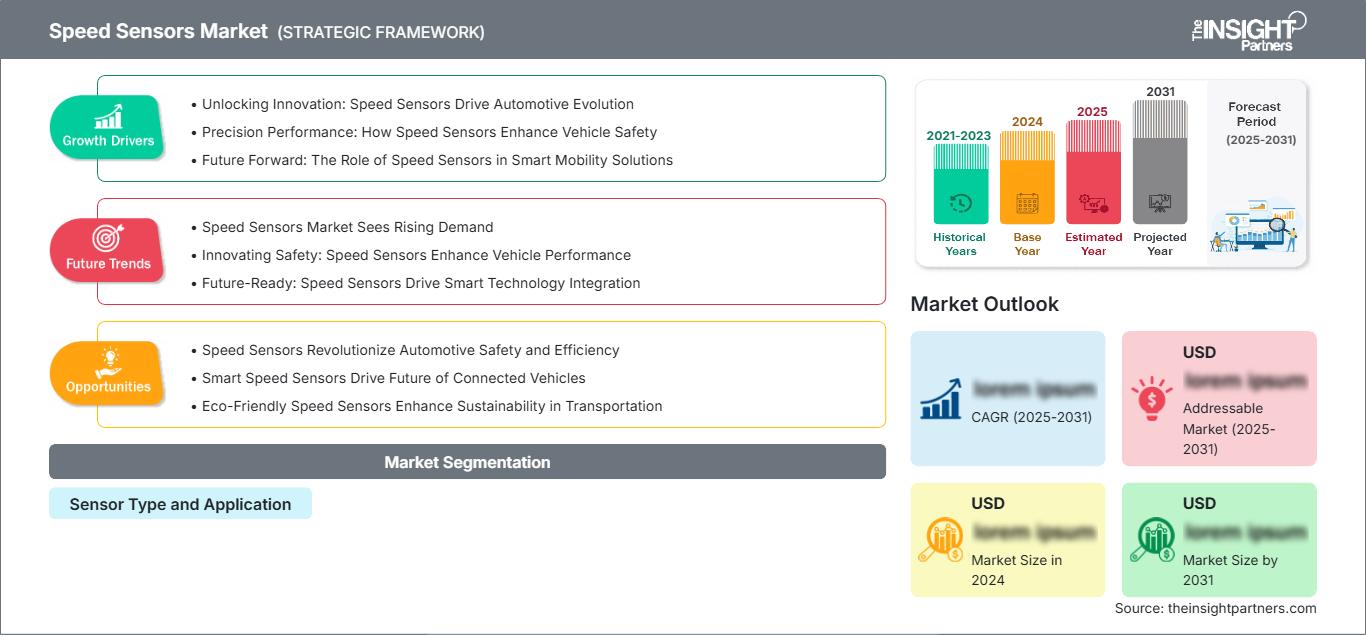
Speed Sensors Market: Strategic Insights
-
Get Top Key Market Trends of this report.This FREE sample will include data analysis, ranging from market trends to estimates and forecasts.
Speed Sensors Market Drivers and Opportunities
Market Drivers:
- Expansion of Electric and Autonomous Vehicles: The transition to EVs requires precise motor speed sensing and regenerative braking control. Furthermore, ADAS features like adaptive cruise control rely heavily on accurate speed inputs, driving market volume.
- Growth in Industrial Automation and Robotics: As factories move toward Industry 4.0, the demand for precise motion control and synchronization in robotic arms and conveyor systems has sustained high demand for industrial-grade encoders and sensors.
- Stringent Government Safety Regulations: Global mandates requiring Electronic Stability Control (ESC) and Anti-lock Braking Systems (ABS) in vehicles have made wheel speed sensors a standard and high-volume component in the automotive supply chain.
Market Opportunities:
- Integration with IoT and Predictive Maintenance: There is a significant opportunity to embed speed sensors with wireless connectivity to monitor the health of industrial turbines and motors, preventing costly downtime through real-time vibration and speed analysis.
- Development of GMR and TMR Technologies: Giant Magnetoresistive (GMR) and Tunnel Magnetoresistive (TMR) sensors offer higher sensitivity and lower power consumption, providing an opportunity to capture the high-end consumer electronics and medical device markets.
- Aerospace and Space Exploration: Increasing investments in commercial space flight and unmanned aerial vehicles (UAVs) create a demand for ultra-reliable, radiation-hardened speed sensors capable of operating in vacuum and high-G environments.
Speed Sensors Market Report Segmentation Analysis
The Speed Sensors Market share is analyzed across various segments to provide a clearer understanding of its structure, growth potential, and emerging trends. Below is the standard segmentation approach used in most industry reports:
By Technology:
- Hall Effect: Represents the largest segment due to its versatility, low cost, and ability to provide contactless sensing in automotive ignition and anti-lock braking systems.
- Magneto-Resistive: A rapidly growing segment known for high sensitivity and accuracy, making it ideal for precision gear tooth sensing and advanced industrial applications.
- Variable Reluctance: A traditional and robust technology widely used in heavy-duty industrial and automotive environments where high-temperature durability and simplicity are required.
By Application:
- Automotive: The dominant application segment, driven by the increasing number of sensors per vehicle for engine management, transmission control, and safety features.
- Industrial: Focuses on factory automation, wind turbine pitch control, and pump monitoring, where speed sensors ensure operational efficiency and safety.
- Aerospace & Defense: A high-value segment requiring ultra-reliable sensors for turbine engines, flight control surfaces, and landing gear speed monitoring.
- Consumer Electronics: Includes applications in smart home devices, fitness equipment, and cooling fans, where compact and low-power speed sensing is essential.
By Geography:
- North America
- Europe
- Asia Pacific
- South & Central America
- Middle East & Africa
Speed Sensors Market Report Scope
| Report Attribute | Details |
|---|---|
| Market size in 2025 | US$ 6.82 Billion |
| Market Size by 2034 | US$ 9.36 Billion |
| Global CAGR (2026 - 2034) | 3.57% |
| Historical Data | 2021-2024 |
| Forecast period | 2026-2034 |
| Segments Covered |
By Technology
|
| Regions and Countries Covered |
North America
|
| Market leaders and key company profiles |
|
Speed Sensors Market Players Density: Understanding Its Impact on Business Dynamics
The Speed Sensors Market is growing rapidly, driven by increasing end-user demand due to factors such as evolving consumer preferences, technological advancements, and greater awareness of the product's benefits. As demand rises, businesses are expanding their offerings, innovating to meet consumer needs, and capitalizing on emerging trends, which further fuels market growth.
Speed Sensors Market Share Analysis by Geography
Asia-Pacific is expected to grow fastest in the coming years. Emerging markets in South & Central America, the Middle East, and Africa also have many untapped opportunities for high-precision sensor manufacturers and automotive electronics suppliers to expand.
The speed sensors market is undergoing a significant transformation, moving from basic rotational monitoring to advanced integrated sensing for smart mobility and industrial IoT. Growth is driven by the global transition to electric vehicles, the mainstreaming of autonomous driving technologies, and the expansion of smart manufacturing. Below is a summary of market share and trends by region:
North America
- Market Share: A significant segment, anchored by a sophisticated aerospace industry and the rapid commercialization of Level 2+ and Level 3 autonomous vehicles.
- Key Drivers:
- Strong demand for high-reliability sensors in defense and space exploration
- Widespread adoption of electric vehicles (EVs) and smart home appliances
- Presence of leading technological innovators and stringent safety regulations in the US
- Trends: Increasing focus on miniaturized MEMS (Micro-Electro-Mechanical Systems) and the integration of speed sensors into centralized vehicle computing architectures.
Europe
- Market Share: Holds a substantial share, traditionally the second-largest region, centered on the high-performance automotive manufacturing hubs in Germany, France, and Italy.
- Key Drivers:
- Strict Euro NCAP safety standards mandating advanced braking and stability controls
- Large-scale transition toward green manufacturing and sustainable energy solutions
- Robust infrastructure for high-speed rail and industrial automation
- Trends: A strategic shift toward using high-resolution Magneto-Resistive sensors to support finer precision in transmission and engine management systems.
Asia-Pacific
- Market Share: Commands the largest global share, acting as the primary manufacturer for both the automotive and consumer electronics.
- Key Drivers:
- Massive automotive production capacity in China, Japan, and India
- Government-backed initiatives for Industry 4.0 and smart factory deployment
- Rapid urbanization leading to high demand for smart consumer devices and e-mobility
- Trends: Heavy reliance on high-volume production of Hall Effect sensors and the emergence of China as a dominant force in the global EV sensor supply chain.
South and Central America
- Market Share: An emerging market with a growing industrial base, particularly in Brazil and Argentina.
- Key Drivers:
- Modernization of machinery with electronic speed monitoring
- Increasing investments in local automotive assembly and logistics infrastructure
- Rising awareness of vehicle safety features among the growing middle-class population
- Trends: Adoption of robust Variable Reluctance sensors for heavy-duty mining equipment.
Middle East and Africa
- Market Share: A developing market transitioning toward formalized industrial and modernized transportation.
- Key Drivers:
- Expansion of the regional aviation and airport infrastructure in the Gulf
- Investments in Smart City projects requiring sophisticated traffic and infrastructure sensors
- Trends: Implementation of IoT-enabled speed sensors for predictive maintenance in the oil and gas industry and desalination plants.
High Market Density and Competition
Competition is intensifying due to the presence of established leaders such as Robert Bosch GmbH, Honeywell International Inc., and Continental AG. Global semiconductor giants like NXP Semiconductors and Infineon Technologies, alongside specialized players like Allegro MicroSystems and TE Connectivity, also contribute to a diverse and rapidly evolving landscape.
This competitive environment pushes vendors to differentiate through:
- Technological Innovation and Miniaturization: Players are vying for advancements in precision and accuracy while shrinking sensor footprints to fit into compact electronic assemblies and wearables.
- Smart Integration and Edge Computing: Competitive differentiation now depends on sensors capable of running machine learning algorithms directly on the chip, reducing the need for external data processing.
- Supply Chain Transparency and Resilience: Leading companies are adopting vertically integrated models to ensure quality and meet ethical standards, particularly for critical safety components in the automotive and aerospace sectors.
- Multi-functional Capability: Development of sensors that combine speed, direction, and position measurement into a single unit, helping OEMs reduce system complexity and costs.
Opportunities and Strategic Moves
- Partner with Automotive OEMs and Tech Giants: Forming strategic alliances to integrate speed sensors into the emerging software-defined vehicle (SDV) platforms and autonomous driving ecosystems.
- Invest in Next-Generation Materials: Developing GMR (Giant Magneto-Resistive) and TMR (Tunnel Magneto-Resistive) technologies to offer superior sensitivity and lower power consumption for high-end industrial and medical applications.
Major Companies operating in the Speed Sensors Market are:
- Robert Bosch GmbH
- Sensata Technologies Inc.
- Infineon Technologies AG
- Standex Electronics
- Freescale Semiconductor Inc.
- Denso Corporation
- Asahi Kasei Corporation
- Continental AG
- Analog Devices Inc.
- AMETEK Inc.
- Honeywell
- Sensata
- Ford Corporation
- Delphi Automotive
Disclaimer: The companies listed above are not ranked in any particular order.
Speed Sensors Market News and Recent Developments
- In May 2026, Asahi Kasei Microdevices (AKM) developed the CZ3K series current sensors for electric vehicle (EV) applications. The CZ3K series contributes to the downsizing of increasingly high-power bidirectional on-board chargers (OBCs) and DC/DC converters by offering a wide current measurement range of up to ±300A and a low primary conductor resistance of 0.27 mΩ.
- In February 2025, Vision Research announced the release of its Phantom KT-series, a new family of small, powerful, and precise high-speed cameras incorporating 1- and 4.2-megapixel (Mpx) back-side illuminated (BSI) sensors. The KT-series includes four models: the 1-Mpx KT-1610 and KT-1210, and the 4.2-Mpx KT-1640 and KT-1240. Available in both monochrome and color, they offer superior image performance in a small and lightweight form factor, making them ideal for advanced research applications.
Speed Sensors Market Report Coverage and Deliverables
The Speed Sensors Market Size and Forecast (2021–2034) report provides a detailed analysis of the market covering below areas:
- Speed Sensors Market size and forecast at global, regional, and country levels for all the key market segments covered under the scope
- Speed Sensors Market trends, as well as market dynamics such as drivers, restraints, and key opportunities
- Detailed PEST and SWOT analysis
- Speed Sensors Market analysis covering key market trends, global and regional framework, major players, regulations, and recent market developments
- Industry landscape and competition analysis covering market concentration, heat map analysis, prominent players, and recent developments in the Speed Sensors Market.
- Detailed company profiles
Frequently Asked Questions

- Comprehensive Market Sizing and Forecast Analysis
- Detailed Segmentation Analysis
- In-Depth Market Dynamics Assessment
- Regional and Country-Level Insights
- Competitive Landscape and Company Benchmarking
- Strategic Business Intelligence
Recent Reports
Testimonials

The Insight Partners' SCADA System Market report is comprehensive, with valuable insights on current trends and future forecasts. The team was highly professional, responsive, and supportive throughout. We are very satisfied and highly recommend their services.
RAN KEDEM Partner, Reali Technologies LTDs
I requested a report on a very specific software market and the team produced the report in a few days. The information was very relevant and well presented. I then requested some changes and additions to the report. The team was again very responsive and I got the final report in less than a week.
JEAN-HERVE JENN Chairman, Future Analytica
We worked with The Insight Partners for an important market study and forecast. They gave us clear insights into opportunities and risks, which helped shape our plans. Their research was easy to use and based on solid data. It helped us make smart, confident decisions. We highly recommend them.
PIYUSH NAGPAL Sr. Vice President, High Beam Global
The Insight Partners delivered insightful, well-structured market research with strong domain expertise. Their team was professional and responsive throughout. The user-friendly website made accessing industry reports seamless. We highly recommend them for reliable, high-quality research services
YUKIHIKO ADACHI CEO, Deep Blue, LLC.
This is the first time I have purchased a market report from The Insight Partners.While I was unsure at first, I visited their web site and felt more comfortable to take the risk and purchase a market report.I am completely satisfied with the quality of the report and customer service. I had several questions and comments with the initial report, but after a couple of dialogs over email with their analyst I believe I have a report that I can use as input to our strategic planning process.Thank you so much for taking the extra time and making this a positive experience.I will definitely recommend your service to others and you will be my first call when we need further market data.
JOHN SUZUKI President and Chief Executive Officer, Board Director, BK Technologies
I wish to appreciate your support and the professionalism you displayed in the course of attending to my request for information regarding to infectious disease IVD market in Nigeria. I appreciate your patience, your guidance, and the fact that you were willing to offer a discount, which eventually made it possible for us to close a deal. I look forward to engaging The Insight Partners in the future, all thanks to the impression you have created in me as a result of this first encounter.
DR CHIJIOKE ONYIA MANAGING DIRECTOR, PineCrest Healthcare Ltd.Reason to Buy
- Informed Decision-Making
- Understanding Market Dynamics
- Competitive Analysis
- Identifying Emerging Markets
- Customer Insights
- Market Forecasts
- Risk Mitigation
- Boosting Operational Efficiency
- Strategic Planning
- Investment Justification
- Tracking Industry Innovations
- Aligning with Regulatory Trends





 Get Free Sample for