
Automotive Brake Pad Market Outlook and Strategic Insights by 2028
Published Report - Automotive Brake Pad Market Forecast to 2028 - COVID-19 Impact and Global Analysis By Material Type (Metallic Brake Pad, Semi-Metallic Brake Pad, Ceramic Brake Pad, Asbestos Brake Pad, and Non-Asbestos Organic Brake pad) and Vehicle Type (Commercial Vehicle and Passenger Cars)
- Status : Published
- Report Code : TIPAR100000885
- Category : Automotive and Transportation
- No. of Pages : 144
- Available Report Formats :


- Last update date : March 10, 2023


2021 Market Size
US$ 2.58 Bn
Base year value
2028 Forecast
US$ 3.34 Bn
Projected by 2028
CAGR 2022-2028
3.8 %
Growth rate
Addressable Market
US$ 21.02 Bn
(2022-2028)
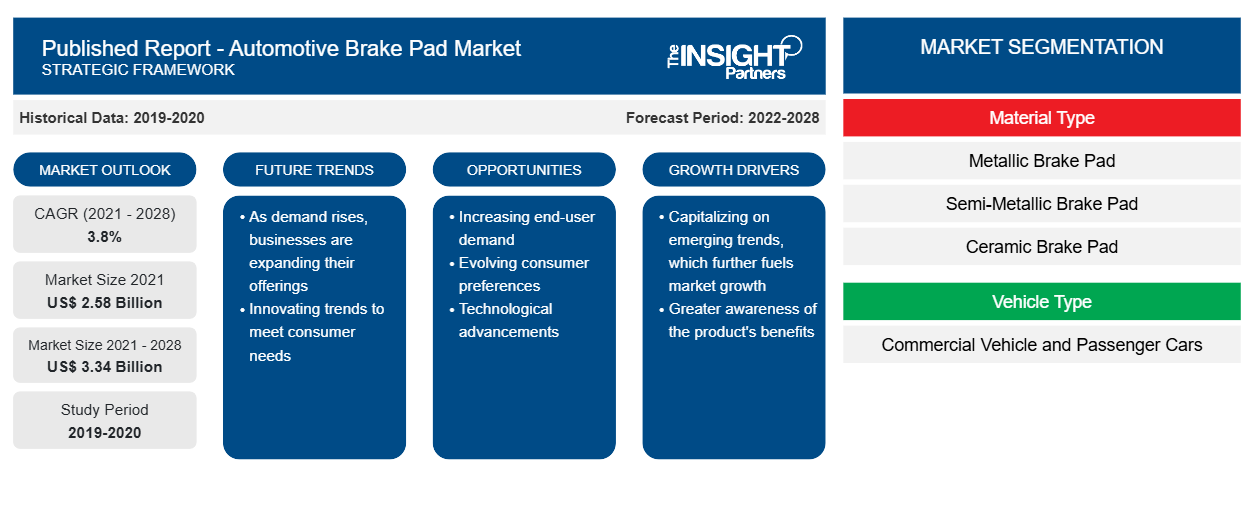
The automotive brake pad market is expected to grow from US$ 2,580.57 million in 2021 to US$ 3,342.58 million by 2028. It is estimated to grow at a CAGR of 3.8% during the period of 2021 to 2028.
Brake pads create friction between the caliper and disc, which helps stop the car when pressed against the brake disc. The absence of brake pads extends the braking distance, and heat from the friction won't disperse correctly, which could cause the whole braking system to overheat and lead to complete brake failure. Thus, brake pads are one of the crucial components among the disc braking system in automotive parts. Therefore, many brake pad manufacturers are entering this lucrative business. Car manufacturers are increasingly demanding brake pads that last the car's lifetime.
Therefore, brake pad manufacturers are focused on making pads that last longer while also catering to stringent quality and environmental requirements. For instance, in February 2021, KB Autosys, a Korean brake pad supplier, had planned to invest US$ 38 million in a new west Georgia factory by setting up a new plant in Meriwether County. Further, with an increasing focus on health, safety, and the environment, disc brake pad manufacturers (compounders) are looking for alternatives to traditional raw materials, such as copper and other materials that give rise to health and safety issues.
Automotive Brake Pad Market –
● REPORT CUSTOMIZATION
Tailor This Report To Align With Your Specific Business Requirements
This report can be customized to align precisely with your business objectives, scope, and target markets. Customization options include tailored segmentation, geography, competitive analysis, and strategic insights to support informed decision-making.
Customize This Report →WHAT YOU CAN ADJUST
- ● Segmentations
- ● Geography
- ● Competitive Analysis
- ● Language Preferences
Published Report - Automotive Brake Pad Market: Strategic Insights
-
Get Top Key Market Trends of this report.This FREE sample will include data analysis, ranging from market trends to estimates and forecasts.
Impact of COVID-19 Pandemic on Automotive brake pad Market
In 2020, due to the restriction on the manufacturing and the proclaimed lockdowns, vendors in the brake pad sector worldwide were being severely hampered, putting global automobile brake pad makers at a deficit. As governments across the world have imposed lockdowns in first half of 2020, several automotive brake pad manufacturers' demand and supply activities experienced significant drop. From the beginning of the 2021, the automotive industry started to regain its momentum and with significant space due to increasing demand of passenger vehicles from emerging countries. However, with growing automotive industry the brake pad manufacturers is regaining its pace with the resumption of operations at manufacturing units, which would boost the uptake of automotive brake pads in the coming years.
Overall, In 2020, the COVID-19 outbreak acted as a significant limitation on the automobile parts and components business, as trade restrictions and consumption disrupted supply chains fell due to government lockdowns around the world. However, during the projected period of 2021–2028, government incentives, expanding regional demand, and the easy availability of raw materials are expected to boost the automotive brake pad market expansion. For instance, India's Automobile Mission Plan FAME-II prioritizes government assistance to the country's burgeoning automotive and component manufacturing industries. Automobile parts and accessories manufacturing businesses have undergone extensive renovation in recent years, resulting in the emergence of a highly competitive industry.
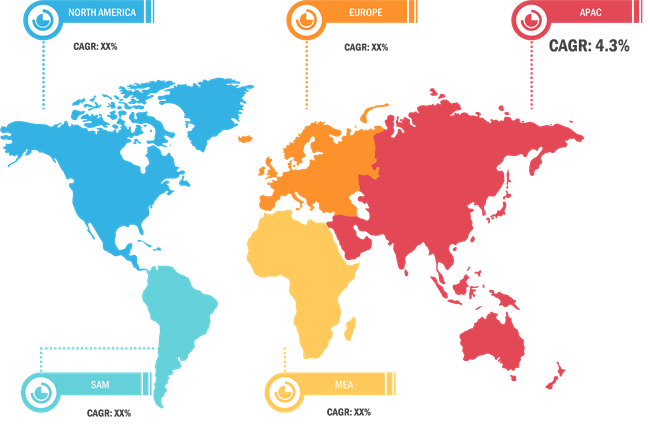
Lucrative Regions for Automotive Brake Pad Market
- This FREE sample will include data analysis, ranging from market trends to estimates and forecasts.
Automotive Brake Pad Market Insights
Growing Uptake of Electric Vehicles Fuels Brake Pad Usage, Creates Lucrative Opportunity for Automotive Brake Pad Market
The growing demand for low emission vehicles and supportive government regulations, such as subsidies & tax rebates for adopting zero-emission vehicles, is a potential trend, driving the automotive brake pad market. As per the IEA data, in 2020, the global electric car stock peaked the 10 million vehicles sales, a 43% increase from 2019.
In electric vehicles, a regenerative-hydraulic hybrid braking system is used. In the event of applying the brake, regenerative braking torque offers the same deceleration rate as available in conventional vehicles. Further, the hydraulic braking torque is applied. Electric vehicles are silent in operation, wherein a traditional brake pad creates noise, making it unfavorable for use in electric vehicles. As per the Europe commission, new emission targets set for passenger cars and light commercial vehicles for 2020 were a 37.5% decrease in carbon dioxide emissions for new cars and a 31% emission decrease for light commercial vehicles, such as vans, by 2030.
Automotive Brake Pad Market – by Material Type
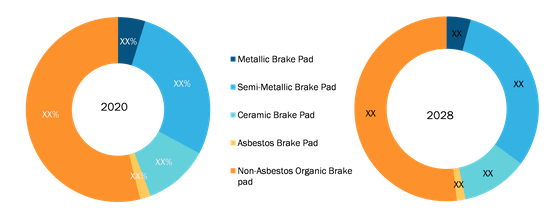
Based on material type, the global automotive brake pad market is segmented into the metallic brake pad, semi-metallic brake pad, ceramic brake pad, asbestos brake pad, and non-asbestos organic brake pad. The non-asbestos organic brake pad segment accounted for the largest share of the market in 2020. Moreover, the semi-metallic brake pad segment is projected to grow at a faster pace during the forecast period.
Automotive brake pad Market, by Material Type, 2020 and 2028 (%)
- This FREE sample will include data analysis, ranging from market trends to estimates and forecasts.
Automotive Brake Pad Market – by Vehicle Type
The automotive brake pad market is segmented into commercial vehicles and passenger vehicles based on vehicle type. The passenger vehicle segment accounted for the largest share in 2020.
Players operating in the automotive brake pad market adopt various strategies, such as mergers, acquisitions, and market initiatives, to expand their businesses. A few recent developments by key players are listed below:
- In May 2021, the thirty-fourth consecutive championship chose Brembo S.p.A. for high performance, reliability and safety components, including brake calipers, steel discs, pads, brake master cylinders, and friction master cylinders. This development would help the company to leverage its product offerings.
- In Aug 2020, Nisshinbo Holdings Inc. introduced Strong Ceramic (SC) friction material under its Nisshinbo brand. The Strong Ceramic material was developed especially for light commercial vehicles and heavy SUVs. This development helped the company build strong brand recognition for providing brake pads of different friction materials.
Published Report - Automotive Brake Pad Market Report Scope
| Report Attribute | Details |
|---|---|
| Market size in 2021 | US$ 2.58 Billion |
| Market Size by 2028 | US$ 3.34 Billion |
| Global CAGR (2021 - 2028) | 3.8% |
| Historical Data | 2019-2020 |
| Forecast period | 2022-2028 |
| Segments Covered |
By Material Type
|
| Regions and Countries Covered |
North America
|
| Market leaders and key company profiles |
|
Published Report - Automotive Brake Pad Market Players Density: Understanding Its Impact on Business Dynamics
The Published Report - Automotive Brake Pad Market is growing rapidly, driven by increasing end-user demand due to factors such as evolving consumer preferences, technological advancements, and greater awareness of the product's benefits. As demand rises, businesses are expanding their offerings, innovating to meet consumer needs, and capitalizing on emerging trends, which further fuels market growth.
Frequently Asked Questions

- Comprehensive Market Sizing and Forecast Analysis
- Detailed Segmentation Analysis
- In-Depth Market Dynamics Assessment
- Regional and Country-Level Insights
- Competitive Landscape and Company Benchmarking
- Strategic Business Intelligence
Recent Reports
Testimonials

The Insight Partners' SCADA System Market report is comprehensive, with valuable insights on current trends and future forecasts. The team was highly professional, responsive, and supportive throughout. We are very satisfied and highly recommend their services.
RAN KEDEM Partner, Reali Technologies LTDs
I requested a report on a very specific software market and the team produced the report in a few days. The information was very relevant and well presented. I then requested some changes and additions to the report. The team was again very responsive and I got the final report in less than a week.
JEAN-HERVE JENN Chairman, Future Analytica
We worked with The Insight Partners for an important market study and forecast. They gave us clear insights into opportunities and risks, which helped shape our plans. Their research was easy to use and based on solid data. It helped us make smart, confident decisions. We highly recommend them.
PIYUSH NAGPAL Sr. Vice President, High Beam Global
The Insight Partners delivered insightful, well-structured market research with strong domain expertise. Their team was professional and responsive throughout. The user-friendly website made accessing industry reports seamless. We highly recommend them for reliable, high-quality research services
YUKIHIKO ADACHI CEO, Deep Blue, LLC.
This is the first time I have purchased a market report from The Insight Partners.While I was unsure at first, I visited their web site and felt more comfortable to take the risk and purchase a market report.I am completely satisfied with the quality of the report and customer service. I had several questions and comments with the initial report, but after a couple of dialogs over email with their analyst I believe I have a report that I can use as input to our strategic planning process.Thank you so much for taking the extra time and making this a positive experience.I will definitely recommend your service to others and you will be my first call when we need further market data.
JOHN SUZUKI President and Chief Executive Officer, Board Director, BK Technologies
I wish to appreciate your support and the professionalism you displayed in the course of attending to my request for information regarding to infectious disease IVD market in Nigeria. I appreciate your patience, your guidance, and the fact that you were willing to offer a discount, which eventually made it possible for us to close a deal. I look forward to engaging The Insight Partners in the future, all thanks to the impression you have created in me as a result of this first encounter.
DR CHIJIOKE ONYIA MANAGING DIRECTOR, PineCrest Healthcare Ltd.Reason to Buy
- Informed Decision-Making
- Understanding Market Dynamics
- Competitive Analysis
- Identifying Emerging Markets
- Customer Insights
- Market Forecasts
- Risk Mitigation
- Boosting Operational Efficiency
- Strategic Planning
- Investment Justification
- Tracking Industry Innovations
- Aligning with Regulatory Trends





 Get Free Sample for