
Fiber Optic Sensor Market Dynamics and Trends by 2028
Published Report - Fiber Optic Sensor Market Forecast to 2028 - COVID-19 Impact and Global Analysis By Application (Temperature Sensing, Pressure Sensing, Acoustic Sensing, Strain Sensing, and Others) and Vertical (Oil & Gas, Manufacturing, Infrastructure, Power and Utilities, and Others)
- Status : Published
- Report Code : TIPAR100000943
- Category : Electronics and Semiconductor
- No. of Pages : 158
- Available Report Formats :


- Last update date : June 12, 2024


2020 Market Size
US$ 2.98 Bn
Base year value
2028 Forecast
US$ 5.51 Bn
Projected by 2028
CAGR 2021-2028
9.16 %
Growth rate
Addressable Market
US$ 36.08 Bn
(2021-2028)
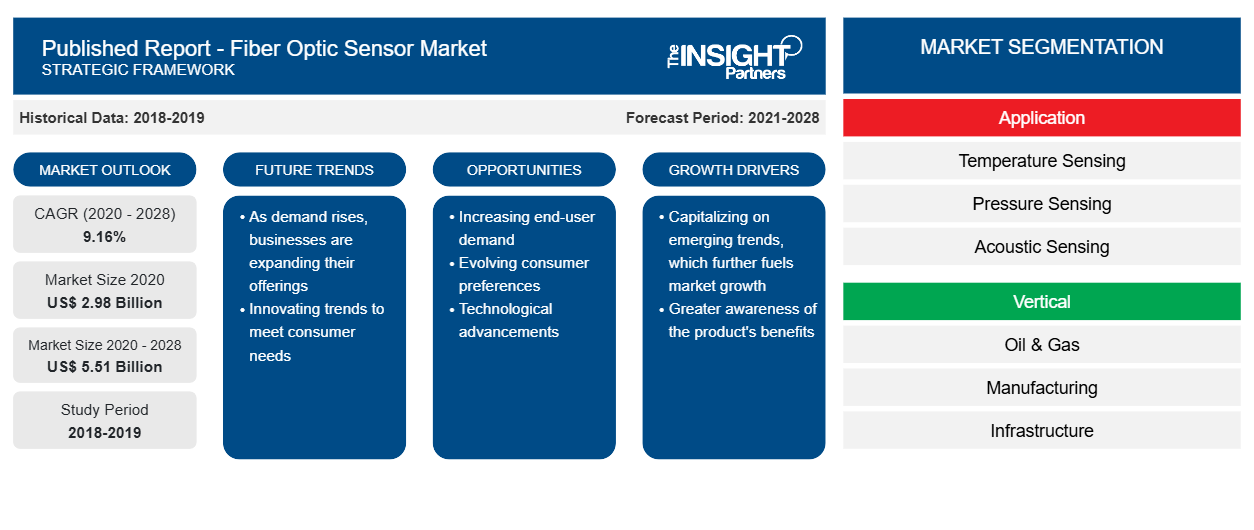
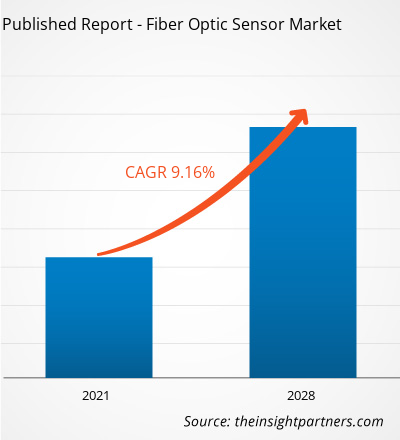
The fiber optic sensor market is projected to reach US$ 5,506.24 million by 2028 from US$ 2,980.47 million in 2021; it is estimated to register a CAGR of 9.16% during 2021-2028.
Optical fiber sensing is a technology used to measure chemical changes, strain, temperature, electric and magnetic fields, pressure, displacement, rotation, radiation, liquid level, flow, light intensity, and vibrations. The optical sensors are capable of linear and seamless sensing rather than distributed sensing; moreover, in communications applications, they serve as sensors and no electricity is needed for the sensing operations. The fiber optic sensors can also be used in high-voltage, high-temperature, or corrosive environments. Further, these sensors are capable of remote sensing. They are found in applications of oil & gas, manufacturing, infrastructure, power and utilities, automotive, and healthcare sectors, among others. In June 2019, Luna entered into a license agreement with Meggitt. This agreement is aimed at supplying fiber optic components and technology for aircraft fire and overheat detection equipment.
Impact of COVID-19 Pandemic on Fiber Optic Sensor Market
The COVID-19 pandemic created enormous disruption across industries, including electronics and semiconductors. Every phase of the business model has witnessed a drastic change, including the manufacturing units, capital expenditures, R&D, demand, supply chain, production decisions, and mergers and acquisitions (M & M&A). Over the past several months, the COVID-19 outbreak had severely challenged the electronics and manufacturers in strategy making. The disruption among raw material suppliers, temporary closure of manufacturing units, limited funding, and weak demand from customers have showcased adverse impact on the electronics and semiconductor manufacturers.
● REPORT CUSTOMIZATION
Tailor This Report To Align With Your Specific Business Requirements
This report can be customized to align precisely with your business objectives, scope, and target markets. Customization options include tailored segmentation, geography, competitive analysis, and strategic insights to support informed decision-making.
Customize This Report →WHAT YOU CAN ADJUST
- ● Segmentations
- ● Geography
- ● Competitive Analysis
- ● Language Preferences
Published Report - Fiber Optic Sensor Market: Strategic Insights
-
Get Top Key Market Trends of this report.This FREE sample will include data analysis, ranging from market trends to estimates and forecasts.
Fiber Optic Sensors: Market Insights
Escalating Demand in Automotive Sector Fuels Growth of Fiber Optic Sensors Market
In the automotive sector, fiber optic sensors are used in lighting applications. The fiber transmits cold light, making it a safe alternative to traditional sealed beam or halogen lighting. Apart from the safety advantages, the light source is easily accessible and offers greater freedom of design. The deployment of fiber optics also allows the separation of light source and output location, thereby providing high-performance lighting options with reduced physical space requirements, making them suitable for difficult and restricted access locations. The sensors are also used in automobiles in onboard safety devices and systems, such as operating airbags, traction control devices, and safety systems. According to the Organisation Internationale des Constructeurs d'Automobiles (OICA), ~91.3 million vehicles were sold across the world in 2019. Further, the rising disposable incomes, mainly in emerging countries in APAC, promotes the sales of passenger vehicles, in turn, will fuel the adoption of fiber optic sensors. Thus, the rising annual automotive sales are a significant factor contributing to the growth of the fiber optic sensor market.
Application-Based Market Insights
Based on application, the fiber optic sensor market is segmented into temperature sensing, pressure sensing, acoustic sensing, strain sensing, and others. The temperature sensing segment held the largest market share in 2020.
Vertical-Based Market Insights
Based on vertical, the fiber optic sensor market is segmented into oil & gas, manufacturing, infrastructure, power and utilities, and others. The oil & gas segment held the largest market share in 2020.
The players operating in the fiber optic sensor market adopt strategies such as mergers, acquisitions, and market initiatives to maintain their positions in the market. A few developments by key players are listed below:
- In April 2020, AOMS Technologies and PCL Construction entered a partnership to make IoT-enabled "Smart Construction" a new reality. This partnership is expected to further enhance Job Site Insights (JSI) and PCLS's cloud-based construction platform.
- In May 2020, Omnisens SA announced the release of ODAS, its new family of Distributed Acoustic Sensing (DAS) interrogators that combines chirped pulse laser technology with Omnisens' techniques on programmable chirp coding and modulation.
Fiber Optic Sensor
Published Report - Fiber Optic Sensor Market Report Scope
| Report Attribute | Details |
|---|---|
| Market size in 2020 | US$ 2.98 Billion |
| Market Size by 2028 | US$ 5.51 Billion |
| Global CAGR (2020 - 2028) | 9.16% |
| Historical Data | 2018-2019 |
| Forecast period | 2021-2028 |
| Segments Covered |
By Application
|
| Regions and Countries Covered |
North America
|
| Market leaders and key company profiles |
|
Published Report - Fiber Optic Sensor Market Players Density: Understanding Its Impact on Business Dynamics
The Published Report - Fiber Optic Sensor Market is growing rapidly, driven by increasing end-user demand due to factors such as evolving consumer preferences, technological advancements, and greater awareness of the product's benefits. As demand rises, businesses are expanding their offerings, innovating to meet consumer needs, and capitalizing on emerging trends, which further fuels market growth.
The global fiber optic sensor market has been segmented as mentioned below:
By Application
- Temperature Sensing
- Pressure Sensing
- Acoustic Sensing
- Strain Sensing
- Others
By Vertical
- Oil & Gas
- Manufacturing
- Infrastructure
- Power and Utilities
- Others
By Geography
- North America
- US
- Canada
- Mexico
- Europe
- France
- Germany
- Italy
- UK
- Russia
- Rest of Europe
- Asia Pacific (APAC)
- China
- India
- South Korea
- Japan
- Australia
- Rest of APAC
- Middle East & Africa (MEA)
- South Africa
- Saudi Arabia
- UAE
- Rest of MEA
- South America (SAM)
- Brazil
- Argentina
- Rest of SAM
Company Profiles
- AOMS Technologies
- Davidson Instruments
- Omnisens SA
- Solifos AG
- Baumer Holding AG
- Keyence Corporation
- OMRON Corporation
- Luna Innovations Inc
- SICK AG
- Yokogawa Electric Corporation
Frequently Asked Questions

- Comprehensive Market Sizing and Forecast Analysis
- Detailed Segmentation Analysis
- In-Depth Market Dynamics Assessment
- Regional and Country-Level Insights
- Competitive Landscape and Company Benchmarking
- Strategic Business Intelligence
Recent Reports
Testimonials

The Insight Partners' SCADA System Market report is comprehensive, with valuable insights on current trends and future forecasts. The team was highly professional, responsive, and supportive throughout. We are very satisfied and highly recommend their services.
RAN KEDEM Partner, Reali Technologies LTDs
I requested a report on a very specific software market and the team produced the report in a few days. The information was very relevant and well presented. I then requested some changes and additions to the report. The team was again very responsive and I got the final report in less than a week.
JEAN-HERVE JENN Chairman, Future Analytica
We worked with The Insight Partners for an important market study and forecast. They gave us clear insights into opportunities and risks, which helped shape our plans. Their research was easy to use and based on solid data. It helped us make smart, confident decisions. We highly recommend them.
PIYUSH NAGPAL Sr. Vice President, High Beam Global
The Insight Partners delivered insightful, well-structured market research with strong domain expertise. Their team was professional and responsive throughout. The user-friendly website made accessing industry reports seamless. We highly recommend them for reliable, high-quality research services
YUKIHIKO ADACHI CEO, Deep Blue, LLC.
This is the first time I have purchased a market report from The Insight Partners.While I was unsure at first, I visited their web site and felt more comfortable to take the risk and purchase a market report.I am completely satisfied with the quality of the report and customer service. I had several questions and comments with the initial report, but after a couple of dialogs over email with their analyst I believe I have a report that I can use as input to our strategic planning process.Thank you so much for taking the extra time and making this a positive experience.I will definitely recommend your service to others and you will be my first call when we need further market data.
JOHN SUZUKI President and Chief Executive Officer, Board Director, BK Technologies
I wish to appreciate your support and the professionalism you displayed in the course of attending to my request for information regarding to infectious disease IVD market in Nigeria. I appreciate your patience, your guidance, and the fact that you were willing to offer a discount, which eventually made it possible for us to close a deal. I look forward to engaging The Insight Partners in the future, all thanks to the impression you have created in me as a result of this first encounter.
DR CHIJIOKE ONYIA MANAGING DIRECTOR, PineCrest Healthcare Ltd.Reason to Buy
- Informed Decision-Making
- Understanding Market Dynamics
- Competitive Analysis
- Identifying Emerging Markets
- Customer Insights
- Market Forecasts
- Risk Mitigation
- Boosting Operational Efficiency
- Strategic Planning
- Investment Justification
- Tracking Industry Innovations
- Aligning with Regulatory Trends





 Get Free Sample for