
Frozen Food Market Size and Competitive Analysis by 2028
Published Report - Frozen Food Market Forecast to 2028 - COVID-19 Impact and Global Analysis By Type (Frozen Desserts; Frozen Bakery; Frozen Meat, Poultry, and Seafood; Frozen Ready Meals; Frozen Snacks and Appetizers; Others) and By Distribution Channel (Supermarkets and Hypermarkets, Convenience Stores, Online Retail, and Others)
- Status : Published
- Report Code : TIPAR00004541
- Category : Food and Beverages
- No. of Pages : 190
- Available Report Formats :


- Last update date : June 14, 2024


2021 Market Size
US$ 251.16 Bn
Base year value
2028 Forecast
US$ 373.77 Bn
Projected by 2028
CAGR 2022-2028
5.9 %
Growth rate
Addressable Market
US$ 2,225.78 Bn
(2022-2028)
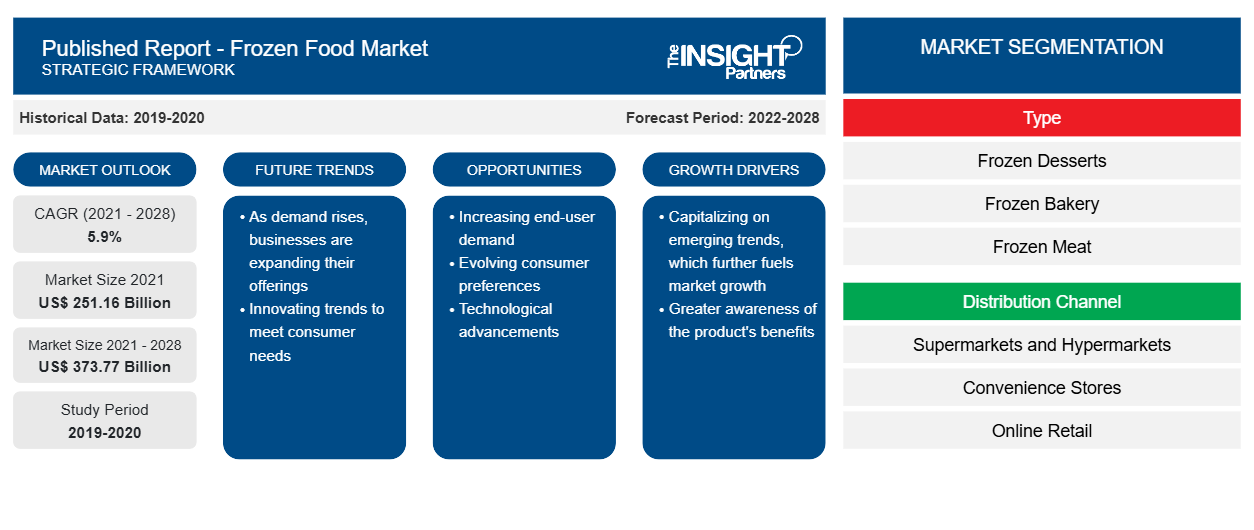
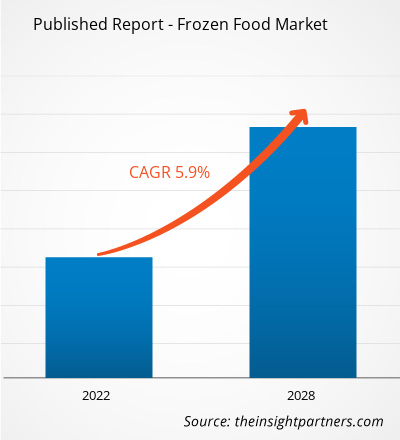
[Research Report] The frozen food market is expected to grow from US$ 251,155.35 million in 2021 to US$ 373,767.59 million by 2028; it is expected to grow at a CAGR of 5.9% from 2022 to 2028.
Market Insights and Analyst View:
Frozen food includes ice cream, frozen yogurt, frozen meat, frozen seafood, frozen ready meals, snacks, appetizers, soups, fruits, and vegetables. These products are preserved by freezing them around -25 degree Celsius. Frozen food products do not contain artificial preservatives making them healthier than other processed food. Moreover, they can be easily stored in home freezers with temperature at 0-degree Fahrenheit. The rising demand for convenience food owing to the hectic lifestyle of people is driving the growth of frozen food market. Moreover, rapid urbanization, rising per capita income, and changing retail scenario are some of the key factors driving the frozen food market growth.
Growth Drivers and Challenges:
Flourishment of e-commerce has been driving the global frozen food market growth. In recent years, there has been a massive transformation in the organized retail sector. The emergence of e-commerce has resulted in considerable changes in the way people shop and spend their money. The increasing penetration of smartphones and the internet, easy access to emerging technologies, rising purchasing power, and convenience provided by online retail platforms of shopping from anywhere at any time are among the key factors bolstering e-commerce. These platforms are adopting a significant frozen food marketing strategy, which further boosted the sales of frozen food. According to the US Department of Commerce Retail Indicator Division, e-commerce sales, frozen food market in the US reached US$ 870 billion in 2021, up by 14.2% from 2020. Furthermore, online sales for groceries grew by 170% in 2021, accounting for 9.6% of total grocery sales in the US.
People are increasingly preferring online retail platforms for purchasing frozen foods. According to American Frozen Food Institute, online sales of frozen food products increased by 75% in 2020. The online sales of food and beverages rose significantly during the pandemic due to the shutdown of brick-and-mortar stores and the imposition of social restrictions by governments. As people’s movement was constrained by lockdowns and they were compelled to work from their homes, there was a substantial shift to online shopping. Moreover, heavy discounts, wide availability of different brands under one roof, and home delivery options have been other notable factors driving consumers’ focus toward online shopping. With the rising penetration of e-commerce across different geographies, the manufacturers of frozen foods such as Kellogg's Company, Conagra Brandsare also enlarging their online presence by selling their products through well-known e-commerce platforms such as Amazon.com, Lidl, and Walmart. This factor contributes to the growth of the frozen food market by eliminating the dependency on offline retail stores.
● REPORT CUSTOMIZATION
Tailor This Report To Align With Your Specific Business Requirements
This report can be customized to align precisely with your business objectives, scope, and target markets. Customization options include tailored segmentation, geography, competitive analysis, and strategic insights to support informed decision-making.
Customize This Report →WHAT YOU CAN ADJUST
- ● Segmentations
- ● Geography
- ● Competitive Analysis
- ● Language Preferences
Published Report - Frozen Food Market: Strategic Insights
-
Get Top Key Market Trends of this report.This FREE sample will include data analysis, ranging from market trends to estimates and forecasts.
Report Segmentation and Scope:
The “Global Frozen Food Market” is segmented based on type, distribution channel, and geography. Based on type, the frozen food market is segmented into frozen desserts; frozen meat, poultry, & seafood; frozen bakery; frozen snacks & appetizers; frozen ready meals; and others. Based on distribution channel, the frozen food market is segmented into supermarkets & hypermarkets, convenience stores, online retail, and others. The frozen food market based on geography is segmented into North America (US, Canada, and Mexico), Europe (Germany, France, Italy, UK, Russia, and Rest of Europe), Asia Pacific (Australia, China, Japan, India, South Korea, and Rest of Asia Pacific), Middle East & Africa (South Africa, Saudi Arabia, UAE, and Rest of Middle East & Africa), and South & Central America (Brazil, Argentina, and Rest of South & Central America).
Segmental Analysis:
Based on distribution channel, the frozen food market is segmented into supermarkets & hypermarkets, convenience stores, online retail, and others. The supermarkets and hypermarkets segment held the significant share in the frozen food market growth and is expected to register the significant growth over the forecast period. Supermarkets and hypermarkets stores offer attractive discounts, multiple payment options, and a pleasant customer experience. Supermarkets and hypermarkets focus on maximizing product sales to increase their profit. Frozen food distribution companies , and frozen foods manufacturers usually prefer to sell their products through supermarkets and hypermarkets owing to heavy customer footfall at such stores. Moreover, such stores have modern storage facilities which ensure ideal storage conditions for frozen foods.
Regional Analysis:
Based on geography, the frozen food market is divided into five key regions: North America, Europe, Asia Pacific, South & Central America, and Middle East & Africa. The global frozen food market was dominated by Europe in 2022, and it has accounted around US$ 85,000 million during the forecast period. The Europe frozen food market is segmented into Germany, France, Italy, the UK, Russia, and the Rest of Europe. The market growth is mainly attributed to the rising demand for convenience food, extensive retail infrastructure, and availability of a wide range of products of different brands across different distribution channels. Moreover, the presence of consumers with high per-capita income is also driving the demand for frozen food, such as frozen meals, and snacks. Consumers are seeking nutritional benefits from the products they consume. Therefore, the demand for clean, organic, gluten-free, and minimally processed frozen food has increased significantly, which is boosting the market growth in the region.
The frozen food market is projected to witness significant growth in the coming years due to the significant presence of prominent players, such as Nestle S.A. and Bounduelle Group, operating actively across Europe. Moreover, these companies offer a broad array of frozen foods, including frozen desserts, frozen bakeries, frozen ready meals, frozen meat, and frozen soups. This factor is expected to boost the frozen food market growth over the forecast period.
Industry Developments and Future Opportunities:
Various initiatives taken by the key players operating in the frozen food market are listed below:
- In June 2021, Conagra Brands Incorporated has added new products to its company portfolio, encompassing new meals from its brands, Banquet, Healthy Choice, Hungry Man and Marie Callender's. The Healthy Choice Max product delivers 33-34g of proteins, with delicious flavors, whereas Healthy Choice Zero is a keto-friendly meal with no added sugar and less than 10 g carbohydrates.
- In November 2021, General Mills partnered with Regrow Agriculture to monitor agriculture at scale.
- In January 2022, Pepperidge Farm expanded its product category for Goldfish brand, aiming to attract adults, by launching crackers in two varieties, Sharp Cheddar and Cheddar Jalapeno and other limited-edition Goldfish with Frank’s RedHot sauce and Jalapeño Popper Goldfish crackers. The cracker are termed megabites.
- In May 2021, Bonduelle Group launched three new products namely, lentils, chickpeas and bulgur, in frozen foods segment, under brand Bonduelle.
Frozen Food
Published Report - Frozen Food Market Report Scope
| Report Attribute | Details |
|---|---|
| Market size in 2021 | US$ 251.16 Billion |
| Market Size by 2028 | US$ 373.77 Billion |
| Global CAGR (2021 - 2028) | 5.9% |
| Historical Data | 2019-2020 |
| Forecast period | 2022-2028 |
| Segments Covered |
By Type
|
| Regions and Countries Covered |
North America
|
| Market leaders and key company profiles |
|
Published Report - Frozen Food Market Players Density: Understanding Its Impact on Business Dynamics
The Published Report - Frozen Food Market is growing rapidly, driven by increasing end-user demand due to factors such as evolving consumer preferences, technological advancements, and greater awareness of the product's benefits. As demand rises, businesses are expanding their offerings, innovating to meet consumer needs, and capitalizing on emerging trends, which further fuels market growth.
Covid-19 Impact:
People were mandated to stay at home due to lockdowns and travel restrictions. Moreover, due to work-from-home mandates, the at-home consumption trend in frozen food emerged significantly during the pandemic. As people stayed in their homes, the dietary habits of consumers changed with increased munching and cooking at home. This factor also created a massive demand for frozen food. The CEO of Kraft Heinz Co. made the official announcement in March 2020 that the business is making every effort to close the demand-supply imbalance as a result of the profound changes taking place in the food industry. The company acknowledged that frozen food, macaroni, cheese, and vinegar are some of its best-selling products and that demand for them has increased significantly due to the coronavirus outbreak. As people continued working from home due to the outbreak, they stocked up their pantries, positively impacting frozen food sales. Moreover, as schools and colleges remained closed, children had enough time for breakfast, positively impacting the sales of frozen breakfast products, including frozen breakfast cereals, pancakes, pizzas, and cakes. For instance, The Kellogg Company stated that the financial results in the second quarter of 2020 were better than expected due to the increased demand for its breakfast cereals and frozen waffles. Also, the frozen food manufacturers are focusing on enhancing their online presence by offering their products through e-commerce platforms such as Amazon.com, Walmart, and Lidl. This factor is expected to positively impact the growth of the frozen food market over the forecast period. Further, the value-added services are key differentiation strategy, that can frozen food distributors may adopt to increase the frozen food sales including, veg frozen food, frozen ready-to-eat, frozen entrée, frozen snack, etc.
Competitive Landscape and Key Companies:
Some of the prominent players operating in the global frozen food market include Conagra Brands, General Mills, Pepperidge Farm Incorporated, Bonduelle Group, McCain Foods Limited, Bellisio Foods, Inc., Tyson Foods, Inc., Kellogg's Company, Nestlé S.A., and The Kraft Heinz Company, among others. These players offer cutting-edge frozen food with innovative features to deliver superior experience to the consumers.
Frequently Asked Questions

- Comprehensive Market Sizing and Forecast Analysis
- Detailed Segmentation Analysis
- In-Depth Market Dynamics Assessment
- Regional and Country-Level Insights
- Competitive Landscape and Company Benchmarking
- Strategic Business Intelligence
Recent Reports
Testimonials

The Insight Partners' SCADA System Market report is comprehensive, with valuable insights on current trends and future forecasts. The team was highly professional, responsive, and supportive throughout. We are very satisfied and highly recommend their services.
RAN KEDEM Partner, Reali Technologies LTDs
I requested a report on a very specific software market and the team produced the report in a few days. The information was very relevant and well presented. I then requested some changes and additions to the report. The team was again very responsive and I got the final report in less than a week.
JEAN-HERVE JENN Chairman, Future Analytica
We worked with The Insight Partners for an important market study and forecast. They gave us clear insights into opportunities and risks, which helped shape our plans. Their research was easy to use and based on solid data. It helped us make smart, confident decisions. We highly recommend them.
PIYUSH NAGPAL Sr. Vice President, High Beam Global
The Insight Partners delivered insightful, well-structured market research with strong domain expertise. Their team was professional and responsive throughout. The user-friendly website made accessing industry reports seamless. We highly recommend them for reliable, high-quality research services
YUKIHIKO ADACHI CEO, Deep Blue, LLC.
This is the first time I have purchased a market report from The Insight Partners.While I was unsure at first, I visited their web site and felt more comfortable to take the risk and purchase a market report.I am completely satisfied with the quality of the report and customer service. I had several questions and comments with the initial report, but after a couple of dialogs over email with their analyst I believe I have a report that I can use as input to our strategic planning process.Thank you so much for taking the extra time and making this a positive experience.I will definitely recommend your service to others and you will be my first call when we need further market data.
JOHN SUZUKI President and Chief Executive Officer, Board Director, BK Technologies
I wish to appreciate your support and the professionalism you displayed in the course of attending to my request for information regarding to infectious disease IVD market in Nigeria. I appreciate your patience, your guidance, and the fact that you were willing to offer a discount, which eventually made it possible for us to close a deal. I look forward to engaging The Insight Partners in the future, all thanks to the impression you have created in me as a result of this first encounter.
DR CHIJIOKE ONYIA MANAGING DIRECTOR, PineCrest Healthcare Ltd.Reason to Buy
- Informed Decision-Making
- Understanding Market Dynamics
- Competitive Analysis
- Identifying Emerging Markets
- Customer Insights
- Market Forecasts
- Risk Mitigation
- Boosting Operational Efficiency
- Strategic Planning
- Investment Justification
- Tracking Industry Innovations
- Aligning with Regulatory Trends





 Get Free Sample for