
Cellular IoT Market Growth and Forecast by 2027
Published Report - Cellular IoT Market to 2027 - Global Analysis and Forecasts by Technology (2G & 3G, 4G, LTE-M, NB-IoT, and 5G); End-Use Industry (Industrial, Infrastructure & Construction, Retail, Consumer Electronics, Automotive & Transportation, Energy & Utilities, Healthcare, and Others)
- Status : Published
- Report Code : TIPAR00003104
- Category : Technology, Media and Telecommunications
- No. of Pages : 150
- Available Report Formats :


- Last update date : June 13, 2024


2018 Market Size
US$ 2.95 Bn
Base year value
2027 Forecast
US$ 18.28 Bn
Projected by 2027
CAGR 2019-2027
22.6 %
Growth rate
Addressable Market
US$ 84.14 Bn
(2019-2027)
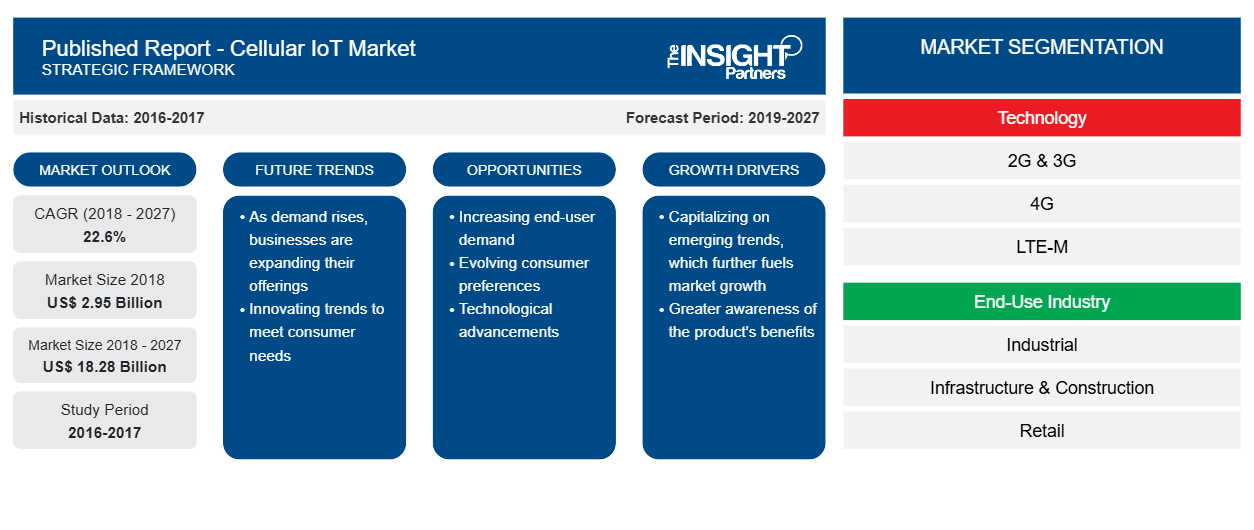
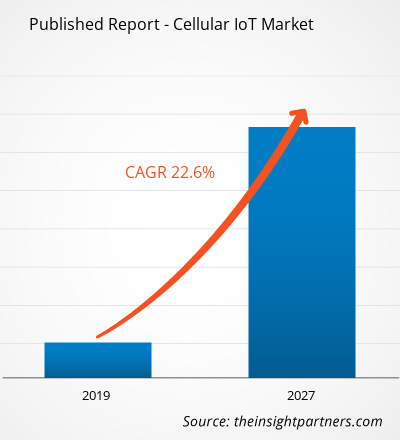
The cellular IoT market was valued at US$ 2,946.3 million in 2018 and is projected to reach US$ 18,280.7 million by 2027; it is expected to grow at a CAGR of 22.6% from 2019 to 2027.
Factors such as increasing levels of disposable income, availability of affordable smartphones, and internet plans with low tariff is leading to the rapid adoption of smartphones and other consumer electronics around the world, which is driving the growth of “connected things” or IoT. In addition to this, the increasing number of IoT use cases in smart homes, smart cities, smart transportation, and smart buildings is further driving the demand for IoT connected devices. Ericsson Mobility Report (2019) estimated the rise in overall number of IoT connections worldwide from 10.8 billion in 2019 to 24.9 billion in 2025 at CAGR of 15%. These connections include wide area IoT connections, Cellular IoT connections, and short-range IoT connections. The investments in IoT start-ups and supporting market ecosystem are also fuelling the research and development of IoT technology. The major technology companies in the US, China, and Europe are playing important role in the development of IoT solutions. Google, Microsoft, Cisco, Amazon, GE, Qualcomm, Intel, and Samsung have also invested a considerable amount in the similar activities. For the successful deployment of IoT across industries, there is a growing demand for robust connectivity technologies. Hence, such increasing investments in communication technologies such as 5G, NB-IoT, and LTE-M at an unprecedented pace are driving the Cellular IoT market growth globally.
● REPORT CUSTOMIZATION
Tailor This Report To Align With Your Specific Business Requirements
This report can be customized to align precisely with your business objectives, scope, and target markets. Customization options include tailored segmentation, geography, competitive analysis, and strategic insights to support informed decision-making.
Customize This Report →WHAT YOU CAN ADJUST
- ● Segmentations
- ● Geography
- ● Competitive Analysis
- ● Language Preferences
Published Report - Cellular IoT Market: Strategic Insights
-
Get Top Key Market Trends of this report.This FREE sample will include data analysis, ranging from market trends to estimates and forecasts.
Market Insights
Growing applications of IoT in automotive sector
Automotive is the fastest-growing sector in terms of the implementation of IoT, especially in applications such as in-vehicle infotainment, predictive maintenance, security, data analytics, dashboard reporting, and real-time monitoring. Increasing disposable incomes and rising middle class population are the major factors driving the sales of passenger cars in emerging markets of the world. According to Organisation Internationale des Constructeurs d’Automobiles (OICA) estimates, the global passenger car registrations reached 68,690,468 worldwide in 2018. Moreover, the production of passenger cars worldwide reached 70,567,581 units in the last quarter of 2018. Such high level of competition in the global automotive sector is propelling the companies operating this space to adopt advanced technologies such as IoT and AI. Audi, BMW, General Motors, Mercedes-Benz, and Jaguar-Land Rover are a few of the major automakers offering advanced infotainment systems integrated with various technologies into their cars. The demand for connected vehicles and rising investments in autonomous vehicles are further boosting the adoption of IoT and efficient communication technologies, such as 4G and 5G. Automotive systems wherein IoT is implemented include logistics management, fleet management, telematics, sensor sharing, advanced driver assistance systems, infotainment, and autonomous driving. Thus, the expansion of application of IoT in such systems, along with continuous technological advancements, in the automotive sector is fueling the Cellular IoT market growth.
Technology Market Insights
The cellular IoT market is bifurcated on basis of technology into 2G & 3G, 4G, LTE-M, NB-IoT, and 5G. With growing number of mobile subscriptions and increasing demand for highly efficient networks that can handle rising data traffic, network operators are continuously focusing on innovating and improving communication technologies. The fast replacement of older 2G networks with 3G/4G, increasing 5G testing across the world, and advanced NB-IoT & LTE-M technologies are among the factors that are anticipated to drive the cellular IoT market in the coming years.
End Use Industry Market Insight
The cellular IoT market is bifurcated on basis of end use industry into industrial, infrastructure & construction, retail, consumer electronics, automotive & transportation, energy & utilities, healthcare, and others. The other industries include finance, education, hospitality, and agriculture. The others category varies across regions/countries on the basis of major industries present in those specific regions/countries.
The players operating in the enterprise content management market focus on strategies such as mergers, acquisitions, and market initiatives to maintain their positions in the market. A few developments by key players are listed below:
Cellular IoT
Published Report - Cellular IoT Market Report Scope
| Report Attribute | Details |
|---|---|
| Market size in 2018 | US$ 2.95 Billion |
| Market Size by 2027 | US$ 18.28 Billion |
| Global CAGR (2018 - 2027) | 22.6% |
| Historical Data | 2016-2017 |
| Forecast period | 2019-2027 |
| Segments Covered |
By Technology
|
| Regions and Countries Covered |
North America
|
| Market leaders and key company profiles |
|
Published Report - Cellular IoT Market Players Density: Understanding Its Impact on Business Dynamics
The Published Report - Cellular IoT Market is growing rapidly, driven by increasing end-user demand due to factors such as evolving consumer preferences, technological advancements, and greater awareness of the product's benefits. As demand rises, businesses are expanding their offerings, innovating to meet consumer needs, and capitalizing on emerging trends, which further fuels market growth.
- In January 2020, Ericsson and VodafoneZiggo introduced an all-new 5G co-creation environment in the Netherlands. The 5G HUB consists of training facilities, testing laboratories, and a demo studio with IoT and 5G capabilities. The hub would cater to startups, companies, and students a chance to unleash 5G in practice.
- In August 2018, Arm acquired Treasure Data to set the stage for IoT transformation. The new Arm Pelion IoT Platform will enable organizations to quickly, securely and sustainably create actionable insights from IoT, enterprise and third-party data.
Global Cellular IoT Market Segments:
Cellular IoT Market – By Technology
- 2G & 3G
- 4G
- LTE-M
- NB-IoT
- 5G
Cellular IoT Market – By End-Use Industry
- Industrial
- Infrastructure & Construction
- Retail
- Consumer Electronics
- Automotive & Transportation
- Energy & Utilities
- Healthcare
Cellular IoT Market – By Geography
-
North America
- U.S.
- Canada
- Mexico
-
Europe
- France
- Germany
- Italy
- Spain
- UK
- Rest of Europe
-
Asia Pacific (APAC)
- Australia
- China
- India
- Japan
- Rest of APAC
-
Middle East & Africa (MEA)
- Saudi Arabia
- UAE
- South Africa
- Rest of MEA
-
South America (SAM)
- Brazil
- Rest of SAM
Companies
- AT&T INC
- ARM Holdings Plc
- Telefonaktiebolaget LM Ericsson
- Huawei Technologies Co., Ltd.
- MediaTek Inc.
- Qualcomm Incorporated
- Sierra Wireless, Inc.
- Sequans Communications SA
- Thales Group
- ZTE Corporation
Frequently Asked Questions

- Comprehensive Market Sizing and Forecast Analysis
- Detailed Segmentation Analysis
- In-Depth Market Dynamics Assessment
- Regional and Country-Level Insights
- Competitive Landscape and Company Benchmarking
- Strategic Business Intelligence
Recent Reports
Testimonials

The Insight Partners' SCADA System Market report is comprehensive, with valuable insights on current trends and future forecasts. The team was highly professional, responsive, and supportive throughout. We are very satisfied and highly recommend their services.
RAN KEDEM Partner, Reali Technologies LTDs
I requested a report on a very specific software market and the team produced the report in a few days. The information was very relevant and well presented. I then requested some changes and additions to the report. The team was again very responsive and I got the final report in less than a week.
JEAN-HERVE JENN Chairman, Future Analytica
We worked with The Insight Partners for an important market study and forecast. They gave us clear insights into opportunities and risks, which helped shape our plans. Their research was easy to use and based on solid data. It helped us make smart, confident decisions. We highly recommend them.
PIYUSH NAGPAL Sr. Vice President, High Beam Global
The Insight Partners delivered insightful, well-structured market research with strong domain expertise. Their team was professional and responsive throughout. The user-friendly website made accessing industry reports seamless. We highly recommend them for reliable, high-quality research services
YUKIHIKO ADACHI CEO, Deep Blue, LLC.
This is the first time I have purchased a market report from The Insight Partners.While I was unsure at first, I visited their web site and felt more comfortable to take the risk and purchase a market report.I am completely satisfied with the quality of the report and customer service. I had several questions and comments with the initial report, but after a couple of dialogs over email with their analyst I believe I have a report that I can use as input to our strategic planning process.Thank you so much for taking the extra time and making this a positive experience.I will definitely recommend your service to others and you will be my first call when we need further market data.
JOHN SUZUKI President and Chief Executive Officer, Board Director, BK Technologies
I wish to appreciate your support and the professionalism you displayed in the course of attending to my request for information regarding to infectious disease IVD market in Nigeria. I appreciate your patience, your guidance, and the fact that you were willing to offer a discount, which eventually made it possible for us to close a deal. I look forward to engaging The Insight Partners in the future, all thanks to the impression you have created in me as a result of this first encounter.
DR CHIJIOKE ONYIA MANAGING DIRECTOR, PineCrest Healthcare Ltd.Reason to Buy
- Informed Decision-Making
- Understanding Market Dynamics
- Competitive Analysis
- Identifying Emerging Markets
- Customer Insights
- Market Forecasts
- Risk Mitigation
- Boosting Operational Efficiency
- Strategic Planning
- Investment Justification
- Tracking Industry Innovations
- Aligning with Regulatory Trends





 Get Free Sample for