
Offshore Pipeline Market Share and Forecast by 2027
Published Report - Offshore Pipeline Market Forecast to 2027 - COVID-19 Impact and Global Analysis by Diameter (More than 24 inches and Less than 24 inches), Line Type (Export Line, Transport Line, and Others), and Product (Oil, Gas, and Refined Products)
- Status : Published
- Report Code : TIPAR00006141
- Category : Energy and Power
- No. of Pages : 166
- Available Report Formats :


- Last update date : June 17, 2024


2019 Market Size
US$ 11.97 Bn
Base year value
2027 Forecast
US$ 15.01 Bn
Projected by 2027
CAGR 2020-2027
3.1 %
Growth rate
Addressable Market
US$ 110.13 Bn
(2020-2027)
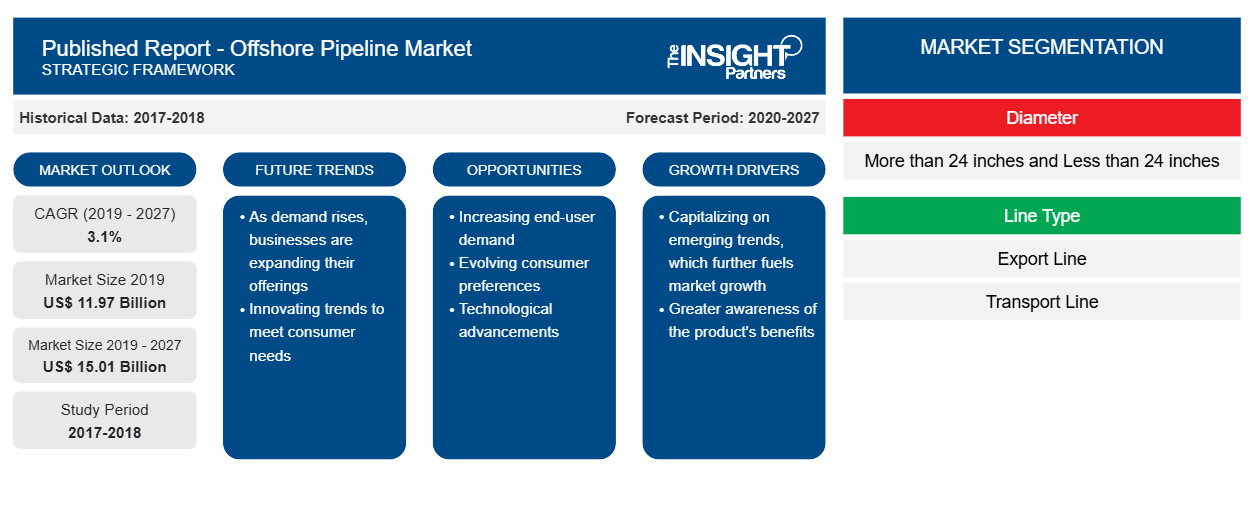
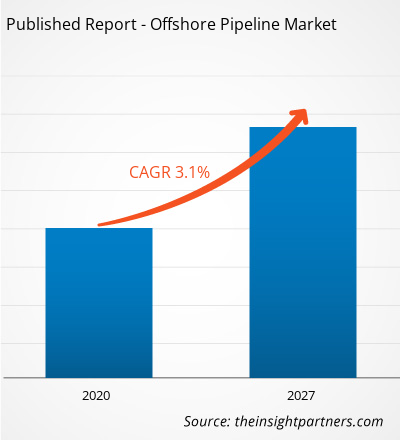
[Research Report] The offshore pipeline market was valued at US$ 11.97 billion in 2019 and is projected to reach US$ 15.01 billion by 2027; it is expected to grow at a CAGR of 3.1% from 2020 to 2027.
The global offshore pipeline market comprises a substantial number of market players, resulting in a fragmented global market. Bechtel Corporation; Fugro; John Wood Group PLC; Larsen & Toubro Limited; McDermott International, Inc.; Petrofac Limited; Saipem S.p.A.; Sapura Energy Berhad; Subsea 7 S.A.; and TechnipFMC plc are a few of the players operating in the market with the considerable customer base, big contracts, and strong market position. These players significantly invest in the expansion of their business competencies to sustain their market position..
Currently, the global offshore pipeline market is dominated by Europe and North America accounting for the ~60% of the global market share collectively. The increasing demand for cost-effective transportation method for oil and gas is one of the major factors expected to boost the demand for offshore pipeline in the oversea oil & gas sector across these two regions.
● REPORT CUSTOMIZATION
Tailor This Report To Align With Your Specific Business Requirements
This report can be customized to align precisely with your business objectives, scope, and target markets. Customization options include tailored segmentation, geography, competitive analysis, and strategic insights to support informed decision-making.
Customize This Report →WHAT YOU CAN ADJUST
- ● Segmentations
- ● Geography
- ● Competitive Analysis
- ● Language Preferences
Published Report - Offshore Pipeline Market: Strategic Insights
-
Get Top Key Market Trends of this report.This FREE sample will include data analysis, ranging from market trends to estimates and forecasts.
Impact of COVID-19 Pandemic on Offshore Pipeline Market
The COVID-19 outbreak is adversely affecting various industries across the world. Major countries in Europe, Asia Pacific, and North America are imposing strict measures on business activities and transportation. These factors are putting restrictions on supply and demand for various pipeline systems and services; which are hindering the revenue growth of the global offshore pipeline market players, and it is likely to continue till early 2021.
Offshore pipeline Market Insights
Rise in Demand for Natural Gas and Crude Oil
The demand for natural gas and crude oil is constantly increasing across the world. For instance, the demand for oil was increased by 1.3% globally in 2018 due to the robust growth of oil industry in the US. According to the International Energy Agency forecasts, the oil demand in Q3 of 2019 was rose by 1.1 million of barrels per day (Mbd), which was more than double as compared to the previous quarter. The US and China have presented the most considerable growth. The surge in petrochemical demand across the US resulted in increased consumption. Growing industrial production with high demand for trucking services drive the need for petrochemicals, which fuels the growth of the offshore pipeline market. The growth in air traffic volumes worldwide, particularly in Asia's developing economies, is another factor increasing oil consumption.
Diameter-Based Market Insights
Based on diameter, the offshore pipeline market is bifurcated into more than 24 inches and less than 24 inches. The more than 24 inches segment is expected to register a higher CAGR during the forecast period. It is anticipated that ~35,000 km of 24 inches pipeline network will be completed globally during 2018–2023, which is supporting the market growth for more than 24 inches diameter segment. The hydrocarbon flow and pressure are controlled based on the diameter of the pipe. A few of the major contractors in the market are the National Petroleum Construction Company (NPCC), Saipem, and McDermott International.
Line Type-Based Market Insights
The offshore pipeline market, by line type, is segmented into transport line, export line, and other lines. The transport line segment is anticipated to dominate the market during the forecast period. Offshore pipelines are a key component of any offshore oil and gas project. These pipelines are used to transport oil and gas products from underwater wells to the platform, and consequently oil and gas from the platform to the shore for further process and distribution.
Product-Based Market Insights
The offshore pipeline market, by product, is segmented into oil, gas, and refined product. The refined product segment is expected to dominate the market during the forecast period owing to its increasing demand, particularly from the developing economies across the world. Oil pipelines are used for carrying crude oil to refineries from subsea or within the oilfield. These include export lines, feeder lines, and flowlines. These pipelines are not very large in length. Further, the market for oil segment is expected to grow owing to the construction of new refineries due to increasing discoveries of new oilfields worldwide.
Players operating in the offshore pipeline market focus on strategies such as market initiatives, acquisitions, and product launches to maintain their positions in the market. A few developments by the key players are:
In 2020, Sapura Energy Berhad won several new contracts for its Engineering and Construction (E&C) division with a combined value of ~766 million Malaysian ringgit (US$ 180 million). One of those projects is a contract for the PRP7 Pipeline Replacement Project by Brunei Shell Petroleum Co. Sdn Bhd.
In 2019, Subsea 7 announced the award of a sizeable contract by Aker BP for the Hod Field Development Project, located 12 km from the Valhall area in the southern part of the North Sea. The contract scope includes EPCI for pipelines, umbilicals, and tie-ins using key vessels from Subsea 7’s modern fleet.
Offshore Pipeline
Published Report - Offshore Pipeline Market Report Scope
| Report Attribute | Details |
|---|---|
| Market size in 2019 | US$ 11.97 Billion |
| Market Size by 2027 | US$ 15.01 Billion |
| Global CAGR (2019 - 2027) | 3.1% |
| Historical Data | 2017-2018 |
| Forecast period | 2020-2027 |
| Segments Covered |
By Diameter
|
| Regions and Countries Covered |
North America
|
| Market leaders and key company profiles |
|
Published Report - Offshore Pipeline Market Players Density: Understanding Its Impact on Business Dynamics
The Published Report - Offshore Pipeline Market is growing rapidly, driven by increasing end-user demand due to factors such as evolving consumer preferences, technological advancements, and greater awareness of the product's benefits. As demand rises, businesses are expanding their offerings, innovating to meet consumer needs, and capitalizing on emerging trends, which further fuels market growth.
Offshore Pipeline Market – by Diameter
- More than 24 inches
- Less than 24 inches
Offshore Pipeline Market – by Line Type
- Export Line
- Transport
- Others
Offshore Pipeline Market – by Product
- Oil
- Gas
- Refined Products
Offshore Pipeline Market – by Geography
-
North America
- US
- Canada
- Mexico
-
Europe
- UK
- Germany
- France
- Italy
- Russia
- Rest of Europe
-
Asia Pacific (APAC)
- China
- Japan
- India
- Australia
- South Korea
- Rest of APAC
-
Middle East and Africa (MEA)
- Saudi Arabia
- UAE
- South Africa
- Rest of MEA
-
South America (SAM)
- Brazil
- Argentina
- Rest of SAM
Offshore Pipeline Market – Company Profiles
- Bechtel Corporation
- Fugro
- John Wood Group PLC
- Larsen & Toubro Limited
- McDermott International, Inc.
- Petrofac Limited
- Saipem S.p.A.
- Sapura Energy Berhad
- Subsea 7 S.A.
- TechnipFMC plc
Frequently Asked Questions

- Comprehensive Market Sizing and Forecast Analysis
- Detailed Segmentation Analysis
- In-Depth Market Dynamics Assessment
- Regional and Country-Level Insights
- Competitive Landscape and Company Benchmarking
- Strategic Business Intelligence
Recent Reports
Testimonials

The Insight Partners' SCADA System Market report is comprehensive, with valuable insights on current trends and future forecasts. The team was highly professional, responsive, and supportive throughout. We are very satisfied and highly recommend their services.
RAN KEDEM Partner, Reali Technologies LTDs
I requested a report on a very specific software market and the team produced the report in a few days. The information was very relevant and well presented. I then requested some changes and additions to the report. The team was again very responsive and I got the final report in less than a week.
JEAN-HERVE JENN Chairman, Future Analytica
We worked with The Insight Partners for an important market study and forecast. They gave us clear insights into opportunities and risks, which helped shape our plans. Their research was easy to use and based on solid data. It helped us make smart, confident decisions. We highly recommend them.
PIYUSH NAGPAL Sr. Vice President, High Beam Global
The Insight Partners delivered insightful, well-structured market research with strong domain expertise. Their team was professional and responsive throughout. The user-friendly website made accessing industry reports seamless. We highly recommend them for reliable, high-quality research services
YUKIHIKO ADACHI CEO, Deep Blue, LLC.
This is the first time I have purchased a market report from The Insight Partners.While I was unsure at first, I visited their web site and felt more comfortable to take the risk and purchase a market report.I am completely satisfied with the quality of the report and customer service. I had several questions and comments with the initial report, but after a couple of dialogs over email with their analyst I believe I have a report that I can use as input to our strategic planning process.Thank you so much for taking the extra time and making this a positive experience.I will definitely recommend your service to others and you will be my first call when we need further market data.
JOHN SUZUKI President and Chief Executive Officer, Board Director, BK Technologies
I wish to appreciate your support and the professionalism you displayed in the course of attending to my request for information regarding to infectious disease IVD market in Nigeria. I appreciate your patience, your guidance, and the fact that you were willing to offer a discount, which eventually made it possible for us to close a deal. I look forward to engaging The Insight Partners in the future, all thanks to the impression you have created in me as a result of this first encounter.
DR CHIJIOKE ONYIA MANAGING DIRECTOR, PineCrest Healthcare Ltd.Reason to Buy
- Informed Decision-Making
- Understanding Market Dynamics
- Competitive Analysis
- Identifying Emerging Markets
- Customer Insights
- Market Forecasts
- Risk Mitigation
- Boosting Operational Efficiency
- Strategic Planning
- Investment Justification
- Tracking Industry Innovations
- Aligning with Regulatory Trends





 Get Free Sample for