
Oilfield Service Market Analysis and Opportunities by 2028
Published Report - Oilfield Service Market Forecast to 2028 - COVID-19 Impact and Global Analysis By Application (Onshore and Offshore) and Service Type (Well Completion, Wire Line, Artificial Lift, Perforation, Drilling and Completion Fluids, and Others)
- Status : Published
- Report Code : TIPAR100001361
- Category : Energy and Power
- No. of Pages : 151
- Available Report Formats :


- Last update date : January 05, 2023


2021 Market Size
US$ 96.47 Bn
Base year value
2028 Forecast
US$ 145.96 Bn
Projected by 2028
CAGR 2022-2028
6.1 %
Growth rate
Addressable Market
US$ 861.77 Bn
(2022-2028)
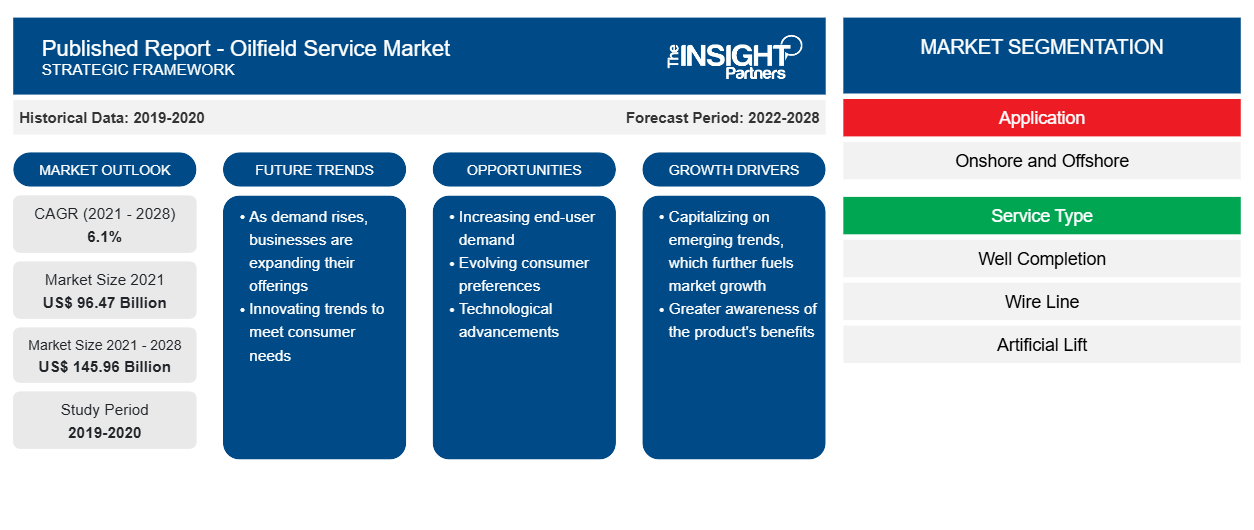
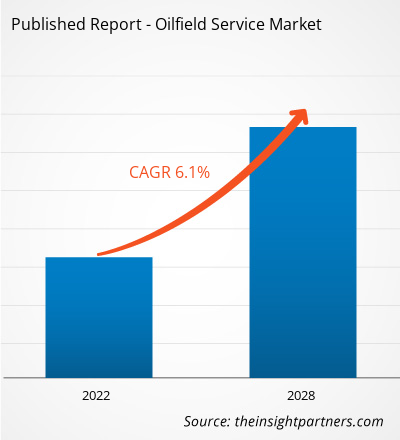
The oilfield service market was valued at US$ 96,465.86 million in 2021 and is projected to reach US$ 145,963.08 million by 2028; it is expected to grow at a CAGR of 6.1% from 2021 to 2028.
Oilfield services comprise a variety of oilfield-related operations, such as exploration, drilling, stimulation, completion, intervention, and production, throughout the life cycle of a well. Oilfield services assist operators in controlling subsurface pressures, reducing borehole erosion, minimizing formation damage, optimizing drilling parameters, and analyzing penetration rate and hole cleaning. Technological advancements in oilfield equipment has increased efficiency in resource extraction and management. Furthermore, prominent corporations have turned to technology-based services to meet the increased demand for oil and gas. Other factors contributing to the rising use of technologically-enhanced oilfield services include increased accuracy and precision and decreased time and labor costs. Hence, oilfield service market is predicted to develop rapidly in the coming years as oil and gas production and shale gas extraction expand across the world.
Due to increased energy demand and lucrative investment prospects in the oil & gas industry, production and exploration activities are increasing. For instance, in July 2019, i3 Energy PLC awarded Baker Hughes GE an oilfield service contract to drill at the Liberator and Serenity assets in the North Sea. Furthermore, by 2035, unconventional onshore oil production will be doubled to roughly 22 Mbpd, accounting for nearly 30% of world crude oil production. As a result, increased production and development operations in the oil & gas industry are predicted to drive the oilfield service market growth in the future.
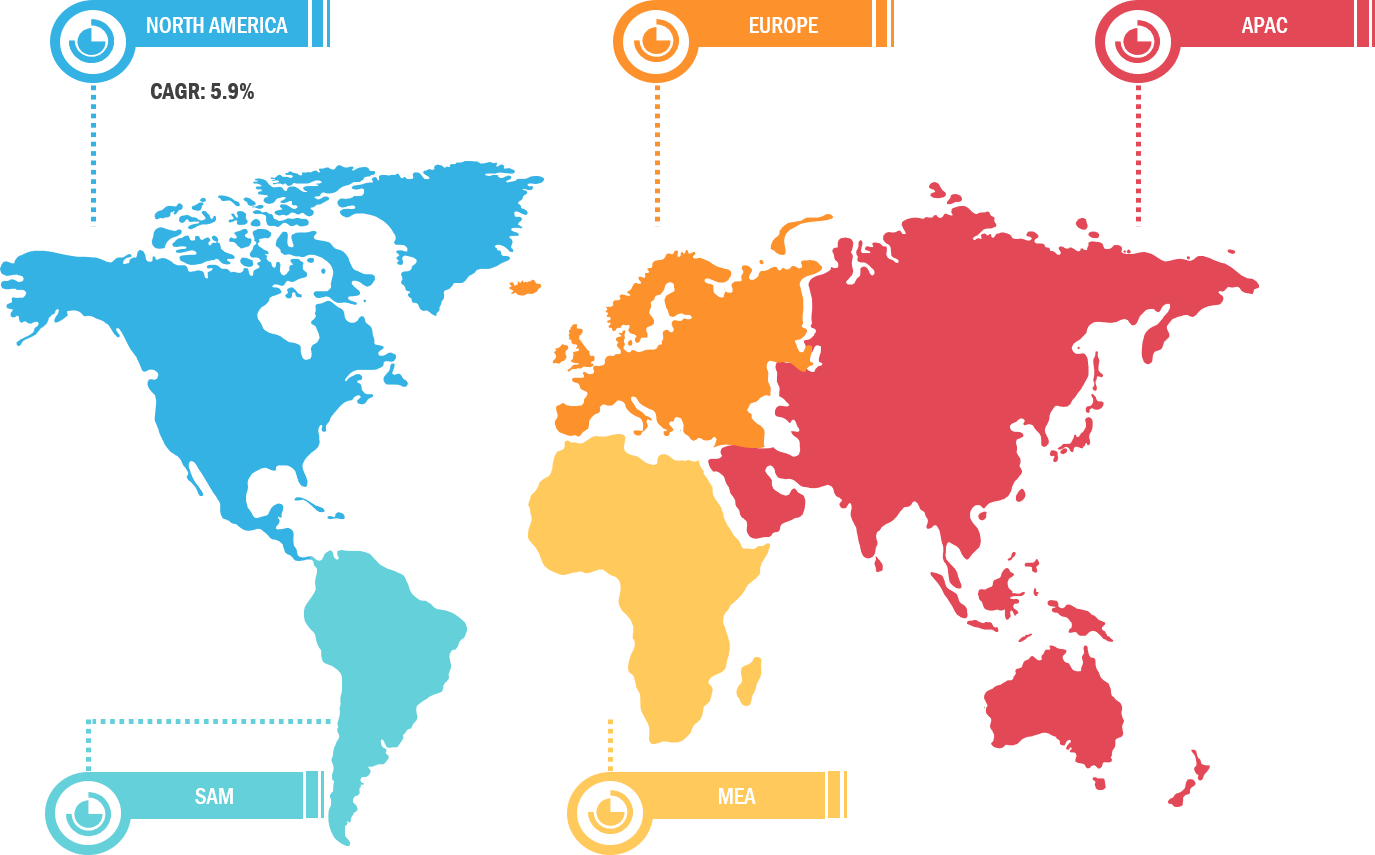
Based on application, the oilfield service market is bifurcated into onshore and offshore. Based on service type, the market is segmented into well completion, wire line, artificial lift, perforation, drilling and completion fluids, and others. By geography, the oilfield service market is segmented into North America, Europe, Asia Pacific, Middle East and Africa, and South America.
● REPORT CUSTOMIZATION
Tailor This Report To Align With Your Specific Business Requirements
This report can be customized to align precisely with your business objectives, scope, and target markets. Customization options include tailored segmentation, geography, competitive analysis, and strategic insights to support informed decision-making.
Customize This Report →WHAT YOU CAN ADJUST
- ● Segmentations
- ● Geography
- ● Competitive Analysis
- ● Language Preferences
Published Report - Oilfield Service Market: Strategic Insights
-
Get Top Key Market Trends of this report.This FREE sample will include data analysis, ranging from market trends to estimates and forecasts.
Impact of COVID-19 Pandemic on Oilfield Service Market
The oilfield service market disrupted in 2020 due to the COVID-19 outbreak. Steps taken by corporations and governments to restrict the virus spread have resulted in a significant and rapid decrease in transportation and related operations, affecting demand for oil and gas. According to the International Energy Agency (IEA), geopolitical events boosted the supply of low-cost oil to the global market while decreasing demand owing to the pandemic's onset, resulting in a drop in oil prices in March 2020. Such incidents have reduced the demand for oil and natural gas, and intervention services and supplies, which have resulted in severe volatility in oil prices. The West Texas Intermediate (WTI) oil price was US$ 61.1 on December 31, 2019, and it was US$ 23.4 on March 23, 2020, a drop of more than 60.0%. As of April 2020, OPEC and other oil-producing nations have agreed to cut oil output by 10 million barrels per day (BPD), or around 23.0% of current levels. The implementation of COVID-19-related restrictions has hindered the expansion of the oilfield service market The crisis has pushed some existing production to cease because low oil prices are uneconomical to continue production operations. Furthermore, the fast accumulation of oil stockpiles has depleted available storage capacity in a few places globally, even leading to negative pricing. Several oilfield service businesses have filed for bankruptcy and are reorganizing their capital assets. Furthermore, they reported significant revenue decreases in 2020, compared to 2019. For example, Halliburton (US) reported a 55.1% loss in sales in 2020, whereas Schlumberger (US), Baker Hughes (US), and Weatherford International (US) recorded yearly revenue declines of 39.5%, 15.1%, and 34.5%, respectively.
Lucrative Regions for Oilfield Service Market
- This FREE sample will include data analysis, ranging from market trends to estimates and forecasts.
Market Insights – Oilfield Service Market
Rising Oil and Gas Production and Exploration (E&P) Activities
The oilfield service market is being pushed by increased exploration and production activities due to the rising demand for energy across the world. Growing urbanization and industrialization, and rapid technology improvements have contributed considerably to the oilfield service market growth. The upstream portion of the oil and gas business is exploration and production (E&P), and it encompasses the phases of search, exploration, drilling, and extraction. The exploration and production (E&P) sector is the first oil and gas production stage. Furthermore, conventional onshore oil output will be more than quadruple to roughly 22 Mbpd by 2035, accounting for nearly 30% of total world crude oil production. In addition, recent discoveries in the Americas may increase the region's world-class geography for hydrocarbon development and production in the following years, providing significant new investment possibilities in exploration and production (E&P) firms. Advances are the identification and development of new subsurface potential (for instance, unconventional resources in Argentina and deep-water resources in Brazil) and the introduction of appealing access and tax regimes to stimulate new investments (for instance, energy reforms in Mexico, new fiscal terms in Argentina, and moves toward non-Petrobras operatorship in Brazil). Due to increased energy demand across Asia Pacific, driven by fast economic development, the region is becoming highly reliant on oil and gas imports. Therefore, Asia Pacific countries are boosting their offshore exploration and production (E&P) efforts to improve local energy output and reduce reliance on imported oil and gas. As a result, rising production and exploration activities in the oil & gas sector fuel the growth of the oilfield service market.
Application-Based Insights
Based on application, the oilfield service market is bifurcated into onshore and offshore. Increased onshore activities in various nations, such as China and Saudi Arabia, due to rising demand for natural gas and crude oil have boosted industry expansion. Meanwhile, the market for the offshore segment is predicted to grow significantly during the forecast period due to the development of existing offshore wells and rising investments in deep and ultra-deep-water drilling activities and subsea oil and gas assets. Furthermore, the increasing number of offshore rigs across the world and rising investments by the top oil and gas firms are projected to boost the oilfield service market in the coming years.
Service Type-Based Insights
Based on service type, the global oilfield service market is segmented into well completion, wire line, artificial lift, perforation, drilling and completion fluids, and others. The oilfield services business is an essential partner for oil exploration and production enterprises. They offer onshore and offshore oil well maintenance, completion, production, supply, and logistical support services. Oilfield services firms, in general, build, repair, and maintain equipment used in the production and transportation of oil. This oil is expected to grow in the coming years due to the rising consumption of oil, increasing usage of internal sources of finance, and technological improvements.
Players operating in the oilfield service market are mainly focused on the development of advanced and efficient products.
- In 2022, Baker Hughes announced partnership and investment in NET Powers. The partnerships will enable the company to accelerate the oilfield service market development of zero-emissions power plant.
- In April 2021, Nov Inc and Chevron announced their collaboration. The collaboration will accelerate and enhance the delivery and development of technologically advanced products and services. Nov Inc will benefit from this collaboration in the development of the next-generation subsea systems.
Published Report - Oilfield Service Market Report Scope
| Report Attribute | Details |
|---|---|
| Market size in 2021 | US$ 96.47 Billion |
| Market Size by 2028 | US$ 145.96 Billion |
| Global CAGR (2021 - 2028) | 6.1% |
| Historical Data | 2019-2020 |
| Forecast period | 2022-2028 |
| Segments Covered |
By Application
|
| Regions and Countries Covered |
North America
|
| Market leaders and key company profiles |
|
Published Report - Oilfield Service Market Players Density: Understanding Its Impact on Business Dynamics
The Published Report - Oilfield Service Market is growing rapidly, driven by increasing end-user demand due to factors such as evolving consumer preferences, technological advancements, and greater awareness of the product's benefits. As demand rises, businesses are expanding their offerings, innovating to meet consumer needs, and capitalizing on emerging trends, which further fuels market growth.
Frequently Asked Questions

- Comprehensive Market Sizing and Forecast Analysis
- Detailed Segmentation Analysis
- In-Depth Market Dynamics Assessment
- Regional and Country-Level Insights
- Competitive Landscape and Company Benchmarking
- Strategic Business Intelligence
Recent Reports
Testimonials

The Insight Partners' SCADA System Market report is comprehensive, with valuable insights on current trends and future forecasts. The team was highly professional, responsive, and supportive throughout. We are very satisfied and highly recommend their services.
RAN KEDEM Partner, Reali Technologies LTDs
I requested a report on a very specific software market and the team produced the report in a few days. The information was very relevant and well presented. I then requested some changes and additions to the report. The team was again very responsive and I got the final report in less than a week.
JEAN-HERVE JENN Chairman, Future Analytica
We worked with The Insight Partners for an important market study and forecast. They gave us clear insights into opportunities and risks, which helped shape our plans. Their research was easy to use and based on solid data. It helped us make smart, confident decisions. We highly recommend them.
PIYUSH NAGPAL Sr. Vice President, High Beam Global
The Insight Partners delivered insightful, well-structured market research with strong domain expertise. Their team was professional and responsive throughout. The user-friendly website made accessing industry reports seamless. We highly recommend them for reliable, high-quality research services
YUKIHIKO ADACHI CEO, Deep Blue, LLC.
This is the first time I have purchased a market report from The Insight Partners.While I was unsure at first, I visited their web site and felt more comfortable to take the risk and purchase a market report.I am completely satisfied with the quality of the report and customer service. I had several questions and comments with the initial report, but after a couple of dialogs over email with their analyst I believe I have a report that I can use as input to our strategic planning process.Thank you so much for taking the extra time and making this a positive experience.I will definitely recommend your service to others and you will be my first call when we need further market data.
JOHN SUZUKI President and Chief Executive Officer, Board Director, BK Technologies
I wish to appreciate your support and the professionalism you displayed in the course of attending to my request for information regarding to infectious disease IVD market in Nigeria. I appreciate your patience, your guidance, and the fact that you were willing to offer a discount, which eventually made it possible for us to close a deal. I look forward to engaging The Insight Partners in the future, all thanks to the impression you have created in me as a result of this first encounter.
DR CHIJIOKE ONYIA MANAGING DIRECTOR, PineCrest Healthcare Ltd.Reason to Buy
- Informed Decision-Making
- Understanding Market Dynamics
- Competitive Analysis
- Identifying Emerging Markets
- Customer Insights
- Market Forecasts
- Risk Mitigation
- Boosting Operational Efficiency
- Strategic Planning
- Investment Justification
- Tracking Industry Innovations
- Aligning with Regulatory Trends





 Get Free Sample for