
Pain Management Devices Market Key Companies and SWOT Analysis by 2027
Published Report - Pain Management Devices Market Forecast to 2027 - COVID-19 Impact and Global Analysis by Product Type (Neuromodulation Devices, Ablation Devices, Analgesic Infusion Pumps); Application (Neuropathic Pain, Cancer Pain, Facial Pain and Migraine, Musculoskeletal Pain, Others); and Geography
- Status : Published
- Report Code : TIPAR100000860
- Category : Life Sciences
- No. of Pages : 197
- Available Report Formats :


- Last update date : June 12, 2024


2019 Market Size
US$ 4.53 Bn
Base year value
2027 Forecast
US$ 8.39 Bn
Projected by 2027
CAGR 2020-2027
8.1 %
Growth rate
Addressable Market
US$ 52.28 Bn
(2020-2027)
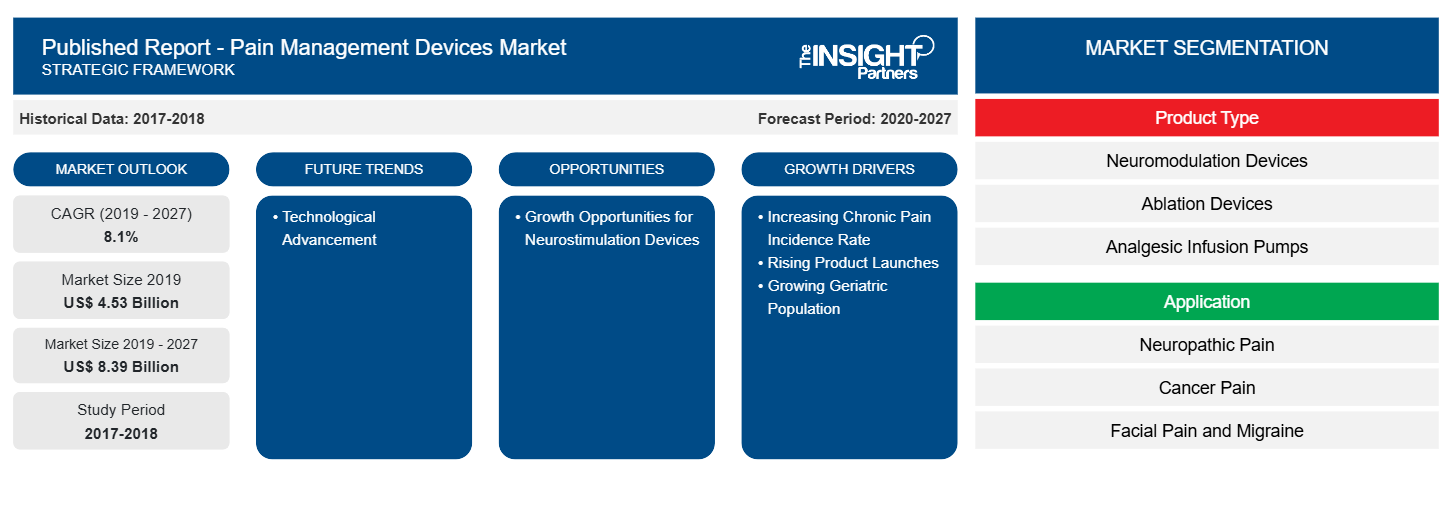
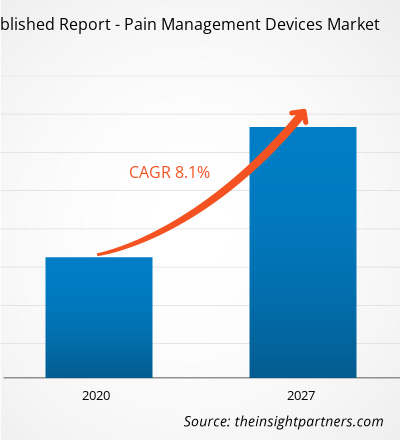
[Research Report] The pain management devices market is expected to reach US$ 8,388.67 million in 2027 from US$ 4,527.31 million in 2019. The market is estimated to grow with a CAGR of 8.1% from 2020 to 2027.
Market Insights and Analyst View:
Pain management devices control or manage the pain caused by arthritis, an old injury, and cancer treatments. Devices are used according to the individual's difficulty due to the pain; the devices are available in hospitals and can be used during pain management therapy or bought over the counter. Pain management devices are used for the implantation, replacement, or other surgical management of a device required to treat pain. Infusion pumps or neurostimulator are used to treat nerve pain and chest pain caused by coronary heart diseases. The demand for pain management devices is continuously growing due to the increasing chronic pain incidence rate, rising product launches, and growing geriatric population.
Growth Drivers and Challenges:
The increasing incidences of chronic diseases such as cancer, cardiovascular diseases, neurovascular diseases, and musculoskeletal diseases are likely to drive the growth of the pain management devices market. These diseases critically affect a person's health by lowering immunity and resulting in chronic pain. Chronic pain is most commonly seen in adults and geriatric populations. For instance, according to the Centers for Disease Control and Prevention, during 2021, an estimated 20.9% of U.S. adults (51.6 million persons) experienced chronic pain, and 6.9% (17.1 million persons) experienced high-impact chronic pain.
Nevertheless, chronic pain diseases are also noticeable among children. Furthermore, incidences of chronic pain are commonly seen among athletes, sportspersons, and people living with past injuries. Chronic pain incidences increase a person's dependency on others for various daily tasks. Therefore, pain management is essential to carry out a normal daily routine. Pain management devices relieve longer durations and improve their health. A wearable pain management device is easy to use and operate; thus, it reduces the person's dependency on others. Therefore, due to pain management devices' advantages, the demand is rising among patients with chronic diseases.
● REPORT CUSTOMIZATION
Tailor This Report To Align With Your Specific Business Requirements
This report can be customized to align precisely with your business objectives, scope, and target markets. Customization options include tailored segmentation, geography, competitive analysis, and strategic insights to support informed decision-making.
Customize This Report →WHAT YOU CAN ADJUST
- ● Segmentations
- ● Geography
- ● Competitive Analysis
- ● Language Preferences
Published Report - Pain Management Devices Market: Strategic Insights
-
Get Top Key Market Trends of this report.This FREE sample will include data analysis, ranging from market trends to estimates and forecasts.
One challenge is the lack of awareness of pain management through therapy and devices among people in low- and middle-income countries. For instance, most people in APAC, the MEA, and Latin America reside in rural parts. There is a lack of communication, accessibility, and knowledge sharing about medical technologies to the masses. Due to the lack of awareness about pain management devices, most people consume analgesic medicines to treat chronic pain. In addition, analgesic medicine is easily available as an OTC drug and at a low price. Therefore, the shift toward medicinal products is more than pain management devices.
Report Segmentation and Scope:
The “Global Pain Management Devices Market” is segmented based on product type and application. Based on product type, the pain management devices market is segmented into neuromodulation devices, ablation devices, and analgesic infusion pumps. In terms of application, the pain management devices market is divided into neuropathic pain, cancer pain, facial pain and migraine, musculoskeletal pain, and others. The pain management devices market, based on geography, is segmented into North America (US, Canada, and Mexico), Europe (Germany, France, Italy, UK, Russia, and Rest of Europe), Asia Pacific (Australia, China, Japan, India, South Korea, and Rest of Asia Pacific), Middle East & Africa (South Africa, Saudi Arabia, UAE, and Rest of Middle East & Africa), and South & Central America (Brazil, Argentina, and Rest of South & Central America)
Segmental Analysis:
The pain management devices market, by product type, is segmented into neuromodulation devices, ablation devices, and analgesic infusion pumps. The neuromodulation devices segment held the largest share of the market in 2019. However, the ablation devices segment is estimated to register the highest CAGR in the market during the forecast period. Neuromodulation devices are technically advanced and designed to treat hemicrania attacks and cluster headaches. The devices suppress the nervous system activities to reduce pain. A neuromodulation device utilizes electrical currents or magnets to control signaling activity in the brain. A neuromodulation device is often known as a neurostimulator and has two types, such as portable and implantable. The FDA has issued a few approvals for neuromodulation devices to treat migraines. Various big and small medical device companies are focusing on this segment. For instance, Abbott and Medtronic offer implantable neurostimulation devices, whereas few companies have launched portable neuromodulation devices to treat chronic pain. The segment is divided into transcutaneous electrical nerve stimulation (TENS) and spinal cord stimulation (SCS) devices.
The neuromodulation devices are further bifurcated into spinal cord stimulators (SCS) and transcutaneous electrical nerve stimulation (TENS) devices.
Based on application, the pain management devices market is divided into neuropathic pain, cancer pain, facial pain and migraine, musculoskeletal pain, and others. The neuropathic pain segment held the largest share of the market in 2019. However, the musculoskeletal pain segment is estimated to register the highest CAGR in the market during the forecast period.
Regional Analysis:
Based on geography, the pain management devices market is divided into five key regions: North America, Europe, Asia Pacific, South & Central America, and Middle East & Africa. The market in North America has been analyzed with a prime focus on three major countries—the US, Canada, and Mexico. The North American region is the largest pain management device market. The factors that have enabled the North America region to be the largest market include the increasing number of patients suffering from pain due to chronic diseases, increasing competition between the market players, needing pain management devices, high R&D spending to develop new therapeutic products and sophisticated infrastructure. In North America, the US is the largest market for pain management devices. In the US, chronic lower back pain is one of the most common chronic conditions. Chronic pain may inhibit daily activities or mobility and has been linked to poor perceived health, anxiety and depression, and dependence on opioids.
In 2019, Asia Pacific registered as the fastest-growing global pain management devices market. The market's growth is expected to be fastest owing to the factors such as the rising need for devices due to the high prevalence of cancer and diabetes patients, rapidly improving healthcare infrastructure, growing government support, and the increasing number of startups in this region. In addition, in the last few years, companies in China are developing pain relief patches for different medical conditions. For instance, Shandong Zhushitang Medical Devices Co., Ltd offers Prostate Heat Patch for patients with prostatic hyperplasia, low sexual function, frequent urination, odynuria, urgent urination, prostatitis, and kidney deficiency. Similarly, Shanghai Lumsail Industrial Inc offers cold laser therapy for Pain Relief in patients with arthritis, neck and back pain, migraines, sinusitis, and others.
Procedure Trays Market Opportunity:
The development in the medical sector has enabled the introduction of neurostimulation devices to treat chronic pain. Various companies, such as Abbott, Medtronic, and Omron Healthcare, Inc, have launched neurostimulation devices. Also, various companies have shifted their focus to neurostimulation therapy. The neurostimulation therapy alters the pain signals while traveling toward the brain. During the therapy, the device delivers electrical stimulation to the brain, dorsal root ganglion, and spinal cord. The electrical stimulation helps to relax the muscles and reduces pain to a greater extent.
Neurostimulation has progressed over the last few decades from a low-resolution approach to a highly sophisticated methodology involving state-of-the-art technologies. Neurostimulation has been tested for many neurological applications, indicating great promise and attracting growing attention in academia and industry. Neurostimulation is used in many medical technologies, with some devices already approved for clinical use. The field of neurostimulation developed hand-in-hand with advances in other fields. Adopting emerging technologies, such as wireless energy transfer, silicon micro-fabrication, hermetic packaging, application-specific integrated circuit (ASIC) technology, flexible electronics and many more, assisted in the field's rapid development.
Neurostimulation therapy is an innovative technology that will likely have wider growth opportunities in the coming years. In March 2021, a non-invasive multi-channel brain neuromodulation system was approved for acute migraine treatment. The device is worn as a headset and targets multiple nerves on the head. It has been shown to reduce pain and other migraine-related symptoms like sensitivity to light and sound.
Competitive Landscape and Key Companies:
Some prominent players operating in the global pain management devices market are Medtronic plc, ST. Jude Medical, Inc., Boston Scientific Corporation, Hospira, Inc., Halyard Health Inc., Smiths Medical, B. Braun Melsungen AG, Neurotech NA, Inc., BD, and Nevro Corp. These companies focus on new technologies, advancements in existing products, and geographic expansions to meet the growing consumer demand worldwide and increase their product range in specialty portfolios. The companies implementing various inorganic and organic developments in the global pain management devices market. Below are a few instances:
Pain Management Devices
Published Report - Pain Management Devices Market Report Scope
| Report Attribute | Details |
|---|---|
| Market size in 2019 | US$ 4.53 Billion |
| Market Size by 2027 | US$ 8.39 Billion |
| Global CAGR (2019 - 2027) | 8.1% |
| Historical Data | 2017-2018 |
| Forecast period | 2020-2027 |
| Segments Covered |
By Product Type
|
| Regions and Countries Covered |
North America
|
| Market leaders and key company profiles |
|
Published Report - Pain Management Devices Market Players Density: Understanding Its Impact on Business Dynamics
The Published Report - Pain Management Devices Market is growing rapidly, driven by increasing end-user demand due to factors such as evolving consumer preferences, technological advancements, and greater awareness of the product's benefits. As demand rises, businesses are expanding their offerings, innovating to meet consumer needs, and capitalizing on emerging trends, which further fuels market growth.
- In December 2022, Abbott received the U.S. Food and Drug Administration (FDA) approval for Eterna spinal cord stimulation (SCS) system – the smallest implantable, rechargeable spinal cord stimulator currently available for treating chronic pain.
- In July 2022, The U.S. Food and Drug Administration (FDA) granted Breakthrough Device Designation to investigate the use of its deep brain stimulation (DBS) system (Abbott) in treatment-resistant depression (TRD), a form of major depressive disorder (MDD). Abbott's DBS system is a personalized, adjustable therapy that involves implanting thin wires or leads into targeted brain areas. A pulse generator implanted under the skin in the chest is connected to the leads and produces electrical impulses that can modulate abnormal brain activity.
- In June 2022, CoachCare, a leading remote patient monitoring (RPM) and virtual health company partnered with NXTSTIM to provide the first-ever commercial RPM solution for pain management. NXTSTIM EcoAI provides personalized pain therapy with comprehensive pain relief, strengthening, and relaxation. It makes achieving pain relief much easier, simpler, and more enjoyable.
- In July 2021, FDA approved Senza Spinal Cord Stimulation System – P130022/S039. Senza Spinal Cord Stimulation (SCS) system is an implanted, rechargeable spinal cord stimulation system intended to treat long-term (chronic) pain in the trunk or limbs that are difficult to manage (intractable). The SCS system is used to manage chronic pain in the trunk or limbs, including one-sided or two-sided pain associated with failed back surgery syndrome, intractable low back pain, leg pain, and nerve damage caused by diabetes (diabetic neuropathy).
- In December 2020, The WaveWriter Alpha SCS Systems were approved by the U.S. Food and Drug Administration and is indicated as an aid in the management of chronic intractable pain of the trunk and/or limbs including unilateral or bilateral pain associated with failed back surgery syndrome, Complex Regional Pain Syndrome Types I and II, intractable low back pain and leg pain.
- In February 2020, Avanos Medical, Inc. received approval from the U.S. Food and Drug Administration (FDA) for marketing of its new, 80-Watt COOLIEF Radiofrequency (RF) system for neurological lesion procedures. This new device is easy-to-use, equipped with an advanced designed RF generator and other associated devices. Cooled RF is a non-opioid, minimally invasive outpatient pain management procedure that uses cooled radiofrequency energy to safely treat chronic pain by targeting the sensory nerves causing pain.
Frequently Asked Questions

- Comprehensive Market Sizing and Forecast Analysis
- Detailed Segmentation Analysis
- In-Depth Market Dynamics Assessment
- Regional and Country-Level Insights
- Competitive Landscape and Company Benchmarking
- Strategic Business Intelligence
Recent Reports
Testimonials

The Insight Partners' SCADA System Market report is comprehensive, with valuable insights on current trends and future forecasts. The team was highly professional, responsive, and supportive throughout. We are very satisfied and highly recommend their services.
RAN KEDEM Partner, Reali Technologies LTDs
I requested a report on a very specific software market and the team produced the report in a few days. The information was very relevant and well presented. I then requested some changes and additions to the report. The team was again very responsive and I got the final report in less than a week.
JEAN-HERVE JENN Chairman, Future Analytica
We worked with The Insight Partners for an important market study and forecast. They gave us clear insights into opportunities and risks, which helped shape our plans. Their research was easy to use and based on solid data. It helped us make smart, confident decisions. We highly recommend them.
PIYUSH NAGPAL Sr. Vice President, High Beam Global
The Insight Partners delivered insightful, well-structured market research with strong domain expertise. Their team was professional and responsive throughout. The user-friendly website made accessing industry reports seamless. We highly recommend them for reliable, high-quality research services
YUKIHIKO ADACHI CEO, Deep Blue, LLC.
This is the first time I have purchased a market report from The Insight Partners.While I was unsure at first, I visited their web site and felt more comfortable to take the risk and purchase a market report.I am completely satisfied with the quality of the report and customer service. I had several questions and comments with the initial report, but after a couple of dialogs over email with their analyst I believe I have a report that I can use as input to our strategic planning process.Thank you so much for taking the extra time and making this a positive experience.I will definitely recommend your service to others and you will be my first call when we need further market data.
JOHN SUZUKI President and Chief Executive Officer, Board Director, BK Technologies
I wish to appreciate your support and the professionalism you displayed in the course of attending to my request for information regarding to infectious disease IVD market in Nigeria. I appreciate your patience, your guidance, and the fact that you were willing to offer a discount, which eventually made it possible for us to close a deal. I look forward to engaging The Insight Partners in the future, all thanks to the impression you have created in me as a result of this first encounter.
DR CHIJIOKE ONYIA MANAGING DIRECTOR, PineCrest Healthcare Ltd.Reason to Buy
- Informed Decision-Making
- Understanding Market Dynamics
- Competitive Analysis
- Identifying Emerging Markets
- Customer Insights
- Market Forecasts
- Risk Mitigation
- Boosting Operational Efficiency
- Strategic Planning
- Investment Justification
- Tracking Industry Innovations
- Aligning with Regulatory Trends





 Get Free Sample for