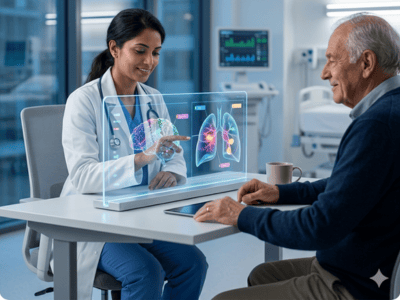
Healthcare systems worldwide are facing immense pressure due to rising patient volumes, workforce shortages, and increasing medical complexities. Hospitals continue experiencing overcrowding, while patients often wait longer for consultations, treatments, and diagnostic procedures. At the same time, healthcare professionals manage enormous amounts of clinical data every day. These challenges have created an urgent demand for smarter and more efficient healthcare solutions across modern medical systems.
Artificial intelligence is now playing a transformative role in addressing these growing healthcare concerns. By using advanced algorithms and data-driven technologies, AI helps medical professionals analyze complex information rapidly and accurately. Moreover, AI identifies patterns and clinical risks that human observation may sometimes overlook during busy healthcare operations. As a result, healthcare organizations increasingly rely on AI technologies to improve patient outcomes and operational efficiency. Today, artificial intelligence has evolved from an experimental innovation into a practical healthcare solution, improving diagnosis and patient care worldwide.
AI Improves Diagnostic Accuracy and Speed
Artificial intelligence is significantly improving the accuracy and speed of medical diagnosis across healthcare institutions. AI systems learn from massive datasets containing medical images, laboratory reports, patient histories, and clinical outcomes. Consequently, these systems recognize disease patterns faster and often more accurately than conventional diagnostic methods.
Medical imaging remains one of the most important applications of AI in healthcare. AI-powered tools analyze MRIs, CT scans, ultrasounds, and X-rays with remarkable precision and consistency. Also, such technologies allow doctors to recognize early symptoms of illnesses, such as cancers, pneumonia, heart diseases, and even neurological problems. Early diagnosis gives an opportunity for earlier treatments, which increases patients' chances of living longer and recovering better.
Moreover, AI assists healthcare practitioners with sophisticated clinical decision support systems. This technology takes into consideration the patients' symptoms, past medical history, and laboratory results to provide probable diagnoses. Hence, the doctors will be able to make quicker and data-driven decisions when diagnosing their patients. However, AI does not replace physicians; instead, it strengthens their ability to deliver accurate and timely medical care.
Laboratories also benefit greatly from artificial intelligence technologies. AI systems analyze blood samples, detect abnormalities, and identify infection markers faster than traditional laboratory workflows. Moreover, automated AI-driven analysis reduces human error and improves consistency in diagnostic testing procedures. This increased efficiency helps hospitals manage growing patient demands more effectively.
Moreover, AI is used for diagnosing and monitoring patients based on their speech and behavioral analysis. The systems analyze the electronic health records and doctor-patient conversations to detect warning signs associated with mental health conditions. Thus, healthcare practitioners can take action early and offer greater assistance to patients who are suffering from mental disorders.
Key AI Innovations Transforming Healthcare
Several advanced AI innovations are currently reshaping diagnosis and patient care across North America and other global healthcare markets.
Predictive Analytics and Early-Warning Systems
Hospitals increasingly use predictive AI systems to monitor patients continuously and identify early signs of clinical deterioration. These technologies analyze vital signs, laboratory data, and medical histories in real time. Hence, health care practitioners get an early warning prior to the development of life-threatening or medical complications. Early intervention helps avoid complications, decreases hospitalizations, and improves survival chances for the patients.
Generative AI Ambient Scribe Technology
AI systems referred to as ambient scribes are revolutionizing the process of documenting and administration in hospitals and clinics. AI technology transforms conversations between doctors and patients into medical records and clinical notes. Therefore, physicians spend less time completing paperwork and more time focusing on patient care activities. Additionally, reduced administrative burdens help decrease healthcare worker stress and burnout.
Multimodal and Agentic AI Systems
Modern healthcare AI systems increasingly combine information from a variety of medical sources, such as imaging findings, electronic records, genetic data, and laboratory information. These multimodal systems offer detailed information about patient summaries and personalized treatment plans. Additionally, they assist the doctors in recognizing potential risks and developing targeted treatment strategies based on individual patient conditions.
AI for Rare and Complex Diseases
Artificial intelligence is also improving the diagnosis of rare and highly complex medical disorders. AI models analyze large and diverse datasets to recognize uncommon disease patterns and overlapping symptoms. Consequently, physicians receive valuable support when diagnosing diseases that involve rigorous testing procedures and consultation with specialists. Studies conducted by researchers prove that AI helps diagnose diseases accurately when doctors collaborate closely with advanced AI systems.
Future of AI in Patient Care
The future of artificial intelligence in healthcare appears both promising and transformative despite ongoing implementation challenges. AI technologies continue expanding rapidly across hospitals, research institutions, and healthcare networks worldwide. In 2025, more than 1,450 FDA-approved AI medical devices had entered clinical practice, reflecting growing confidence in AI-driven healthcare innovation.
Researchers are also developing large language models capable of supporting diagnosis in complex emergency cases. In some situations, these advanced systems already demonstrate diagnostic accuracy comparable to that of experienced healthcare professionals. Nevertheless, experts agree that AI should complement human expertise rather than replace healthcare providers entirely.
However, the implementation of AI in the healthcare sector is inconsistent among various regions and organizations. Rural and underfunded health care institutions do not have adequate access to AI technology. Consequently, healthcare disparities may increase if organizations fail to address unequal technology distribution effectively.
In the coming years, healthcare leaders will have to consider ethical application of AI, improved regulatory frameworks, and universal access to technology. With proper oversight and collaboration, artificial intelligence can become a trusted healthcare partner supporting diagnosis, treatment planning, and long-term patient care. Ultimately, AI has the potential to transform healthcare delivery by improving efficiency, accuracy, accessibility, and patient outcomes globally.
.png)
.png)
.png)
.png)
.png)
.png)
.png)
.png)