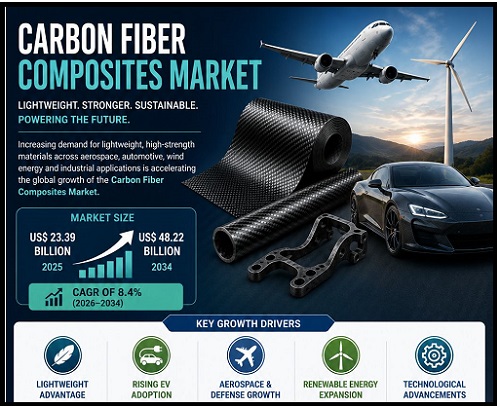
The carbon fiber composites market is projected to grow from US$ 23.39 billion in 2025 to US$ 48.22 billion by 2034, registering a CAGR of 8.4% during 2026–2034.
Growing demand for lightweight materials across automotive, aerospace, renewable energy, and defense industries is accelerating market adoption worldwide. Technological advancements in manufacturing processes, increasing investment in electric mobility, and rising focus on sustainability are further strengthening growth prospects.
Carbon fiber composites offer several advantages compared to traditional materials, including higher strength-to-weight ratios, enhanced fatigue resistance, corrosion protection, and improved design flexibility. These benefits continue to expand their use across both established and emerging applications.
Key Market Statistics
|
Indicator |
Value |
|
Market Value (2025) |
US$ 23.39 Billion |
|
Forecast Value (2034) |
US$ 48.22 Billion |
|
CAGR |
8.4% |
|
Largest Regional Market |
North America |
|
Fastest-Growing Region |
Asia Pacific |
|
Major End-Use Industries |
Aerospace, Automotive, Wind Energy, Defense |
|
Emerging Opportunity |
Electric Vehicles and Hydrogen Storage |
|
Key Trend |
Composite Recycling Technologies |
Major Growth Drivers
Increasing Demand for Lightweight Materials
One of the primary factors driving market growth is the increasing demand for lightweight materials capable of improving operational efficiency.
In transportation industries, reducing vehicle and aircraft weight directly contributes to:
- Lower fuel consumption
- Reduced carbon emissions
- Improved performance
- Greater energy efficiency
As manufacturers seek competitive advantages through weight reduction, carbon fiber composites are becoming preferred material solutions.
Rapid Expansion of Electric Vehicles
Electric vehicle adoption is accelerating worldwide as governments promote clean transportation and consumers increasingly embrace sustainable mobility solutions.
Carbon fiber composites are widely used in:
- Battery enclosures
- Vehicle frames
- Structural components
- Roof systems
- Body panels
Lightweight materials help electric vehicles achieve longer driving ranges and improved battery efficiency, making carbon fiber composites highly attractive to EV manufacturers.
Growing Aerospace Demand
The aerospace industry remains one of the largest consumers of carbon fiber composites.
Major aircraft manufacturers such as Boeing and Airbus increasingly utilize advanced composites to reduce aircraft weight, improve fuel efficiency, and lower maintenance requirements.
Applications include:
- Aircraft fuselages
- Wings
- Tail structures
- Cabin interiors
- Engine components
Growing global air travel demand and fleet modernization initiatives continue to support market expansion.
Expansion of Renewable Energy Infrastructure
The renewable energy sector is creating substantial growth opportunities for composite manufacturers.
Wind turbine manufacturers increasingly rely on carbon fiber composites to produce larger, stronger, and lighter turbine blades that improve energy generation efficiency and durability.
As investments in renewable energy continue to rise globally, demand for advanced composite materials is expected to increase significantly.
Applications by Industry
Automotive
The automotive sector represents one of the fastest-growing application areas.
Vehicle manufacturers are incorporating carbon fiber composites to achieve:
- Weight reduction
- Enhanced fuel economy
- Lower emissions
- Improved crash performance
Premium automotive brands including BMW, Mercedes-Benz, and Tesla have significantly expanded the use of carbon fiber composites in vehicle manufacturing.
Aerospace and Defense
Aerospace remains a cornerstone market for carbon fiber composites.
Benefits include:
- High structural strength
- Reduced aircraft weight
- Improved fuel efficiency
- Enhanced durability
Defense applications include:
- Military aircraft
- Naval vessels
- Armored vehicles
- Unmanned aerial vehicles (UAVs)
- Missile systems
Growing defense modernization programs worldwide are expected to support sustained demand.
Wind Energy
Carbon fiber composites play an increasingly important role in renewable energy infrastructure.
Their use in wind turbine blades enables:
- Longer blade designs
- Higher energy output
- Reduced maintenance
- Improved operational lifespan
As offshore and onshore wind projects expand globally, demand for advanced composites continues to increase.
Construction and Infrastructure
The construction sector is increasingly adopting carbon fiber composites for:
- Structural reinforcement
- Bridge rehabilitation
- Seismic retrofitting
- Corrosion-resistant infrastructure
Their durability and lightweight properties offer significant advantages over traditional construction materials.
Emerging Technologies Transforming the Market
Technological innovation is reshaping the carbon fiber composites industry.
Automated Fiber Placement (AFP)
AFP technologies improve manufacturing precision while reducing production costs and material waste.
Digital Twin Manufacturing
Digital twins enable manufacturers to optimize design, testing, and production processes using virtual simulations.
AI-Driven Composite Design
Artificial intelligence is helping engineers develop stronger, lighter, and more cost-effective composite materials.
3D Printing of Carbon Fiber Components
Additive manufacturing technologies are creating new opportunities for customized composite parts with reduced production timelines.
Smart Composite Materials
Advanced composites integrated with sensors are enabling real-time structural monitoring across aerospace, automotive, and industrial applications.
Emerging Opportunities in the Carbon Fiber Composites Market
Several high-growth opportunities are expected to shape the future market landscape.
Hydrogen Storage Systems
Hydrogen-powered transportation requires lightweight, high-pressure storage tanks that utilize advanced carbon fiber composites.
Urban Air Mobility (eVTOL)
Electric vertical takeoff and landing (eVTOL) aircraft represent a rapidly emerging application area where lightweight materials are essential.
Space Exploration
Growing investments in commercial space programs are driving demand for advanced composite materials capable of withstanding extreme operating conditions.
Offshore Wind Energy
Larger offshore wind installations require longer and stronger turbine blades, creating significant opportunities for carbon fiber composite manufacturers.
Sustainable Infrastructure
Governments are increasingly investing in durable and environmentally friendly infrastructure solutions, supporting broader adoption of composite materials.
Regional Market Analysis
North America
North America currently represents the largest market due to:
- Strong aerospace manufacturing capabilities
- Significant defense spending
- Advanced automotive production
- High adoption of innovative materials
Europe
Europe continues to experience strong growth driven by:
- Electric vehicle adoption
- Sustainability regulations
- Renewable energy investments
- Aerospace innovation
Asia Pacific
Asia Pacific is expected to be the fastest-growing regional market throughout the forecast period.
Growth is supported by:
- Expanding manufacturing industries
- Increasing automotive production
- Aerospace sector investments
- Renewable energy development
China, Japan, South Korea, and India are emerging as key manufacturing and consumption hubs.
Competitive Landscape
The carbon fiber composites market is highly competitive and innovation-driven.
Leading market participants include:
- Toray Industries
- Hexcel Corporation
- SGL Carbon
- Teijin Limited
- Mitsubishi Chemical Group
- Solvay
- Zoltek
- Hyosung Advanced Materials
- Nippon Graphite Fiber Corporation
- Gurit
Companies are focusing on:
- Capacity expansion
- Product innovation
- Sustainable manufacturing
- Strategic partnerships
- Geographic expansion
- Recycling technologies
As demand continues to increase, competition is expected to intensify across both mature and emerging markets.
Market Challenges
High Manufacturing Costs
Carbon fiber production remains relatively expensive compared to conventional materials, limiting adoption in certain cost-sensitive applications.
Complex Production Processes
Manufacturing carbon fiber composites requires specialized equipment, technical expertise, and strict quality control standards.
Recycling Constraints
Although recycling technologies are improving, large-scale commercial recycling infrastructure remains under development.
Nevertheless, ongoing technological innovation is expected to gradually address these challenges and unlock additional growth opportunities.
Future Outlook
The future of the carbon fiber composites market appears highly promising. With market value projected to more than double by 2034, manufacturers are expected to benefit from expanding applications across transportation, renewable energy, aerospace, defense, and infrastructure sectors.
Several long-term trends will continue shaping industry growth:
- Expansion of electric mobility
- Growth of hydrogen-powered transportation
- Increasing renewable energy investments
- Development of recycled composite materials
- Adoption of Industry 4.0 manufacturing technologies
- Rising demand for sustainable lightweight structures
As industries seek stronger, lighter, and more environmentally responsible materials, carbon fiber composites are expected to remain at the forefront of engineering and manufacturing innovation.
Frequently Asked Questions (FAQs)
What is driving the growth of the carbon fiber composites market?
Growing demand for lightweight, durable, and high-performance materials across automotive, aerospace, renewable energy, and defense sectors is driving market expansion.
How do carbon fiber composites improve electric vehicle performance?
They reduce vehicle weight, improve battery efficiency, extend driving range, and enhance overall vehicle performance.
Which industry uses carbon fiber composites the most?
The aerospace industry remains one of the largest consumers, followed by automotive, wind energy, and defense sectors.
What are carbon fiber composites made of?
They consist of carbon fibers embedded within a polymer matrix, typically epoxy resin, creating a lightweight yet extremely strong material.
Why are carbon fiber composites stronger than steel?
Carbon fiber composites offer exceptional strength-to-weight ratios, meaning they provide comparable or greater strength while weighing significantly less.
What is the difference between thermoplastic and thermoset composites?
Thermoplastic composites can be reheated and reshaped, while thermoset composites permanently cure after manufacturing and cannot be remolded.
How are carbon fiber composites used in aircraft manufacturing?
They are used in aircraft fuselages, wings, tail structures, cabin interiors, and engine components to reduce weight and improve fuel efficiency.
Are carbon fiber composites sustainable?
Advancements in recycled carbon fiber technologies are improving sustainability and supporting circular economy initiatives.
What are the latest innovations in carbon fiber composites?
Key innovations include AI-driven design, automated fiber placement, digital twin manufacturing, smart composites, and 3D printing technologies.
Which region is expected to grow fastest?
Asia Pacific is expected to witness the fastest growth due to expanding manufacturing capabilities, industrialization, and renewable energy investments.
Key Takeaways
- The carbon fiber composites market is projected to grow from US$ 23.39 billion in 2025 to US$ 48.22 billion by 2034.
- The market is expected to register a CAGR of 8.4% during 2026–2034.
- Electric vehicles are emerging as one of the fastest-growing application segments.
- Aerospace remains the largest end-use industry for advanced composite materials.
- Recycled carbon fiber and thermoplastic composites are gaining significant momentum.
- Asia Pacific is expected to be the fastest-growing regional market.
- Technological innovation, sustainability initiatives, and renewable energy investments will continue driving long-term market growth.
.png)
.png)
.png)
.png)
.png)
.png)
.png)
.png)