
Markt für Automatisiert Breach und Attack Simulation: Größe & Prognose 2034
Marktgröße und Prognosen für automatisierte Sicherheitslücken- und Angriffssimulationen (2021–2034), globaler und regionaler Marktanteil, Trends und Wachstumschancenanalyse. Berichtsabdeckung: nach Angebot (Plattform, Dienstleistungen); Anwendung (Konfigurationsmanagement, Patch-Management, Bedrohungsanalyse, Sonstiges); Endnutzer (Unternehmen und Rechenzentren, Managed Service Provider) und Geografie (Nordamerika, Europa, Asien-Pazifik sowie Süd- und Mittelamerika).
- Status : Veröffentlichte Daten
- Berichtscode : TIPRE00006446
- Kategorie : Technologie, Medien und Telekommunikation
- Anzahl der Seiten : 150
- Verfügbare Berichtsformate :


- Datum der letzten Aktualisierung : August 19, 2026


2025 Market Size
US$ 900.47 Mn
Base year value
2034 Forecast
US$ 7,828.81 Mn
Projected by 2034
CAGR 2026-2034
27.16 %
Growth rate
Addressable Market
US$ 32,431.63 Mn
(2026-2034)
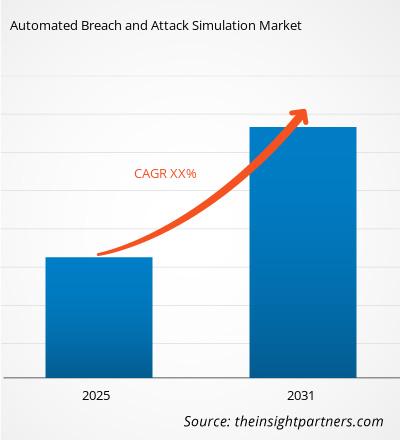
The global Automated Breach and Attack Simulation market was valued at US$ 900.47 million in 2025 and is expected to reach US$ 7828.81 million by 2034; it is estimated to record a CAGR of 27.16% during 2026-2034.
Automated Breach and Attack Simulation Market Assessment and Insights
- North America accounted for 38–41% share in 2025 and is expected to grow at a CAGR of 29.8–30.6% during 2026–2034, supported by mature security operations and continuous control validation.
- US represented 80–83% of North America share in 2025 and is projected to grow at a CAGR of 30.0–30.8% through 2034, led by enterprise security modernization.
- Europe held 24–27% share in 2025 and is forecast to grow at a CAGR of 30.4–31.2%, led by the UK, Germany, France, Italy, and Spain as cyber resilience mandates increase.
- Asia Pacific captured 23–26% share in 2025 and is expected to grow at a CAGR of 32.2–33.0%, driven by China, India, Japan, South Korea, and Australia.
- Largest Segment: Platform held 64–67% market share in 2025 and is expected to grow at a CAGR of 31.2–31.9%, reflecting adoption of automated security validation engines.
- High Growth Segment: Managed Service Providers held 22–25% market share in 2025 and is forecast to grow at a CAGR of 33.0–34.0%, supported by outsourced cyber exposure management.
- Key companies analyzed in detail: AttackIQ, Inc., Cymulate Ltd., DXC Technology Company, FireMon, LLC, Qualys, Inc., Rapid7, Inc., SafeBreach Inc., Skybox Security, Inc., Threatcare, and XM Cyber Ltd.
Source: The Insight Partners' analysis based on proprietary research, government publications, company annual reports, investor presentations, industry databases, and expert interviews.
Validation of security has moved from annual penetration tests to automation and continuous simulation of attacker tactics. The BAS solution set can simulate attacker behavior on endpoints, network, identity, cloud environment, and email. This change is very much aligned with the evolving production realities in the domain of cybersecurity and needs from the SOC team for proof of security control effectiveness in real time.
The future demand for BAS is likely to be driven by enterprise migration to the cloud, the need for regulatory stress testing, and adoption in the APAC and Middle East regions. There is going to be increased spending on solutions that integrate threat intelligence, attack path identification, and remediation process management. Buyers in the financial services, healthcare, and critical infrastructure domains are likely to move fast on the adoption front due to boardroom pressure.
Automated Breach and Attack Simulation Market Report Scope
| Report Attribute | Details |
|---|---|
| Market size in 2025 | US$ 900.47 Million |
| Market Size by 2034 | US$ 7,828.81 Million |
| Global CAGR (2026 - 2034) | 27.16% |
| Historical Data | 2021-2024 |
| Forecast period | 2026-2034 |
Automated Breach and Attack Simulation Market Analysis
The automated breach and attack simulation market growth is driven by the need to validate defenses against ransomware, credential compromise, lateral movement, and cloud misconfiguration. Value chain consists of BAS software developers, managed security service companies, threat intelligence vendors, system integrators, cloud vendors, and corporate security teams. Consumers employ such solutions in order to perform tests on EDR, SIEM, firewalls, identity, and response playbooks using simulation of attacks.
The supply side is favorable to solutions that enable customers to have a safe simulation, correct prioritization, and advice on remediation. Integration of BAS results with ticketing, SOAR, vulnerability management, and exposure management processes is now common among vendors. The services are critical when there is no capacity for internal testing within security teams.
There is a combination of specialty BAS vendors, cybersecurity platforms, and managed services that make up the market analysis. Companies like AttackIQ, Inc., Cymulate Ltd., SafeBreach Inc., and XM Cyber Ltd. are linked to continuous validation and exposure management, whereas companies such as Qualys, Inc., Rapid7, Inc., FireMon, LLC, and Skybox Security, Inc. link BAS to vulnerability, risk, and security policy management.
There is a shift toward investment in AI-based attack modeling, cloud-based validation, and integration of continuous threat exposure management solutions. DXC Technology Company offers enterprise-level service delivery support, whereas Threatcare helps out with simulation-based capabilities. It is becoming increasingly important to position oneself based on the effectiveness of controls, speed of deployment, and risk prioritization.
● REPORT CUSTOMIZATION
Tailor This Report To Align With Your Specific Business Requirements
This report can be customized to align precisely with your business objectives, scope, and target markets. Customization options include tailored segmentation, geography, competitive analysis, and strategic insights to support informed decision-making.
Customize This Report →WHAT YOU CAN ADJUST
- ● Segmentations
- ● Geography
- ● Competitive Analysis
- ● Language Preferences
Automated Breach and Attack Simulation Market:
Passen Sie diesen Bericht Ihren Anforderungen an
Sie erhalten kostenlos Anpassungen an jedem Bericht, einschließlich Teilen dieses Berichts oder einer Analyse auf Länderebene, eines Excel-Datenpakets sowie tolle Angebote und Rabatte für Start-ups und Universitäten.
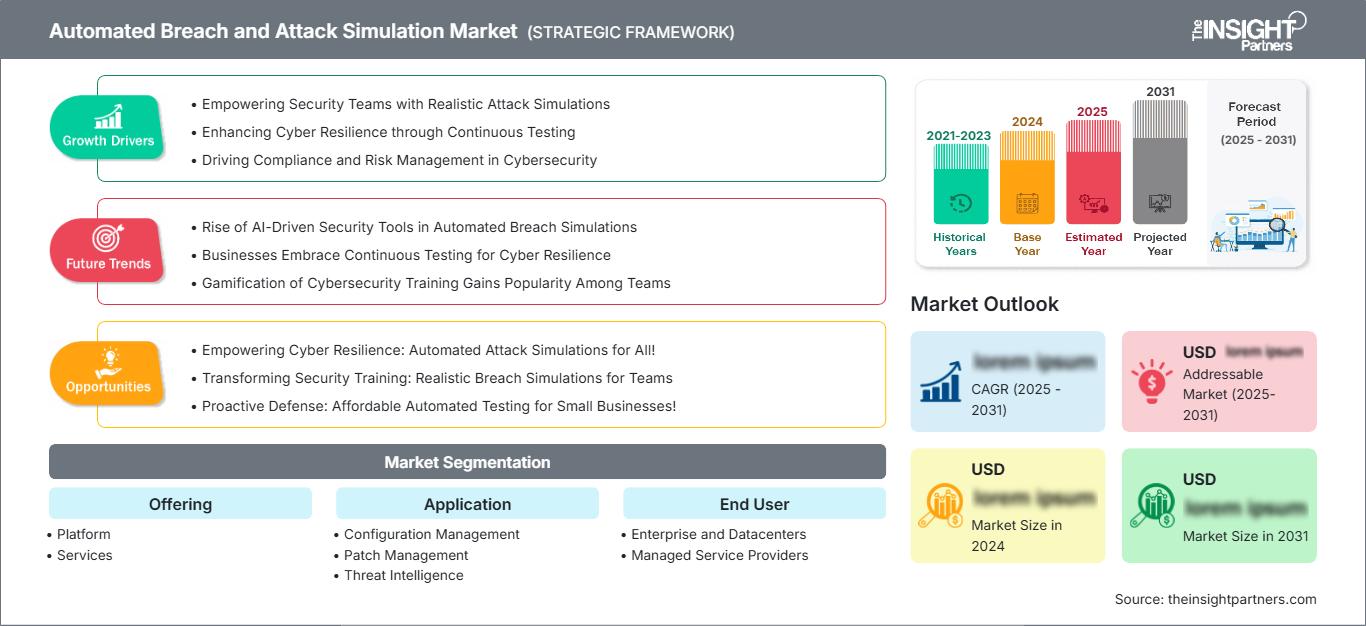
Markt für automatisierte Sicherheitsverletzungs- und Angriffssimulation: Strategische Einblicke
-
Holen Sie sich die wichtigsten Markttrends aus diesem Bericht.Dieses KOSTENLOSE Beispiel umfasst Datenanalysen, die von Markttrends bis hin zu Schätzungen und Prognosen reichen.
Regional Insights
North America automated breach and attack simulation market
North America's automated breach and attack simulation market share is estimated at 38–41% in 2025, with a CAGR of 29.8–30.6% during 2026–2034. Adoption is strongest across financial services, healthcare, technology, government, and defense-linked enterprises that require frequent security control testing.
The region benefits from high cybersecurity spending, early exposure management adoption, and broad use of EDR, SIEM, and cloud-native security stacks. BAS platforms are being deployed to validate ransomware readiness, identify misconfigured controls, and measure cyber resilience after infrastructure changes. Board-level security reporting and cyber-insurance scrutiny also support demand.
U.S. automated breach and attack simulation Market
The U.S. represented 80–83% of North America's share in 2025 and is projected to grow at a CAGR of 30.0–30.8% during 2026–2034. Demand is concentrated among large enterprises, federal agencies, managed security providers, and regulated industries.
Company presence is reinforced by AttackIQ, Inc., Qualys, Inc., Rapid7, Inc., SafeBreach Inc., FireMon, LLC, and Skybox Security, Inc. Application trends include configuration management, patch validation, threat intelligence testing, credential attack simulation, and SOC detection tuning. Enterprises are also using BAS outputs to support zero-trust roadmaps and incident response exercises.
Europe automated breach and attack simulation Market
Europe held 24–27% share in 2025 and is expected to grow at a CAGR of 30.4–31.2% during 2026–2034. The UK leads adoption through financial services, technology, and managed security ecosystems, while Germany emphasizes industrial cyber resilience and operational technology protection.
France, Italy, and Spain are expanding adoption as banks, telecom operators, manufacturers, and public-sector organizations prepare for stricter cyber resilience expectations. DORA, NIS2, and national cybersecurity programs are increasing interest in realistic scenario testing, documented control validation, and remediation evidence that can be reviewed by auditors and executive risk committees.
APAC automated breach and attack simulation Market
APAC accounted for 23–26% share in 2025 and is forecast to grow at a CAGR of 32.2–33.0% through 2034. China is the leading country, supported by digital infrastructure scale, manufacturing security needs, and expanding cloud adoption.
India, Japan, South Korea, and Australia are increasing BAS deployments across BFSI, technology services, telecom, and public infrastructure. Growth is supported by rising cyber incidents, managed security services, regional data protection rules, and enterprise demand for automated validation after frequent software and cloud configuration changes.
Middle East & Africa automated breach and attack simulation Market
The Middle East & Africa market is projected to grow at a CAGR of 27.8–28.8% during 2026–2034. The UAE leads adoption through finance, aviation, energy, government, and digital infrastructure programs.
Saudi Arabia, South Africa, and the Rest of MEA show growing interest as cloud modernization, smart city programs, and critical infrastructure digitization expand cyber exposure. Energy-sector operators and large enterprises are using validation tools to test segmentation, patch effectiveness, and incident response readiness across hybrid environments.
Segmentation Analysis
Offering
Offering is segmented into Platform and Services. The market scope is led by platform revenue because buyers require repeatable simulation engines, attack libraries, analytics, and remediation workflows. The offering segment is expected to grow at a CAGR of 30.8–31.6% during 2026–2034 as enterprises shift from periodic testing to continuous validation.
- Platform enables automated attack emulation, control testing, exposure scoring, and remediation prioritization, making it the core layer for enterprises seeking ongoing evidence of cyber defense performance.
- Services support implementation, adversary scenario design, reporting, managed validation, and program optimization, especially for organizations that need expert guidance or outsourced cybersecurity testing capacity.
Application
The application includes Configuration Management, Patch Management, and Threat Intelligence. The application segment is forecast to grow at a CAGR of 31.0–31.8% during 2026–2034 as buyers connect simulation results with operational remediation. Demand is strongest where misconfiguration, delayed patching, and outdated threat assumptions create measurable exposure across hybrid infrastructure.
- Configuration Management uses simulations to confirm whether firewalls, identity policies, cloud permissions, and endpoint controls are correctly configured after infrastructure changes or security tool updates.
- Patch Management applies BAS testing to verify whether known vulnerabilities are mitigated, helping teams prioritize fixes based on exploitability rather than treating all patches equally.
- Threat Intelligence translates real-world attacker tactics into controlled simulations, allowing security teams to test readiness against relevant ransomware, phishing, lateral movement, and data exfiltration patterns.
End User
End User is segmented into Enterprise and Datacenters and Managed Service Providers. The end-user segment is expected to grow at a CAGR of 31.5–32.4% during 2026–2034. Enterprises use BAS to strengthen internal cyber resilience, while managed providers embed simulations into continuous monitoring and advisory services for clients.
- Enterprise and Datacenters represent the largest buyer group because complex hybrid networks, compliance exposure, and high-value assets require recurring validation of security controls and response processes.
- Managed Service Providers are the fastest-growing buyer group as customers seek outsourced BAS programs, recurring exposure reports, and expert-led remediation guidance without expanding internal teams.
Opportunity Snapshot
|
Application |
Revenue Contribution |
Trend Tag |
Adoption Stage |
|---|---|---|---|
|
Configuration Management |
High |
Control Drift |
Scaling |
|
Patch Management |
Medium |
Exploit Proof |
Scaling |
|
Threat Intelligence |
High |
TTP Mapping |
Mature |
Automated Breach and Attack Simulation Market Growth Drivers and Impact Analysis
Shift from Periodic Testing to Continuous Validation
Companies have realized that penetration testing once a year is not enough because of continuous changes to the environment every day, cloud adoption, new vulnerabilities, and advanced techniques used by attackers. BAS solutions make it possible to perform repeatable, safe tests in order to check if the controls continue to function correctly. It turns the validation of security into an operation. The effect of this driver is that remediation efforts will be better prioritized, detection tuning will be done faster, and reporting will be more efficient for CISOs, demonstrating a reduction of exposure.
Ransomware and Credential-Based Attack Pressure
There is an increasing trend among ransomware criminals and identity hackers to leverage segmentation gaps, misconfigurations of identity management, unpatched infrastructure, and gaps in detection technologies. By using BAS solutions, these kinds of lateral movement attacks, privilege escalation, phishing, and data exfiltration vectors are simulated to know where the weaknesses of the defenses are. This particular driver holds greater significance for financial institutions, healthcare organizations, manufacturers, and government bodies where downtimes are expensive.
Regulatory Demand for Evidence-Based Cyber Resilience
Regulators and boards are asking organizations to prove that cybersecurity controls work under realistic threat conditions. Frameworks covering operational resilience, data protection, and sector-specific security are increasing the value of documented control testing. BAS platforms provide repeatable evidence by recording simulated attack paths, detection results, and remediation progress. This driver supports adoption in financial services, telecom, energy, healthcare, and government. It also encourages managed service providers to package validation reports as recurring assurance deliverables for clients facing audit and cyber-insurance requirements.
Automated Breach and Attack Simulation Market Future Trends
AI-Assisted Attack Path Modeling
The automated breach and attack simulation market trends point toward AI-assisted attack path modeling that prioritizes realistic scenarios based on asset exposure, identity risk, and current threat intelligence. Future platforms will recommend simulations that mirror the most likely attacker routes rather than relying on static test libraries. This shift will help security teams focus on high-impact risks, reduce alert fatigue, and improve the link between BAS results, vulnerability management, and executive risk reporting.
Convergence with Continuous Threat Exposure Management
BAS platforms are expected to converge with continuous threat exposure management programs as buyers seek a unified view of vulnerabilities, misconfigurations, control gaps, and remediation status. Instead of treating simulation as a separate test, enterprises will embed validation into exposure workflows. This trend will increase demand for integrations with asset inventories, cloud security tools, EDR, SIEM, SOAR, and ticketing systems, creating stronger closed-loop remediation.
Automated Breach and Attack Simulation Market Opportunities
Managed BAS Services for Mid-Market Buyers
The automated breach and attack simulation market Forecasts indicate a strong opportunity for managed BAS programs aimed at mid-market organizations with limited internal security engineering capacity. Providers can package simulation design, recurring control validation, executive reporting, and remediation guidance into subscription services. This lowers adoption barriers while giving customers evidence of resilience against ransomware and cloud misconfiguration. Managed delivery also creates recurring revenue for service providers and expands BAS usage beyond large enterprises.
Sector-Specific Simulation Libraries
Vendors can differentiate by building simulation libraries tailored to financial services, healthcare, telecom, manufacturing, and energy. Each sector faces distinct attack paths, compliance obligations, and operational risks. Preconfigured scenarios can reduce setup time and improve relevance for security teams. Buyers gain faster value by testing threats that mirror their environment, while suppliers improve scalability through reusable content, verticalized reporting templates, and stronger alignment with audit and risk governance requirements.
Frequently Asked Questions

Ankita ist eine dynamische Marktforschungs- und Beratungsexpertin mit über 8 Jahren Erfahrung in den Bereichen Technologie, Medien, IKT sowie Elektronik und Halbleiter. Sie hat über 100 Beratungs- und Forschungsaufträge für globale Kunden wie Microsoft, Oracle, NEC Corporation, SAP, KPMG und Expeditors International erfolgreich geleitet und durchgeführt. Zu ihren Kernkompetenzen gehören Marktbewertung, Datenanalyse, Prognose, Strategieformulierung, Wettbewerbsbeobachtung und das Verfassen von Berichten. Ankita ist versiert in der Abwicklung kompletter Projektzyklen – von der Angebotserstellung vor dem Verkauf und Kundengesprächen bis hin zur Bereitstellung umsetzbarer Erkenntnisse nach dem Verkauf. Sie ist versiert in der Leitung funktionsübergreifender Teams, der Strukturierung komplexer Forschungsmodule und der Ausrichtung von Lösungen an kundenspezifischen Geschäftszielen. Ihre ausgezeichneten Kommunikationsfähigkeiten, Führungsqualitäten und Präsentationsfähigkeiten haben es ihr ermöglicht, in einem schnelllebigen und sich entwickelnden Marktumfeld stets wertorientierte Ergebnisse zu liefern.
- Umfassende Analyse der Marktgröße und Prognosen
- Detaillierte Segmentierungsanalyse
- Tiefgehende Bewertung der Marktdynamik
- Einblicke auf regionaler und nationaler Ebene
- Wettbewerbslandschaft und Unternehmens-Benchmarking
- Strategische Business Intelligence
Erfahrungsberichte

The Insight Partners lieferte wertvolle Marktinformationen, die unsere globale Markteintrittsstrategie unterstützten. Das Team arbeitete professionell, reagierte schnell und ging aufmerksam auf unser Feedback ein. Während des gesamten Projekts stellte es fundierte Analysen und hilfreiche methodische Erläuterungen bereit.
Junmo Kim Finanzvorstand (CFO), Enertech Co., Ltd.
Der SCADA-Systemmarktbericht von Insight Partners ist umfassend und bietet wertvolle Einblicke in aktuelle Trends und Zukunftsprognosen. Das Team war durchweg hochprofessionell, reaktionsschnell und hilfsbereit. Wir sind sehr zufrieden und können die Dienstleistungen wärmstens empfehlen.
RAN KEDEM Partner, Reali Technologies LTDs
Ich habe einen Bericht über einen sehr spezifischen Softwaremarkt angefordert, und das Team hat ihn innerhalb weniger Tage erstellt. Die Informationen waren sehr relevant und gut präsentiert. Anschließend habe ich einige Änderungen und Ergänzungen zum Bericht angefordert. Das Team reagierte erneut sehr schnell, und ich erhielt den Abschlussbericht in weniger als einer Woche.
JEAN-HERVE JENN Vorsitzende, Future Analytica
Wir haben mit The Insight Partners für eine wichtige Marktstudie und Prognose zusammengearbeitet. Sie gaben uns klare Einblicke in Chancen und Risiken, die uns bei der Gestaltung unserer Pläne halfen. Ihre Recherchen waren benutzerfreundlich und basierten auf soliden Daten. Sie halfen uns, kluge und sichere Entscheidungen zu treffen. Wir können sie wärmstens empfehlen.
PIYUSH NAGPAL Sr. Vizepräsident, Fernlicht Global
Die Insight Partners lieferten aufschlussreiche, gut strukturierte Marktforschung mit fundierter Fachkompetenz. Ihr Team war durchweg professionell und reaktionsschnell. Die benutzerfreundliche Website ermöglichte den Zugriff auf Branchenberichte. Wir empfehlen sie wärmstens für zuverlässige und hochwertige Forschungsdienstleistungen.
YUKIHIKO ADACHI Geschäftsführer, Deep Blue, LLC.
Dies ist das erste Mal, dass ich einen Marktbericht von The Insight Partners erworben habe. Obwohl ich zunächst unsicher war, besuchte ich die Website und fühlte mich dann sicherer, das Risiko einzugehen und einen Marktbericht zu kaufen. Ich bin mit der Qualität des Berichts und dem Kundenservice rundum zufrieden. Ich hatte einige Fragen und Anmerkungen zum ersten Bericht, aber nach einigen E-Mail-Gesprächen mit dem Analysten bin ich überzeugt, dass ich einen Bericht habe, den ich als Input für unseren strategischen Planungsprozess verwenden kann. Vielen Dank, dass Sie sich die Zeit genommen und dies zu einer positiven Erfahrung gemacht haben. Ich werde Ihren Service auf jeden Fall weiterempfehlen und Sie werden meine erste Anlaufstelle sein, wenn wir weitere Marktdaten benötigen.
JOHN SUZUKI Präsident und Chief Executive Officer, Vorstandsmitglied, BK Technologies
Ich möchte mich für Ihre Unterstützung und die Professionalität bedanken, die Sie bei der Bearbeitung meiner Informationsanfrage zum IVD-Markt für Infektionskrankheiten in Nigeria gezeigt haben. Ich schätze Ihre Geduld, Ihre Beratung und die Tatsache, dass Sie bereit waren, einen Rabatt anzubieten, der uns schließlich den Abschluss eines Geschäfts ermöglichte. Ich freue mich darauf, The Insight Partners in Zukunft wieder zu beauftragen, dank des Eindrucks, den Sie bei dieser ersten Begegnung bei mir hinterlassen haben.
DR. CHIJIOKE ONYIA GESCHÄFTSFÜHRERIN, PineCrest Healthcare Ltd.Grund zum Kauf
- Fundierte Entscheidungsfindung
- Marktdynamik verstehen
- Wettbewerbsanalyse
- Kundeneinblicke
- Marktprognosen
- Risikominimierung
- Strategische Planung
- Investitionsbegründung
- Identifizierung neuer Märkte
- Verbesserung von Marketingstrategien
- Steigerung der Betriebseffizienz
- Anpassung an regulatorische Trends




















 Kostenlose Probe anfordern für -