
Automated Breach and Attack Simulation Market Growth, Size & Forecast by 2034
Coverage: by Offering (Platform, Services); Application (Configuration Management, Patch Management, Threat Intelligence, Others); End User (Enterprise and Datacenters, Managed Service Providers) , and Geography (North America, Europe, Asia Pacific, and South and Central America)
- Status : Data Released
- Report Code : TIPRE00006446
- Category : Technology, Media and Telecommunications
- No. of Pages : 150
- Available Report Formats :


- Last update date : August 19, 2026


2025 Market Size
US$ 900.47 Mn
Base year value
2034 Forecast
US$ 7,828.81 Mn
Projected by 2034
CAGR 2026-2034
27.16 %
Growth rate
Addressable Market
US$ 32,431.63 Mn
(2026-2034)
The global Automated Breach and Attack Simulation market was valued at US$ 900.47 million in 2025 and is expected to reach US$ 7828.81 million by 2034; it is estimated to record a CAGR of 27.16% during 2026-2034.
Automated Breach and Attack Simulation Market Assessment and Insights
- North America accounted for 38–41% share in 2025 and is expected to grow at a CAGR of 29.8–30.6% during 2026–2034, supported by mature security operations and continuous control validation.
- US represented 80–83% of North America share in 2025 and is projected to grow at a CAGR of 30.0–30.8% through 2034, led by enterprise security modernization.
- Europe held 24–27% share in 2025 and is forecast to grow at a CAGR of 30.4–31.2%, led by the UK, Germany, France, Italy, and Spain as cyber resilience mandates increase.
- Asia Pacific captured 23–26% share in 2025 and is expected to grow at a CAGR of 32.2–33.0%, driven by China, India, Japan, South Korea, and Australia.
- Largest Segment: Platform held 64–67% market share in 2025 and is expected to grow at a CAGR of 31.2–31.9%, reflecting adoption of automated security validation engines.
- High Growth Segment: Managed Service Providers held 22–25% market share in 2025 and is forecast to grow at a CAGR of 33.0–34.0%, supported by outsourced cyber exposure management.
- Key companies analyzed in detail: AttackIQ, Inc., Cymulate Ltd., DXC Technology Company, FireMon, LLC, Qualys, Inc., Rapid7, Inc., SafeBreach Inc., Skybox Security, Inc., Threatcare, and XM Cyber Ltd.
Source: The Insight Partners' analysis based on proprietary research, government publications, company annual reports, investor presentations, industry databases, and expert interviews.
Validation of security has moved from annual penetration tests to automation and continuous simulation of attacker tactics. The BAS solution set can simulate attacker behavior on endpoints, network, identity, cloud environment, and email. This change is very much aligned with the evolving production realities in the domain of cybersecurity and needs from the SOC team for proof of security control effectiveness in real time.
The future demand for BAS is likely to be driven by enterprise migration to the cloud, the need for regulatory stress testing, and adoption in the APAC and Middle East regions. There is going to be increased spending on solutions that integrate threat intelligence, attack path identification, and remediation process management. Buyers in the financial services, healthcare, and critical infrastructure domains are likely to move fast on the adoption front due to boardroom pressure.
Automated Breach and Attack Simulation Market Report Scope
| Report Attribute | Details |
|---|---|
| Market size in 2025 | US$ 900.47 Million |
| Market Size by 2034 | US$ 7,828.81 Million |
| Global CAGR (2026 - 2034) | 27.16% |
| Historical Data | 2021-2024 |
| Forecast period | 2026-2034 |
Automated Breach and Attack Simulation Market Analysis
The automated breach and attack simulation market growth is driven by the need to validate defenses against ransomware, credential compromise, lateral movement, and cloud misconfiguration. Value chain consists of BAS software developers, managed security service companies, threat intelligence vendors, system integrators, cloud vendors, and corporate security teams. Consumers employ such solutions in order to perform tests on EDR, SIEM, firewalls, identity, and response playbooks using simulation of attacks.
The supply side is favorable to solutions that enable customers to have a safe simulation, correct prioritization, and advice on remediation. Integration of BAS results with ticketing, SOAR, vulnerability management, and exposure management processes is now common among vendors. The services are critical when there is no capacity for internal testing within security teams.
There is a combination of specialty BAS vendors, cybersecurity platforms, and managed services that make up the market analysis. Companies like AttackIQ, Inc., Cymulate Ltd., SafeBreach Inc., and XM Cyber Ltd. are linked to continuous validation and exposure management, whereas companies such as Qualys, Inc., Rapid7, Inc., FireMon, LLC, and Skybox Security, Inc. link BAS to vulnerability, risk, and security policy management.
There is a shift toward investment in AI-based attack modeling, cloud-based validation, and integration of continuous threat exposure management solutions. DXC Technology Company offers enterprise-level service delivery support, whereas Threatcare helps out with simulation-based capabilities. It is becoming increasingly important to position oneself based on the effectiveness of controls, speed of deployment, and risk prioritization.
● REPORT CUSTOMIZATION
Tailor This Report To Align With Your Specific Business Requirements
This report can be customized to align precisely with your business objectives, scope, and target markets. Customization options include tailored segmentation, geography, competitive analysis, and strategic insights to support informed decision-making.
Customize This Report →WHAT YOU CAN ADJUST
- ● Segmentations
- ● Geography
- ● Competitive Analysis
- ● Language Preferences
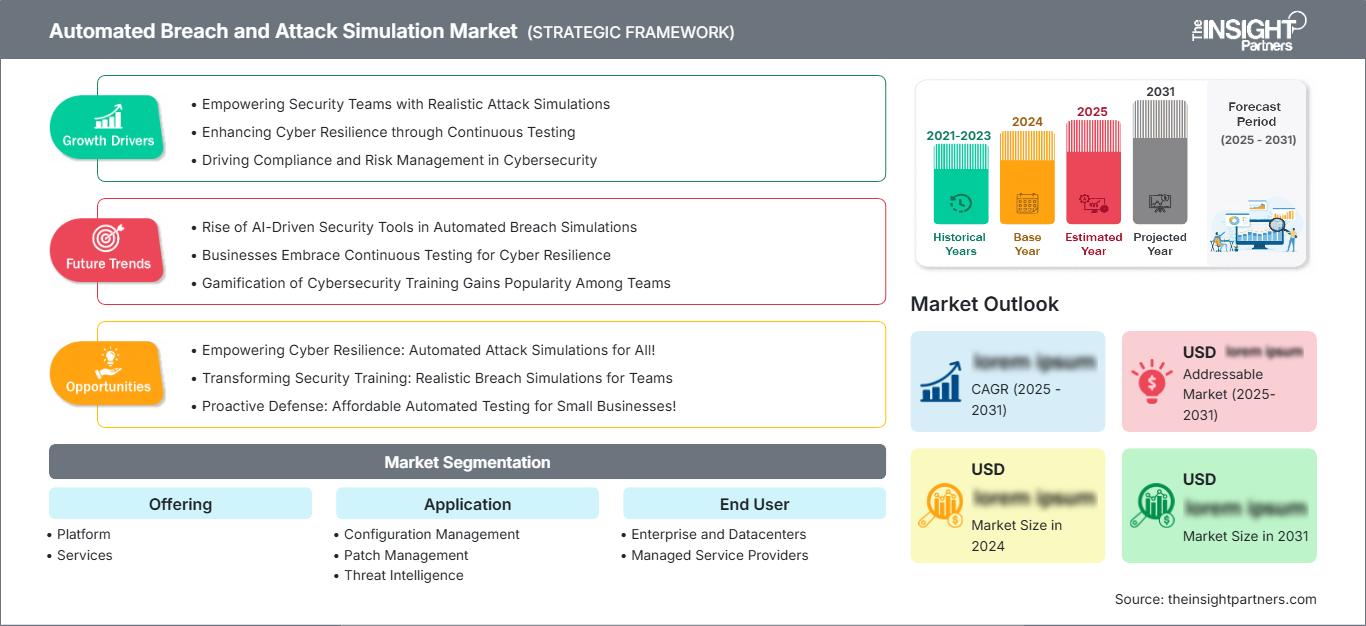
Automated Breach and Attack Simulation Market: Strategic Insights
Regional Insights
North America automated breach and attack simulation market
North America's automated breach and attack simulation market share is estimated at 38–41% in 2025, with a CAGR of 29.8–30.6% during 2026–2034. Adoption is strongest across financial services, healthcare, technology, government, and defense-linked enterprises that require frequent security control testing.
The region benefits from high cybersecurity spending, early exposure management adoption, and broad use of EDR, SIEM, and cloud-native security stacks. BAS platforms are being deployed to validate ransomware readiness, identify misconfigured controls, and measure cyber resilience after infrastructure changes. Board-level security reporting and cyber-insurance scrutiny also support demand.
U.S. automated breach and attack simulation Market
The U.S. represented 80–83% of North America's share in 2025 and is projected to grow at a CAGR of 30.0–30.8% during 2026–2034. Demand is concentrated among large enterprises, federal agencies, managed security providers, and regulated industries.
Company presence is reinforced by AttackIQ, Inc., Qualys, Inc., Rapid7, Inc., SafeBreach Inc., FireMon, LLC, and Skybox Security, Inc. Application trends include configuration management, patch validation, threat intelligence testing, credential attack simulation, and SOC detection tuning. Enterprises are also using BAS outputs to support zero-trust roadmaps and incident response exercises.
Europe automated breach and attack simulation Market
Europe held 24–27% share in 2025 and is expected to grow at a CAGR of 30.4–31.2% during 2026–2034. The UK leads adoption through financial services, technology, and managed security ecosystems, while Germany emphasizes industrial cyber resilience and operational technology protection.
France, Italy, and Spain are expanding adoption as banks, telecom operators, manufacturers, and public-sector organizations prepare for stricter cyber resilience expectations. DORA, NIS2, and national cybersecurity programs are increasing interest in realistic scenario testing, documented control validation, and remediation evidence that can be reviewed by auditors and executive risk committees.
APAC automated breach and attack simulation Market
APAC accounted for 23–26% share in 2025 and is forecast to grow at a CAGR of 32.2–33.0% through 2034. China is the leading country, supported by digital infrastructure scale, manufacturing security needs, and expanding cloud adoption.
India, Japan, South Korea, and Australia are increasing BAS deployments across BFSI, technology services, telecom, and public infrastructure. Growth is supported by rising cyber incidents, managed security services, regional data protection rules, and enterprise demand for automated validation after frequent software and cloud configuration changes.
Middle East & Africa automated breach and attack simulation Market
The Middle East & Africa market is projected to grow at a CAGR of 27.8–28.8% during 2026–2034. The UAE leads adoption through finance, aviation, energy, government, and digital infrastructure programs.
Saudi Arabia, South Africa, and the Rest of MEA show growing interest as cloud modernization, smart city programs, and critical infrastructure digitization expand cyber exposure. Energy-sector operators and large enterprises are using validation tools to test segmentation, patch effectiveness, and incident response readiness across hybrid environments.
Segmentation Analysis
Offering
Offering is segmented into Platform and Services. The market scope is led by platform revenue because buyers require repeatable simulation engines, attack libraries, analytics, and remediation workflows. The offering segment is expected to grow at a CAGR of 30.8–31.6% during 2026–2034 as enterprises shift from periodic testing to continuous validation.
- Platform enables automated attack emulation, control testing, exposure scoring, and remediation prioritization, making it the core layer for enterprises seeking ongoing evidence of cyber defense performance.
- Services support implementation, adversary scenario design, reporting, managed validation, and program optimization, especially for organizations that need expert guidance or outsourced cybersecurity testing capacity.
Application
The application includes Configuration Management, Patch Management, and Threat Intelligence. The application segment is forecast to grow at a CAGR of 31.0–31.8% during 2026–2034 as buyers connect simulation results with operational remediation. Demand is strongest where misconfiguration, delayed patching, and outdated threat assumptions create measurable exposure across hybrid infrastructure.
- Configuration Management uses simulations to confirm whether firewalls, identity policies, cloud permissions, and endpoint controls are correctly configured after infrastructure changes or security tool updates.
- Patch Management applies BAS testing to verify whether known vulnerabilities are mitigated, helping teams prioritize fixes based on exploitability rather than treating all patches equally.
- Threat Intelligence translates real-world attacker tactics into controlled simulations, allowing security teams to test readiness against relevant ransomware, phishing, lateral movement, and data exfiltration patterns.
End User
End User is segmented into Enterprise and Datacenters and Managed Service Providers. The end-user segment is expected to grow at a CAGR of 31.5–32.4% during 2026–2034. Enterprises use BAS to strengthen internal cyber resilience, while managed providers embed simulations into continuous monitoring and advisory services for clients.
- Enterprise and Datacenters represent the largest buyer group because complex hybrid networks, compliance exposure, and high-value assets require recurring validation of security controls and response processes.
- Managed Service Providers are the fastest-growing buyer group as customers seek outsourced BAS programs, recurring exposure reports, and expert-led remediation guidance without expanding internal teams.
Opportunity Snapshot
| Application | Revenue Contribution | Trend Tag | Adoption Stage |
|---|---|---|---|
| Configuration Management | High | Control Drift | Scaling |
| Patch Management | Medium | Exploit Proof | Scaling |
| Threat Intelligence | High | TTP Mapping | Mature |
Automated Breach and Attack Simulation Market Growth Drivers and Impact Analysis
Shift from Periodic Testing to Continuous Validation
Companies have realized that penetration testing once a year is not enough because of continuous changes to the environment every day, cloud adoption, new vulnerabilities, and advanced techniques used by attackers. BAS solutions make it possible to perform repeatable, safe tests in order to check if the controls continue to function correctly. It turns the validation of security into an operation. The effect of this driver is that remediation efforts will be better prioritized, detection tuning will be done faster, and reporting will be more efficient for CISOs, demonstrating a reduction of exposure.
Ransomware and Credential-Based Attack Pressure
There is an increasing trend among ransomware criminals and identity hackers to leverage segmentation gaps, misconfigurations of identity management, unpatched infrastructure, and gaps in detection technologies. By using BAS solutions, these kinds of lateral movement attacks, privilege escalation, phishing, and data exfiltration vectors are simulated to know where the weaknesses of the defenses are. This particular driver holds greater significance for financial institutions, healthcare organizations, manufacturers, and government bodies where downtimes are expensive.
Regulatory Demand for Evidence-Based Cyber Resilience
Regulators and boards are asking organizations to prove that cybersecurity controls work under realistic threat conditions. Frameworks covering operational resilience, data protection, and sector-specific security are increasing the value of documented control testing. BAS platforms provide repeatable evidence by recording simulated attack paths, detection results, and remediation progress. This driver supports adoption in financial services, telecom, energy, healthcare, and government. It also encourages managed service providers to package validation reports as recurring assurance deliverables for clients facing audit and cyber-insurance requirements.
Automated Breach and Attack Simulation Market Future Trends
AI-Assisted Attack Path Modeling
The automated breach and attack simulation market trends point toward AI-assisted attack path modeling that prioritizes realistic scenarios based on asset exposure, identity risk, and current threat intelligence. Future platforms will recommend simulations that mirror the most likely attacker routes rather than relying on static test libraries. This shift will help security teams focus on high-impact risks, reduce alert fatigue, and improve the link between BAS results, vulnerability management, and executive risk reporting.
Convergence with Continuous Threat Exposure Management
BAS platforms are expected to converge with continuous threat exposure management programs as buyers seek a unified view of vulnerabilities, misconfigurations, control gaps, and remediation status. Instead of treating simulation as a separate test, enterprises will embed validation into exposure workflows. This trend will increase demand for integrations with asset inventories, cloud security tools, EDR, SIEM, SOAR, and ticketing systems, creating stronger closed-loop remediation.
Automated Breach and Attack Simulation Market Opportunities
Managed BAS Services for Mid-Market Buyers
The automated breach and attack simulation market Forecasts indicate a strong opportunity for managed BAS programs aimed at mid-market organizations with limited internal security engineering capacity. Providers can package simulation design, recurring control validation, executive reporting, and remediation guidance into subscription services. This lowers adoption barriers while giving customers evidence of resilience against ransomware and cloud misconfiguration. Managed delivery also creates recurring revenue for service providers and expands BAS usage beyond large enterprises.
Sector-Specific Simulation Libraries
Vendors can differentiate by building simulation libraries tailored to financial services, healthcare, telecom, manufacturing, and energy. Each sector faces distinct attack paths, compliance obligations, and operational risks. Preconfigured scenarios can reduce setup time and improve relevance for security teams. Buyers gain faster value by testing threats that mirror their environment, while suppliers improve scalability through reusable content, verticalized reporting templates, and stronger alignment with audit and risk governance requirements.
Frequently Asked Questions

- Comprehensive Market Sizing and Forecast Analysis
- Detailed Segmentation Analysis
- In-Depth Market Dynamics Assessment
- Regional and Country-Level Insights
- Competitive Landscape and Company Benchmarking
- Strategic Business Intelligence
Recent Reports
Testimonials

The Insight Partners provided valuable market intelligence that supported our global go-to-market strategy. Their team was professional, responsive, and attentive to our feedback, providing thoughtful analysis and helpful methodological clarifications throughout the project.
Junmo Kim Chief Financial Officer (CFO), Enertech Co., Ltd.
The Insight Partners' SCADA System Market report is comprehensive, with valuable insights on current trends and future forecasts. The team was highly professional, responsive, and supportive throughout. We are very satisfied and highly recommend their services.
RAN KEDEM Partner, Reali Technologies LTDs
I requested a report on a very specific software market and the team produced the report in a few days. The information was very relevant and well presented. I then requested some changes and additions to the report. The team was again very responsive and I got the final report in less than a week.
JEAN-HERVE JENN Chairman, Future Analytica
We worked with The Insight Partners for an important market study and forecast. They gave us clear insights into opportunities and risks, which helped shape our plans. Their research was easy to use and based on solid data. It helped us make smart, confident decisions. We highly recommend them.
PIYUSH NAGPAL Sr. Vice President, High Beam Global
The Insight Partners delivered insightful, well-structured market research with strong domain expertise. Their team was professional and responsive throughout. The user-friendly website made accessing industry reports seamless. We highly recommend them for reliable, high-quality research services
YUKIHIKO ADACHI CEO, Deep Blue, LLC.
This is the first time I have purchased a market report from The Insight Partners.While I was unsure at first, I visited their web site and felt more comfortable to take the risk and purchase a market report.I am completely satisfied with the quality of the report and customer service. I had several questions and comments with the initial report, but after a couple of dialogs over email with their analyst I believe I have a report that I can use as input to our strategic planning process.Thank you so much for taking the extra time and making this a positive experience.I will definitely recommend your service to others and you will be my first call when we need further market data.
JOHN SUZUKI President and Chief Executive Officer, Board Director, BK Technologies
I wish to appreciate your support and the professionalism you displayed in the course of attending to my request for information regarding to infectious disease IVD market in Nigeria. I appreciate your patience, your guidance, and the fact that you were willing to offer a discount, which eventually made it possible for us to close a deal. I look forward to engaging The Insight Partners in the future, all thanks to the impression you have created in me as a result of this first encounter.
DR CHIJIOKE ONYIA MANAGING DIRECTOR, PineCrest Healthcare Ltd.Reason to Buy
- Informed Decision-Making
- Understanding Market Dynamics
- Competitive Analysis
- Identifying Emerging Markets
- Customer Insights
- Market Forecasts
- Risk Mitigation
- Boosting Operational Efficiency
- Strategic Planning
- Investment Justification
- Tracking Industry Innovations
- Aligning with Regulatory Trends





 Get Free Sample for