Marktübersicht, Wachstum, Trends, Analyse und Forschungsbericht zu Impfstoffen im Nahen Osten und Afrika (2025–2031)
Historische Daten : 2021-2023 | Basisjahr : 2024 | Prognosezeitraum : 2025-2031Marktgröße und Prognose für Impfstoffe im Nahen Osten und Afrika (2021–2031), regionaler Marktanteil, Trends und Wachstumschancenanalyse. Berichtsabdeckung: Typ (konjugiert, inaktiviert, Lebendimpfstoff, rekombinant und Toxoid), Indikation (HPV, PCV, DTP, Hepatitis, Influenza, Dengue und andere), Verabreichungsweg (Injektion, oral und andere) und Altersgruppe (Kinder und Erwachsene).
- Status : Veröffentlicht
- Berichtscode : TIPRE00041548
- Kategorie : Biowissenschaften
- Anzahl der Seiten : 198
- Verfügbare Berichtsformate :





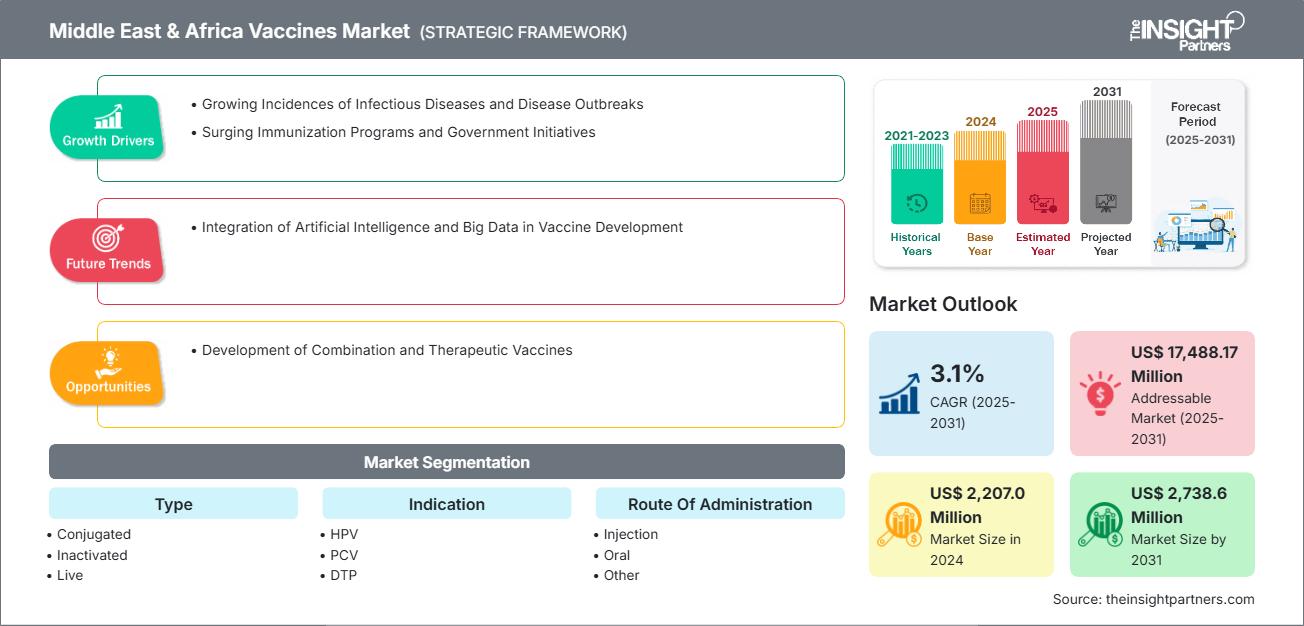
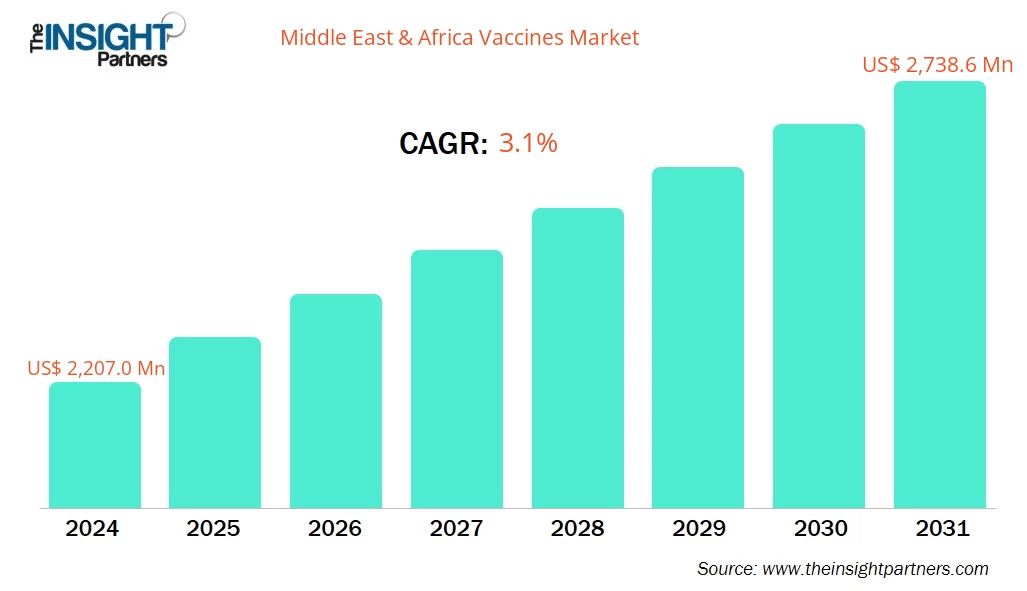
Der Markt für Impfstoffe im Nahen Osten und in Afrika wird bis 2031 voraussichtlich ein Volumen von 2.738,6 Millionen US-Dollar erreichen, gegenüber 2.207,0 Millionen US-Dollar im Jahr 2024. Es wird erwartet, dass der Markt von 2025 bis 2031 eine durchschnittliche jährliche Wachstumsrate (CAGR) von 3,1 % verzeichnen wird.
Zusammenfassung und Marktanalyse für Impfstoffe im Nahen Osten und Afrika:
Der Impfstoffmarkt in der MEA-Region ist in die Vereinigten Arabischen Emirate (VAE), Saudi-Arabien, Südafrika und die übrige MEA-Region unterteilt. Die Vereinigten Arabischen Emirate haben den größten Marktanteil und sind ein bedeutendes Zentrum für die Impfstoffherstellung und -verteilung. Dieses Wachstum wird durch hohe Investitionen in Forschung und Entwicklung angetrieben, unterstützt durch eine gut ausgebaute Infrastruktur und moderne Forschungseinrichtungen, vor allem in den VAE und Saudi-Arabien. Beide Länder haben Innovationen im Gesundheitswesen gefördert und damit ein günstiges Umfeld für die wissenschaftliche Entwicklung im Bereich der Immunisierung geschaffen. Für Südafrika wird hingegen in den kommenden Jahren ein moderates Wachstum des Impfstoffmarktes prognostiziert. Dies ist vor allem auf den Ausbau der regionalen Impfstoffproduktion durch lokale Pharma- und Biotech-Unternehmen zurückzuführen. Mit dem Fokus auf die lokale Produktion will Südafrika die Importabhängigkeit verringern und so günstigere Impfstoffe und einen besseren Zugang zu ihnen fördern. All diese Bemühungen auf kontinentaler Ebene tragen gemeinsam zur Dynamik des Impfstoffmarktes in der MEA-Region bei.
Passen Sie diesen Bericht Ihren Anforderungen an.
Sie erhalten eine kostenlose Anpassung aller Berichte – einschließlich Teilen dieses Berichts, Länderanalysen und Excel-Datenpaketen – sowie attraktive Angebote und Rabatte für Start-ups und Universitäten.
Impfstoffmarkt im Nahen Osten und Afrika: Strategische Einblicke
-
Ermitteln Sie die wichtigsten Markttrends dieses Berichts.Diese KOSTENLOSE Probe beinhaltet eine Datenanalyse, die von Markttrends bis hin zu Schätzungen und Prognosen reicht.
Marktsegmentierungsanalyse für Impfstoffe im Nahen Osten und Afrika:
- Der Impfstoffmarkt im Nahen Osten und Afrika ist nach Impfstofftyp in Konjugatimpfstoffe, inaktivierte Impfstoffe, Lebendimpfstoffe, rekombinante Impfstoffe und Toxoidimpfstoffe unterteilt. Das Segment der Konjugatimpfstoffe hielt 2024 den größten Marktanteil.
- Nach Indikation ist der Impfstoffmarkt im Nahen Osten und Afrika in HPV, PCV, DTP, Hepatitis, Influenza, Dengue und Sonstige unterteilt. Das HPV-Segment hatte 2024 den größten Marktanteil.
- Nach Verabreichungsweg ist der Impfstoffmarkt im Nahen Osten und Afrika in Injektion, orale Verabreichung und Sonstige unterteilt. Das Segment der Injektionen hatte 2024 den größten Marktanteil.
- Der Impfstoffmarkt im Nahen Osten und Afrika ist nach Altersgruppen in Kinderimpfstoffe und Erwachsenenimpfstoffe unterteilt. Das Kindersegment hatte 2024 den größeren Marktanteil.
Berichtsumfang zum Impfstoffmarkt im Nahen Osten und Afrika
| Berichtattribute | Details |
|---|---|
| Marktgröße im Jahr 2024 | 2.207,0 Millionen US-Dollar |
| Marktgröße bis 2031 | 2.738,6 Millionen US-Dollar |
| CAGR (2025 - 2031) | 3,1 % |
| Historische Daten | 2021-2023 |
| Prognosezeitraum | 2025–2031 |
| Segments Covered |
By Type
|
| Regions and Countries Covered |
Middle East and Africa
|
| Market leaders and key company profiles |
|
Middle East & Africa Vaccines Market Players Density: Understanding Its Impact on Business Dynamics
The Middle East & Africa Vaccines Market is growing rapidly, driven by increasing end-user demand due to factors such as evolving consumer preferences, technological advancements, and greater awareness of the product's benefits. As demand rises, businesses are expanding their offerings, innovating to meet consumer needs, and capitalizing on emerging trends, which further fuels market growth.
- Get the Middle East & Africa Vaccines Market top key players overview
Middle East & Africa Vaccines Market Outlook
The vaccine industry is currently experiencing a transformative phase, with combination and therapeutic vaccines emerging as the most promising opportunities for manufacturers. Innovations in these vaccines not only address evolving public health challenges but also provide significant commercial and operational advantages.
Combination vaccines are formulations designed to protect against multiple diseases in a single shot. Traditionally used in pediatric care, as seen with vaccines like MMR (measles, mumps, rubella) and DTP (diphtheria, tetanus, pertussis), combination vaccines are now expanding their reach to adult and elderly populations. This is particularly relevant for respiratory illnesses such as influenza, COVID-19, and Respiratory Syncytial Virus (RSV). Combination vaccines can greatly improve immunization rates, resulting in a quicker and more extensive reduction in disease burden. They are especially important as new vaccines for diseases such as dengue, typhoid, RSV, and tuberculosis are being developed. According to Gavi, by 2030, combination vaccines will provide protection against 30 infections with fewer doses. Major pharmaceutical companies, including Moderna, Pfizer/BioNTech, Novavax, Sanofi, GSK, and AstraZeneca, are developing combination vaccines for COVID-19, influenza, and RSV. These products are anticipated to transform seasonal immunization strategies and enhance uptake among adults and elderly populations. Additionally, therapeutic vaccines are designed not to prevent diseases but to treat existing conditions, which can include chronic infections, cancers, and allergies. This approach represents a new frontier in vaccine technology, utilizing advancements in mRNA, viral vectors, and personalized medicine. For instance, cancer vaccines aim to stimulate the immune system to recognize and attack tumor cells. Additionally, some vaccines are being developed for chronic infections such as hepatitis B and HIV.
As of 2024, the US Food and Drug Administration (FDA) has approved three therapeutic vaccines: Sipuleucel-T for advanced prostate cancer, Bacillus Calmette-Guérin for high-risk, non-muscle-invasive bladder cancer, and Talimogene laherparepvec for melanoma. As research progresses, therapeutic vaccines are expected to become a significant segment within the broader vaccine market, addressing unmet medical needs and expanding the potential customer base. Several companies are currently under trial for therapeutic cancer vaccines aimed at cancers and other chronic diseases. These vaccines are designed to enhance the body's immune response against cancer cells and are often used alongside other treatment modalities.
Both combination and therapeutic vaccines align with global health priorities by improving access, reducing the disease burden, and addressing complex health challenges. Their development benefits from significant public and private investment, collaborative partnerships, and ongoing advancements in biotechnology.
Therefore, the development of combination and therapeutic vaccines presents substantial opportunities for vaccine manufacturers to grow, innovate, and create a meaningful impact. These vaccines simplify immunization, expand their applications, and address both preventive and therapeutic health needs worldwide.
Middle East & Africa Vaccines Market Country Insights
By country, the Middle East & Africa Vaccines Market is segmented into Saudi Arabia, South Africa, the United Arab Emirates, and the Rest of Middle East & Africa. South Africa held the largest share in 2024.
South Africa is actively investing in local vaccine manufacturing, supported by government policies prioritizing preferential procurement, long-term contracts, and tax incentives for domestic producers. According to Gavi, the African Union (AU) aims to develop, produce, and supply over 60% of the continent's vaccine doses by 2040, a significant increase from the level of less than 1% in 2021. This ambitious goal will require coordinated efforts and a strategic action plan. As an initial step, the Partnerships for African Vaccine Manufacturing (PAVM) has been established under the Africa CDC. The South African government, in partnership with Gavi, UNICEF, and other organizations, has enhanced its immunization campaigns, particularly for COVID-19 and seasonal influenza. This focus is crucial, given the country's significant burden of comorbidities such as HIV and tuberculosis.
The introduction of new vaccine types, including subunit, mRNA, and viral vector vaccines, by both international and local manufacturers has expanded the vaccine options available in South Africa. Major global companies like Pfizer, BioNTech, Sanofi, and the Serum Institute of India are actively involved in the market, introducing advanced vaccines for diseases such as COVID-19, influenza, and HPV. In December 2023, the International Finance Corporation (IFC) announced a 7 million rand loan and advisory support for Biovac to improve vaccine production and pandemic preparedness in Africa. The funding supported Biovac's production of various vaccines, including HPV and cholera. Additionally, IFC will collaborate with Biovac on a new multi-vaccine production plant in Cape Town, increasing production capacity from 150 million to about 560 million doses annually. This initiative aims to enhance local capabilities for producing both traditional bacterial-based and mRNA vaccines, reducing Africa's dependency on vaccine imports.
Middle East & Africa Vaccines Market Company Profiles
Zu den wichtigsten Akteuren auf dem Markt gehören Abbott Laboratories, GSK Plc, Pfizer Inc., Merck & Co. Inc., Novartis AG, Sanofi SA, CSL Ltd, Serum Institute of India Pvt Ltd, BioNTech SE und Sinovac Biotech Ltd.
Diese Akteure verfolgen verschiedene Strategien wie Expansion, Produktinnovation sowie Fusionen und Übernahmen, um ihren Kunden innovative Produkte anzubieten und ihren Marktanteil zu erhöhen.
Marktforschungsmethodik für Impfstoffe im Nahen Osten und Afrika
Für die Erhebung und Analyse der in diesem Bericht präsentierten Daten wurde folgende Methodik angewendet:
Sekundärforschung
Der Forschungsprozess beginnt mit einer umfassenden Sekundärrecherche, bei der interne und externe Quellen genutzt werden, um qualitative und quantitative Daten für jeden Markt zu erheben. Zu den häufig verwendeten Sekundärquellen gehören unter anderem:
- Unternehmenswebsites, Geschäftsberichte, Finanzberichte, Brokeranalysen und Investorenpräsentationen
- Fachzeitschriften der Branche und andere relevante Publikationen
- Regierungsdokumente, statistische Datenbanken und Marktberichte
- Nachrichtenartikel, Pressemitteilungen und Webcasts speziell für Unternehmen, die auf diesem Markt tätig sind.
Notiz:
Alle im Abschnitt „Unternehmensprofile“ enthaltenen Finanzdaten wurden auf US-Dollar standardisiert. Bei Unternehmen, die in anderen Währungen berichten, wurden die Zahlen anhand der jeweiligen Wechselkurse des entsprechenden Jahres in US-Dollar umgerechnet.
Primärforschung
The Insight Partners führt jährlich eine große Anzahl von Primärinterviews mit Branchenakteuren und Experten durch, um seine Datenanalyse zu validieren und wertvolle Erkenntnisse zu gewinnen. Diese Forschungsinterviews dienen folgenden Zwecken:
- Ergebnisse aus Sekundärforschung validieren und verfeinern
- Die Expertise und das Marktverständnis des Analyseteams verbessern
- Gewinnen Sie Einblicke in Marktgröße, Trends, Wachstumsmuster, Wettbewerbsdynamik und Zukunftsaussichten.
Die Primärforschung erfolgt mittels E-Mail-Korrespondenz und Telefoninterviews und umfasst verschiedene Märkte, Kategorien, Segmente und Untersegmente in unterschiedlichen Regionen. Zu den Teilnehmern gehören typischerweise:
- Branchenakteure: Vizepräsidenten, Manager für Geschäftsentwicklung, Manager für Marktforschung und nationale Vertriebsleiter
- Externe Experten: Bewertungsspezialisten, Research-Analysten und Meinungsführer mit branchenspezifischer Expertise

Mrinal ist eine erfahrene Research-Analystin mit über 8 Jahren Erfahrung in der Marktanalyse und Beratung im Bereich Life Sciences. Mit ihrer strategischen Denkweise und ihrem unerschütterlichen Streben nach Exzellenz hat sie sich umfassende Expertise in den Bereichen Pharmaprognosen, Marktchancenbewertung und Entwicklung von Branchen-Benchmarks angeeignet. Ihre Arbeit konzentriert sich darauf, umsetzbare Erkenntnisse zu liefern, die Kunden fundierte strategische Entscheidungen ermöglichen. Mrinals Kernkompetenz liegt in der Übersetzung komplexer quantitativer Datensätze in aussagekräftige Geschäftsinformationen. Ihr analytischer Scharfsinn ist entscheidend für die Entwicklung von Go-to-Market-Strategien (GTM) und die Erschließung von Wachstumschancen in der Pharma- und Medizinproduktebranche. Als vertrauenswürdige Beraterin konzentriert sie sich konsequent auf die Optimierung von Arbeitsabläufen und die Etablierung von Best Practices, um so Innovation und Betriebseffizienz für ihre Kunden zu fördern.
- Historische Analyse (2 Jahre), Basisjahr, Prognose (7 Jahre) mit CAGR
- PEST- und SWOT-Analyse
- Marktgröße Wert/Volumen – Global, Regional, Land
- Branchen- und Wettbewerbslandschaft
- Excel-Datensatz
Erfahrungsberichte

Der SCADA-Systemmarktbericht von Insight Partners ist umfassend und bietet wertvolle Einblicke in aktuelle Trends und Zukunftsprognosen. Das Team war durchweg hochprofessionell, reaktionsschnell und hilfsbereit. Wir sind sehr zufrieden und können die Dienstleistungen wärmstens empfehlen.
RAN KEDEM Partner, Reali Technologies LTDs
Ich habe einen Bericht über einen sehr spezifischen Softwaremarkt angefordert, und das Team hat ihn innerhalb weniger Tage erstellt. Die Informationen waren sehr relevant und gut präsentiert. Anschließend habe ich einige Änderungen und Ergänzungen zum Bericht angefordert. Das Team reagierte erneut sehr schnell, und ich erhielt den Abschlussbericht in weniger als einer Woche.
JEAN-HERVE JENN Vorsitzende, Future Analytica
Wir haben mit The Insight Partners für eine wichtige Marktstudie und Prognose zusammengearbeitet. Sie gaben uns klare Einblicke in Chancen und Risiken, die uns bei der Gestaltung unserer Pläne halfen. Ihre Recherchen waren benutzerfreundlich und basierten auf soliden Daten. Sie halfen uns, kluge und sichere Entscheidungen zu treffen. Wir können sie wärmstens empfehlen.
PIYUSH NAGPAL Sr. Vizepräsident, Fernlicht Global
Die Insight Partners lieferten aufschlussreiche, gut strukturierte Marktforschung mit fundierter Fachkompetenz. Ihr Team war durchweg professionell und reaktionsschnell. Die benutzerfreundliche Website ermöglichte den Zugriff auf Branchenberichte. Wir empfehlen sie wärmstens für zuverlässige und hochwertige Forschungsdienstleistungen.
YUKIHIKO ADACHI Geschäftsführer, Deep Blue, LLC.
Dies ist das erste Mal, dass ich einen Marktbericht von The Insight Partners erworben habe. Obwohl ich zunächst unsicher war, besuchte ich die Website und fühlte mich dann sicherer, das Risiko einzugehen und einen Marktbericht zu kaufen. Ich bin mit der Qualität des Berichts und dem Kundenservice rundum zufrieden. Ich hatte einige Fragen und Anmerkungen zum ersten Bericht, aber nach einigen E-Mail-Gesprächen mit dem Analysten bin ich überzeugt, dass ich einen Bericht habe, den ich als Input für unseren strategischen Planungsprozess verwenden kann. Vielen Dank, dass Sie sich die Zeit genommen und dies zu einer positiven Erfahrung gemacht haben. Ich werde Ihren Service auf jeden Fall weiterempfehlen und Sie werden meine erste Anlaufstelle sein, wenn wir weitere Marktdaten benötigen.
JOHN SUZUKI Präsident und Chief Executive Officer, Vorstandsmitglied, BK Technologies
Ich möchte mich für Ihre Unterstützung und die Professionalität bedanken, die Sie bei der Bearbeitung meiner Informationsanfrage zum IVD-Markt für Infektionskrankheiten in Nigeria gezeigt haben. Ich schätze Ihre Geduld, Ihre Beratung und die Tatsache, dass Sie bereit waren, einen Rabatt anzubieten, der uns schließlich den Abschluss eines Geschäfts ermöglichte. Ich freue mich darauf, The Insight Partners in Zukunft wieder zu beauftragen, dank des Eindrucks, den Sie bei dieser ersten Begegnung bei mir hinterlassen haben.
DR. CHIJIOKE ONYIA GESCHÄFTSFÜHRERIN, PineCrest Healthcare Ltd.Grund zum Kauf
- Fundierte Entscheidungsfindung
- Marktdynamik verstehen
- Wettbewerbsanalyse
- Kundeneinblicke
- Marktprognosen
- Risikominimierung
- Strategische Planung
- Investitionsbegründung
- Identifizierung neuer Märkte
- Verbesserung von Marketingstrategien
- Steigerung der Betriebseffizienz
- Anpassung an regulatorische Trends














Exklusive Berichtsrabatte freischalten
Jetzt anfragen




 Kostenlose Probe anfordern für - Impfstoffmarkt im Nahen Osten und Afrika