
6G Market Trends, Size & Forecast by 2034
6G Market Size and Forecasts (2021 - 2034), Global and Regional Share, Trends, and Growth Opportunity Analysis Report Coverage : By Usage-Scenario (Further-Enhanced Mobile Broadband (FeMBB), Extremely Reliable, Low Latency Communications (ERLLC), Long-Distance and High-Mobility Communications (LDHMC), Ultra-Massive Machine Type Communications (umMTC), Extremely Low-Power Communications (ELPC)); Communication Infrastructure (Cellular, Broadband, Fixed); End-User (Consumers, Enterprises)
- Status : Data Released
- Report Code : TIPRE00039696
- Category : Electronics and Semiconductor
- No. of Pages : 150
- Available Report Formats :


- Last update date : July 13, 2026


2025 Market Size
US$ 12.89 Bn
Base year value
2034 Forecast
US$ 650.54 Bn
Projected by 2034
CAGR 2026-2034
54.60 %
Growth rate
Addressable Market
US$ 1,804.93 Bn
(2026-2034)
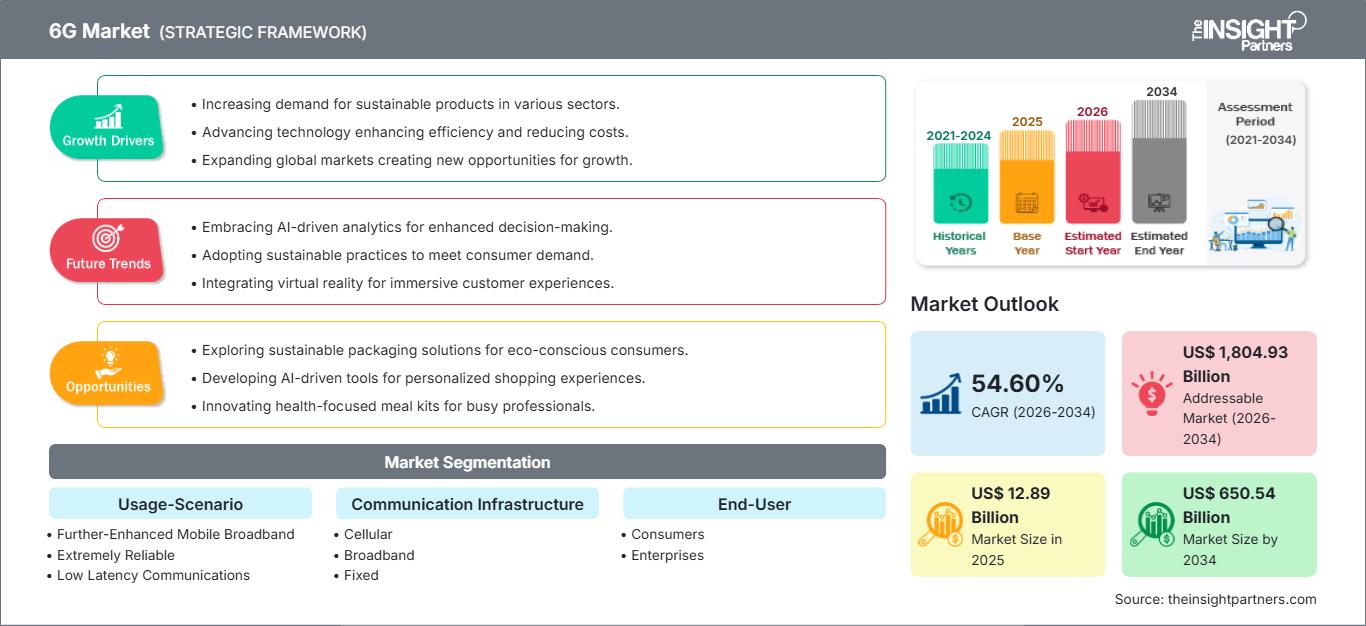
The 6G Market is valued at US$ 12.89 Billion in 2025 and is projected to reach US$ 650.54 Billion by 2034; it is expected to register a CAGR of 54.60% during 2026–2034. The market is moving from advanced research toward pre-commercial ecosystem formation, with operators, governments, vendors, and enterprise users preparing for AI-native connectivity, integrated sensing, and ultra-reliable digital infrastructure.
North America is projected to expand at a 52–55% CAGR between 2026 and 2034, fueled by the region’s advanced spectrum strategy, AI-RANs, cloud-edge densification, and secure communication technologies. The growth of North America’s 6G Market will be driven by the region’s transition to 5G Standalone, open radio access network architecture, semiconductor development, and enterprise deterministic connectivity.
6G Market Assessment and Insights
- North America: The region held 34–37% share in 2025 and is expected to grow at a CAGR of 52–55% between 2026–2034, supported by AI-native network trials, cloud-edge infrastructure, defense modernization, and enterprise private-network demand.
- US: The US represented 72–76% of North America share in 2025 and is expected to grow at a CAGR of 53–56% between 2026–2034, led by operators, hyperscalers, semiconductor research, and federal wireless programs.
- Europe: Europe accounted for 19–22% share in 2025 and is expected to grow at a CAGR of 50–53% between 2026–2034, with Germany, the UK, France, Spain, and Italy advancing industrial automation and standards-led deployment.
- Asia Pacific: Asia Pacific held 31–34% share in 2025 and is expected to grow at a CAGR of 55–58% between 2026–2034, driven by China, Japan, South Korea, India, and Australia through manufacturing scale, dense networks, and policy-backed R&D.
- Largest Segment: Enterprises held 61–64% market share in 2025 and are expected to grow at a CAGR of 55–58% between 2026–2034 as automation, robotics, digital twins, and secure edge services shape adoption.
- High Growth Segment: Ultra-Massive Machine Type Communications held 13–16% market share in 2025 and is expected to grow at a CAGR of 58–61% between 2026–2034 as dense sensor networks scale.
- Key companies analyzed in detail: AT&T Inc., NTT DOCOMO, INC., Orange S.A., Bharti Airtel Limited, Vodafone Group Plc, SK Telecom Co., Ltd., Deutsche Telekom AG, Verizon Communications Inc., Telefónica, S.A., Rakuten Mobile, Inc., and KT Corporation.
Source: The Insight Partners' analysis based on proprietary research, government publications, company annual reports, investor presentations, industry databases, and expert interviews.
The 6G Market has progressed from abstract wireless research to platform development through coordination among operators, chipset companies, cloud providers, infrastructure vendors, regulatory agencies, and standardization groups. Technological changes focus around AI-native radio access, experiments in the sub-terahertz band, sense-and-communicate, non-terrestrial networks, and cloud-native cores. Production trends are changing in the context of telecom supply chains favoring programmable hardware, energy-efficient radios, open interfaces, and software-defined network infrastructure capable of ensuring service assurance.
Forward movement will come from new geographies that leverage 6G technology to connect industrial productivity, resilient public infrastructure, and digital nation-building. Investment is anticipated to be made in areas such as spectrum study, AI-RAN labs, semiconductor packaging, satellite and cellular convergence, and enterprise testbeds. Favorable regulatory trends are being set through the IMT-2030 framework of ITU, 3GPP pre-standardization, and national 6G initiatives.
6G Market Report Scope
| Report Attribute | Details |
|---|---|
| Market size in 2025 | US$ 12.89 Billion |
| Market Size by 2034 | US$ 650.54 Billion |
| Global CAGR (2026 - 2034) | 54.60% |
| Historical Data | 2021-2024 |
| Forecast period | 2026-2034 |
6G Market Analysis
Demand in the 6G Market will be created by applications needing not speed, but intelligence, reliability, precise positioning, and capacity. Six usage scenarios defined by IMT-2030 (6G) identified by ITU include immersive communication, hyper-reliable low-latency communication, massive communication, ubiquitous connectivity, artificial intelligence and communication, and integrated sensing and communication. This expands the scope of 6G to cover more than just consumer broadband applications.
This ecosystem ranges from radio hardware, antennas, chipset, network software, AI orchestration, testing systems, cloud-based cores, edge computing platforms, to non-terrestrial connectivity. The supply chain is affected by semiconductor availability, spectrum preparedness, energy-efficiency goals, and openness in network architecture. Service providers have resorted to the use of 5G Advanced, Private Wireless Networks, and Open RAN upgrades as an interim solution to the 6G Network.
The competitive landscape is increasingly multi-layered. AT&T Inc. and Verizon Communications Inc. are positioned around enterprise connectivity, Open RAN, and secure network modernization, while NTT DOCOMO, INC., SK Telecom Co., Ltd., KT Corporation, and Rakuten Mobile, Inc. are active in AI-radio and advanced network trials. Orange S.A., Vodafone Group Plc, Deutsche Telekom AG, Telefónica, S.A., and Bharti Airtel Limited are building regional influence through standards participation, private networks, and future service partnerships.
Investment trends show that 6G Market share will be influenced by control over architecture rather than mobile subscriptions alone. Companies that combine AI-RAN, cloud-edge orchestration, cybersecurity, device ecosystems, and vertical-industry partnerships will be better positioned to strengthen their 6G market share. Strategic differentiation is expected to depend on standards influence, spectrum strategy, proof of industrial productivity gains, and the ability to convert research pilots into monetizable service-level agreements.
● REPORT CUSTOMIZATION
Tailor This Report To Align With Your Specific Business Requirements
This report can be customized to align precisely with your business objectives, scope, and target markets. Customization options include tailored segmentation, geography, competitive analysis, and strategic insights to support informed decision-making.
Customize This Report →WHAT YOU CAN ADJUST
- ● Segmentations
- ● Geography
- ● Competitive Analysis
- ● Language Preferences
6G Market: Strategic Insights
Regional Insights
North America 6G Market
North America accounted for 34–37% share in 2025 and is expected to grow at a CAGR of 52–55% between 2026–2034. Regional leadership is supported by strong operator capital intensity, 5G Standalone migration, cloud-region density, defense communications demand, and early work on AI-native radio access networks. The GSMA reported that mobile technologies generated almost US$ 1.6 trillion of economic value in North America, reinforcing the region’s ability to fund next-generation infrastructure.
The structural drivers include private wireless, autonomy on mobility lanes, industrial automation, and secure edge services for government organizations. The roles played by AT&T Inc. and Verizon Communications Inc. are significant, as they offer an enterprise portfolio, an open RAN strategy, and cloud partnerships aligned with future service differentiation. The trends to be seen in the region will depend on spectrum alignment, energy-efficient densification, and testbed operations.
U.S. 6G Market
The U.S. represented 72–76% of North America share in 2025 and is expected to grow at a CAGR of 53–56% during 2026–2034. Its location is characterized by the government spectrum studies, semiconductor technology development, military modernization, leading hyperscale cloud service providers, and the needs of enterprises. The regulatory focus of the 6G working group of the Federal Communications Commission (FCC) includes openness, customization, satellite connectivity, terahertz frequencies, privacy, and security.
The US-based companies involved in the 6G technology include AT&T Inc. and Verizon Communications Inc. Due to their enterprise services and network modernization efforts, the companies are prepared to become part of the 6G commercialization process. The US-based applications under development include smart factories, autonomous transportation, logistics highways, military networks, immersive training, and cloud edge computing services.
Europe 6G Market
Europe held 19–22% share in 2025 and is expected to grow at a CAGR of 50–53% between 2026–2034. The UK is advancing through telecom innovation programs, private networks, defense connectivity, and smart-port experimentation. Adoption is likely to emphasize resilient infrastructure, media production, distributed cloud, and public-sector digitalization where secure, low-latency connectivity supports operational continuity.
Germany is the leading European country due to its automotive, machinery, robotics, and automation industries, which create a clear need for determinism in wireless technology. Deutsche Telekom AG is a key player in regional ecosystem development, and the industry will use 6G for digital twins, vision, robot cooperation, and safety-critical manufacturing that require deterministic, low-latency operation.
France, Italy, and Spain will advance through smart city initiatives, transportation, public safety systems, and industrial parks. Orange S.A., Vodafone Group Plc, and Telefónica, S.A. will be the key players in the region. Europe’s 6G Market Size growth will be contingent upon spectrum harmonization, equipment sovereignty, energy efficiency, and cross-border use cases in line with EU digital policy.
APAC 6G Market
APAC held 31–34% share in 2025 and is expected to grow at a CAGR of 55–58% between 2026–2034. The growth driver for China will be its manufacturing scale, spectrum technology research, and technology-based government projects. Japan and South Korea will contribute operator-driven R&D capabilities with NTT DOCOMO, INC., SK Telecom Co., Ltd., KT Corporation, and Rakuten Mobile, Inc.
India and Australia complement each other, each with its own set of growth drivers. The growth driver for India will be the expanding digital network infrastructure, while Australia will have its requirements in mining, logistics, military, and remote connectivity applications. Regional 6G Market growth will be policy-backed and industry-led.
Middle East & Africa 6G Market
Middle East & Africa is expected to grow at a CAGR of 46–49% between 2026–2034, led by Saudi Arabia and the UAE. Energy infrastructure, smart-city investments, logistics corridors, and sovereign digital strategies will shape early demand. Saudi Arabia is expected to lead through large-scale infrastructure programs and industrial diversification.
Smart mobility, aviation, public safety, and immersive urban services would be some key applications for UAE, while South Africa and the remainder of MEA region would follow through more gradually using fixed wireless, industrial connectivity, and government digitalization. It will depend on spectrum regulation, backhaul fiber infrastructure, affordability, and terrestrial-satellite convergence.
Segmentation Analysis
Usage-Scenario
The Usage-Scenario segment is expected to grow at a CAGR of 54–57% between 2026–2034 as networks move from capacity expansion toward mission-specific service classes. Demand is linked to immersive communication, industrial automation, massive sensing, long-range mobility, and low-power IoT. This segment defines how operators translate 6G technical capabilities into commercial services.
- Further-Enhanced Mobile Broadband: Further-enhanced mobile broadband supports immersive video, holographic communication, cloud gaming, and extended reality services that require extreme capacity, consistent throughput, and dense urban coverage beyond existing mobile broadband capabilities.
- Extremely Reliable, Low Latency Communications: This scenario enables mission-critical automation, remote control, connected robotics, and industrial safety systems where deterministic response, network resilience, and near-instant communication are essential for operational continuity.
- Long-Distance and High-Mobility Communications: Long-distance and high-mobility communications support aviation, railways, maritime routes, connected vehicles, and remote operations requiring stable coverage across fast-moving assets and geographically dispersed environments.
- Ultra-Massive Machine Type Communications: Ultra-massive machine type communications address dense sensor networks, smart cities, logistics tracking, industrial IoT, and environmental monitoring where billions of low-cost devices need efficient, scalable connectivity.
- Extremely Low-Power Communications: Extremely low-power communications enable long-life sensors, wearable devices, remote monitoring assets, and battery-constrained IoT systems requiring minimal energy consumption and reliable intermittent data transmission.
Communication Infrastructure
The Communication Infrastructure segment is expected to grow at a CAGR of 53–56% between 2026–2034 as operators upgrade radio, broadband, fixed access, edge, and transport layers for AI-native operations. Investment will focus on programmable networks, secure backhaul, densification, spectrum efficiency, and hybrid terrestrial-non-terrestrial architectures that support high-performance commercial services.
- Cellular: Cellular infrastructure forms the core access layer for 6G mobility, supporting AI-native radio systems, dense small cells, integrated sensing, spectrum sharing, and ultra-reliable services across urban and industrial environments.
- Broadband: Broadband infrastructure supports high-capacity fixed-mobile convergence, immersive home connectivity, enterprise cloud access, and bandwidth-intensive applications requiring consistent throughput across fiber, wireless, and edge-enabled networks.
- Fixed: Fixed infrastructure provides stable connectivity for enterprises, smart campuses, industrial facilities, and public networks where deterministic performance, secure backhaul, and predictable service quality are more important than mobility.
End-User
The End-User segment is expected to grow at a CAGR of 55–58% between 2026–2034, led by enterprises that can link connectivity to productivity, uptime, safety, and automation returns. Consumer adoption will scale later through immersive media and advanced devices. Enterprise demand gives the 6G Market a stronger business-case foundation than consumer speed upgrades alone.
- Consumers: Consumers will adopt 6G through immersive entertainment, holographic interaction, advanced mobile broadband, wearables, smart homes, and personalized digital services that require seamless connectivity and intelligent network responsiveness.
- Enterprises: Enterprises represent the strategic demand center for 6G, using advanced connectivity for automation, digital twins, robotics, predictive operations, secure edge computing, industrial metaverse applications, and mission-critical workflows.
Opportunity Snapshot
| End-User | Revenue Contribution | Trend Tag | Adoption Stage |
| Consumers | Medium | Immersive Media | Emerging |
| Enterprises | High | Industrial AI | Scaling |
6G Market Growth Drivers and Impact Analysis
AI-Native Networks Reshape Telecom Architecture
AI-native design is a core driver because future networks must predict, optimize, secure, and allocate resources without manual intervention. The ITU’s IMT-2030 work highlights ubiquitous intelligence, while operator trials show AI improving wireless performance under changing propagation conditions. Market impact will be strongest where enterprises need deterministic service quality, dynamic traffic prioritization, and energy-efficient network operation. By embedding AI in radio access, core, and edge systems, operators can shift from best-effort connectivity to outcome-based services for robotics, autonomous logistics, industrial metaverse applications, and safety-critical workflows.
Enterprise Automation Creates High-Value 6G Demand
Enterprise automation gives the 6G Market a high-value commercial pathway because factories, ports, hospitals, mines, transport systems, and energy assets require reliable wireless control rather than simple mobile coverage. Extremely reliable low-latency communication, positioning, sensing, and secure edge computing can support robotics, digital twins, predictive maintenance, and remote operations. The impact is a shift in telecom revenue models toward managed industrial connectivity, service-level guarantees, analytics, and vertical solutions. Enterprises will evaluate adoption through downtime reduction, worker safety, throughput improvement, and automation payback, reinforcing the positive 6G Market Forecast.
Terahertz Spectrum Expands Capacity Frontiers
Sub-terahertz and terahertz spectrum research expands the capacity frontier for dense 6G services. These bands can support very high throughput for holographic communication, extended reality, machine collaboration, and localized high-capacity enterprise environments. The market impact will first appear in campuses, stadiums, airports, factories, and smart-city zones where premium performance justifies dense infrastructure. Commercialization depends on antenna design, beam management, device power efficiency, backhaul capacity, and cost control. Operators that master high-frequency deployment economics can capture specialized 6G Market opportunities before national-scale coverage matures.
6G Market Future Trends
Integrated Sensing and Communication Becomes Core
Integrated sensing and communication will reshape 6G Market trends by allowing networks to detect movement, map environments, locate assets, and support situational awareness while carrying data. This changes telecom infrastructure into a sensing layer for factories, warehouses, roads, ports, and public-safety environments. Future value will come from packaging sensing as a service, including asset localization, collision avoidance, infrastructure monitoring, and predictive maintenance. Operators and vendors that combine connectivity with analytics, privacy controls, and industrial software will be positioned to monetize sensing-enabled networks, strengthening their market Share.
Non-Terrestrial Networks Extend 6G Coverage
Non-terrestrial network integration is expected to become a defining future trend as 6G links terrestrial cellular systems with satellites and high-altitude platforms. The approach can extend coverage across maritime routes, aviation corridors, remote mines, rural areas, disaster zones, and defense operations. Future commercialization will depend on device compatibility, spectrum coordination, latency management, and seamless service orchestration. Operators that develop hybrid connectivity models can address resilience, coverage continuity, and underserved geographies while expanding the market scope beyond dense urban deployment, supporting the long-term 6G Market Forecast
6G Market Opportunities
Private 6G Networks for Industrial Campuses
Private 6G networks offer a strong investment opportunity because industrial campuses need secure, predictable, and customized connectivity for robotics, computer vision, digital twins, worker safety, and automated quality control. Operators can move beyond connectivity resale by bundling edge computing, cybersecurity, device management, analytics, and service-level guarantees. Early commercial models should target factories, ports, mines, energy facilities, and logistics hubs where uptime and productivity gains are measurable, supporting long-term 6G Market Size expansion. The opportunity favors companies that combine telecom assets with vertical expertise and systems integration capabilities.
6G-Enabled Consumer Immersive Services
Consumer immersive services remain an important long-term opportunity once devices, content ecosystems, and pricing models mature. Further-enhanced mobile broadband can support spatial computing, holographic calling, cloud gaming, live entertainment, and premium event connectivity. The opportunity requires partnerships among operators, device makers, cloud platforms, and media companies to lower latency and battery constraints. While enterprises may lead early monetization, consumer scale can expand the 6G Market size when immersive services demonstrate clear value beyond faster downloads and conventional video streaming.
Recent Developments
- March 2026: SK Telecom and Ericsson signed an MoU to advance mobile network innovation from 5G toward 6G, covering AI-powered RAN, open and autonomous networks, zero-trust security, spectrum strategy, extreme MIMO, energy efficiency, and integrated sensing and communication. The collaboration is intended to support joint research, validation, and potential commercialization through 2031.
- November 2025: NTT DOCOMO announced a successful outdoor trial of an AI-driven wireless interface for 6G with NTT, Nokia Bell Labs, and SK Telecom. The trial used real-time transceiver systems and reported throughput improvements of up to 100% under outdoor conditions, demonstrating how AI can compensate for changing radio propagation environments.
- March 2026: NTT DOCOMO and SK Telecom published a white paper on advancing vRAN and AI-RAN in mobile networks, outlining requirements for future network evolution toward 6G. The work reflects operator-level alignment around virtualization, AI-enabled radio infrastructure, and open network development as foundations for next-generation telecom architecture.
Frequently Asked Questions

- Comprehensive Market Sizing and Forecast Analysis
- Detailed Segmentation Analysis
- In-Depth Market Dynamics Assessment
- Regional and Country-Level Insights
- Competitive Landscape and Company Benchmarking
- Strategic Business Intelligence
Recent Reports
Testimonials

The Insight Partners' SCADA System Market report is comprehensive, with valuable insights on current trends and future forecasts. The team was highly professional, responsive, and supportive throughout. We are very satisfied and highly recommend their services.
RAN KEDEM Partner, Reali Technologies LTDs
I requested a report on a very specific software market and the team produced the report in a few days. The information was very relevant and well presented. I then requested some changes and additions to the report. The team was again very responsive and I got the final report in less than a week.
JEAN-HERVE JENN Chairman, Future Analytica
We worked with The Insight Partners for an important market study and forecast. They gave us clear insights into opportunities and risks, which helped shape our plans. Their research was easy to use and based on solid data. It helped us make smart, confident decisions. We highly recommend them.
PIYUSH NAGPAL Sr. Vice President, High Beam Global
The Insight Partners delivered insightful, well-structured market research with strong domain expertise. Their team was professional and responsive throughout. The user-friendly website made accessing industry reports seamless. We highly recommend them for reliable, high-quality research services
YUKIHIKO ADACHI CEO, Deep Blue, LLC.
This is the first time I have purchased a market report from The Insight Partners.While I was unsure at first, I visited their web site and felt more comfortable to take the risk and purchase a market report.I am completely satisfied with the quality of the report and customer service. I had several questions and comments with the initial report, but after a couple of dialogs over email with their analyst I believe I have a report that I can use as input to our strategic planning process.Thank you so much for taking the extra time and making this a positive experience.I will definitely recommend your service to others and you will be my first call when we need further market data.
JOHN SUZUKI President and Chief Executive Officer, Board Director, BK Technologies
I wish to appreciate your support and the professionalism you displayed in the course of attending to my request for information regarding to infectious disease IVD market in Nigeria. I appreciate your patience, your guidance, and the fact that you were willing to offer a discount, which eventually made it possible for us to close a deal. I look forward to engaging The Insight Partners in the future, all thanks to the impression you have created in me as a result of this first encounter.
DR CHIJIOKE ONYIA MANAGING DIRECTOR, PineCrest Healthcare Ltd.Reason to Buy
- Informed Decision-Making
- Understanding Market Dynamics
- Competitive Analysis
- Identifying Emerging Markets
- Customer Insights
- Market Forecasts
- Risk Mitigation
- Boosting Operational Efficiency
- Strategic Planning
- Investment Justification
- Tracking Industry Innovations
- Aligning with Regulatory Trends





 Get Free Sample for