
Air Fresheners Market Growth, Trends & Demand by 2034
Coverage: By Product Type (Sprays/Aerosols, Electric Air Fresheners, Gels Air Fresheners, Others); Distribution Channel (Supermarkets and Hypermarkets, Specialty Stores, Online Retail, Others) , and Geography (North America, Europe, Asia Pacific, and South and Central America)
- Status : Data Released
- Report Code : TIPRE00024588
- Category : Consumer Goods
- No. of Pages : 150
- Available Report Formats :


- Last update date : August 12, 2026


2025 Market Size
US$ 16.48 Bn
Base year value
2034 Forecast
US$ 25.80 Bn
Projected by 2034
CAGR 2026-2034
5.10 %
Growth rate
Addressable Market
US$ 191.77 Bn
(2026-2034)
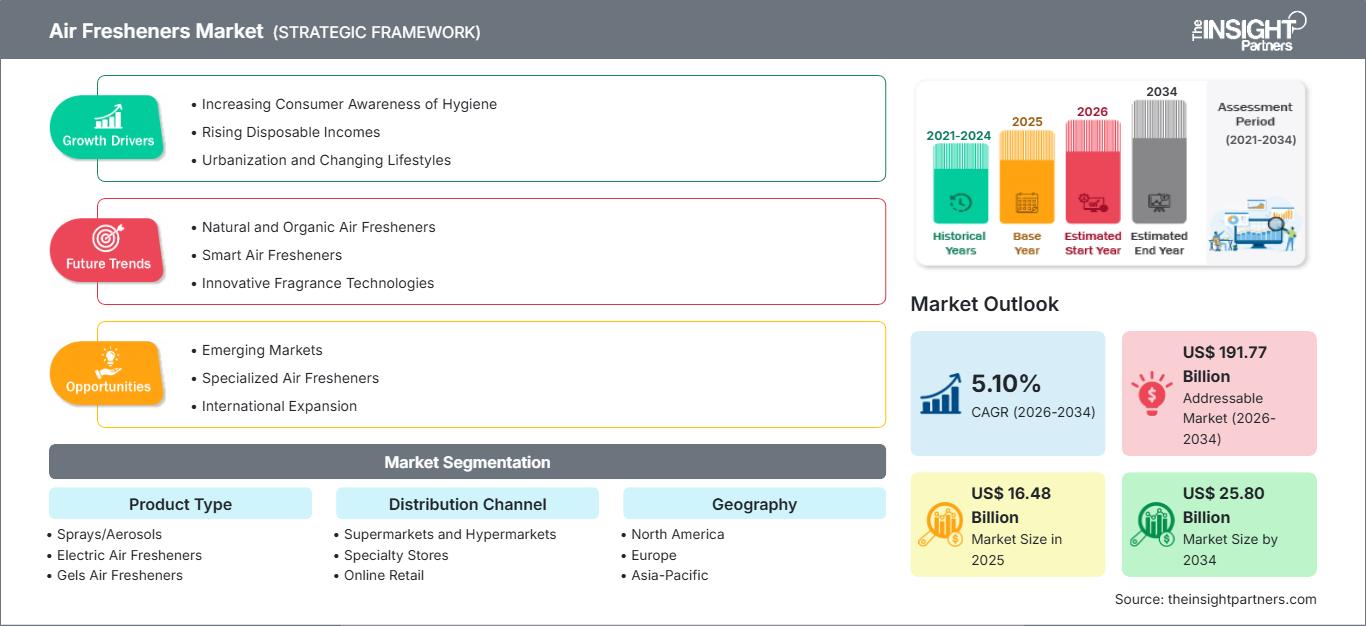
The air fresheners market was valued at US$ 16.48 billion in 2025 and is projected to reach US$ 25.80 billion by 2034, registering a CAGR of 5.10% during 2026–2034. Demand is supported by household hygiene awareness, compact urban living, automobile ownership, and consumer preference for pleasant indoor environments. Product innovation across sprays, electric dispensers, gels, and refill-based formats is reshaping purchasing behavior in mature and emerging markets.
North America remains a high-value regional base for the air fresheners market size, supported by organized retail penetration, premium home-care spending, pet ownership, and wider adoption of automated air care systems. The region is estimated to hold 34–38% share in 2025 and is expected to grow at a CAGR of 4.6–5.2% during 2026–2034, with the U.S. contributing the largest share.
Air Fresheners Market Assessment and Insights
- North America: Accounted for an estimated 34–38% share in 2025 and is projected to grow at a CAGR of 4.6–5.2% during 2026–2034, led by premium sprays, plug-ins, refills, and odor-control products.
- US: Represented around 72–76% of North America revenue in 2025 and is expected to grow at a CAGR of 4.7–5.3% through 2034.
- Europe: Held an estimated 27–31% share in 2025 and is forecast to expand at a CAGR of 4.3–4.9%, led by Germany, the UK, France, Italy, and Spain.
- Asia Pacific: Represented 24–28% share in 2025 and is projected to grow at a CAGR of 5.9–6.7%, supported by China, India, Japan, South Korea, and Australia.
- Largest Segment: Sprays/Aerosols held an estimated 39–43% market share in 2025 and is expected to grow at a CAGR of 4.4–5.0% during 2026–2034.
- High Growth Segment: Electric Air Fresheners held an estimated 19–23% share in 2025 and is expected to grow at a CAGR of 6.0–6.8% during 2026–2034.
- Key companies analyzed in detail: The Procter & Gamble Company, Reckitt Benckiser Group plc, Henkel AG & Co. KGaA, Church & Dwight Co., Inc., Car-Freshner Corporation, S. C. Johnson & Son, Inc., Kobayashi Pharmaceutical Co., Ltd., Godrej Consumer Products Limited, Farcent Enterprise Co., Ltd., and Newell Brands Inc.
Source: The Insight Partners' analysis based on proprietary research, government publications, company annual reports, investor presentations, industry databases, and expert interviews.
Manufacturing in this market has moved from basic fragrance masking toward controlled-release formulations, odor neutralization, and automated dispensing. Brand owners are investing in lower-VOC aerosols, essential oil blends, refill formats, and compact dispensers that suit bathrooms, vehicles, closets, and shared commercial spaces. The Air Fresheners Market Report indicates that consumer preference for premium fragrances and sustainable products is encouraging continuous product innovation. Market growth is also driven by advances in fragrance encapsulation, packaging recycling capabilities, and multi-channel marketing.
Future investments will likely focus on the Asia Pacific region as well as premium categories in North America because of rising trial rates due to higher urban dwellings, cars, and online shopping options. Restrictions on volatile organic compounds and pressure from consumers on synthetic components are also leading manufacturers towards transparent labeling, water-based systems, and more refillable products.
Air Fresheners Market Report Scope
| Report Attribute | Details |
|---|---|
| Market size in 2025 | US$ 16.48 Billion |
| Market Size by 2034 | US$ 25.80 Billion |
| Global CAGR (2026 - 2034) | 5.10% |
| Historical Data | 2021-2024 |
| Forecast period | 2026-2034 |
Air Fresheners Market Analysis
Rising attention to indoor comfort, pet odor management, bathroom hygiene, and home ambiance is strengthening the air fresheners market demand across residential and light commercial settings. However, sprays have continued to be popular for their instant deodorizing effect, while electrical devices have increasingly become popular owing to their lasting efficiency and scheduled dispensing. Repeat purchases, seasonal launches, and multipacks enhance retailers' basket size.
Value chain components include perfume houses, aerosol propellant suppliers, packaging converters, electronic component manufacturers, and mass retailers. The supply chain has gradually been undergoing a shift towards refill cartridges, recycling cans, and essential oils as consumers evaluate effectiveness against the safety of ingredients. While e-commerce has increased access to premium and unique scents, supermarkets and hypermarkets have retained their dominance in volume sales through product visibility and promotion.
Competitive positioning in the air fresheners market analysis is led by companies with strong brands, fragrance technology, and broad distribution. Procter & Gamble Company and Reckitt Benckiser Group plc engage each other via the Febreze and Air Wick brands, while the category depth is achieved by S. C. Johnson & Son, Inc. with Glade. Henkel AG & Co. KGaA, Church & Dwight Co., Inc. and Godrej Consumer Products Limited increase regional relevance.
Experts like the Car-Freshner Corporation, Kobayashi Pharmaceutical Co., Ltd., Farcent Enterprise Co., Ltd. and Newell Brands Inc. introduce competitive variety to the category via automotive, gel, candle and home fragrances. The investment focus is on clean label fragrances, controlled release and connected dispensers. Strategic advantage is increasingly associated with finding an optimal balance between pricing, scent efficacy, compliance, sustainability claims and consumer appeal.
● REPORT CUSTOMIZATION
Tailor This Report To Align With Your Specific Business Requirements
This report can be customized to align precisely with your business objectives, scope, and target markets. Customization options include tailored segmentation, geography, competitive analysis, and strategic insights to support informed decision-making.
Customize This Report →WHAT YOU CAN ADJUST
- ● Segmentations
- ● Geography
- ● Competitive Analysis
- ● Language Preferences
Air Fresheners Market: Strategic Insights
Regional Insights
North America air fresheners market
North America is estimated to account for 34–38% air fresheners market share in 2025, with a CAGR of 4.6–5.2% during 2026–2034. Demand is concentrated in household odor control, pet care, bathrooms, automobiles, and commercial washrooms. Strong supermarket distribution, club-store packs, and online subscriptions sustain repeat purchases across sprays, plug-ins, and refills. Increasing consumer focus on home comfort and indoor freshness continues to support consistent demand across residential and commercial settings.
Premiumization is visible in essential oil fragrances, automatic dispensers, and odor-neutralizing claims. Regulatory pressure on VOC emissions and consumer concern about synthetic ingredients encourage water-based formulas and refill-efficient packaging. Brand loyalty remains high, but private labels are gaining visibility in value-focused formats. Manufacturers are also expanding product portfolios with natural ingredients and longer-lasting fragrance technologies to appeal to evolving consumer preferences.
U.S. air fresheners Market
The U.S. represented 72–76% of North America revenue in 2025 and is expected to grow at a CAGR of 4.7–5.3% during 2026–2034. Demand is supported by high usage in kitchens, bathrooms, pet households, vehicles, offices, and hospitality spaces, with sprays and electric refills capturing frequent replenishment cycles. Growing consumer interest in convenience and premium home-care products further supports market expansion.
Company presence is broad, led by Febreze, Air Wick, Glade, Yankee Candle, Little Trees, and Arm & Hammer-related odor control formats. E-commerce improves product discovery for premium, seasonal, and natural fragrances, while mass retailers continue to drive household penetration through shelf placement and bundle pricing. Product innovation and seasonal fragrance launches also contribute to sustained consumer engagement.
Europe air fresheners Market
Europe held an estimated 27–31% share in 2025 and is projected to expand at a CAGR of 4.3–4.9%. The UK and Germany lead regional demand through mature home-care spending, high fragrance product awareness, and strong organized retail networks. France, Italy, and Spain contribute through household scenting traditions and growing preference for premium and aesthetically designed fragrance products.
European regulation and labeling expectations create stronger demand for lower-emission formulas, natural ingredients, and recyclable packaging. Electric diffusers and sprays remain important, while gels and candles serve ambiance-led occasions. Brands increasingly differentiate through subtle fragrances, refill options, sustainability claims, and products designed to enhance indoor wellness and home environments.
APAC air fresheners Market
APAC accounted for an estimated 24–28% share in 2025 and is expected to record a CAGR of 5.9–6.7% during 2026–2034. While China dominates in terms of value, India plays an important role through added volume from urban homes, car accessories, and modern retail channels. The increasing disposable incomes and consciousness regarding home hygiene are boosting the growth.
The growth of the Japanese, South Korean, and Australian markets comes through the premium product offerings, mini dispensers, and superior quality gels. Growing urban housing, concern for air quality, and availability of domestic and foreign fragrances due to e-commerce will keep driving the market forward. Local players can compete by offering low-priced and appealing fragrances to consumers.
Middle East & Africa air fresheners Market
The Middle East & Africa market is projected to grow at a CAGR of 4.8–5.6% during 2026–2034. Demand is driven mainly by Saudi Arabia and the UAE, with factors including hospitality, malls, office space, luxury residences, and cultural preference for pleasant indoor fragrances. South Africa will continue to be a prominent market because of its well-developed retail base and extensive availability of products.
The factors contributing to the growth include infrastructure development, an increase in tourism, organized retailing, and higher disposable incomes in urban markets. Aerosols and gel are commonly available types of air fresheners, but the demand for electric dispensers is on the rise in hotels, commercial washrooms, and luxury residences. Heat resistance, longevity of fragrance, and premium perfumes have become significant purchasing factors.
Segmentation Analysis
Product Type
Product Type is projected to grow at a CAGR of 5.0–5.6% during 2026–2034. The air fresheners market scope across product type reflects different usage occasions: sprays for immediate odor control, electric systems for continuous scenting, gels for passive diffusion, and other formats for candles, beads, and specialty fresheners.
- Sprays/Aerosols remain the largest sub-segment because they deliver quick odor masking, broad scent variety, low upfront cost, and wide retail availability across supermarkets, convenience stores, automotive outlets, and household care aisles.
- Electric Air Fresheners are expanding as consumers seek longer-lasting, programmable, and refill-based solutions for bedrooms, bathrooms, offices, and hospitality spaces where continuous fragrance release improves convenience.
- Gels Air Fresheners serve compact spaces such as closets, cars, bathrooms, and small rooms, offering passive fragrance delivery, easy placement, and value-oriented pricing without batteries or manual spraying.
Distribution Channel
Distribution Channel is projected to grow at a CAGR of 4.9–5.5% during 2026–2034. Supermarkets and hypermarkets continue to support high-volume replenishment, while online retail expands premium discovery and subscription purchases. Specialty stores provide fragrance-led differentiation, especially in home décor and automotive categories.
- Supermarkets and Hypermarkets lead volume sales through shelf visibility, promotions, multipacks, private labels, and easy comparison across sprays, gels, plug-ins, and refill products.
- Specialty Stores support premium home fragrance, candles, automotive fresheners, and curated scent portfolios where consumers seek differentiated fragrances and higher perceived ambiance value.
- Online Retail is gaining strategic importance through reviews, subscription refills, bundle offers, imported brands, and the discovery of natural, refillable, or device-based products.
Opportunity Snapshot
| Segment Name | Revenue Contribution | Trend Tag | Adoption Stage |
| Sprays/Aerosols | High | Low VOC | Mature |
| Electric Air Fresheners | Medium | Smart Refills | Scaling |
| Gels Air Fresheners | Medium | Compact Use | Mature |
Air Fresheners Market Growth Drivers and Impact Analysis
Urban indoor living and odor-control needs
The trend towards higher densities of people, smaller sizes of homes, pets, cooking inside, and more time spent at home is creating an increased demand for reliable odor control. Fragrances have become part of household hygiene and not just decoration. This ensures regular use of sprays and gels, and it also helps in making the plug-ins a regular means of odor control. There is commercial usage in places like hotels, shopping malls, offices, and health care facilities waiting rooms for the comfort of customers. This ensures wide demand with no need for any specific occasion. Besides this, awareness about air quality and cleanliness inside has also contributed to the demand.
Technology-led shift toward continuous fragrance delivery
Electric dispensers, automatic sprays, motion sensors, and refill cartridges are changing how consumers use air care products. These formats improve convenience by reducing manual spraying and providing consistent fragrance intensity over time. They also create recurring revenue through refills, helping brands deepen customer retention. The air fresheners market benefits because device-led ecosystems support premium pricing and product upgrades. As smart-home adoption expands, manufacturers can link fragrance control with scheduling, room usage, and personalized scent preferences. Continuous innovation in dispenser technology is also improving ease of use, fragrance longevity, and overall consumer satisfaction.
Clean-label, low-emission, and sustainable formulation demand
In today's world, consumers are becoming more aware and comparing different air care products on the basis of ingredients used, volatile organic compounds (VOC), natural scents, and packaging. This trend is compelling manufacturers to re-engineer their products by using aerosols, water-based carrier systems, increasing the use of essential oils, and making their packaging recyclable. Regulatory forces in North America and Europe are also compelling them to move in this direction. The effect is double-edged; the cost of compliance increases, but differentiation becomes more profitable. Those who combine safety with great odors will benefit from this effect.
Air Fresheners Market Future Trends
Personalized and connected scent ecosystems
Air freshener market trends are moving toward personalized fragrance experiences that adjust to room type, time of day, and user preference. Connectable diffusers and programmable dispensers will be used for fragrance management, refill notifications, and regulation of fragrance intensity. This trend will probably grow initially in affluent homes, hotels, and offices where ambient conditions management is appreciated. Eventually, the decreasing cost of devices and subscription services through online shopping might popularize this connected solution in more urban areas that have a high level of smart homes. Moreover, compatibility with smart home systems will provide higher convenience and increased usage of fragrance management automation systems.
Natural fragrance systems and refill circularity
Natural scent profiles, positioning of essential oils, and refilling capability would become more significant in discriminating the products in light of consumers' scrutiny of artificial scent claims. It is anticipated that brands would have to merge botanical scents with recyclable packaging, concentrated refills, and reduced plastic cartridges. The trend would apply most prominently in Europe and North America, but similarly, environmentally friendly packaging trends are becoming prevalent even in APAC among premium consumers. In addition to improving brand loyalty, the use of refilling capability would reduce packaging waste and shelf burden for retailers.
Air Fresheners Market Opportunities
Premium electric refills for households and hospitality
Air fresheners market forecasts indicate a strong opportunity in electric refill systems that combine convenience, fragrance control, and recurring purchases. Hotel establishments, serviced apartments, office spaces, and high-end residences need continuous scent emission without regular manual intervention. Device refills, durable cartridges, and room-specific scent kits offer ways for manufacturers to create value. It is in the best interest of retailers to encourage recurring purchases of refills while brands gain consumer loyalty information through online subscriptions. The most fertile market segments are those who buy plug-ins, candles, and luxury indoor scents. Demand for home automation services and a luxurious indoor environment is anticipated to further drive the trend.
Affordable natural sprays for emerging urban consumers
There exist opportunities within emerging households in cities of India, Southeast Asia, the Middle East and certain parts of Africa for spray variants that could be positioned in terms of affordability, naturalness and low emissions. Such consumers tend to start their experience in the category by using cheap aerosols and gels but growing incomes and hygiene concerns leave scope for better formulations. The products can be mass-marketed via small pack sizes, local scent variants, and good presence in supermarkets. It will be important to balance out price sensitivity along with the credibility of ingredients and odor control properties in compact dwellings.
Frequently Asked Questions

- Comprehensive Market Sizing and Forecast Analysis
- Detailed Segmentation Analysis
- In-Depth Market Dynamics Assessment
- Regional and Country-Level Insights
- Competitive Landscape and Company Benchmarking
- Strategic Business Intelligence
Testimonials

The Insight Partners provided valuable market intelligence that supported our global go-to-market strategy. Their team was professional, responsive, and attentive to our feedback, providing thoughtful analysis and helpful methodological clarifications throughout the project.
Junmo Kim Chief Financial Officer (CFO), Enertech Co., Ltd.
The Insight Partners' SCADA System Market report is comprehensive, with valuable insights on current trends and future forecasts. The team was highly professional, responsive, and supportive throughout. We are very satisfied and highly recommend their services.
RAN KEDEM Partner, Reali Technologies LTDs
I requested a report on a very specific software market and the team produced the report in a few days. The information was very relevant and well presented. I then requested some changes and additions to the report. The team was again very responsive and I got the final report in less than a week.
JEAN-HERVE JENN Chairman, Future Analytica
We worked with The Insight Partners for an important market study and forecast. They gave us clear insights into opportunities and risks, which helped shape our plans. Their research was easy to use and based on solid data. It helped us make smart, confident decisions. We highly recommend them.
PIYUSH NAGPAL Sr. Vice President, High Beam Global
The Insight Partners delivered insightful, well-structured market research with strong domain expertise. Their team was professional and responsive throughout. The user-friendly website made accessing industry reports seamless. We highly recommend them for reliable, high-quality research services
YUKIHIKO ADACHI CEO, Deep Blue, LLC.
This is the first time I have purchased a market report from The Insight Partners.While I was unsure at first, I visited their web site and felt more comfortable to take the risk and purchase a market report.I am completely satisfied with the quality of the report and customer service. I had several questions and comments with the initial report, but after a couple of dialogs over email with their analyst I believe I have a report that I can use as input to our strategic planning process.Thank you so much for taking the extra time and making this a positive experience.I will definitely recommend your service to others and you will be my first call when we need further market data.
JOHN SUZUKI President and Chief Executive Officer, Board Director, BK Technologies
I wish to appreciate your support and the professionalism you displayed in the course of attending to my request for information regarding to infectious disease IVD market in Nigeria. I appreciate your patience, your guidance, and the fact that you were willing to offer a discount, which eventually made it possible for us to close a deal. I look forward to engaging The Insight Partners in the future, all thanks to the impression you have created in me as a result of this first encounter.
DR CHIJIOKE ONYIA MANAGING DIRECTOR, PineCrest Healthcare Ltd.Reason to Buy
- Informed Decision-Making
- Understanding Market Dynamics
- Competitive Analysis
- Identifying Emerging Markets
- Customer Insights
- Market Forecasts
- Risk Mitigation
- Boosting Operational Efficiency
- Strategic Planning
- Investment Justification
- Tracking Industry Innovations
- Aligning with Regulatory Trends





 Get Free Sample for