
Cellphone Image Sensor Market Size, Share, and Growth Analysis by 2034
Coverage: By Type (1 MP and Below, 2-5 MP, 8-13 MP, Above 13 MP); Application (Android System, IOS System, Others), and Geography (North America, Europe, Asia Pacific, and South and Central America)
- Status : Data Released
- Report Code : TIPRE00017356
- Category : Electronics and Semiconductor
- No. of Pages : 150
- Available Report Formats :


- Last update date : August 05, 2026


2025 Market Size
US$ 19.82 Bn
Base year value
2034 Forecast
US$ 39.65 Bn
Projected by 2034
CAGR 2026-2034
8.01 %
Growth rate
Addressable Market
US$ 267.44 Bn
(2026-2034)
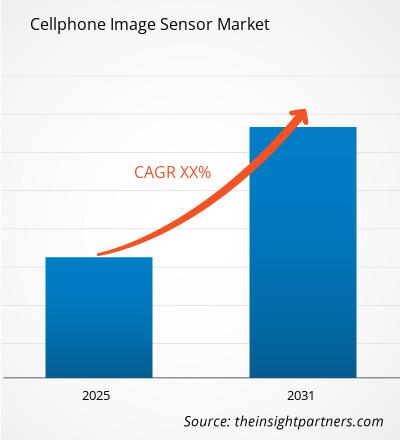
The global Cellphone Image Sensor market was valued at US$ 19.82 billion in 2025 and is expected to reach US$ 39.65 billion by 2034; it is estimated to record a CAGR of 8.01% during 2026-2034.
Cellphone Image Sensor Market Assessment and Insights
- North America held 27–29% share in 2025 and is growing at a CAGR range of 7.3–7.8% during 2026–2034, supported by premium handset replacement, creator-led video capture, and high penetration of multi-camera smartphones.
- US represented 78–82% of North America in 2025 and is growing at a CAGR range of 7.4–7.9% during 2026–2034, led by flagship iOS and Android demand.
- Europe accounted for 18–20% share in 2025 and is growing at a CAGR range of 6.7–7.2% during 2026–2034, with Germany, the UK, France, Italy, and Spain leading premium camera adoption.
- Asia Pacific captured 43–46% share in 2025 and is growing at a CAGR range of 8.8–9.4% during 2026–2034, driven by China, Japan, South Korea, India, and dense smartphone manufacturing ecosystems.
- Largest Segment Above 13 MP held 61–64% market share in 2025, with a CAGR range of 8.6–9.2% during 2026–2034 as flagship and upper-mid devices standardize high-resolution main sensors.
- High Growth Segment Android System held 70–73% market share in 2025, with a CAGR range of 8.7–9.3% during 2026–2034 because OEM diversity accelerates sensor design wins.
- Key companies analyzed in detail: Henkel AG and Co. KGaA, Himax Technologies, Inc., Panasonic Holdings Corporation, OmniVision Technologies, Inc., Samsung Electronics Co., Ltd., Semiconductor Components Industries, LLC, Sharp Corporation, Silicon Optronics, Inc., Sony Corporation, Toshiba Corporation.
Source: The Insight Partners' analysis based on proprietary research, government publications, company annual reports, investor presentations, industry databases, and expert interviews.
Sensor advancement now progresses from simple megapixel competition towards stacking CMOS structure, larger optics, high dynamic range capability, and built-in signal processing capabilities that optimize zooming, auto-focus, and image stabilization. Production trends have been changing due to demand for dual-sourcing and better module integration on behalf of mobile phone brands. The most rapid development within the Cellphone Image Sensor Market comes in cases where camera improvements can be compensated with additional cost of premium phone.
As for future concerns, investments will be made in Asia-based manufacturing alliances, specific pixel technologies, and image signal processing to enable AI-driven optimization of scenes. Emerging geographic regions like India, Southeast Asia, and Middle East become more significant because replacement cycle of smartphones in mature regions extends in time. Attention from regulation bodies to energy efficiency and device reparability will have an impact on thin and low-power module design.
Cellphone Image Sensor Market Report Scope
| Report Attribute | Details |
|---|---|
| Market size in 2025 | US$ 19.82 Billion |
| Market Size by 2034 | US$ 39.65 Billion |
| Global CAGR (2026 - 2034) | 8.01% |
| Historical Data | 2021-2024 |
| Forecast period | 2026-2034 |
Cellphone Image Sensor Market Analysis
Demand is now more related to the value proposition of the handsets rather than the number of units alone. According to IDC, the projected growth in 2025 shipments of smartphones would be 1.0%, while the expected growth in ASPs would be 5.0%, thereby signifying the importance of camera specifications in premiumization. Consequently, the Cellphone Image Sensor Market would be positively impacted by the increasing numbers of sensors per handset, the quality of the video specification, and the preference of consumers toward low-light shooting capabilities, taking portraits, and optical equivalent zooms in small form factor phones.
The value chain includes wafer design, manufacturing, color filter array, lens, adhesives, processors, and even the phone itself. There is a need for tradeoffs between pixel size, optical format, power consumption, autofocus capability, and heat dissipation on the part of the suppliers. The modern flagship phone would require the coordinated efforts of the sensor makers, module manufacturers, processor manufacturers, and OEM software teams.
Competition still centers around Sony Corporation, Samsung Electronics Co., Ltd., and OmniVision Technologies, Inc., but Panasonic Holdings Corporation, Sharp Corporation, Toshiba Corporation, Himax Technologies, Inc., Silicon Optronics, Inc., Semiconductor Components Industries, LLC, and Henkel AG and Co. KGaA are in the picture when it comes to their respective roles of supporting optics, packaging, bonding, and semiconductor requirements. Cellphone Image Sensor Market reveals differentiation in the areas of HDR video, power management, and sensor intelligence.
The trend is toward investment into 50 MP and 200 MP models, bigger sizes for flagship models, and 100 dB dynamic range. TechInsights has identified an increase in revenues from image sensors sales for smartphones above 10% in Q2 and Q3 2025. In particular, Sony, Samsung System LSI, and OMNIVISION lead in the segment.
● REPORT CUSTOMIZATION
Tailor This Report To Align With Your Specific Business Requirements
This report can be customized to align precisely with your business objectives, scope, and target markets. Customization options include tailored segmentation, geography, competitive analysis, and strategic insights to support informed decision-making.
Customize This Report →WHAT YOU CAN ADJUST
- ● Segmentations
- ● Geography
- ● Competitive Analysis
- ● Language Preferences
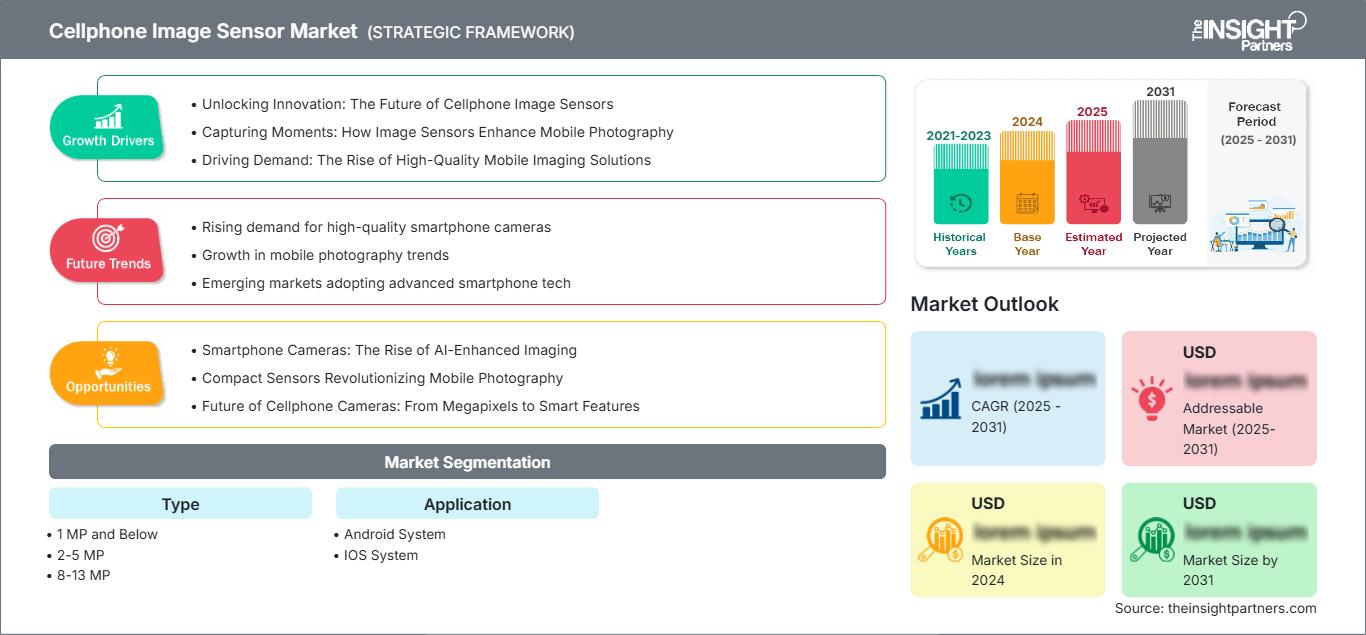
Cellphone Image Sensor Market: Strategic Insights
Regional Insights
North America Cellphone Image Sensor Market
The North American region held a 27-29% share in 2025 and is expected to register a CAGR growth of 7.3-7.8% in 2026-2034. The region is favored due to the availability of premium smartphones, extensive trade-in program initiatives by the operators, and fast uptake of camera-driven upgrade cycle. The demand in the Cellphone Image Sensor Market share is driven by the high requirement for video recording, AI photography, and imaging workflows for creators.
Financing through the carriers and bundled service packages minimize the hassle involved with replacing the devices, making sure that the premium smartphones remain within reach despite strained household budgets. Professional social media content creation, mobile commerce imaging, and telehealth applications have significantly driven demand in this region, necessitating clear front and rear cameras.
U.S. Cellphone Image Sensor Market
The US accounted for 78–82% of North America in 2025, with forecasted growth at 7.4–7.9% CAGR between 2026 and 2034. The US market benefits from Apple and Samsung device cycles that drive camera developments, while other manufacturers engage in competition using advanced sensors and AI-imaging solutions. Supplier presence is indirect, yet it has significant influence via design centers, sales offices, and OEM relations.
Camera applications are likely to involve cinematic video, stabilization of telephoto lenses, night shots, and improved front camera for video conferences. Premium cameras will use several sensors with different functions, such as wide-angle, ultra-wide, telephoto, and depth-related. USA customers are willing to pay for imaging advancements provided by trade-in programs that compensate for the cost of a device.
Europe Cellphone Image Sensor Market
Europe had market share of 18-20% in 2025 and is expected to grow at CAGR between 6.7%-7.2% from 2026-2034. Germany leads owing to demand for premium android, expertise in automotive electronics, and financing for retail. United Kingdom follows owing to large market for iOS smartphones along with content creation. France boosts premium and refurbished channel.
Italy and Spain continue to be critical markets for mid-level Android adoption, with 50 MP and above cameras defining value perception in the segment. Regulations in Europe around sustainability, reparability, and power consumption can force module design changes with focus on durable low power components. Demand growth is less volatile than Asia Pacific, but high ASP segment keeps Europe important.
APAC Cellphone Image Sensor Market
APAC held the highest market share of 43-46% in 2025 and will continue to grow in the forecast period from 2026-2034 at a CAGR of 8.8-9.4%. China holds leadership due to a high level of smartphone production capacity and competition among local OEMs, whereas Japan and South Korea act as leaders in sensor innovation and semiconductor production.
India, Australia, and Southeast Asia add volume due to Android upgrades, online purchasing, and production in the region. Policies on localizing electronics manufacturing and components will support the development of procurement in the region. Growth of the region is connected to the fast uptake of high-resolution rear camera smartphones and efficient sensors.
Middle East & Africa Cellphone Image Sensor Market
Middle East & Africa is projected to grow at a CAGR range of 7.9–8.5% during 2026–2034. Saudi Arabia and the UAE lead premium smartphone uptake through high disposable income, tourism, and digital commerce, while South Africa supports demand for mid-tier Android camera upgrades.
Infrastructure expansion, 5G adoption, and social-commerce activity are increasing reliance on mobile video and product imaging. Rest of MEA remains price-sensitive, but camera specifications are becoming a key differentiator in sub-premium devices. Energy and infrastructure investments also support retail modernization, improving availability of branded smartphones with upgraded camera modules.
Segmentation Analysis
Type
Type is expected to grow at a CAGR range of 8.1–8.7% during 2026–2034. The Cellphone Image Sensor Market scope across type categories reflects a shift from low-resolution legacy components toward high-resolution CMOS sensors in main, ultra-wide, and telephoto modules. OEMs use sensor mix optimization to balance cost, phone thickness, and perceived image quality.
- 1 MP and Below remains limited to basic imaging, auxiliary sensing, and highly cost-sensitive devices where small die size and low power matter more than image fidelity.
- 2-5 MP supports entry-level modules, depth sensing, and front-camera uses in low-cost devices, but demand is pressured by rising consumer expectations for clearer video communication.
- 8-13 MP continues serving secondary cameras and mainstream front modules where balanced cost, compact design, and acceptable image quality are essential for mid-tier smartphones.
- Above 13 MP dominates premium and upper-mid devices as vendors adopt 50 MP, 108 MP, and 200 MP sensors for sharper images, zoom flexibility, and stronger marketing differentiation.
Application
Application is forecast to grow at a CAGR range of 8.4–9.0% during 2026–2034. Android and iOS ecosystems shape procurement differently: Android creates broad sensor variety across many OEMs, while iOS emphasizes tightly optimized hardware-software integration. Both platforms increase demand for computational photography, video stabilization, and multi-camera consistency.
- Android System leads volume because multiple OEMs refresh camera specifications frequently across price bands, creating broad opportunities for high-resolution, ultra-wide, macro, telephoto, and front-facing sensors.
- IOS System delivers high-value demand through consistent premium positioning, deep image-processing integration, and strong replacement cycles where camera quality is a central purchase driver.
Opportunity Snapshot
| Application | Revenue Contribution | Trend Tag | Adoption Stage |
| Android System | High | OEM Variety | Scaling |
| IOS System | High | Premium Imaging | Mature |
Cellphone Image Sensor Market Growth Drivers and Impact Analysis
Premium Smartphone Camera Differentiation
Camera functionality continues to be one of the few areas in which customers can assess handsets right away, thus making sensors an important component in the process of device positioning. According to IDC, smartphone manufacturers are focusing on camera functionality, thinness, AI and folding phones as ways to promote premiumization. As a result, the trend increases the sensor value per phone due to larger main sensors, advanced telephoto lenses, and front camera capabilities of flagships. It translates into the increase in ASPs and qualification cycles and supplier bargaining power due to improved performance and stability.
Expansion of Multi-Camera Architectures
Modern smartphones are now moving to using multiple sensors that will deliver wide, ultra-wide, telephoto, macro, and depth sensing features. This design ensures an increase in the number of opportunities in sensors regardless of a modest increase in the number of handset units. Suppliers are now differentiated through their pricing in the form of sensors' resolution, optical format, and auto focus feature. There is an expanded design opportunity for the suppliers ranging from high-end 200 MP sensors to smaller secondary sensors.
On-Device AI and Computational Photography
AI-enabled imaging is changing sensor requirements from passive capture toward intelligent data generation. Sony’s 2025 LYTIA 901 integrates AI-based processing for high-powered zoom, while Samsung’s ISOCELL HP5 uses AI remosaic processing for 200 MP output. These developments show that processing capability is becoming part of sensor differentiation. Market impact includes stronger demand for low-noise signals, faster readout, and better synchronization with application processors. Suppliers able to reduce processing burden at the sensor level can help OEMs manage power, heat, and image latency.
Cellphone Image Sensor Market Future Trends
HDR Video Becomes a Core Sensor Benchmark
The next phase of Cellphone Image Sensor Market trends will prioritize video quality rather than still-image resolution alone. OMNIVISION’s 2025 OV50X and OV50R releases target up to 110 dB HDR, while Sony’s LYT-828 exceeds 100 dB dynamic range for mobile applications. This direction suggests that flagship competition will focus on retaining highlight and shadow detail in motion, especially for social video, live streaming, and night scenes. Sensors with efficient single-exposure HDR may gain share because they reduce motion artifacts and improve preview consistency.
Thinner High-Resolution Modules Gain Priority
Future sensor designs will need to reconcile higher resolution with slimmer industrial design. Samsung’s 0.5 micrometer ISOCELL HP5 illustrates how pixel miniaturization can support 200 MP imaging in compact formats, provided crosstalk and noise are controlled. OEMs are expected to favor sensors that deliver marketing-friendly resolution without increasing camera bump thickness. This trend will make isolation structures, microlenses, low-noise circuitry, and packaging precision more important. Suppliers that combine compact die design with credible low-light output can win across foldable and thin flagship platforms.
Cellphone Image Sensor Market Opportunities
Mid-Tier Android Sensor Upgrades
The largest actionable opportunity lies in bringing flagship-derived imaging into mid-tier Android devices. Many consumers delay phone replacement unless visible camera improvements are clear, so OEMs can stimulate upgrades by adopting 50 MP main sensors, better ultra-wide modules, and efficient HDR video at controlled cost. Cellphone Image Sensor Market Forecasts point to strong gains where suppliers offer scalable product families that reuse architecture across price tiers. Vendors should prioritize reference designs, faster qualification, and partnerships with module makers serving India, Southeast Asia, Latin America, and MEA.
Sensor-Level Processing Partnerships
Sensor vendors can create higher-margin opportunities by collaborating earlier with application processor suppliers and smartphone OEM imaging teams. As AI remosaicing, HDR fusion, and low-power preview features move closer to the sensor, differentiation depends on co-optimized hardware and software. Partnerships can reduce OEM development risk, improve image consistency across camera modes, and shorten tuning cycles. This approach also allows suppliers to defend ASPs because performance is embedded in the overall imaging stack rather than judged only by pixel count or sensor size.
Recent Developments
- June 2026: Sony Semiconductor Solutions unveiled the LYTIA L910 CMOS image sensor for smartphones, featuring LOFIC (Lateral Overflow Integration Capacitor) technology. The 50 MP sensor delivers up to 100 dB dynamic range in a single exposure, reducing highlight clipping and improving image quality in high-contrast scenes while supporting 4K HDR video.
- June 2026: Sony's new LYTIA L910 image sensor was highlighted for offering one of the highest dynamic range capabilities available for smartphone cameras. Its advanced HDR technology captures greater detail in bright and dark areas simultaneously, enabling more lifelike photos and videos in challenging lighting conditions.
- June 2026: Sony introduced new imaging hardware designed to reduce motion blur in smartphone photography. By combining LOFIC technology with enhanced HDR processing and faster image capture, the sensor improves sharpness, minimizes blur in moving subjects, and delivers clearer photos in demanding shooting environments.
Frequently Asked Questions

- Comprehensive Market Sizing and Forecast Analysis
- Detailed Segmentation Analysis
- In-Depth Market Dynamics Assessment
- Regional and Country-Level Insights
- Competitive Landscape and Company Benchmarking
- Strategic Business Intelligence
Recent Reports
Testimonials

The Insight Partners' SCADA System Market report is comprehensive, with valuable insights on current trends and future forecasts. The team was highly professional, responsive, and supportive throughout. We are very satisfied and highly recommend their services.
RAN KEDEM Partner, Reali Technologies LTDs
I requested a report on a very specific software market and the team produced the report in a few days. The information was very relevant and well presented. I then requested some changes and additions to the report. The team was again very responsive and I got the final report in less than a week.
JEAN-HERVE JENN Chairman, Future Analytica
We worked with The Insight Partners for an important market study and forecast. They gave us clear insights into opportunities and risks, which helped shape our plans. Their research was easy to use and based on solid data. It helped us make smart, confident decisions. We highly recommend them.
PIYUSH NAGPAL Sr. Vice President, High Beam Global
The Insight Partners delivered insightful, well-structured market research with strong domain expertise. Their team was professional and responsive throughout. The user-friendly website made accessing industry reports seamless. We highly recommend them for reliable, high-quality research services
YUKIHIKO ADACHI CEO, Deep Blue, LLC.
This is the first time I have purchased a market report from The Insight Partners.While I was unsure at first, I visited their web site and felt more comfortable to take the risk and purchase a market report.I am completely satisfied with the quality of the report and customer service. I had several questions and comments with the initial report, but after a couple of dialogs over email with their analyst I believe I have a report that I can use as input to our strategic planning process.Thank you so much for taking the extra time and making this a positive experience.I will definitely recommend your service to others and you will be my first call when we need further market data.
JOHN SUZUKI President and Chief Executive Officer, Board Director, BK Technologies
I wish to appreciate your support and the professionalism you displayed in the course of attending to my request for information regarding to infectious disease IVD market in Nigeria. I appreciate your patience, your guidance, and the fact that you were willing to offer a discount, which eventually made it possible for us to close a deal. I look forward to engaging The Insight Partners in the future, all thanks to the impression you have created in me as a result of this first encounter.
DR CHIJIOKE ONYIA MANAGING DIRECTOR, PineCrest Healthcare Ltd.Reason to Buy
- Informed Decision-Making
- Understanding Market Dynamics
- Competitive Analysis
- Identifying Emerging Markets
- Customer Insights
- Market Forecasts
- Risk Mitigation
- Boosting Operational Efficiency
- Strategic Planning
- Investment Justification
- Tracking Industry Innovations
- Aligning with Regulatory Trends





 Get Free Sample for