
Contact Adhesive Market Growth, Trends & Forecast by 2034
Contact Adhesive Market Size and Forecasts (2021–2034), Global and Regional Share, Trends, and Growth Opportunity Analysis Report Coverage : by Resin Type (Neoprene, Polyurethane, Acrylic, SBC); Technology (Solvent-Based, Water-Based); End-use Industry (Woodworking, Leather & Footwear, Automotive); and Geography (North America, Europe, Asia Pacific, and South and Central America)
- Status : Data Released
- Report Code : TIPRE00040248
- Category : Chemicals and Materials
- No. of Pages : 150
- Available Report Formats :


- Last update date : September 01, 2026


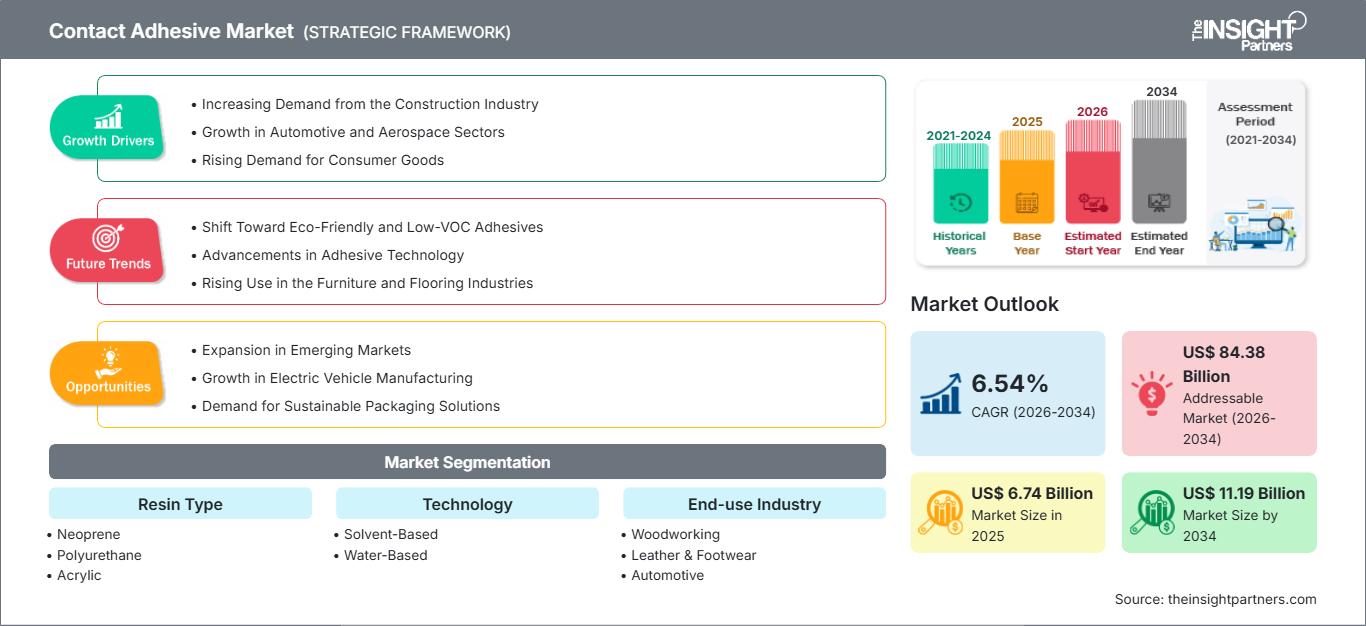
2025 Market Size
US$ 6.74 Bn
Base year value
2034 Forecast
US$ 11.19 Bn
Projected by 2034
CAGR 2026-2034
6.54 %
Growth rate
Addressable Market
US$ 84.38 Bn
(2026-2034)
Contact adhesives are increasingly used where immediate tack, flexible bonding, and compatibility with diverse substrates are required. The contact adhesive market was valued at US$ 6.74 Billion in 2025 and is projected to reach US$ 11.19 Billion by 2034, expanding at a 6.54% CAGR during 2026–2034. Demand is supported by manufacturing activity across woodworking, footwear, automotive interiors, and other applications requiring efficient assembly and durable bonds.
North America remains an important high-value market, with the Contact Adhesive Market size supported by established woodworking, automotive, furniture, and renovation industries. The region is estimated to expand at a 5.8–6.5% CAGR during 2026–2034, supported by demand for faster assembly, solvent-emission management, lightweight components, and higher-performance bonding systems across industrial and commercial applications.
Contact Adhesive Market Assessment and Insights
- North America: North America is estimated to account for 25–29% share in 2025, with the market growing at a 5.8–6.5% CAGR during 2026–2034, supported by automotive interiors, furniture production, renovation, and industrial assembly.
- US: The US represents approximately 72–76% of North America's 2025 share, expanding at a 5.7–6.4% CAGR during 2026–2034, supported by established manufacturing and renovation activity.
- Europe: Europe is estimated at 22–26% share in 2025, growing at a 5.5–6.2% CAGR during 2026–2034. Germany, Italy, France, the UK, and Spain remain important markets because of automotive, furniture, footwear, and industrial manufacturing.
- Asia Pacific: Asia Pacific holds approximately 34–38% share in 2025 and is projected to expand at a 7.0–7.8% CAGR during 2026–2034, led by China, India, Japan, and South Korea.
- Largest Segment: Neoprene is estimated to represent 40–44% market share in 2025, with a 5.9–6.6% CAGR during 2026–2034, reflecting broad substrate compatibility and established industrial use.
- High Growth Segment: Polyurethane is estimated at 20–24% share in 2025, with a 7.0–7.8% CAGR during 2026–2034, supported by automotive, furniture, and demanding flexible-bond applications.
- Key companies analyzed in detail: Henkel AG & Co. KGaA, H.B. Fuller Company, Sika AG, Arkema, 3M Company, Huntsman Corporation, Illinois Tool Works Inc., Pidilite Industries Limited, MAPEI S.p.A., and Collano AG.
Source: The Insight Partners' analysis based on proprietary research, government publications, company annual reports, investor presentations, industry databases, and expert interviews.
Contact adhesive products have seen a shift from traditional solvent-heavy formulas to more sophisticated products, which balance properties such as quick grabbing, bonding strength, elasticity, and environmentality. The choice of resins becomes more dependent on the substrate pair and operational parameters, while waterborne technology becomes relevant when emissions and worker safety are at stake. More regionalization in production is another trend helping the producers to minimize their logistics risks and respond better to customer formulation needs.
During the forecast period, new manufacturing hubs of Asia Pacific are projected to attract more investment in terms of formulation and conversion capacity. The investments will be made into waterborne chemistries, advanced polyurethane adhesives, automated dispensing equipment, and formulations developed according to environmental requirements. Volatile Organic Compounds' regulatory pressure together with customers' demand for low-emission manufacturing is gradually going to change the product portfolios without excluding solventborne adhesives.
Contact Adhesive Market Report Scope
| Report Attribute | Details |
|---|---|
| Market size in 2025 | US$ 6.74 Billion |
| Market Size by 2034 | US$ 11.19 Billion |
| Global CAGR (2026 - 2034) | 6.54% |
| Historical Data | 2021-2024 |
| Forecast period | 2026-2034 |
Contact Adhesive Market Analysis
The Contact Adhesive Market growth prospects are directly linked with furniture manufacturing, shoe making, automotive interiors, and renovation works. In all these applications, there is a preference for fast bond formation since the adhesives help minimize the mechanical fastening needs and facilitate production cycles. The value chain includes polymer and resin manufacturers, formulators, distributors, machinery, fabricators, and OEMS. The availability and prices of raw materials are crucial factors in formulation economics.
Factors such as regional manufacturing presence and resin integration are increasingly becoming important for supply conditions. Large-scale players can handle the complexities involved in formulation and sourcing better, while niche players can differentiate through products designed specifically for substrates, technology services, and shorter delivery times. Companies are also increasingly trying to strike a balance between solvent and water-based product lines in their range.
The Contact Adhesive Market Report analyzes moderate diversification within the competition within the industry with big multinationals and regional firms. Henkel AG & Co. KGaA and H.B. Fuller Company have advantages with wide range of formulations and existing connections in industries while Sika AG and Arkema work for many industrial and construction needs. 3M Company competes through application engineering and specific adhesive technology while Pidilite Industries Limited is well-positioned in India’s adhesive business.
Positioning becomes more and more based on formulation diversification, geographic manufacturing, customer-based development and stability in sourcing materials. H.B. Fuller Company attempts to re-position its portfolio to specialty adhesive products while Sika AG continues geographic expansion through acquisitions. The Bostik division of Arkema is investing into adhesive technology and manufacturing capacity. Such trends suggest that scale, technology depth and end user proximity will remain key competitive advantages.
● REPORT CUSTOMIZATION
Tailor This Report To Align With Your Specific Business Requirements
This report can be customized to align precisely with your business objectives, scope, and target markets. Customization options include tailored segmentation, geography, competitive analysis, and strategic insights to support informed decision-making.
Customize This Report →WHAT YOU CAN ADJUST
- ● Segmentations
- ● Geography
- ● Competitive Analysis
- ● Language Preferences
Contact Adhesive Market: Strategic Insights
Regional Insights
North America Contact Adhesive Market
North America's Contact Adhesive Market share is forecast at 25-29%, with a compound annual growth rate of 5.8-6.5%. The United States is the leading market in the region due to applications related to furniture, cabinetry, flooring, automotive interiors, and commercial renovation. Canada is driven by applications related to construction woodworking and manufacturing, while Mexico gets boost from automotive manufacturing and nearshoring.
Demand is becoming more sensitive to production efficiency and environmental factors. Waterborne technology options are being considered, but solvent-based products continue to be used in cases where fast drying and quick bonding is required. Lightweighting trends in the automotive industry and the use of composites for interiors drive demand for specialized adhesives. The region has an advantage due to a well-established distribution channel and technical service expertise.
U.S. Contact Adhesive Market
The US holds around 72-76% of North America's 2025 share and is forecasted to witness growth at a 5.7-6.4% CAGR over the years 2026-2034. Demand exists in furniture, cabinetry, automotive interiors, flooring, footwear, and commercial building. Notable players are Henkel AG & Co. KGaA, H.B. Fuller Company, 3M Company, and Illinois Tool Works Inc.
Increasing use of adhesives in applications requiring fast tack together with low emission and consistency in performance is seen across engineered wood, plastics, foams, textiles, and laminates. Activities in renovation generate regular demand, whereas the automotive industry provides opportunities for high-end formulations. US-based manufacturers are also focusing on adopting automation in processes and dispensing equipment, which makes suppliers offer formulations that cater to this need.
Europe Contact Adhesive Market
Europe represents 22-26% share in 2025, with a CAGR of 5.5-6.2% between 2026 and 2034. Germany continues to be the leading nation, driven by the presence of automotive and industrial manufacturing sectors, while Italy boasts of the furniture and footwear sector. France, the UK and Spain contribute via construction, interiors, furniture and consumer product manufacturing.
UK market is driven by renovation, furniture refurbishing and industrial assembling. Germany is notable for its demand from automotive interiors, engineered wood and machinery manufacturing sectors, thereby offering chances for high performance formulations. Italy, France and Spain are notable for their furniture, footwear, construction and interiors sectors. European producers operate under relatively stringent environmental norms, resulting in water-based formulations and lower emission chemistry and application.
APAC Contact Adhesive Market
The APAC region occupies around 34–38% share in 2025 and is expected to register a CAGR of 7.0–7.8% during 2026–2034 and is thus the dominant regional market. Among all the APAC countries, China is the most significant one, followed by Japan, India, South Korea, and Australia.
China has been engaged in many activities regarding furniture, cars, electronics, and manufacturing, whereas India has been benefited with the rise in furniture, footwear, and automobile manufacturing. The demand in Japan and South Korea has been for high-performance industrial bonding, whereas there is a demand for construction and renovation in Australia.
Middle East & Africa Contact Adhesive Market
However, the Middle East & Africa region is a smaller developing demand center, which comprises Saudi Arabia, UAE, and South Africa as key markets. The growth rate of the region in terms of CAGR is forecasted between 6.0% to 6.8% during 2026-2034. Both Saudi Arabia and UAE get benefitted due to the growth of construction and diversification projects, while South Africa offers an established base of furniture, footwear, automotive, and industrial. The Rest of MEA is highly fragmented and demand is restricted to cities and industries. Energy availability, infrastructure, and raw material imports play a significant role in production economics of the region.
Segmentation Analysis
Resin Type
Neoprene, polyurethane, acrylic, and SBC formulations address different requirements relating to substrate compatibility, flexibility, heat resistance, drying behavior, and durability. The resin segment is expected to expand at a 6.0–6.8% CAGR during 2026–2034. Product selection increasingly depends on application-specific performance rather than resin cost alone.
- Neoprene: Neoprene remains the largest resin category because of established performance across wood, rubber, laminates, foams, and other substrates. Its balanced adhesion and resistance profile supports continued industrial adoption.
- Polyurethane: Polyurethane benefits from increasing use where flexibility, durability, and strong adhesion to challenging substrates are required. Automotive interiors and engineered furniture provide important demand opportunities.
- Acrylic: Acrylic formulations are selected for applications requiring weatherability, aging resistance, and dependable adhesion. Their use is supported by specialized industrial and assembly applications requiring stable long-term performance.
- SBC: SBC systems provide flexibility, rapid tack, and processing advantages across selected contact-bonding applications. Their formulation versatility supports continued use where immediate bonding and economical processing are important.
Technology
Technology selection is increasingly influenced by application speed, substrate compatibility, workplace requirements, and environmental considerations. The technology segment is projected to grow at a 6.2–7.0% CAGR during 2026–2034, with manufacturers maintaining both platforms to address different performance requirements.
- Solvent-Based: Solvent-based products remain important where rapid drying, high initial tack, and reliable bonding performance are required. Industrial applications continue to support their use despite increasing pressure to reduce emissions.
- Water-Based: Water-based technologies are gaining adoption where lower emissions and improved workplace conditions are priorities. Furniture, interiors, and selected industrial applications are encouraging formulation improvements that narrow performance gaps.
End-use Industry
End-use demand is shaped by manufacturing volumes, substrate changes, assembly productivity, and replacement of mechanical fastening. The segment is expected to grow at a 6.3–7.1% CAGR during 2026–2034. Automotive and woodworking applications offer particularly strong opportunities for higher-performance bonding systems.
- Woodworking: Woodworking remains a core application because contact adhesives support laminates, veneers, furniture components, and cabinetry. Demand benefits from furniture manufacturing and renovation activity requiring efficient assembly.
- Leather & Footwear: Footwear manufacturers value rapid bonding, flexibility, and compatibility with leather, rubber, textiles, and synthetic materials. Production growth in Asian manufacturing centers supports continued formulation demand.
- Automotive: Automotive applications increasingly use adhesives for interior trim, upholstery, foam, and selected lightweight components. Demand is supported by production efficiency, weight reduction, and improved appearance requirements.
Opportunity Snapshot
| Industry Vertical | Revenue Contribution | Trend Tag | Adoption Stage |
| Woodworking | High | Furniture Bonding | Mature |
| Leather & Footwear | Medium | Flexible Bonding | Mature |
| Automotive | High | Lightweight Interiors | Scaling |
Contact Adhesive Market Growth Drivers and Impact Analysis
Expansion of Furniture and Engineered Wood Manufacturing
Furniture manufacturing is a major demand engine because contact adhesives provide rapid bonding for laminates, veneers, foams, and decorative surfaces. Growth in modular furniture, ready-to-assemble products, cabinetry, and renovation increases the number of bonding operations performed per finished unit. Manufacturers increasingly prioritize formulations that deliver predictable open time and immediate tack while reducing rework. In emerging production centers, particularly across Asia, rising furniture exports can support additional adhesive consumption. The impact extends beyond volume because higher-quality furniture increasingly requires consistent surface appearance and durable bonds. Suppliers able to offer application-specific products, technical support, and dispensing guidance can capture greater value from this shift. The resulting demand favors products balancing productivity, substrate compatibility, and cost efficiency rather than relying solely on low formulation prices.
Growth of Lightweight Automotive Interior Components
Automotive manufacturers increasingly use plastics, foams, textiles, composites, and coated materials in interior assemblies, creating bonding requirements that cannot always be addressed efficiently with mechanical fastening. Contact adhesives can support trim attachment, upholstery, acoustic components, and selected interior laminations while maintaining flexibility. As vehicle platforms become more focused on weight efficiency and simplified assembly, adhesive solutions can reduce component complexity and improve visual quality. Production localization in Asia, Mexico, and other automotive centers expands the addressable customer base. Suppliers that develop formulations compatible with multiple substrates can reduce the need for separate bonding systems within production lines. The commercial impact is therefore linked not only to vehicle output but also to the increasing number of bonded interfaces per vehicle and the need for repeatable industrial application.
Increasing Preference for Lower-Emission Bonding Systems
Environmental and workplace considerations are accelerating formulation development across adhesive manufacturing. Customers increasingly evaluate volatile organic compound emissions, worker exposure, drying requirements, and material efficiency alongside bond performance. Water-based technologies can address part of this requirement, although solvent-based products remain necessary for applications demanding rapid drying or specific substrate performance. The transition creates opportunities for suppliers to improve water-based polymers, optimize rheology, and develop formulations capable of matching established solvent-based performance. Manufacturers that successfully reduce drying time or improve initial tack can accelerate adoption in high-throughput environments. Regulatory requirements are also encouraging customers to reconsider material selection during plant upgrades. Consequently, sustainability is becoming a formulation and process-development issue rather than a standalone marketing consideration, influencing purchasing specifications and long-term supplier relationships.
Contact Adhesive Market Future Trends
Increasing Use of Bio-Based and Circular Raw Materials
The next phase of Contact Adhesive Market Trends is likely to involve greater incorporation of bio-based, recycled, and circular feedstocks without sacrificing bond strength or processing consistency. Resin producers are increasingly evaluating renewable monomers, bio-attributed raw materials, and lower-carbon feedstocks as customers seek improved environmental profiles. This trend could influence contact adhesive formulations through changes in polymer architecture, tackifier selection, and solvent systems. Commercial adoption will depend on supply reliability, certification, cost competitiveness, and compatibility with existing equipment. Companies with access to integrated polymer chemistry and formulation expertise are better positioned to scale these solutions. Over time, purchasing specifications may increasingly include carbon-footprint information and renewable-content requirements alongside traditional technical parameters.
Digitalized Formulation and Application Optimization
Digital tools are expected to influence formulation development, quality control, and adhesive application during the forecast period. Manufacturers can use process data to optimize viscosity, coating weight, drying conditions, and dispensing parameters for individual substrates. Automated application can also improve material utilization and reduce variation between production batches. In high-volume furniture and automotive plants, these improvements can lower adhesive consumption per component while increasing production consistency. Digital monitoring may additionally help identify defects caused by surface preparation, temperature, humidity, or application pressure. The trend creates opportunities for adhesive suppliers to move beyond material sales and provide application-specific process support. Such capabilities can strengthen customer retention because performance becomes linked to a broader technical solution rather than a single formulation.
Contact Adhesive Market Opportunities
Localized Production in High-Growth Asian Manufacturing Centers
Expanding production capacity in India, Southeast Asia, and selected Chinese industrial clusters creates opportunities for adhesive suppliers to establish regional manufacturing and technical-service operations. Local production can reduce transportation costs, improve inventory responsiveness, and enable faster formulation adjustments for local substrates and manufacturing conditions. India is particularly attractive because furniture, footwear, automotive, and construction-related manufacturing are expanding simultaneously. Suppliers can combine regional resin sourcing with localized technical centers to improve customer qualification and shorten product-development cycles. Partnerships with distributors and large manufacturers can further accelerate penetration. Investment decisions should prioritize locations offering access to polymer feedstocks, skilled formulation personnel, logistics infrastructure, and concentrated industrial customers. A regional strategy can therefore improve both cost competitiveness and customer responsiveness.
Specialized High-Performance Formulations for Automotive Interiors
Automotive interiors offer an opportunity to shift toward higher-value formulations designed for specific combinations of plastics, textiles, foams, composites, and coated substrates. Suppliers can differentiate through heat resistance, low odor, rapid processing, long-term flexibility, and compatibility with automated application equipment. Qualification requirements in automotive manufacturing create higher barriers to entry than many general-purpose applications, potentially supporting longer customer relationships once a formulation is approved. Suppliers can also develop products around electric-vehicle interior requirements, where lightweight materials and new surface combinations may increase bonding complexity. Investment in application laboratories and joint development with tier suppliers can help accelerate qualification. The Contact Adhesive Market Forecast is strongest for companies capable of integrating polymer science, application engineering, and production-process support.
Recent Developments
- February 2026: Henkel Adhesive Technologies announced a strategic collaboration with Sekab aimed at accelerating the transition from fossil-based to bio-based chemicals in industrial adhesive production. The collaboration focuses on replacing conventional, fossil-based ethyl acetate with a fossil-free, bio-based alternative. The initiative supports Henkel’s ambition to combine sustainability with high-performance adhesive solutions, including applications within its Packaging division.
- August 2026: Matrix Adhesives Group acquired IPS Adhesives, beginning a new phase of development for the manufacturer of high-performance adhesive technologies serving building and construction, transportation, industrial, marine, architectural surfacing, and other specialty markets. According to the companies, IPS Adhesives will add its product technologies, brands, international operations, and technical capabilities to the Matrix platform. The transaction includes IPS brands such as Integra Adhesives and Unika for architectural surfacing applications, as well as the SCIGRIP Adhesives structural product line.
Frequently Asked Questions

- Comprehensive Market Sizing and Forecast Analysis
- Detailed Segmentation Analysis
- In-Depth Market Dynamics Assessment
- Regional and Country-Level Insights
- Competitive Landscape and Company Benchmarking
- Strategic Business Intelligence
Recent Reports
Testimonials

The Insight Partners' SCADA System Market report is comprehensive, with valuable insights on current trends and future forecasts. The team was highly professional, responsive, and supportive throughout. We are very satisfied and highly recommend their services.
RAN KEDEM Partner, Reali Technologies LTDs
I requested a report on a very specific software market and the team produced the report in a few days. The information was very relevant and well presented. I then requested some changes and additions to the report. The team was again very responsive and I got the final report in less than a week.
JEAN-HERVE JENN Chairman, Future Analytica
We worked with The Insight Partners for an important market study and forecast. They gave us clear insights into opportunities and risks, which helped shape our plans. Their research was easy to use and based on solid data. It helped us make smart, confident decisions. We highly recommend them.
PIYUSH NAGPAL Sr. Vice President, High Beam Global
The Insight Partners delivered insightful, well-structured market research with strong domain expertise. Their team was professional and responsive throughout. The user-friendly website made accessing industry reports seamless. We highly recommend them for reliable, high-quality research services
YUKIHIKO ADACHI CEO, Deep Blue, LLC.
This is the first time I have purchased a market report from The Insight Partners.While I was unsure at first, I visited their web site and felt more comfortable to take the risk and purchase a market report.I am completely satisfied with the quality of the report and customer service. I had several questions and comments with the initial report, but after a couple of dialogs over email with their analyst I believe I have a report that I can use as input to our strategic planning process.Thank you so much for taking the extra time and making this a positive experience.I will definitely recommend your service to others and you will be my first call when we need further market data.
JOHN SUZUKI President and Chief Executive Officer, Board Director, BK Technologies
I wish to appreciate your support and the professionalism you displayed in the course of attending to my request for information regarding to infectious disease IVD market in Nigeria. I appreciate your patience, your guidance, and the fact that you were willing to offer a discount, which eventually made it possible for us to close a deal. I look forward to engaging The Insight Partners in the future, all thanks to the impression you have created in me as a result of this first encounter.
DR CHIJIOKE ONYIA MANAGING DIRECTOR, PineCrest Healthcare Ltd.Reason to Buy
- Informed Decision-Making
- Understanding Market Dynamics
- Competitive Analysis
- Identifying Emerging Markets
- Customer Insights
- Market Forecasts
- Risk Mitigation
- Boosting Operational Efficiency
- Strategic Planning
- Investment Justification
- Tracking Industry Innovations
- Aligning with Regulatory Trends





 Get Free Sample for