
Electronic Medical Records Market Size, Trends & Demand by 2034
Electronic Medical Records Market Size and Forecasts (2021–2034), Global and Regional Share, Trends, and Growth Opportunity Analysis Report Coverage : by Type (Cloud-Based EMR and On-Premise EMR); Component (Software and Services); End-User (Hospitals, Ambulatory Care Centers, Physician Offices); and Geography (North America, Europe, Asia Pacific, and South and Central America)
- Status : Data Released
- Report Code : TIPRE00040019
- Category : Life Sciences
- No. of Pages : 150
- Available Report Formats :


- Last update date : July 03, 2026


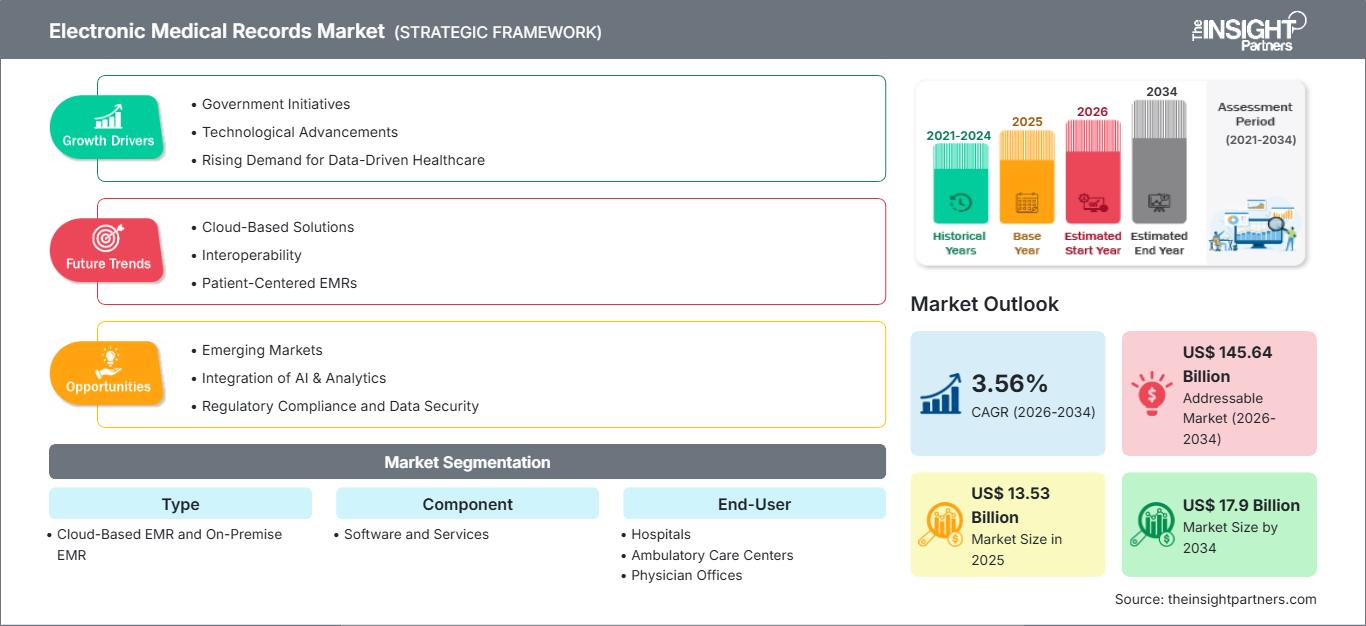
2025 Market Size
US$ 13.53 Bn
Base year value
2034 Forecast
US$ 17.9 Bn
Projected by 2034
CAGR 2026-2034
3.56 %
Growth rate
Addressable Market
US$ 145.64 Bn
(2026-2034)
Electronic Medical Records Market was valued at US$ 13.53 Billion in 2025 and is projected to reach US$ 17.9 Billion by 2034, expanding at a CAGR of 3.56% during 2026–2034. Growth is supported by continued healthcare digitalization, interoperability initiatives, and increasing reliance on clinical information systems to improve care coordination, patient safety, and administrative efficiency. Integration with cloud infrastructure, artificial intelligence-enabled clinical decision support, and evolving regulatory frameworks is further strengthening long-term market development.
North America is expected to maintain the leading regional position throughout the forecast period, supported by mature healthcare IT infrastructure, favorable reimbursement frameworks, and widespread electronic record adoption across hospitals and ambulatory settings. Regional expansion is anticipated to remain within a 3.2–3.8% CAGR range during 2026–2034 as providers continue modernizing legacy systems, improving interoperability, and incorporating AI-assisted clinical documentation while complying with evolving privacy and cybersecurity requirements.
Electronic Medical Records Market Assessment and Insights
- North America: The region benefits from extensive healthcare digitization, strong interoperability initiatives, and sustained investments in clinical information systems. Share in 2025: 38–42%. CAGR between 2026–2034: 3.2–3.8%.
- U.S.: The United States remains the regional leader owing to high EMR penetration, large healthcare networks, and continuous software modernization. Share in 2025 (of North America): 84–88%. CAGR between 2026–2034: 3.1–3.7%.
- Europe: Digital health policies across the United Kingdom, Germany, France, Italy, and Spain continue accelerating interoperability and patient record modernization. Share in 2025: 26–30%. CAGR between 2026–2034: 3.3–3.9%.
- Asia Pacific: China, Japan, India, South Korea, and Australia are expanding healthcare digitization through government-backed modernization programs and hospital IT investments. Share in 2025: 22–26%. CAGR between 2026–2034: 4.2–4.8%.
- Largest Segment: Software dominates the market owing to recurring platform upgrades, interoperability requirements, and integrated clinical workflows. Market share in 2025: 64–68%. CAGR between 2026–2034: 3.5–4.1%.
- High Growth Segment: Cloud-Based EMR demonstrates the strongest expansion because of scalability, lower infrastructure requirements, and remote accessibility. Market share in 2025: 46–50%. CAGR between 2026–2034: 5.0–5.6%.
- Key companies analyzed in detail: Oracle Health (formerly Cerner Corporation), Altera Digital Health (formerly Allscripts Healthcare Solutions), Epic Systems Corporation, McKesson Corporation, NextGen Healthcare, athenahealth, Greenway Health, GE HealthCare Technologies Inc., MEDITECH, and eClinicalWorks.
Source: The Insight Partners' analysis based on proprietary research, government publications, company annual reports, investor presentations, industry databases, and expert interviews.
The Electronic Medical Records Market has transformed from just simple digital records storage systems to integrated information systems that facilitate care coordination, workflow automation, population health management, and evidence-based decision-making. The evolution in technologies such as cloud computing, APIs, artificial intelligence, and interoperability standards is paving the way for easy transfer of data within the healthcare ecosystem. Providers of healthcare are giving more importance to platforms that can help them reduce administrative hassles and increase patient engagement, cybersecurity, and compliance.
Moving forward, the industry is poised to benefit from increasing investments in healthcare made by developing countries, advancements in public health infrastructure, and regulatory focus on an interoperable digital health ecosystem. Emerging countries in Asia Pacific, the Middle East, and certain parts of Latin America are making more investments in electronic health information exchanges, which will give rise to opportunities for cloud-based solutions. Future adoption of AI technologies, predictive analytics, and data frameworks for healthcare will enhance the competitive position while also aiding digital transformations. The Electronic Medical Records market size, Electronic Medical Records market share, Electronic Medical Records market growth, Electronic Medical Records market trends, Electronic Medical Records market scope, and Electronic Medical Records market analysis will all together reveal the future demand for the electronic medical records market.
Electronic Medical Records Market Report Scope
| Report Attribute | Details |
|---|---|
| Market size in 2025 | US$ 13.53 Billion |
| Market Size by 2034 | US$ 17.9 Billion |
| Global CAGR (2026 - 2034) | 3.56% |
| Historical Data | 2021-2024 |
| Forecast period | 2026-2034 |
Electronic Medical Records Market Analysis
The increasing importance of coordination in patient care, regulation compliance, and interoperability of healthcare data will continue driving the demand for electronic medical records in hospitals, ambulatory care facilities, and physicians’ clinics. More and more healthcare providers seek to replace their scattered legacy applications with integrated solutions that allow them to manage clinical documentation, prescribe medications, connect with laboratories, integrate imaging and revenue cycle management systems. Cloud hosting, interoperable data sharing by means of FHIR architecture, and AI-powered clinical documentation are changing the purchasing preferences while decreasing administrative workload and increasing operational effectiveness. The demand for robust software and implementation services will remain high as healthcare providers seek to achieve the goals of value-based care.
Market ecology not only encompasses software vendors but also involves cloud providers, implementation partners, cybersecurity experts, interoperability solutions providers, and managed service firms. Software is the biggest source of income due to the need of upgrading, improving cybersecurity, implementing advanced analytics, and regulatory compliance. On the other hand, the professional services segment, comprising of implementation, migration, customizations, training, and optimization, still accounts for a major portion of total spend.
Competition in the Electronic Medical Records Industry is highly focused on enterprise vendors with significant implementation experience, regulatory know-how, and comprehensive product lines. The Oracle Health Group, Epic Systems Corporation, GE HealthCare Technologies Inc., MEDITECH, athenahealth, NextGen Healthcare, eClinicalWorks, Greenway Health, McKesson Corporation, and Altera Digital Health have been working hard to enhance their competitive positioning by offering cloud native platform innovations, artificial intelligence technologies, improved interoperability, partnerships, and workflow automation. Enterprise vendors are dominating in large integrated delivery networks, whereas ambulatory-oriented providers are competing based on flexible deployment options, ease of implementation, and specific specialties.
Venture capital investment is shifting toward cloud native platforms, cyber-resilience, predictive analytics, and generative AI that will increase productivity of clinicians and engage patients. Healthcare providers value technology partners who can deliver solutions that will enable nationwide interoperability projects, safe exchange of information, compliance with new regulations without interfering with clinical practice. As a result, vendors are working to enhance application programming interfaces, implement intelligent clinical decision support systems and offer subscription based delivery models, which will increase scalability and reduce capital spending.
● REPORT CUSTOMIZATION
Tailor This Report To Align With Your Specific Business Requirements
This report can be customized to align precisely with your business objectives, scope, and target markets. Customization options include tailored segmentation, geography, competitive analysis, and strategic insights to support informed decision-making.
Customize This Report →WHAT YOU CAN ADJUST
- ● Segmentations
- ● Geography
- ● Competitive Analysis
- ● Language Preferences
Electronic Medical Records Market: Strategic Insights
Regional Insights
North America Electronic Medical Records
North America remains the largest regional market, accounting for 38–42% share in 2025, and is projected to expand at a CAGR of 3.2–3.8% during 2026–2034. Market leadership is supported by mature healthcare IT infrastructure, high electronic record penetration, and regulatory initiatives promoting interoperability and secure health information exchange. The region also benefits from continuous investment in cloud migration, cybersecurity, and artificial intelligence-enabled clinical documentation. OECD findings indicate that electronic health record maturity and patient access continue to improve across advanced healthcare systems, although interoperability challenges remain.
Healthcare providers across the United States and Canada continue replacing fragmented legacy platforms with integrated solutions supporting value-based care, remote patient management, and advanced analytics. Strong participation from enterprise vendors, increasing adoption of FHIR-based interoperability standards, and growing emphasis on reducing clinician administrative burden reinforce long-term market expansion. Investments in secure data sharing, predictive analytics, and workflow automation are expected to sustain regional competitiveness throughout the forecast period.
U.S. Electronic Medical Records Market
The U.S. represents 84–88% of the North American market in 2025 and is anticipated to grow at a CAGR of 3.1–3.7% through 2034. High EMR utilization among hospitals and physician practices, supported by continuous software modernization and interoperability initiatives, underpins market demand. Large integrated delivery networks increasingly prioritize cloud-native platforms, AI-assisted documentation, and cybersecurity investments to improve operational efficiency and patient outcomes.
Major suppliers including Oracle Health, Epic Systems Corporation, MEDITECH, GE HealthCare Technologies Inc., athenahealth, and eClinicalWorks maintain a significant commercial presence across acute and ambulatory care environments. Adoption is increasingly driven by integrated clinical workflows, digital patient engagement, revenue cycle optimization, and compliance with evolving federal interoperability requirements, encouraging providers to modernize legacy infrastructure while strengthening data security and exchange capabilities.
Europe Electronic Medical Records Market
Europe accounts for 26–30% of the global market in 2025 and is projected to register a CAGR of 3.3–3.9% through 2034. Regional growth is supported by national digital health strategies, expanding cross-border interoperability initiatives, and increasing adoption of standardized electronic patient records. OECD and WHO Europe continue to report broad EMR implementation across healthcare systems, although implementation maturity differs between countries.
The United Kingdom and Germany remain the leading national markets due to sustained public investment in healthcare digitization, widespread deployment across hospitals and primary care, and ongoing modernization of electronic patient record infrastructure. Both countries continue strengthening secure information exchange and integrated care delivery through national digital health programs.
France, Italy, and Spain continue expanding digital health capabilities through modernization initiatives focused on interoperability, patient access, and healthcare data governance. Although adoption maturity varies, continued investment in national health information systems and standardized data exchange is expected to improve regional integration while supporting long-term Electronic Medical Records deployment across public healthcare organizations.
APAC Electronic Medical Records Market
Asia Pacific represents 22–26% of the global market in 2025 and is forecast to expand at a CAGR of 4.2–4.8%, the fastest among major regions. Government-backed healthcare modernization, expanding hospital infrastructure, and increasing digital health investment continue accelerating EMR implementation across both public and private healthcare systems.
China and Japan lead regional adoption through extensive digital healthcare programs, while South Korea maintains advanced hospital information infrastructure. India continues expanding healthcare digitization, and Australia benefits from mature electronic health initiatives and strong interoperability frameworks.
Cloud deployment, improved healthcare connectivity, and supportive public policy are encouraging broader adoption across emerging economies, creating opportunities for scalable EMR platforms and managed implementation services throughout the forecast period.
Middle East & Africa Electronic Medical Records Market
The Middle East & Africa market is expected to record a CAGR of 4.0–4.6% between 2026 and 2034, supported by healthcare infrastructure modernization and national digital transformation programs. Although regional adoption remains comparatively lower than developed markets, investment momentum continues strengthening across major healthcare systems.
Saudi Arabia and the United Arab Emirates continue investing in smart hospitals, interoperable digital health platforms, and cloud-enabled healthcare information systems as part of broader healthcare transformation initiatives. These programs are improving operational efficiency while encouraging adoption of integrated EMR solutions.
South Africa and the Rest of MEA are gradually increasing implementation through public-sector digitization initiatives, expanding hospital capacity, and greater emphasis on secure patient data management, supporting steady long-term market development.
Segmentation Analysis
Type
The Type segment is expected to register a CAGR of 3.8–4.4% during 2026–2034. Healthcare providers increasingly evaluate deployment flexibility, cybersecurity, interoperability, and total cost of ownership when selecting EMR platforms. Cloud-based implementations continue gaining momentum among medium-sized providers, while on-premise solutions remain relevant for organizations requiring extensive infrastructure control and customized deployment environments.
- Cloud-Based EMR: Rapidly adopted because of subscription-based pricing, remote accessibility, automatic software updates, scalable computing resources, and simplified interoperability, making it particularly attractive for ambulatory care providers and expanding healthcare networks.
- On-Premise EMR: Continues serving large hospitals and organizations with strict internal governance requirements, offering direct infrastructure control, customized integration capabilities, and compliance with organization-specific security and operational policies.
Component
The Component segment is projected to expand at a CAGR of 3.6–4.2% during 2026–2034. Continuous platform modernization, cybersecurity enhancement, interoperability development, and long-term support services are driving spending across both software and implementation ecosystems. Organizations increasingly seek integrated solutions combining clinical functionality with managed services and technical expertise.
- Software: Represents the largest revenue contributor through integrated clinical documentation, e-prescribing, patient engagement, analytics, interoperability tools, and continuous feature enhancements supporting healthcare digital transformation.
- Services: Includes implementation, migration, customization, consulting, staff training, cybersecurity support, maintenance, and optimization, enabling healthcare providers to maximize system utilization while ensuring regulatory compliance.
End-User
The End-User segment is anticipated to grow at a CAGR of 3.5–4.1% during 2026–2034. Adoption patterns vary according to organizational size, patient volume, clinical complexity, and investment capacity. Healthcare providers increasingly prioritize interoperable platforms capable of supporting coordinated care, operational efficiency, and secure information exchange.
- Hospitals: Account for the largest implementation base because of complex clinical workflows, multidisciplinary care coordination, large patient volumes, and enterprise-wide integration requirements spanning laboratories, imaging, pharmacy, and billing systems.
- Ambulatory Care Centers: Increasingly deploy cloud-enabled EMR platforms to improve workflow efficiency, reduce infrastructure costs, strengthen patient engagement, and support expanding outpatient service delivery.
- Physician Offices: Continue adopting user-friendly EMR solutions focused on appointment scheduling, clinical documentation, e-prescribing, billing integration, and regulatory reporting while maintaining affordable implementation and maintenance costs.
Opportunity Snapshot
| Segment Name | Revenue Contribution | Trend Tag | Adoption Stage |
| Hospitals | High | AI Documentation | Mature |
| Ambulatory Care Centers | Medium | Cloud Migration | Scaling |
| Physician Offices | Medium | Workflow Automation | Scaling |
Electronic Medical Records Market Growth Drivers and Impact Analysis
Expansion of Interoperability Standards and Connected Care Ecosystems
The pace of investment in interoperable electronic medical record software is increasing due to increased regulation in terms of secure health information exchange on the part of national governments and healthcare regulators. Wider use of standards such as Fast Healthcare Interoperability Resources (FHIR) allows for greater standardization of the integration process between hospitals, physicians' offices, laboratories, imaging facilities, pharmacies, and payers. These technologies increase care consistency through avoiding duplication of tests, coordination of treatment plans, and improved clinical workflows. Vendor solutions include wider implementation of open application programming interfaces, standardized data models, and cloud-based integration. This results in an ecosystem that promotes healthcare organizations in updating their legacy infrastructure as well as improves their efficiency and regulatory compliance.
Increasing Digital Transformation Investments Across Healthcare Providers
The focus on digital transformation initiatives within healthcare organizations persists because such initiatives ensure higher clinical productivity, decreased complexity in administration, and increased patient engagement. Electronic health records have emerged as the key digital platform utilized in making appointments, documenting clinical processes, managing prescriptions, handling lab results, billing, and performance monitoring. Increasingly, the focus is on cloud computing, cyber security improvements, process automation, and enterprise analytics rather than stand-alone information systems. The increasing need for integrated healthcare platforms is driven not only by the desire to improve operational efficiency and facilitate the provision of value-based healthcare but also by the need for increased operational resilience.
Growing Adoption of Artificial Intelligence in Clinical Documentation
AI is changing how EMRs work by lowering the documentation effort required of clinicians and increasing the efficiency of healthcare processes. AI technology such as natural language processing, ambient clinical documentation, predictive analytics, and decision support allows doctors to use their time to attend to their patients and improve record quality and coding. Tech vendors have found ways to integrate AI systems into the EMR environment to automate mundane processes and extract relevant clinical insights from structured and unstructured healthcare data. Further innovations in machine learning technologies and responsible AI adoption will enhance the integration of EMR platforms.
Electronic Medical Records Market Future Trends
Expansion of Cloud-Native Healthcare Platforms
Healthcare professionals will be moving away from existing traditional on-premise infrastructure and toward cloud-native EMR systems, which allow better scalability and reliability. In future implementations, there will be a greater focus on the subscription-based software, automatic software updates, disaster recovery, and enhanced interoperability with other digital healthcare solutions. Cloud computing will also help integrate telehealth services, remote patient monitoring tools, and advanced analytics platforms to enable the organizations to address their changing clinical needs faster. With better cybersecurity options and increasing confidence in the safety of cloud-based infrastructure from regulators, cloud-native EMRs will become the go-to solution for both new and existing healthcare facilities
Greater Use of Predictive Analytics and Population Health Intelligence
Electronic medical records are progressing from being mere documentation tools to being smarter platforms for healthcare that enable conducting predictive analytics and managing population health. Healthcare facilities now utilize data about patients over an extended period to detect diseases and prevent their occurrence, allocate resources efficiently, and conduct better preventive care. The integration of artificial intelligence and advanced analytics helps detect high-risk groups of patients and make informed decisions by clinicians. In view of the focus on preventive medicine and value-based reimbursement, electronic medical record vendors will further develop the analytical features of their software solutions.
Electronic Medical Records Market Opportunities
Expansion into Emerging Healthcare Digitalization Programs
Developing countries are still continuing with their efforts to modernize the healthcare industry through various national level digital healthcare programs, thus providing lucrative growth prospects to electronic medical record software companies. The development of healthcare facilities along with the adoption of a system of electronic patient records along with health information exchange are the key areas where governments are focused upon in order to make healthcare more accessible and efficient. Electronic medical record software companies that have the ability to provide scalable cloud solutions, implementation services, multilingual interfaces, and affordable deployment options can benefit from these opportunities.
Development of Value-Added Clinical Intelligence Services
Availability of structured information in the healthcare sector has paved way for providers to venture into the domain beyond basic record management services by offering superior clinical intelligence. These include decision-support, predictive analytics, revenue cycle management, quality reports, workflows, and AI-driven documentation as highly valued service additions that boost productivity and quality of care in healthcare organizations. Healthcare organizations are now looking for platforms that can integrate electronic medical record systems with business intelligence, cybersecurity, patient engagement, and interoperability. Providers making substantial investments in modular technology and innovative software offerings are anticipated to see improved client retention and recurring income.
Recent Developments
- November 2025: Oracle Health announced that its next-generation AI-powered Electronic Health Record achieved ONC Health IT certification for U.S. ambulatory care. The cloud-native platform embeds AI across clinical workflows, supports Electronic Prescriptions for Controlled Substances (EPCS), and is designed to reduce documentation burden while improving operational efficiency and patient care.
- September 2025: athenahealth introduced its next-generation AI-native athenaOne electronic health record platform with clinically inferred diagnoses, intelligent workflow automation, and personalized clinical insights. The enhancement is intended to simplify clinician documentation, improve productivity, and strengthen ambulatory practice efficiency through embedded artificial intelligence capabilities.
- May 2025: Oracle Health partnered with Cleveland Clinic and G42 to establish an AI-based global healthcare delivery platform combining Oracle Health applications, Oracle Cloud Infrastructure, and advanced AI technologies. The collaboration aims to improve clinical decision-making, public health management, and scalable digital healthcare delivery through integrated health data platforms.
Frequently Asked Questions

- Comprehensive Market Sizing and Forecast Analysis
- Detailed Segmentation Analysis
- In-Depth Market Dynamics Assessment
- Regional and Country-Level Insights
- Competitive Landscape and Company Benchmarking
- Strategic Business Intelligence
Recent Reports
Testimonials

The Insight Partners' SCADA System Market report is comprehensive, with valuable insights on current trends and future forecasts. The team was highly professional, responsive, and supportive throughout. We are very satisfied and highly recommend their services.
RAN KEDEM Partner, Reali Technologies LTDs
I requested a report on a very specific software market and the team produced the report in a few days. The information was very relevant and well presented. I then requested some changes and additions to the report. The team was again very responsive and I got the final report in less than a week.
JEAN-HERVE JENN Chairman, Future Analytica
We worked with The Insight Partners for an important market study and forecast. They gave us clear insights into opportunities and risks, which helped shape our plans. Their research was easy to use and based on solid data. It helped us make smart, confident decisions. We highly recommend them.
PIYUSH NAGPAL Sr. Vice President, High Beam Global
The Insight Partners delivered insightful, well-structured market research with strong domain expertise. Their team was professional and responsive throughout. The user-friendly website made accessing industry reports seamless. We highly recommend them for reliable, high-quality research services
YUKIHIKO ADACHI CEO, Deep Blue, LLC.
This is the first time I have purchased a market report from The Insight Partners.While I was unsure at first, I visited their web site and felt more comfortable to take the risk and purchase a market report.I am completely satisfied with the quality of the report and customer service. I had several questions and comments with the initial report, but after a couple of dialogs over email with their analyst I believe I have a report that I can use as input to our strategic planning process.Thank you so much for taking the extra time and making this a positive experience.I will definitely recommend your service to others and you will be my first call when we need further market data.
JOHN SUZUKI President and Chief Executive Officer, Board Director, BK Technologies
I wish to appreciate your support and the professionalism you displayed in the course of attending to my request for information regarding to infectious disease IVD market in Nigeria. I appreciate your patience, your guidance, and the fact that you were willing to offer a discount, which eventually made it possible for us to close a deal. I look forward to engaging The Insight Partners in the future, all thanks to the impression you have created in me as a result of this first encounter.
DR CHIJIOKE ONYIA MANAGING DIRECTOR, PineCrest Healthcare Ltd.Reason to Buy
- Informed Decision-Making
- Understanding Market Dynamics
- Competitive Analysis
- Identifying Emerging Markets
- Customer Insights
- Market Forecasts
- Risk Mitigation
- Boosting Operational Efficiency
- Strategic Planning
- Investment Justification
- Tracking Industry Innovations
- Aligning with Regulatory Trends





 Get Free Sample for