
Pet Grooming Products Market Demand, Share & Growth by 2034
Coverage: By Pet Type (Dogs, Cats, and Others), Product Type (Shampoos and Conditioners, Shear and Trimming Tools, Combs and Brushes, and Others), and Distribution Channel (Supermarkets and Hypermarkets, Specialty Stores, Online Retail, and Others)
- Status : Data Released
- Report Code : TIPRE00016060
- Category : Consumer Goods
- No. of Pages : 150
- Available Report Formats :


- Last update date : February 23, 2026


2025 Market Size
US$ 22.31 Bn
Base year value
2034 Forecast
US$ 46.50 Bn
Projected by 2034
CAGR 2026-2034
8.5 %
Growth rate
Addressable Market
US$ 308.66 Bn
(2026-2034)
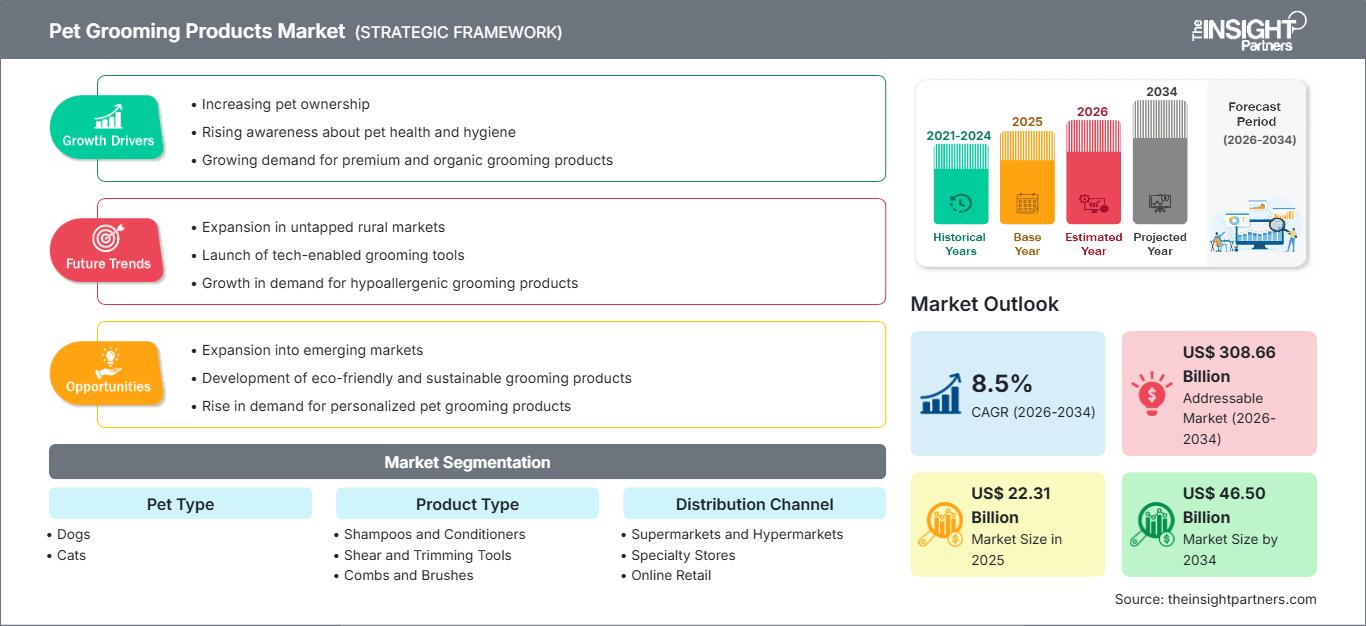
The global Pet Grooming Products market size is projected to reach US$ 46.50 billion by 2034 from US$ 22.31 billion in 2025. The market is anticipated to register a CAGR of 8.5% during the forecast period 2026–2034. Key market dynamics include the accelerating trend of pet humanization, where animals are increasingly treated as family members, and a rising awareness regarding the preventative health benefits of regular grooming. Additionally, the market is expected to benefit from the expansion of mobile grooming services, the proliferation of premium organic product lines, and the rapid growth of the global pet population following the surge in adoptions over recent years.
Pet Grooming Products Market Analysis
The pet grooming products market analysis reveals a strategic transition toward specialized and professional-grade solutions as pet owners move beyond basic hygiene to comprehensive wellness. Competitive landscapes indicate that market leaders are now prioritizing "clean-label" formulations, focusing on hypoallergenic, sulfate-free, and pH-balanced ingredients to address the rising incidence of skin sensitivities in companion animals. Strategic opportunities are emerging in the technological integration segment, where smart tools such as low-noise electric trimmers and self-cleaning brushes are catering to the demand for "DIY" home grooming convenience. The analysis further suggests that market entry and expansion should focus on breed-specific product development, as owners of specialized breeds seek tailored solutions for unique coat textures and dermatological needs. Success in this fragmented market increasingly depends on multi-channel distribution strategies that bridge the gap between high-expertise specialty stores and the high-volume accessibility of digital marketplaces.
Pet Grooming Products Market Overview
The pet grooming products market has evolved and encompasses everything from daily maintenance tools to luxury treatments. While historically dominated by basic shampoos and combs, pet grooming products are now characterized by significant premiumization and diversification into categories like dental care, paw balms, and deodorizing colognes. This growth is underpinned by rising disposable incomes and the "pet parenting" shift, which has rendered grooming a non-discretionary expense for many households. The market is currently seeing a surge in sustainable practices, with biodegradable packaging and cruelty-free certifications becoming standard benchmarks for consumer trust. Global supply chains are adapting to the rise of omnichannel retailing, allowing both established multinational corporations and niche artisanal brands to reach a global audience. As urbanization leads to smaller living spaces and closer proximity between pets and owners, the demand for odor-control and shedding-management products has become a primary driver of consistent volume gains. For instance, the market in the US represents a mature and highly sophisticated market for pet grooming products, characterized by a deep-seated culture of pet humanization. Consumers increasingly favor premium, natural, and locally sourced ingredients that mirror human skincare trends. High household pet ownership and a robust network of professional grooming salons sustain a steady demand for both consumer-grade and professional-grade equipment.
Market Research Highlights
- Global market for Pet Grooming Products was valued at US$ 22.31 Billion in 2025
- Annual market size is expected to reach US$ 46.50 Billion by 2034
- Total addressable market (TAM) during 2026-2034 is projected to reach approximately US$ 308.66 Billion
- Market is anticipated to register a CAGR of 8.5% during the forecast period
- The United States represents a key market, supported by Increasing pet ownership, Rising awareness about pet health and hygiene, Growing demand for premium and organic grooming products, as well as evolving industry dynamics
- Market analysis covers North America, Europe, Asia-Pacific, South and Central America, Middle East and Africa, with growth evaluated across the forecast period
- Market opportunities such as Expansion into emerging markets, Development of eco-friendly and sustainable grooming products, Rise in demand for personalized pet grooming products are expected to influence market dynamics and addressable market
- Report profiles industry participants, including Ancol Pet Products Limited, Beaphar, Wahl Clipper, The Hartz Mountain Corporation, Johnson, while analyzing competitive strategies and innovation developments
-
Source: The Insight Partners' analysis based on proprietary research, government publications, company annual reports, investor presentations, industry databases, and expert interviews.
● REPORT CUSTOMIZATION
Tailor This Report To Align With Your Specific Business Requirements
This report can be customized to align precisely with your business objectives, scope, and target markets. Customization options include tailored segmentation, geography, competitive analysis, and strategic insights to support informed decision-making.
Customize This Report →WHAT YOU CAN ADJUST
- ● Segmentations
- ● Geography
- ● Competitive Analysis
- ● Language Preferences
Pet Grooming Products Market: Strategic Insights
-
Get Top Key Market Trends of this report.This FREE sample will include data analysis, ranging from market trends to estimates and forecasts.
Pet Grooming Products Market Drivers and Opportunities
Market Drivers:
- Increasing Pet Humanization and Adoption Rates: The fundamental shift in viewing pets as integral family members has led to higher per-capita spending on luxury and health-oriented grooming items.
- Rising Awareness of Pet Health and Hygiene: Regular grooming is increasingly recognized by owners as a critical component of preventative veterinary care, driving the sales of specialized medicated and therapeutic products.
- Proliferation of E-commerce and Subscription Models: The convenience of online shopping and auto-ship subscriptions has lowered barriers to entry for niche brands and ensured recurring revenue for essential grooming consumables.
Market Opportunities:
- Expansion into Sustainable and Eco-Friendly Segments: There is a significant opportunity for brands to capture market share by adopting biodegradable ingredients and plastic-free packaging to appeal to environmentally conscious demographics.
- Development of Smart and Low-Stress Grooming Tools: Innovating in quiet, ergonomic, and AI-integrated tools offers a competitive edge in the growing "home-grooming" market segment, where pet comfort is prioritized.
- Capitalizing on Breed-Specific and Customization Trends: Producers can differentiate themselves by moving away from generic products and toward breed-specific grooming kits. By tailoring tools and chemical formulations to the unique coat textures and skin sensitivities of specific breeds, companies can build strong brand loyalty and tap into niche, high-margin consumer segments that value specialized care.
Pet Grooming Products Market Report Segmentation Analysis
The Pet Grooming Products Market share is analyzed across various segments to provide a clearer understanding of its structure, growth potential, and emerging trends. Below is the standard segmentation approach used in most industry reports:
By Pet Type:
- Dogs: Represent the largest segment due to higher grooming frequency and a vast diversity of breed-specific coat requirements.
- Cats: A growing segment as owners become more aware of feline skin health and the benefits of assisted grooming for indoor cats.
By Product Type:
- Shampoos and Conditioners: The primary volume driver, with a heavy shift toward organic, soap-free, and medicated formulations.
- Shear and Trimming Tools: Includes professional-grade clippers and shears, benefiting from the rise in home grooming and professional salon expansion.
- Combs and Brushes: Essential daily-use items that are seeing innovation through ergonomic designs and self-cleaning technologies.
By Distribution Channel:
- Supermarkets and Hypermarkets: Provide high visibility and convenience for mass-market grooming essentials.
- Specialty Stores: The preferred channel for premium and professional-grade products, offering expert advice and curated selections.
- Online Retail: The fastest-growing channel, characterized by a wide variety of global brands and consumer-led review systems.
By Geography:
- North America
- Europe
- Asia Pacific
- South & Central America
- Middle East & Africa
Pet Grooming Products Market Report Scope
| Report Attribute | Details |
|---|---|
| Market size in 2025 | US$ 22.31 Billion |
| Market Size by 2034 | US$ 46.50 Billion |
| Global CAGR (2026 - 2034) | 8.5% |
| Historical Data | 2021-2024 |
| Forecast period | 2026-2034 |
| Segments Covered |
By Pet Type
|
| Regions and Countries Covered |
North America
|
| Market leaders and key company profiles |
|
Pet Grooming Products Market Players Density: Understanding Its Impact on Business Dynamics
The Pet Grooming Products Market is growing rapidly, driven by increasing end-user demand due to factors such as evolving consumer preferences, technological advancements, and greater awareness of the product's benefits. As demand rises, businesses are expanding their offerings, innovating to meet consumer needs, and capitalizing on emerging trends, which further fuels market growth.
Pet Grooming Products Market Share Analysis by Geography
North America holds the largest global market share, while the Asia-Pacific region is projected to register the fastest growth rate during the forecast period.
The pet grooming products market is undergoing a significant transformation, moving from basic hygiene maintenance to a global high-value wellness and lifestyle sector. Growth is driven by the accelerating trend of pet humanization, a surge in demand for organic and "human-grade" ingredient formulations, and the expansion of the professional-grade home grooming category. Below is a summary of market share and trends by region:
North America
- Market Share: Dominates the industry at the global revenue level, with the United States serving as the primary revenue generator.
- Key Drivers:
- High household penetration of pets and a mature culture of pet humanization.
- Significant consumer expenditure on premium, organic, and medicated grooming formulations.
- Robust infrastructure of specialty retail chains and high-end professional grooming salons.
- Trends: Increasing demand for "clean-label" products and the integration of specialized health-focused treatments, such as CBD-infused and hypoallergenic solutions.
Europe
- Market Share: Holds a substantial portion of the market, anchored by a high pet population in countries like Germany, the UK, France, and Russia.
- Key Drivers:
- Stringent regulatory standards regarding product safety and chemical ingredients.
- Growing consumer preference for sustainable, eco-friendly, and cruelty-free grooming brands.
- Well-established supply chains for both artisanal and mass-market pet supplies.
- Trends: A strategic shift toward plastic-free packaging and the rising popularity of waterless grooming products to meet the needs of urban pet owners.
Asia-Pacific
- Market Share: The fastest-growing region globally, driven by rapid urbanization and the expansion of the middle class in China, India, and Southeast Asia.
- Key Drivers:
- A surge in pet ownership among millennials and Gen Z is a lifestyle choice.
- Increasing disposable income is leading to higher spending on westernized pet luxury standards.
- Government-backed initiatives to modernize local pet care and retail sectors.
- Trends: Massive reliance on mobile-first e-commerce platforms and the rapid growth of "aesthetic" grooming trends, including breed-specific fashion styling.
South and Central America
- Market Share: An emerging market with significant growth potential, particularly in Brazil, Chile, and Argentina.
- Key Drivers:
- Rising awareness of pet hygiene as a component of overall animal welfare.
- Modernization of traditional pet shops into commercial-grade specialty centers.
- Increasing adoption of domestic animals in urban high-rise environments.
- Trends: Growth of "farm-to-pet" local brands and the introduction of artisanal grooming kits to differentiate from imported global labels.
Middle East and Africa
- Market Share: A developing segment with localized growth hubs in the GCC countries and South Africa.
- Key Drivers:
- Cultural shifts toward companion animal ownership in urban centers like Dubai and Riyadh.
- High demand for specialized grooming products designed for extreme arid climates (e.g., cooling sprays).
- Strategic investments in "Smart Pet Care" infrastructure to reduce reliance on imported services.
- Trends: Implementation of modern logistics and refrigeration for liquid grooming products, coupled with a focus on high-nutrient, skin-soothing formulations for sensitive breeds.
High Market Density and Competition
Competition is intensifying due to the presence of established leaders such as Ancol Pet Products Limited, Beaphar, Wahl Clipper Corporation, The Hartz Mountain Corporation, Earthwhile Endeavors, Inc. (Earthbath), Coastal Pet Products Inc., Johnson's Veterinary Products Ltd, Nexderma, Glo-Marr Pet Products, and Resco Pet Products, which also contribute to a diverse and rapidly expanding market landscape.
This competitive environment pushes vendors to differentiate through:
- Premiumization and Wellness Branding: Positioning grooming products as essential health and wellness tools by emphasizing pH-balanced, sulfate-free, and organic ingredients. Brands are increasingly mirroring human skincare trends—such as using oatmeal, aloe vera, and essential oils—to appeal to health-conscious "pet parents."
- Expansion Beyond Basic Hygiene: Product portfolios now extend far beyond standard shampoos. Companies are offering professional-grade electric trimmers with ultra-quiet motors for anxious pets, ergonomic de-shedding tools, and therapeutic dental care kits to provide a full salon-style experience at home.
- Vertical Integration and Supply Chain Transparency: Leading producers are securing their supply chains from raw ingredient sourcing to final packaging. By adhering to "clean-label" standards and cruelty-free certifications, they meet the ethical and safety expectations of modern consumers while ensuring product consistency.
- Technological Innovation and Digital Integration: The adoption of advanced manufacturing techniques, such as precision-engineered blades and ergonomic tool designs, helps create high-quality equipment. Furthermore, companies are leveraging digital channels and subscription models to ensure direct-to-consumer reach and brand loyalty.
Opportunities and Strategic Moves
- Development of "Smart" and Low-Stress Grooming Equipment: As more owners opt for home grooming to save costs and reduce pet stress, there is a significant opportunity for brands to innovate in "low-noise" and "low-vibration" technology. Tools that feature AI-integrated sensors to monitor skin health or heat-sensitive safety features for dryers provide a high-value competitive edge in the premium DIY market.
- Sustainability-Driven Product Diversification: Incorporating biodegradable materials and plastic-free packaging presents a major growth lever. Brands that obtain certifications such as Organic, Non-GMO, or Eco-Label can target the environmentally conscious Gen Z and millennial demographics who are increasingly seeking ethical alternatives to conventional plastic-heavy grooming supplies.
Major Companies operating in the Pet Grooming Products Market are:
- Ancol Pet Products Limited
- Beaphar
- Wahl Clipper Corporation
- The Hartz Mountain Corporation
- Earthwhile Endeavors, Inc. (Earthbath)
- Coastal Pet Products Inc.
- Johnson's Veterinary Products Ltd
- Nexderma
- Glo-Marr Pet Products
- Resco Pet Products
Disclaimer: The companies listed above are not ranked in any particular order.
Pet Grooming Products Market News and Recent Developments
- In October 2024, PetIQ, Inc., completed its acquisition by Bansk Group in an all-cash transaction valued at approximately US$1.5 billion. Following the merger, PetIQ stockholders received $31.00 per share, and the company was subsequently delisted from the Nasdaq exchange to operate as a private entity. This move allowed the firm to accelerate long-term growth initiatives for its diversified portfolio, which includes specialized Pet Grooming Products under brands like Sentry, Sergeant's, and Rocco & Roxie.
- In July 2024, Pets Choice Ltd. acquired the plant-based brand HOWND. This acquisition enabled Pet Choice to integrate ethically sourced and vegan-certified Pet Grooming Products, including specialized conditioning sprays and cruelty-free shampoos, into its global retail distribution network.
Pet Grooming Products Market Report Coverage and Deliverables
The "Pet Grooming Products Market Size and Forecast (2021–2034)" report provides a detailed analysis of the market covering below areas:
- Pet Grooming Products Market size and forecast at global, regional, and country levels for all the key market segments covered under the scope
- Pet Grooming Products Market trends, as well as market dynamics such as drivers, restraints, and key opportunities
- Detailed PEST and SWOT analysis
- Pet Grooming Products Market analysis covering key market trends, global and regional framework, major players, regulations, and recent market developments
- Industry landscape and competition analysis covering market concentration, heat map analysis, prominent players, and recent developments in the Pet Grooming Products Market.
- Detailed company profiles
Frequently Asked Questions

- Comprehensive Market Sizing and Forecast Analysis
- Detailed Segmentation Analysis
- In-Depth Market Dynamics Assessment
- Regional and Country-Level Insights
- Competitive Landscape and Company Benchmarking
- Strategic Business Intelligence
Testimonials

The Insight Partners' SCADA System Market report is comprehensive, with valuable insights on current trends and future forecasts. The team was highly professional, responsive, and supportive throughout. We are very satisfied and highly recommend their services.
RAN KEDEM Partner, Reali Technologies LTDs
I requested a report on a very specific software market and the team produced the report in a few days. The information was very relevant and well presented. I then requested some changes and additions to the report. The team was again very responsive and I got the final report in less than a week.
JEAN-HERVE JENN Chairman, Future Analytica
We worked with The Insight Partners for an important market study and forecast. They gave us clear insights into opportunities and risks, which helped shape our plans. Their research was easy to use and based on solid data. It helped us make smart, confident decisions. We highly recommend them.
PIYUSH NAGPAL Sr. Vice President, High Beam Global
The Insight Partners delivered insightful, well-structured market research with strong domain expertise. Their team was professional and responsive throughout. The user-friendly website made accessing industry reports seamless. We highly recommend them for reliable, high-quality research services
YUKIHIKO ADACHI CEO, Deep Blue, LLC.
This is the first time I have purchased a market report from The Insight Partners.While I was unsure at first, I visited their web site and felt more comfortable to take the risk and purchase a market report.I am completely satisfied with the quality of the report and customer service. I had several questions and comments with the initial report, but after a couple of dialogs over email with their analyst I believe I have a report that I can use as input to our strategic planning process.Thank you so much for taking the extra time and making this a positive experience.I will definitely recommend your service to others and you will be my first call when we need further market data.
JOHN SUZUKI President and Chief Executive Officer, Board Director, BK Technologies
I wish to appreciate your support and the professionalism you displayed in the course of attending to my request for information regarding to infectious disease IVD market in Nigeria. I appreciate your patience, your guidance, and the fact that you were willing to offer a discount, which eventually made it possible for us to close a deal. I look forward to engaging The Insight Partners in the future, all thanks to the impression you have created in me as a result of this first encounter.
DR CHIJIOKE ONYIA MANAGING DIRECTOR, PineCrest Healthcare Ltd.Reason to Buy
- Informed Decision-Making
- Understanding Market Dynamics
- Competitive Analysis
- Identifying Emerging Markets
- Customer Insights
- Market Forecasts
- Risk Mitigation
- Boosting Operational Efficiency
- Strategic Planning
- Investment Justification
- Tracking Industry Innovations
- Aligning with Regulatory Trends





 Get Free Sample for