
Mercado de monitorización de corrosión: tamaño, crecimiento y previsiones 2034
Tamaño del mercado y pronósticos de monitoreo de corrosión (2021 - 2034), participación global y regional, tendencias y análisis de oportunidades de crecimiento. Cobertura del informe: Por tipo (técnicas intrusivas, técnicas no intrusivas); técnica (cupones de corrosión, resistencia eléctrica, resistencia a la polarización lineal, medición de espesor ultrasónico, otros); industria (petróleo y gas, química, manufactura, generación de energía, pulpa y papel, otros) y geografía (América del Norte, Europa, Asia Pacífico y América del Sur y Central).
- Estado : Datos publicados
- Código de informe : TIPRE00018374
- Categoría : Electrónica y semiconductores
- Número de páginas : 150
- Formatos de informe disponibles :


- Fecha de última actualización : August 05, 2026


Tamaño del mercado en 2025
5.330 millones de dólares estadounidenses
Valor del año base
Pronóstico para 2034
13.780 millones de dólares estadounidenses
Proyecciones para 2034
Tasa de crecimiento anual compuesta (CAGR) 2026-2034
11,13 %
Índice de crecimiento
Mercado potencial
84.360 millones de dólares estadounidenses
(2026-2034)
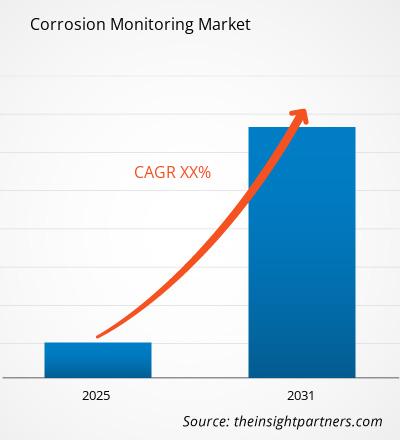
El mercado de monitoreo de corrosión alcanzó un valor de 5330 millones de dólares en 2025 y se estima que llegará a los 13 780 millones de dólares en 2034. Se prevé que experimente una tasa de crecimiento anual compuesta (CAGR) del 11,13 % entre 2026 y 2034. Esto se debe a la creciente importancia de los operadores de industrias como la del petróleo y el gas, la química, la manufactura, la generación de energía y la de la pulpa y el papel en lo que respecta a la integridad de los activos, la prevención de interrupciones inesperadas y la degradación de los materiales.
El mercado de monitoreo de corrosión se ve impulsado por el envejecimiento de los oleoductos, las necesidades de modernización de las refinerías y los procesos de inspección obligatorios en Norteamérica. Se prevé que esta región experimente un crecimiento con una tasa de crecimiento anual compuesta (CAGR) estimada del 9,2 % al 9,8 % durante el período 2026-2034, impulsado principalmente por el uso de transmisores ultrasónicos inalámbricos, cupones de corrosión y sondas de resistencia eléctrica en Estados Unidos.
Evaluación y perspectivas del mercado de monitoreo de la corrosión
- América del Norte representó entre el 31 % y el 34 % de la cuota de mercado en 2025 y está creciendo a una tasa de crecimiento anual compuesta (CAGR) de entre el 9,2 % y el 9,8 % durante el período 2026-2034, gracias a las normas de integridad de los oleoductos, las mejoras en las refinerías y la monitorización remota.
- Estados Unidos representó entre el 72 % y el 76 % de Norteamérica en 2025 y está creciendo a una tasa de crecimiento anual compuesta (CAGR) de entre el 9,4 % y el 10,0 % durante el período 2026-2034, impulsado por las refinerías, los yacimientos de esquisto y las empresas de servicios públicos.
- Europa representó entre el 22 % y el 25 % de la cuota de mercado en 2025 y está creciendo a una tasa de crecimiento anual compuesta (CAGR) de entre el 8,4 % y el 9,1 % durante el período 2026-2034, con Alemania, el Reino Unido, Francia, Italia y España liderando la demanda de reemplazo impulsada por el cumplimiento normativo.
- La región de Asia-Pacífico acaparó entre el 27 % y el 30 % de la cuota de mercado en 2025 y está creciendo a una tasa de crecimiento anual compuesta (CAGR) de entre el 12,5 % y el 13,4 % durante el período 2026-2034, liderada por China, India, Japón, Corea del Sur y Australia.
- El segmento más grande, el de técnicas no intrusivas, representó entre el 56 % y el 60 % de la cuota de mercado en 2025 y está creciendo a una tasa de crecimiento anual compuesta (CAGR) de entre el 11,4 % y el 12,0 % durante el período 2026-2034, impulsado por las necesidades de inspección en línea.
- El segmento de alto crecimiento de medición de espesor por ultrasonidos representó entre el 18 % y el 22 % de la cuota de mercado en 2025 y está creciendo a una tasa de crecimiento anual compuesta (CAGR) de entre el 13,0 % y el 13,8 % durante el período 2026-2034, lo que refleja la adopción de sensores inalámbricos.
- Empresas clave analizadas en detalle : Applied Corrosion Monitoring Ltd, BAC Corrosion Control Ltd., Rohrback Cosasco Systems, LLC, Emerson Electric Co., ICORR Technologies, Intertek Group plc, PT Korosi Specindo, Pyramid Technical Services Pvt. Ltd., Rysco Corrosion Services Inc., SGS Société Générale de Surveillance SA
Fuente: Análisis de The Insight Partners basado en investigaciones propias, publicaciones gubernamentales, informes anuales de empresas, presentaciones para inversores, bases de datos del sector y entrevistas con expertos.
Technology migration will revolutionize the Corrosion Monitoring market in which fixed probes, ultrasonic transmitter, and digitalized platform replace visual inspections of high-consequence assets. Moreover, production dynamics have also shifted as there is an increasing need for frequent, repeatable, and process variable-driven corrosion data at oil refineries, chemical plants, and power generation facilities. The use of coupons for establishing a benchmark will be coupled with electrical resistance and ultrasonic sensors for quicker response time.
The future of this market will see increased spending in emerging geographies due to issues of energy security, petrochemicals, and grid reliability programs. There will be greater regulatory compliance requirements for leaks, emissions, personnel safety, and water contamination, which will drive operators towards formal monitoring programs. Investments will be made in hybrid systems using intrusive and non-intrusive data to establish priorities for maintenance activities at pipelines, vessels, storage tanks, boilers, and process equipment.
Corrosion Monitoring Market Report Scope
| Report Attribute | Details |
|---|---|
| Market size in 2025 | US$ 5.33 Billion |
| Market Size by 2034 | US$ 13.78 Billion |
| Global CAGR (2026 - 2034) | 11.13% |
| Historical Data | 2021-2024 |
| Forecast period | 2026-2034 |
Corrosion Monitoring Market Analysis
There is an increasing demand for corrosion monitoring since process plants require evidence that their equipment can be safely run between turnarounds. Corrosion Monitoring Market growth will be facilitated by the integrity program for oil and gas pipelines, chemical plant reliability goals, and life extension initiatives in the power industry. The supply chain includes probe makers, system integrators, inspection service providers, test labs, cloud analytics suppliers, and plant maintenance groups.
The supply side trend is toward a modular approach as the operator needs corrosion rates, wall thicknesses, temperatures, and process information all to be available in a single process. Non-invasive ultrasonic sensors minimize the need for plant downtime, while invasive coupons and probes are still needed when proof of direct exposure is required.
The competitive intensity is moderate, with worldwide suppliers of automation, inspection firms, and specialists focusing on their strengths on reliability, data, and field servicing. For example, Emerson Electric Co. focuses on wireless non-intrusive monitoring, while Rohrback Cosasco Systems, LLC provides integrated intrusive monitoring. In turn, Intertek Group plc and SGS Société Générale de Surveillance SA are enhancing testing, inspection, and certification-driven adoption.
Investment trends in Corrosion Monitoring Market research are evolving to include predictive maintenance, cloud-based integrity management, and incorporation of corrosion data into DCS. Competing in Corrosion Monitoring Market research are Applied Corrosion Monitoring Ltd, BAC Corrosion Control Ltd., ICORR Technologies, PT Korosi Specindo, Pyramid Technical Services Pvt. Ltd., and Rysco Corrosion Services Inc.
● REPORT CUSTOMIZATION
Tailor This Report To Align With Your Specific Business Requirements
This report can be customized to align precisely with your business objectives, scope, and target markets. Customization options include tailored segmentation, geography, competitive analysis, and strategic insights to support informed decision-making.
Customize This Report →WHAT YOU CAN ADJUST
- ● Segmentations
- ● Geography
- ● Competitive Analysis
- ● Language Preferences
Corrosion Monitoring Market:
Personalice este informe según sus necesidades
Disfrutará de la personalización gratuita de cualquier informe, incluyendo partes del mismo, análisis por país y un paquete de datos de Excel. Además, podrá aprovechar excelentes ofertas y descuentos para startups y universidades.
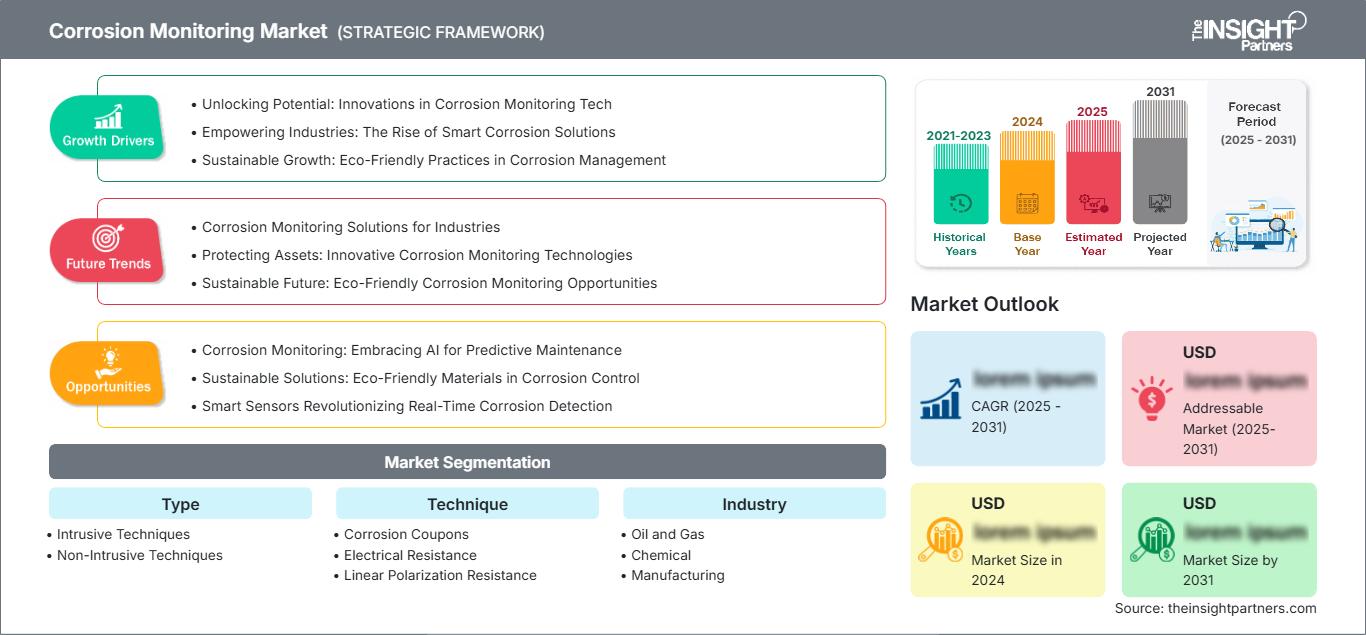
Mercado de monitoreo de corrosión: Perspectivas estratégicas
-
Obtenga las principales tendencias clave del mercado de este informe.Esta muestra GRATUITA incluye análisis de datos, desde tendencias del mercado hasta estimaciones y pronósticos.
Regional Insights
North America Corrosion Monitoring Market
North America represented 31–34% of 2025 revenue and is projected to grow at a CAGR range of 9.2–9.8% through 2034. The region’s Corrosion Monitoring Market share reflects large refinery capacity, long-distance pipeline networks, offshore assets, and stricter inspection requirements for pressure equipment and hazardous materials infrastructure.
Adoption is strongest where failure consequences are high and shutdown windows are limited. Operators are adding wireless ultrasonic thickness measurement, electrical resistance probes, and corrosion coupons to connect inspection evidence with maintenance planning. Investments also reflect aging midstream infrastructure, refinery crude slate variability, and utility asset renewal, which together support steady regional demand.
U.S. Corrosion Monitoring Market
The U.S. represents 72-76% of North America in 2025, with the forecasted CAGR of 9.4-10.0% during 2026-2034. Refineries, natural gas pipelines, petrochemical plants, water infrastructure, and power generation continue to be the key sectors with documentation and safety driving procurement process.
The market is highly penetrated due to automation companies, inspection service providers and experts offering solutions in capital expenditure projects and installed-base opportunities. For instance, Emerson Electric Co. gets advantages from the relationships in refinery automation projects, while Rohrback Cosasco Systems, LLC provides expertise in high-resolution probes. Intertek Group plc and SGS Société Générale de Surveillance SA offer third-party services for companies with a need for integrity management documentation.
Europe Corrosion Monitoring Market
Europe is expected to have a share ranging from 22 to 25% by 2025, while it is forecasted that its market growth rate will be from 8.4 to 9.1% CAGR until 2034. Germany is leading the market owing to the demand for corrosion evidence arising from stringent practices of chemical production, power generation, and industrial maintenance.
France, Italy, and Spain also contribute to the demand due to their refinery industry. Buyers from Europe pay attention to quality inspection documentation, safety of workers, and lifecycle costs reduction. Testing accredited and field-calibrated equipment, as well as report creation technology, can provide an advantage for suppliers.
APAC Corrosion Monitoring Market
Asia Pacific accounted for 27–30% share in 2025 and is expected to grow at a CAGR range of 12.5–13.4% from 2026 to 2034. China leads regional adoption, supported by petrochemical expansion, power investments, and industrial safety programs.
Japan and South Korea prioritize reliability in refining, chemicals, and advanced manufacturing, while India and Australia add pipeline, LNG, mining, and utility opportunities. Policy support for industrial modernization and environmental risk reduction is accelerating monitoring upgrades, especially where downtime penalties and asset replacement costs are rising.
Middle East & Africa Corrosion Monitoring Market
Middle East and Africa demand is expected to grow at a CAGR range of 10.6–11.4% during 2026–2034, with Saudi Arabia leading through upstream, refining, petrochemical, and pipeline asset programs. The UAE follows through refining, terminals, and infrastructure resilience.
South Africa and the Rest of MEA show selective demand from power plants, mining-linked process facilities, and port infrastructure. Energy exporters are investing in corrosion monitoring because sour service, high temperatures, saline exposure, and long asset lives make early detection essential for safe production continuity.
Segmentation Analysis
Type
Type is projected to grow at a CAGR range of 10.8–11.6% during 2026–2034. Corrosion Monitoring Market scope across type categories is shaped by access constraints, safety rules, and the need to balance direct exposure data with online measurement. Non-intrusive techniques dominate where shutdown avoidance matters, while intrusive methods remain valuable for fluid-contact corrosion rate evidence.
- Intrusive Techniques remain important in pipelines and vessels where operators require direct exposure data from coupons, probes, and electrochemical devices to validate corrosivity and treatment effectiveness.
- Non-Intrusive Techniques are preferred for operating assets because wall-thickness measurement and external sensors reduce shutdown needs, improve worker safety, and support continuous integrity tracking.
Technique
Technique is expected to grow at a CAGR range of 11.2–12.1% during 2026–2034. Selection depends on response time, fluid conditions, access, required accuracy, and integration with maintenance systems. Coupons provide historical confirmation, electrical resistance supports metal-loss tracking, linear polarization resistance offers rapid aqueous corrosion estimates, and ultrasonic thickness measurement enables non-intrusive asset surveillance.
- Corrosion Coupons provide low-cost, direct evidence of material loss, making them useful for baseline studies, inhibitor performance checks, and environments where periodic laboratory analysis is acceptable.
- Electrical Resistance probes deliver continuous metal-loss information and are widely used in oil and gas, chemical, and water-containing systems where corrosion rate changes must be detected promptly.
- Linear Polarization Resistance is strategically important in conductive fluids because it provides fast corrosion rate estimates, helping operators adjust chemical treatment before severe degradation occurs.
- Ultrasonic Thickness Measurement is gaining importance because permanently installed sensors and handheld devices measure wall loss without process intrusion, supporting predictive maintenance and remote monitoring.
Industry
Industry is projected to grow at a CAGR range of 10.9–11.8% during 2026–2034. Oil and gas remains the anchor industry because corrosion affects pipelines, refineries, offshore platforms, and storage systems. Chemical, manufacturing, power generation, and pulp and paper facilities are increasing adoption as maintenance teams connect corrosion monitoring with uptime, safety, and compliance targets.
- Oil and Gas drives high-value demand because sour fluids, produced water, crude variability, and offshore exposure require continuous evidence to protect pipelines, separators, and refinery units.
- Chemical facilities use corrosion data to manage aggressive media, acids, solvents, and temperature swings, making monitoring central to process safety and materials selection.
- Manufacturing demand is linked to boilers, cooling systems, tanks, and process lines where corrosion can interrupt production quality and increase maintenance costs.
- Power Generation operators monitor boilers, condensers, cooling water systems, and balance-of-plant assets to extend service life and avoid forced outages.
- Pulp and Paper mills require monitoring across digesters, evaporators, bleach plants, and recovery systems because moisture, chemicals, and heat create persistent corrosion risk.
Opportunity Snapshot
|
Industry |
Revenue Contribution |
Trend Tag |
Adoption Stage |
|
Oil and Gas |
High |
Pipeline Integrity |
Mature |
|
Chemical |
High |
Process Safety |
Scaling |
|
Manufacturing |
Medium |
Plant Reliability |
Scaling |
|
Power Generation |
Medium |
Boiler Integrity |
Scaling |
|
Pulp and Paper |
Low |
Mill Uptime |
Emerging |
Corrosion Monitoring Market Growth Drivers and Impact Analysis
Shift from Scheduled Inspection to Predictive Integrity
Predictive Asset Integrity is now a necessary part of operations, as companies within the processing industries are trying to minimize their downtime, leaks, and emergency work. Corrosion Monitoring enables operators to convert individual test readings into trend data that can be used for proactive interventions by maintenance staff. This is most effective in refineries, chemical facilities, pipelines, and power plants, where corrosion problems lead to shutting down of processes and mandatory reporting. Through the combination of probes, ultrasonic testing devices, and analytical software, companies can make their maintenance schedule driven by reality and not time intervals. This helps with spare part ordering, chemical injection, and turnaround planning.
Rising Exposure of Industrial Assets to Harsh Operating Conditions
Assets are increasingly being used in corrosive environments consisting of combinations of pressure, temperature, salinity, acid gases, and aggressive chemicals. This results in the need for instruments that identify corrosion before it causes any visible damage. Produced water, carbon dioxide, hydrogen sulfide, and variations in crude slate in oil and gas, as well as changing process media in chemicals and pulp and paper processing, increase the potential for internal corrosion. Systems assist in translating these conditions to corrosion rates and wall thickness trends. The effect on the market is an increase in expenditures for sensors, access fittings, data loggers, and service agreements.
Regulatory Pressure on Safety, Environment, and Documentation
Regulators and insurers increasingly expect operators to demonstrate that corrosion risk is controlled through documented programs, not only post-event inspection. This strengthens demand for validated readings, calibration records, and third-party inspection support. Pipelines, refineries, power plants, and chemical facilities face consequences from leaks, spills, fires, and contamination incidents, making corrosion evidence part of operational governance. Continuous and periodic monitoring supports compliance by producing time-stamped records that can be reviewed during audits. The commercial effect is wider procurement of integrated monitoring systems, inspection services, and laboratory analysis that convert technical measurements into defensible integrity decisions.
Corrosion Monitoring Market Future Trends
AI-Enabled Corrosion Forecasting
Corrosion Monitoring Market trends are moving toward predictive models that combine corrosion readings with flow, temperature, chemistry, inspection history, and operating events. Artificial intelligence will help identify patterns that manual review may miss, especially across large pipeline networks and multi-unit refineries. Future systems are likely to generate risk-ranked work orders, chemical treatment recommendations, and remaining-life estimates. Adoption will depend on data quality, sensor density, and operator trust in model outputs. Vendors that can explain predictions, integrate with control systems, and support cybersecurity requirements will gain stronger positions in asset-intensive sectors.
Non-Intrusive Wireless Monitoring at Scale
Wireless ultrasonic and external sensor networks will expand as operators seek safer deployment on live assets. This trend reduces hot work, scaffolding, access shutdowns, and manual measurement variability. Future installations will likely focus on high-risk elbows, crude unit overheads, offshore risers, cooling water systems, and buried or insulated lines. Battery performance, communication reliability, and rugged sensor design will be decisive purchasing factors. As deployment costs fall, non-intrusive monitoring can move from critical assets to broader plant coverage, improving the granularity of integrity decisions and maintenance planning.
Corrosion Monitoring Market Opportunities
Integrity Programs for Energy Transition Infrastructure
Carbon capture, hydrogen blending, renewable fuels, and new storage infrastructure create practical opportunities for monitoring suppliers because materials will face changing corrosion mechanisms. Corrosion Monitoring Market Forecasts indicate that asset owners will need validated corrosion data before scaling these newer energy systems. Suppliers can target pilot projects with sensor packages, materials testing, and analytics that compare corrosion behavior across operating conditions. The most attractive opportunities will be in pipelines, compressors, storage tanks, and process units where fluid composition is uncertain. Early participation can help vendors shape specifications and secure long-term service agreements.
Service-Led Monitoring for Mid-Sized Industrial Operators
Mid-sized chemical, manufacturing, power, and pulp and paper facilities often lack in-house corrosion specialists, creating an opening for bundled monitoring services. Providers can combine site surveys, sensor installation, coupon retrieval, laboratory analysis, reporting, and maintenance recommendations under recurring contracts. This model lowers adoption barriers because customers can access corrosion expertise without building full internal programs. It also supports standardization across multi-site operators that need comparable risk metrics. Companies with local field teams, rapid calibration support, and sector-specific templates can capture demand that may not justify large enterprise software deployments.
Recent Developments
- October 2025: CorrosionRADAR launched Clarity, an AI-powered software platform designed to improve the monitoring and management of corrosion under insulation (CUI) risks in industrial assets. The platform converts sensor data and inspection information into actionable insights, helping operators identify corrosion risks earlier, improve asset visibility, and make more informed maintenance decisions.
- August 2025: CorrosionRADAR introduced the compact CR Node datalogger, a smaller and more flexible version of its long-range CorrosionRADAR: LR monitoring hardware designed for corrosion under insulation (CUI) risk management. The new datalogger maintains the core sensing capabilities of the existing system while offering a more compact design that enables easier installation in confined spaces and challenging industrial environments.
- May 2026: Aramco and Emerson entered into a strategic research and development collaboration to develop next-generation corrosion management solutions for industrial applications. The partnership focuses on using advanced sensing technologies, digital monitoring, and data analytics to improve corrosion detection, enhance asset reliability, and support better maintenance decisions across energy infrastructure.
Frequently Asked Questions

Naveen es un experimentado profesional en investigación de mercados y consultoría con más de 9 años de experiencia en proyectos personalizados, sindicados y de consultoría. Actualmente se desempeña como Vicepresidente Asociado, donde ha gestionado con éxito a las partes interesadas en toda la cadena de valor del proyecto y ha redactado más de 100 informes de investigación y más de 30 proyectos de consultoría. Su trabajo abarca proyectos industriales y gubernamentales, contribuyendo significativamente al éxito de los clientes y a la toma de decisiones basada en datos.
Naveen es licenciado en Ingeniería Electrónica y Comunicaciones por la VTU (Karnataka) y tiene un MBA en Marketing y Operaciones por la Universidad de Manipal. Ha sido miembro activo del IEEE durante 9 años, participando en conferencias, simposios técnicos y realizando voluntariado tanto a nivel de sección como regional. Antes de su puesto actual, trabajó como Consultor Estratégico Asociado en IndustryARC y como Consultor de Servidores Industriales en Hewlett Packard (HP Global).
- Análisis exhaustivo del tamaño del mercado y previsiones
- Análisis detallado de la segmentación
- Evaluación en profundidad de la dinámica del mercado
- Información a nivel regional y nacional
- Panorama competitivo y análisis comparativo de empresas
- Inteligencia empresarial estratégica
Testimonios

The Insight Partners proporcionó información de mercado valiosa que respaldó nuestra estrategia global de entrada en el mercado. Su equipo fue profesional, respondió con rapidez y prestó atención a nuestros comentarios. A lo largo del proyecto, ofreció análisis bien fundamentados y aclaraciones metodológicas útiles.
Junmo Kim Director financiero (CFO), Enertech Co., Ltd.
El informe de mercado de sistemas SCADA de Insight Partners es completo y ofrece información valiosa sobre las tendencias actuales y las previsiones futuras. El equipo fue altamente profesional, receptivo y me brindó un gran apoyo en todo momento. Estamos muy satisfechos y recomendamos ampliamente sus servicios.
RAN KEDEM Socio, Reali Technologies LTDs
Solicité un informe sobre un mercado de software muy específico y el equipo lo elaboró en pocos días. La información era muy relevante y estaba bien presentada. Posteriormente, solicité algunos cambios y adiciones al informe. El equipo fue muy receptivo y recibí el informe final en menos de una semana.
JEAN-HERVE JENN Presidente, Future Analytica
Trabajamos con The Insight Partners para un importante estudio y pronóstico de mercado. Nos brindaron una visión clara de las oportunidades y los riesgos, lo que nos ayudó a definir nuestros planes. Su investigación fue fácil de usar y se basó en datos sólidos. Nos ayudó a tomar decisiones inteligentes y seguras. Los recomendamos ampliamente.
PIYUSH NAGPAL Vicepresidente Sénior, , High Beam Global
The Insight Partners realizó una investigación de mercado profunda y bien estructurada con una sólida experiencia en el sector. Su equipo fue profesional y receptivo en todo momento. El sitio web, fácil de usar, facilitó el acceso a los informes del sector. Los recomendamos ampliamente por sus servicios de investigación confiables y de alta calidad.
YUKIHIKO ADACHI Director Ejecutivo, , Deep Blue, LLC
Esta es la primera vez que compro un informe de mercado de The Insight Partners. Aunque al principio tenía dudas, visité su sitio web y me sentí más cómodo al arriesgarme y comprarlo. Estoy completamente satisfecho con la calidad del informe y el servicio al cliente. Tenía varias preguntas y comentarios sobre el informe inicial, pero después de un par de conversaciones por correo electrónico con su analista, creo que tengo un informe que puedo usar como base para nuestro proceso de planificación estratégica. Muchas gracias por tomarse el tiempo y hacer de esta una experiencia positiva. Sin duda, recomendaré sus servicios y serán mi primera opción cuando necesitemos más datos de mercado.
JOHN SUZUKI Presidente y Director Ejecutivo, Director de la Junta Directiva, BK Technologies
Agradezco su apoyo y la profesionalidad que demostraron al atender mi solicitud de información sobre el mercado de diagnóstico in vitro (IVD) para enfermedades infecciosas en Nigeria. Agradezco su paciencia, su orientación y su disposición a ofrecerme un descuento, lo que finalmente nos permitió cerrar un trato. Espero poder colaborar con The Insight Partners en el futuro, gracias a la impresión que me causó este primer encuentro.
DRA. CHIJIOKE ONYIA, DIRECTORA GENERAL, PineCrest Healthcare Ltd.Razón para comprar
- Toma de decisiones informada
- Comprensión de la dinámica del mercado
- Análisis competitivo
- Información sobre clientes
- Pronósticos del mercado
- Mitigación de riesgos
- Planificación estratégica
- Justificación de la inversión
- Identificación de mercados emergentes
- Mejora de las estrategias de marketing
- Impulso de la eficiencia operativa
- Alineación con las tendencias regulatorias




















 Obtenga una muestra gratuita para -