
ワイヤレスセキュリティカメラ市場:シェア・成長・予測 2034
ワイヤレスセキュリティカメラ市場規模と予測(2021年~2034年)、世界および地域別シェア、トレンド、成長機会分析レポート 対象範囲:用途別(屋外、屋内)、アプリケーション別(商業、公共施設、国境警備、都市インフラ、住宅、産業)、タイプ別(ボックスカメラ、ドームカメラ、PTZカメラ、バレットカメラ、IPカメラ、デイナイトカメラ、サーマル(FLIR)カメラ、ワイヤレスIPカメラ、その他)、コンポーネント別(ハードウェア、ソフトウェア、ビデオ監視サービス(VSaaS))、地域別(北米、ヨーロッパ、アジア太平洋、南米および中米)
- ステータス : 公開されたデータ
- レポートコード : TIPRE00007817
- カテゴリー : エレクトロニクスおよび半導体
- ページ数 : 150
- 利用可能なレポート形式 :


- 最終更新日 : September 28, 2026


2025年の市場規模
789億 2000万米ドル
基準年値
2034年の予測
1,788億4,000 万米ドル
2034年までに予測される
2026年~2034年の年平均成長率(CAGR)
9.51 %
成長率
対象市場
1兆1496億9000万 米ドル
(2026年~2034年)
ワイヤレスセキュリティカメラ市場規模は、2025年の789億2,000万米ドルから2034年には1,788億4,000万米ドルに拡大し、2026年から2034年までの年平均成長率(CAGR)は9.51%となる見込みです。需要は、住宅、商業施設、公共施設、産業施設、公共環境など、あらゆる場所でのコネクテッド監視、遠隔監視、インテリジェントビデオ分析、柔軟なカメラ設置の普及拡大によって形成されています。市場は、カメラ、クラウドサービス、分析、サイバーセキュリティを組み合わせたソフトウェア対応のセキュリティアーキテクチャへとますます移行しています。
北米全域において、ワイヤレスセキュリティカメラ市場は、ブロードバンドの普及、スマートホームの導入、サブスクリプション型監視サービス、および従来の監視インフラの置き換えに支えられ、2026年から2034年にかけて年平均成長率(CAGR)8.8~10.2%で成長すると予測されています。この地域は、成熟した企業セキュリティエコシステム、コネクテッドデバイスへの積極的な投資、AIを活用したビデオインテリジェンスへの需要の高まりといった恩恵を受けており、プライバシーとサイバーセキュリティに関する要件が、ベンダー各社にローカル処理の強化とセキュアなデバイスアーキテクチャの構築を促しています。
ワイヤレスセキュリティカメラ市場の評価と洞察
- 北米:北米は、2025年にはワイヤレスセキュリティカメラ市場の34~38%のシェアを占めると予想され、2026年から2034年にかけて年平均成長率(CAGR)8.8~10.2%で成長すると見込まれています。成熟した接続性、スマートホームの普及、企業の近代化、およびサブスクリプション型監視システムが、住宅用および商業用アプリケーションにおける持続的な導入を支えています。
- 米国:米国は2025年には北米の収益の73~78%を占めると予測されており、コネクテッドホームプラットフォームとクラウド監視の普及拡大に伴い、2026年から2034年にかけて年平均成長率(CAGR)8.7~10.1%で成長すると見込まれている。
- 欧州:欧州は2025年には市場シェアの21~24%を占めると推定され、2026年から2034年にかけて年平均成長率(CAGR)は7.7~9.1%と見込まれています。ドイツ、英国、フランス、イタリア、スペインが主要市場であり、プライバシーコンプライアンスとサイバーセキュリティが購買決定にますます影響を与えています。
- アジア太平洋地域:アジア太平洋地域は2025年には27~31%のシェアを占めると推定され、2026年から2034年にかけて年平均成長率(CAGR)10.8~12.5%で成長すると予測されています。中国、日本、韓国、インドは、スマートシティプログラム、産業のデジタル化、インフラ投資、コネクテッドデバイスのエコシステムの拡大などを通じて、スマートシティの導入を牽引しています。
- 最大のセグメント:ハードウェアは、カメラの導入と交換需要の継続に支えられ、2025年には市場シェアの61~66%を占めると予想され、2026年から2034年にかけて年平均成長率(CAGR)8.2~9.4%で拡大すると見込まれています。
- High Growth Segment: Video Surveillance as a Service is projected at 8–12% market share in 2025, growing at a 13.0–15.5% CAGR between 2026–2034 as organizations prioritize recurring, remotely managed surveillance services.
- Key companies analyzed in detail: Amcrest Industries LLC, Lorex Technology Inc., Zmodo Technology Shenzhen Corp., Ltd., GW Security, Inc., Sony Corporation, Robert Bosch GmbH, Panasonic Holdings Corporation, Honeywell International Inc., Tianjin Yaan Technology Co., Ltd., Hangzhou Hikvision Digital Technology Co., Ltd., Zhejiang Dahua Technology Co., Ltd., Hanwha Vision Co., Ltd., and Axis Communications AB.
Source: The Insight Partners' analysis based on proprietary research, government publications, company annual reports, investor presentations, industry databases, and expert interviews.
The development of the wireless security cameras market is being pushed through the move from recording systems that operate in isolation to networked and software-based surveillance. Advancements in CMOS technology, performance in low light conditions, edge computing, H.265 compression, battery technology, Wi-Fi connectivity, and cellular communications are facilitating more deployments. Meanwhile, manufacturers are balancing cost considerations with cybersecurity and device lifecycle management. Manufacturing approaches are becoming increasingly international with components sourced globally but assemblies made regionally.
Over the forecast period, emerging markets will receive increased investment as more cities, factories, logistics operations, and housing developments increase connected surveillance installations. Regulatory pressure will affect vendor selection in cases where there is a need for cybersecurity testing or where only certified equipment can be used. Simultaneously, cloud-based surveillance systems and AI-powered event detection will make services business models appealing, while manufacturing in the region and integration capabilities will grow in importance.
Wireless Security Cameras Market Report Scope
| Report Attribute | Details |
|---|---|
| Market size in 2025 | US$ 78.92 Billion |
| Market Size by 2034 | US$ 178.84 Billion |
| Global CAGR (2026 - 2034) | 9.51% |
| Historical Data | 2021-2024 |
| Forecast period | 2026-2034 |
Wireless Security Cameras Market Analysis
The demand is now being driven by needs of security that go beyond perimeter surveillance. The need for loss prevention from retailers, monitoring from factories, and remote access from residents have all emerged. The eco-system covers the areas of imagers, processors, lenses, wireless units, batteries, software platforms, storage, analysis, installers, integrators, and monitors. It is these interdependencies that give rise to needs for interoperability and cybersecurity among the buying criteria.
On the supply side, there are changes taking place in the integration of intelligence into the cameras. The benefits of edge processing include reduction of bandwidth and faster reaction times while cloud computing platforms support central administration over dispersed locations. Availability of components, price of semiconductors, wireless technologies, and certifications also play a role in the economics of the products. Ecosystems allow for integration of hardware and software with services.
Competition stays intense as traditional security manufacturers find themselves competing against specialty connected camera brands and consumer electronics firms. Amcrest Industries LLC, Lorex Technology Inc., Zmodo Technology Shenzhen Corp., Ltd., and GW Security, Inc. focus on providing accessible connected security, while Sony Corporation provides advanced imaging capabilities. On the other hand, Robert Bosch GmbH, Panasonic Holdings Corporation, and Honeywell International Inc. cater to professional applications where reliability and cybersecurity matters.
There is an increasing strategic emphasis on AI-powered analytics, secure connectivity, cloud-based management, and industry-specific solutions. Hanwha Vision Co., Ltd., Axis Communications AB, Hangzhou Hikvision Digital Technology Co., Ltd., and Zhejiang Dahua Technology Co., Ltd. operate within the competitive professional security applications space, whereas new service business models provide possibilities for developing revenue streams. As a result, the wireless security cameras market report looks at total system economics more often now than just hardware costs.
● REPORT CUSTOMIZATION
Tailor This Report To Align With Your Specific Business Requirements
This report can be customized to align precisely with your business objectives, scope, and target markets. Customization options include tailored segmentation, geography, competitive analysis, and strategic insights to support informed decision-making.
Customize This Report →WHAT YOU CAN ADJUST
- ● Segmentations
- ● Geography
- ● Competitive Analysis
- ● Language Preferences
Wireless Security Cameras Market:
要件に合わせてレポートをカスタマイズ
レポートの一部、国レベルの分析、Excelデータパックなどを含め、スタートアップ&大学向けに特別オファーや割引もご利用いただけます(無償)
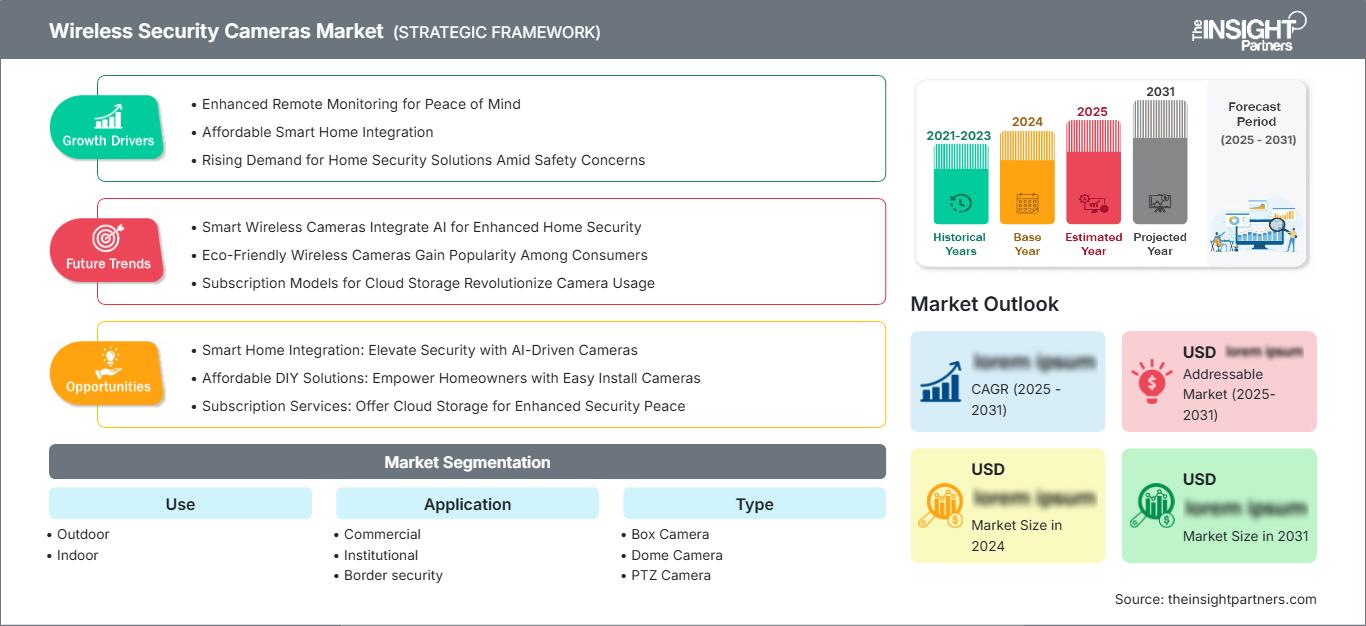
ワイヤレスセキュリティカメラ市場: 戦略的洞察
-
このレポートの主要な市場動向を入手してください。この無料サンプルには、市場動向から見積もりや予測に至るまでのデータ分析が含まれます。
Regional Insights
North America wireless security cameras market
North America is expected to maintain the largest regional position, representing 34–38% share in 2025 and expanding at an estimated 8.8–10.2% CAGR from 2026–2034. The region is experiencing a number of advantages in the form of extensive broadband internet access, mature smart homes ecosystem, security integrators and higher replacement rates. Remote accessibility features in home security cameras are becoming a favored choice for residential users, while commercial customers are choosing cloud management features for ease of management.
The majority of the demand in the region emanates from the United States, thanks to consumer awareness, monitoring capabilities and security budgets among enterprises. On the other hand, Canada adds to the demand through residential, retail and institutional deployments. Moreover, demand is driven by expectations in terms of cybersecurity, insurer demands as well as access control and alarm system integration.
U.S. wireless security cameras market
The US is expected to represent 73–78% of North American revenue in 2025, with an estimated 8.7–10.1% CAGR from 2026–2034. Adoption is driven by connected home ecosystems, professional monitoring services, availability of broadband and high demand for remote surveillance of property. Residences continue to be significant users, as do retail, distribution, educational, healthcare, and commercial properties that deploy intelligent video cameras.
Current applications show a trend towards cameras that can detect persons, vehicles, packages, and abnormal activities. Increasingly, manufacturers are integrating local and cloud-based processing to enhance system responsiveness and reduce bandwidth waste. Amcrest Industries LLC, Lorex Technology Inc., and Honeywell International Inc. are some of the firms that compete in various market segments.
Europe wireless security cameras market
Europe is projected to account for 21–24% share in 2025, expanding at approximately 7.7–9.1% CAGR from 2026–2034. The UK and Germany are important markets owing to the presence of commercial security infrastructure, and France, Italy, and Spain are adding their importance owing to modernization of cities and residences. Issues of privacy, cybersecurity, and data governance will affect the product architecture and purchase decisions.
The UK has strong commercial and governmental surveillance infrastructure in place, along with growing interest in intelligent systems. Industrial security and privacy-friendly solutions are important aspects in the German market, whereas in France, there is an expansion of connectivity for monitoring in both commercial and governmental applications. Italy and Spain have adopted the solutions in hotels, retail stores, residential property, and infrastructure.
APAC wireless security cameras market
According to the wireless security cameras market forecast, Asia Pacific is projected at 27–31% share in 2025, growing at 10.8–12.5% CAGR from 2026–2034. China remains a major manufacturing and deployment center, while Japan and South Korea favor sophisticated imaging and industrial applications. India is benefiting from urban development and stronger cybersecurity requirements, while Australia supports premium residential and commercial installations.
Regional demand is reinforced by smart-city programs, industrial automation, logistics expansion, and infrastructure modernization. India’s tighter security requirements for connected CCTV equipment are also increasing attention to testing and trusted supply chains. The wireless security cameras market is expected to benefit from expanding connectivity and local production capabilities across major Asian economies.
Middle East & Africa wireless security cameras market
Middle East and Africa is expected to expand at approximately 8.0–10.0% CAGR from 2026–2034, with Saudi Arabia and the UAE leading regional investment. Large scale infrastructure projects, airports, hotels, energy installations, and smart cities contribute to the surveillance requirement for professionals, and South Africa has been a key market.
Integrated security systems have become increasingly important in Saudi Arabia and the UAE in new developments in urban and infrastructure areas. There is ongoing demand for South Africa in the areas of retail, industrial, transportation, and residential. The wireless security cameras market in the region is also driven by the energy sector as well as large government purchases.
Segmentation Analysis
Use
The Use segment is shaped by installation environment, connectivity requirements, power availability, and exposure conditions. The segment is expected to grow at a 8.9–10.4% CAGR from 2026–2034, with buyers increasingly selecting cameras according to operating conditions, installation flexibility, and required coverage.
- Outdoor: Outdoor systems address perimeter, parking, logistics, infrastructure, and property monitoring. Weather resistance, night visibility, wider fields of view, and reliable wireless connectivity remain central purchasing considerations.
- Indoor: Indoor cameras serve homes, offices, retail facilities, institutions, and industrial spaces. Compact designs, privacy controls, two-way communication, and integration with access systems support continued adoption.
Application
The Application segment is projected to advance at a 9.1–10.6% CAGR from 2026–2034, supported by diverse security requirements across private and public environments. Increasing demand for remote monitoring is broadening deployment beyond conventional surveillance applications.
- Commercial: Retailers, offices, warehouses, and hospitality facilities use connected cameras for security, operational visibility, incident investigation, and employee safety.
- Institutional: Schools, healthcare facilities, government buildings, and campuses require centralized monitoring, controlled access, and dependable evidence management.
- Border security: Border applications emphasize long-range observation, thermal imaging, analytics, and reliable connectivity across geographically dispersed environments.
- City Infrastructure: Municipal deployments cover transport, public spaces, utilities, and critical infrastructure, with increasing integration of analytics and centralized command platforms.
- Residential: Homes increasingly adopt wireless cameras because installation is simpler and remote viewing can be integrated with broader smart-home systems.
- Industrial: Industrial users deploy cameras across plants, warehouses, energy facilities, and production areas where safety, perimeter protection, and operational visibility overlap.
Type
The Type segment is expected to expand at a 8.7–10.2% CAGR from 2026–2034 as customers prioritize application-specific form factors and increasingly intelligent imaging. Selection depends on viewing range, mobility, environmental conditions, and analytics requirements.
- Box Camera: Box cameras provide flexible lens selection and are suited to specialized professional installations where optical configuration and integration flexibility are important.
- Dome Camera: Dome cameras offer discreet installation and broad coverage, making them useful across retail, offices, hospitality, and institutional environments.
- PTZ Camera: PTZ systems support remote pan, tilt, and zoom control, making them valuable for large areas requiring dynamic monitoring and rapid incident tracking.
- Bullet Camera: Bullet designs provide directional coverage and are widely suited to entrances, perimeters, corridors, parking areas, and other defined surveillance zones.
- IP Camera: IP cameras support networked video, software integration, remote management, and analytics, making them central to modern connected surveillance architectures.
- Day/Night Camera: Day/night cameras maintain useful imaging across changing illumination, supporting continuous monitoring in commercial, industrial, and outdoor environments.
- Thermal Camera: Thermal cameras identify heat signatures and can support surveillance where visibility is limited by darkness, smoke, distance, or challenging weather conditions.
- Wireless IP Camera: Wireless IP cameras combine network connectivity with installation flexibility, reducing cabling requirements across residential, commercial, and distributed monitoring locations.
Components
The Components segment is projected to grow at a 9.3–11.0% CAGR from 2026–2034, reflecting continued hardware deployments alongside software and service monetization. Buyers increasingly evaluate complete surveillance architectures rather than individual camera units.
- Hardware: Hardware remains the principal revenue foundation, encompassing cameras, imaging components, connectivity modules, storage devices, and related installation equipment.
- Software: Software enables device management, analytics, alerting, cybersecurity, video search, and integration, increasing the value generated from installed camera fleets.
- Video Surveillance as a Service: VSaaS provides recurring monitoring, cloud storage, remote administration, and analytics, reducing upfront complexity for organizations managing distributed locations.
Opportunity Snapshot
|
Application |
Revenue Contribution (High/Medium/Low) |
Trend Tag |
Adoption Stage |
|
Commercial |
High |
AI Monitoring |
Mature |
|
Institutional |
Medium |
Campus Security |
Scaling |
|
Border security |
Medium |
Perimeter Analytics |
Scaling |
|
City Infrastructure |
High |
Smart-City Video |
Scaling |
|
Residential |
High |
Remote Monitoring |
Mature |
|
Industrial |
High |
Industrial Vision |
Scaling |
Wireless Security Cameras Market Growth Drivers and Impact Analysis
Expansion of Edge AI and Intelligent Video Processing
The integration of AI directly into cameras is changing the economics of surveillance by reducing dependence on continuous human monitoring. Edge processing is capable of doing object classification, detecting abnormal behavior, and sending alerts, while keeping transmission of video data to a minimum level. Intelligence can be used for applications where bandwidth, speed, or privacy are critical factors. Intelligence will provide an opportunity for vendors to differentiate themselves based on other factors, aside from resolution and form factor of their cameras. For customers, they now have an option to look into a system based not just on recording capabilities but also on event detections.
Demand for Flexible Deployment Across Distributed Properties
Wireless connectivity proves especially useful in situations where wiring is costly, disruptive, or difficult. Cameras that can be installed in retail locations that are distributed, warehouses, construction sites, residences, and other remotely installed locations become easier due to reduced limitations in terms of physical connections. Additionally, battery-operated and cell phones increase potential applications even further. With these benefits, installation times are lowered, allowing companies to implement the cameras gradually without the need for extensive rewiring operations. Remotely managed wireless cameras also make it easier for service providers to manage their fleets of devices from multiple locations. These advantages have a high business value when security coverage needs to be changed quickly in response to different layouts or geographic locations.
Stronger Cybersecurity and Surveillance Governance Requirements
Connected cameras are increasingly treated as networked computing devices rather than passive imaging equipment. Governments and enterprise buyers are therefore paying greater attention to device authentication, secure firmware, vulnerability management, data handling, and trusted supply chains. India’s strengthened CCTV security requirements illustrate how procurement rules can directly influence product qualification and supplier strategy. Similar concerns across other jurisdictions are encouraging vendors to embed stronger security controls and provide clearer software support practices. This environment raises compliance costs but can also favor established manufacturers capable of demonstrating secure product development and dependable updates. For buyers, cybersecurity is becoming a lifecycle consideration that affects vendor selection, deployment architecture, and total cost of ownership rather than a secondary technical feature.
Wireless Security Cameras Market Future Trends
Privacy-Preserving Intelligence and Hybrid Processing
Privacy-preserving architectures are likely to become a defining trend as intelligent surveillance expands into homes, workplaces, healthcare facilities, and public environments. Future cameras will increasingly combine local inference with selective cloud processing, allowing sensitive video to remain closer to its source while transmitting metadata or event clips when necessary. This architecture can reduce bandwidth consumption and support faster alerts while addressing regulatory expectations around personal data. Vendors are likely to differentiate through configurable retention, encryption, anonymization, access controls, and transparent processing policies. The wireless security cameras market trends will therefore increasingly connect imaging performance with privacy engineering. Customers may favor platforms that provide granular control over where video is processed, stored, accessed, and deleted rather than selecting products solely on resolution or connectivity.
Convergence of Surveillance With Broader Operational Platforms
監視システムは、アクセス制御、ビル管理、産業オートメーション、物流ソフトウェア、緊急対応プラットフォームとの統合がますます進むと予想されます。カメラは、単なる録画インフラとしてではなく、運用上の意思決定を支援する視覚データを提供するようになります。小売業では、ビデオは行列や在庫状況の把握に役立ち、産業施設では安全システムを補完し、都市部では交通やインフラ管理を支援できます。標準化されたAPIとクラウド管理により、多様なデバイス群間での統合が容易になります。この統合により、購買権限はセキュリティ部門から、より広範な技術・運用チームへと移行する可能性があります。その結果、将来の製品には、強力な相互運用性、文書化されたインターフェース、分析の移植性、ライフサイクルサポートが必要となり、監視インテリジェンスを企業ワークフローに接続できるベンダーにとって、新たなビジネスチャンスが生まれます。
ワイヤレスセキュリティカメラの市場機会
地域密着型の製造と信頼できるサプライチェーン
政府や企業がサプライチェーンの強靭性、サイバーセキュリティ、そして信頼性の高い機器を重視するようになるにつれ、地域生産は重要な機会となっています。現地での組み立ては、納期の短縮、公共調達要件への対応、そして地域特有の接続性や規制条件への製品の適応を可能にします。インドは、CCTVセキュリティ要件の強化とローカライゼーションへの取り組みの拡大を通じて、この方向性の顕著な例を示しています。同様の戦略は、重要インフラ事業者が製品の出所やソフトウェアサポートに関する透明性の向上を求める他の市場でも展開される可能性があります。地域での組み立て、テスト、サービス、そしてサイバーセキュリティの能力を確立できる企業は、政府やインフラプロジェクトにおける自社の地位を強化できます。したがって、投資機会はカメラ製造にとどまらず、認証施設、部品パートナーシップ、現地ソフトウェアサポート、そして専門的なシステム統合へと広がっています。
サブスクリプション型監視およびマネージドサービス
継続的なサービスモデルは、監視システムの購入を、定期的なハードウェア支出から予測可能な運用コストへと移行させる機会を提供します。中小企業、一般家庭、地理的に分散した企業は、大規模な社内インフラストラクチャを維持することなく、クラウドストレージ、リモート管理、ヘルスモニタリング、分析、マネージドレスポンスの恩恵を受けることができます。プロバイダーは、階層型ストレージ、高度な分析、マルチサイト管理、プロフェッショナルな監視を通じて、継続的な収益を構築できます。このモデルは、カメラと接続性、アラーム、アクセス制御、サイバーセキュリティサービスをバンドルする機会も生み出します。最も有望な見込みは、顧客の技術リソースが限られている場合や、サイト要件が急速に変化する場合に現れるでしょう。信頼性の高いハードウェアと、シンプルなサービスアクティベーション、透明性の高い価格設定、強力なデータ管理、迅速なサポートを組み合わせたベンダーは、顧客維持率を向上させ、設置済みデバイスのライフサイクル価値を高めることができます。
よくある質問

Naveenは、カスタム、シンジケート、コンサルティングの各プロジェクトにおいて9年以上の実績を持つ、経験豊富な市場調査およびコンサルティングのプロフェッショナルです。現在はアソシエイトバイスプレジデントを務め、プロジェクトバリューチェーン全体にわたるステークホルダー管理を成功させ、100件以上の調査レポートと30件以上のコンサルティング案件を執筆しています。産業および政府機関のプロジェクトに幅広く携わり、クライアントの成功とデータに基づく意思決定に大きく貢献しています。
Naveenは、カルナータカ州VTUで電子通信工学の学位を取得し、マニパル大学でマーケティング&オペレーションズのMBAを取得しています。IEEEの会員として9年間活動し、会議や技術シンポジウムへの参加、セクションレベルおよび地域レベルでのボランティア活動に積極的に取り組んでいます。現職以前は、IndustryARCでアソシエイト戦略コンサルタント、Hewlett Packard(HP Global)で産業用サーバーコンサルタントを務めていました。
- 包括的な市場規模および予測分析
- 詳細なセグメンテーション分析
- 市場動向(ダイナミクス)の徹底的な評価
- 地域および国別のインサイト
- 競争環境および企業ベンチマーク
- 戦略的ビジネスインテリジェンス
お客様の声

The Insight Partnersは、当社のグローバルな市場参入戦略を支える有益な市場インテリジェンスを提供してくれました。同社のチームはプロフェッショナルかつ迅速に対応し、こちらのフィードバックにも丁寧に耳を傾け、プロジェクト全体を通じて、思慮深い分析や手法に関する有益な説明を行ってくれました。
Junmo Kim 最高財務責任者(CFO), エナテック株式会社
Insight PartnersのSCADAシステム市場レポートは包括的で、現在のトレンドと将来の予測に関する貴重な洞察が含まれています。チームは終始、非常にプロフェッショナルで、対応が早く、サポートも充実していました。私たちは彼らのサービスに非常に満足しており、強くお勧めします。
ラン・ケデム パートナー, レアリテクノロジーズ株式会社
非常に特殊なソフトウェア市場に関するレポートを依頼したところ、チームは数日でレポートを作成してくれました。情報は非常に関連性が高く、分かりやすくまとめられていました。その後、レポートにいくつか修正と追加を依頼しましたが、チームは非常に迅速に対応し、1週間も経たないうちに最終レポートを受け取ることができました。
ジャン=エルヴェ・ジェン 会長, フューチャー・アナリティカ
重要な市場調査と予測のために、The Insight Partnersと協力しました。彼らは機会とリスクに関する明確な洞察を提供し、私たちの計画策定に役立ちました。彼らの調査は使いやすく、確かなデータに基づいており、賢明で自信に満ちた意思決定に役立ちました。彼らを強くお勧めします。
ピユーシュ・ナグパル 上級副社長, ハイビームグローバル
Insight Partnersは、深い専門知識に基づき、洞察力に富み、構造化された市場調査を提供しました。チームは終始プロフェッショナルで、対応力も抜群でした。ユーザーフレンドリーなウェブサイトにより、業界レポートへのアクセスもスムーズでした。信頼性の高い高品質な調査サービスをお探しなら、Insight Partnersを強くお勧めします。
安達幸彦 最高経営責任者(CEO), ディープブルーLLC。
The Insight Partnersから市場レポートを購入するのは今回が初めてです。最初は不安でしたが、ウェブサイトを見て、リスクを負ってでも購入してみようという気持ちになりました。レポートの品質とカスタマーサービスには大変満足しています。最初のレポートにはいくつか質問やコメントがありましたが、アナリストとメールで何度かやり取りした結果、戦略策定プロセスへのインプットとして活用できるレポートが完成しました。貴重なお時間を割いていただき、貴重な体験をさせていただき、誠にありがとうございました。他の方にもぜひお勧めしたいですし、今後さらに市場データが必要になった際には、まずThe Insight Partnersにご連絡させていただきます。
ジョン・スズキ 社長兼最高経営責任者、取締役, BKテクノロジーズ
ナイジェリアの感染症IVD市場に関する情報提供依頼に対し、ご対応いただいた際、ご尽力とプロフェッショナルな姿勢に深く感謝申し上げます。忍耐強く、的確なアドバイスをいただき、また、最終的に取引成立に至った割引のご提供にも深く感謝申し上げます。今回の最初の出会いで得た強い印象のおかげで、今後もThe Insight Partnersとの連携を心待ちにしております。
チジオケ博士 オニア マネージングディレクター, パインクレストヘルスケア株式会社購入理由
- 情報に基づいた意思決定
- 市場動向の理解
- 競合分析
- 顧客インサイト
- 市場予測
- リスク軽減
- 戦略計画
- 投資の正当性
- 新興市場の特定
- マーケティング戦略の強化
- 業務効率の向上
- 規制動向への対応




















 無料サンプルを入手 -