
Wireless Security Cameras Market Size, Trends & Growth by 2034
Coverage: by Use (Outdoor, Indoor); Application (Commercial, Institutional, Border security, City Infrastructure, Residential, Industrial); Type (Box Camera, Dome Camera, PTZ Camera, Bullet Camera, IP Camera, Day/Night Camera, Thermal (FLIR) Camera, Wireless IP Camera, Other); Components (Hardware, Software, Video Surveillance as a Service (VSaaS)) , and Geography (North America, Europe, Asia Pacific, and South and Central America)
- Status : Data Released
- Report Code : TIPRE00007817
- Category : Electronics and Semiconductor
- No. of Pages : 150
- Available Report Formats :


- Last update date : September 28, 2026


2025 Market Size
US$ 78.92 Bn
Base year value
2034 Forecast
US$ 178.84 Bn
Projected by 2034
CAGR 2026-2034
9.51 %
Growth rate
Addressable Market
US$ 1,149.69 Bn
(2026-2034)
The wireless security cameras market size is expanding from US$ 78.92 Billion in 2025 to US$ 178.84 Billion by 2034, reflecting a CAGR of 9.51% from 2026 to 2034. Demand is being shaped by broader deployment of connected surveillance, remote monitoring, intelligent video analytics, and flexible camera installation across residential, commercial, institutional, industrial, and public environments. The market is increasingly shifting toward software-enabled security architectures that combine cameras, cloud services, analytics, and cybersecurity.
Across North America, the wireless security cameras market is expected to advance at an estimated 8.8–10.2% CAGR between 2026 and 2034, supported by high broadband availability, smart-home adoption, subscription monitoring, and replacement of legacy surveillance infrastructure. The region benefits from mature enterprise security ecosystems, strong investment in connected devices, and increasing demand for AI-enabled video intelligence, while privacy and cybersecurity requirements are encouraging vendors to strengthen local processing and secure device architectures.
Wireless Security Cameras Market Assessment and Insights
- North America: North America is expected to represent 34–38% wireless security cameras market share in 2025, growing at a 8.8–10.2% CAGR between 2026–2034. Mature connectivity, smart-home penetration, enterprise modernization, and subscription surveillance support sustained adoption across residential and commercial applications.
- US: The US is projected to account for 73–78% of North American revenue in 2025, expanding at a 8.7–10.1% CAGR between 2026–2034 as connected-home platforms and cloud surveillance gain wider acceptance.
- Europe: Europe is estimated at 21–24% share in 2025, with a 7.7–9.1% CAGR between 2026–2034. Germany, the UK, France, Italy, and Spain are key markets, with privacy compliance and cybersecurity increasingly influencing purchasing decisions.
- Asia Pacific: Asia Pacific is estimated at 27–31% share in 2025, growing at a 10.8–12.5% CAGR between 2026–2034. China, Japan, South Korea, and India are leading adoption through smart-city programs, industrial digitization, infrastructure investment, and expanding connected-device ecosystems.
- Largest Segment: Hardware is expected to hold 61–66% market share in 2025, expanding at a 8.2–9.4% CAGR between 2026–2034, supported by continuing camera deployments and replacement demand.
- High Growth Segment: Video Surveillance as a Service is projected at 8–12% market share in 2025, growing at a 13.0–15.5% CAGR between 2026–2034 as organizations prioritize recurring, remotely managed surveillance services.
- Key companies analyzed in detail: Amcrest Industries LLC, Lorex Technology Inc., Zmodo Technology Shenzhen Corp., Ltd., GW Security, Inc., Sony Corporation, Robert Bosch GmbH, Panasonic Holdings Corporation, Honeywell International Inc., Tianjin Yaan Technology Co., Ltd., Hangzhou Hikvision Digital Technology Co., Ltd., Zhejiang Dahua Technology Co., Ltd., Hanwha Vision Co., Ltd., and Axis Communications AB.
Source: The Insight Partners' analysis based on proprietary research, government publications, company annual reports, investor presentations, industry databases, and expert interviews.
The development of the wireless security cameras market is being pushed through the move from recording systems that operate in isolation to networked and software-based surveillance. Advancements in CMOS technology, performance in low light conditions, edge computing, H.265 compression, battery technology, Wi-Fi connectivity, and cellular communications are facilitating more deployments. Meanwhile, manufacturers are balancing cost considerations with cybersecurity and device lifecycle management. Manufacturing approaches are becoming increasingly international with components sourced globally but assemblies made regionally.
Over the forecast period, emerging markets will receive increased investment as more cities, factories, logistics operations, and housing developments increase connected surveillance installations. Regulatory pressure will affect vendor selection in cases where there is a need for cybersecurity testing or where only certified equipment can be used. Simultaneously, cloud-based surveillance systems and AI-powered event detection will make services business models appealing, while manufacturing in the region and integration capabilities will grow in importance.
Wireless Security Cameras Market Report Scope
| Report Attribute | Details |
|---|---|
| Market size in 2025 | US$ 78.92 Billion |
| Market Size by 2034 | US$ 178.84 Billion |
| Global CAGR (2026 - 2034) | 9.51% |
| Historical Data | 2021-2024 |
| Forecast period | 2026-2034 |
Wireless Security Cameras Market Analysis
The demand is now being driven by needs of security that go beyond perimeter surveillance. The need for loss prevention from retailers, monitoring from factories, and remote access from residents have all emerged. The eco-system covers the areas of imagers, processors, lenses, wireless units, batteries, software platforms, storage, analysis, installers, integrators, and monitors. It is these interdependencies that give rise to needs for interoperability and cybersecurity among the buying criteria.
On the supply side, there are changes taking place in the integration of intelligence into the cameras. The benefits of edge processing include reduction of bandwidth and faster reaction times while cloud computing platforms support central administration over dispersed locations. Availability of components, price of semiconductors, wireless technologies, and certifications also play a role in the economics of the products. Ecosystems allow for integration of hardware and software with services.
Competition stays intense as traditional security manufacturers find themselves competing against specialty connected camera brands and consumer electronics firms. Amcrest Industries LLC, Lorex Technology Inc., Zmodo Technology Shenzhen Corp., Ltd., and GW Security, Inc. focus on providing accessible connected security, while Sony Corporation provides advanced imaging capabilities. On the other hand, Robert Bosch GmbH, Panasonic Holdings Corporation, and Honeywell International Inc. cater to professional applications where reliability and cybersecurity matters.
There is an increasing strategic emphasis on AI-powered analytics, secure connectivity, cloud-based management, and industry-specific solutions. Hanwha Vision Co., Ltd., Axis Communications AB, Hangzhou Hikvision Digital Technology Co., Ltd., and Zhejiang Dahua Technology Co., Ltd. operate within the competitive professional security applications space, whereas new service business models provide possibilities for developing revenue streams. As a result, the wireless security cameras market report looks at total system economics more often now than just hardware costs.
● REPORT CUSTOMIZATION
Tailor This Report To Align With Your Specific Business Requirements
This report can be customized to align precisely with your business objectives, scope, and target markets. Customization options include tailored segmentation, geography, competitive analysis, and strategic insights to support informed decision-making.
Customize This Report →WHAT YOU CAN ADJUST
- ● Segmentations
- ● Geography
- ● Competitive Analysis
- ● Language Preferences
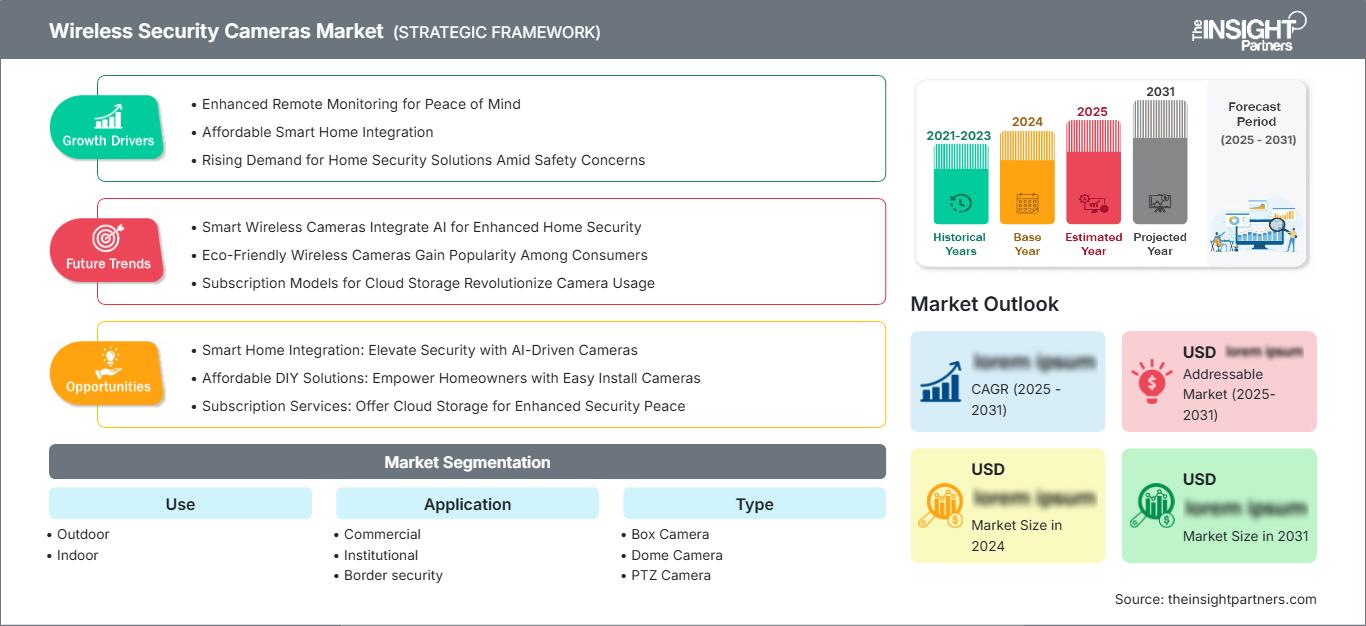
Wireless Security Cameras Market: Strategic Insights
Regional Insights
North America wireless security cameras market
North America is expected to maintain the largest regional position, representing 34–38% share in 2025 and expanding at an estimated 8.8–10.2% CAGR from 2026–2034. The region is experiencing a number of advantages in the form of extensive broadband internet access, mature smart homes ecosystem, security integrators and higher replacement rates. Remote accessibility features in home security cameras are becoming a favored choice for residential users, while commercial customers are choosing cloud management features for ease of management.
The majority of the demand in the region emanates from the United States, thanks to consumer awareness, monitoring capabilities and security budgets among enterprises. On the other hand, Canada adds to the demand through residential, retail and institutional deployments. Moreover, demand is driven by expectations in terms of cybersecurity, insurer demands as well as access control and alarm system integration.
U.S. wireless security cameras market
The US is expected to represent 73–78% of North American revenue in 2025, with an estimated 8.7–10.1% CAGR from 2026–2034. Adoption is driven by connected home ecosystems, professional monitoring services, availability of broadband and high demand for remote surveillance of property. Residences continue to be significant users, as do retail, distribution, educational, healthcare, and commercial properties that deploy intelligent video cameras.
Current applications show a trend towards cameras that can detect persons, vehicles, packages, and abnormal activities. Increasingly, manufacturers are integrating local and cloud-based processing to enhance system responsiveness and reduce bandwidth waste. Amcrest Industries LLC, Lorex Technology Inc., and Honeywell International Inc. are some of the firms that compete in various market segments.
Europe wireless security cameras market
Europe is projected to account for 21–24% share in 2025, expanding at approximately 7.7–9.1% CAGR from 2026–2034. The UK and Germany are important markets owing to the presence of commercial security infrastructure, and France, Italy, and Spain are adding their importance owing to modernization of cities and residences. Issues of privacy, cybersecurity, and data governance will affect the product architecture and purchase decisions.
The UK has strong commercial and governmental surveillance infrastructure in place, along with growing interest in intelligent systems. Industrial security and privacy-friendly solutions are important aspects in the German market, whereas in France, there is an expansion of connectivity for monitoring in both commercial and governmental applications. Italy and Spain have adopted the solutions in hotels, retail stores, residential property, and infrastructure.
APAC wireless security cameras market
According to the wireless security cameras market forecast, Asia Pacific is projected at 27–31% share in 2025, growing at 10.8–12.5% CAGR from 2026–2034. China remains a major manufacturing and deployment center, while Japan and South Korea favor sophisticated imaging and industrial applications. India is benefiting from urban development and stronger cybersecurity requirements, while Australia supports premium residential and commercial installations.
Regional demand is reinforced by smart-city programs, industrial automation, logistics expansion, and infrastructure modernization. India’s tighter security requirements for connected CCTV equipment are also increasing attention to testing and trusted supply chains. The wireless security cameras market is expected to benefit from expanding connectivity and local production capabilities across major Asian economies.
Middle East & Africa wireless security cameras market
Middle East and Africa is expected to expand at approximately 8.0–10.0% CAGR from 2026–2034, with Saudi Arabia and the UAE leading regional investment. Large scale infrastructure projects, airports, hotels, energy installations, and smart cities contribute to the surveillance requirement for professionals, and South Africa has been a key market.
Integrated security systems have become increasingly important in Saudi Arabia and the UAE in new developments in urban and infrastructure areas. There is ongoing demand for South Africa in the areas of retail, industrial, transportation, and residential. The wireless security cameras market in the region is also driven by the energy sector as well as large government purchases.
Segmentation Analysis
Use
The Use segment is shaped by installation environment, connectivity requirements, power availability, and exposure conditions. The segment is expected to grow at a 8.9–10.4% CAGR from 2026–2034, with buyers increasingly selecting cameras according to operating conditions, installation flexibility, and required coverage.
- Outdoor: Outdoor systems address perimeter, parking, logistics, infrastructure, and property monitoring. Weather resistance, night visibility, wider fields of view, and reliable wireless connectivity remain central purchasing considerations.
- Indoor: Indoor cameras serve homes, offices, retail facilities, institutions, and industrial spaces. Compact designs, privacy controls, two-way communication, and integration with access systems support continued adoption.
Application
The Application segment is projected to advance at a 9.1–10.6% CAGR from 2026–2034, supported by diverse security requirements across private and public environments. Increasing demand for remote monitoring is broadening deployment beyond conventional surveillance applications.
- Commercial: Retailers, offices, warehouses, and hospitality facilities use connected cameras for security, operational visibility, incident investigation, and employee safety.
- Institutional: Schools, healthcare facilities, government buildings, and campuses require centralized monitoring, controlled access, and dependable evidence management.
- Border security: Border applications emphasize long-range observation, thermal imaging, analytics, and reliable connectivity across geographically dispersed environments.
- City Infrastructure: Municipal deployments cover transport, public spaces, utilities, and critical infrastructure, with increasing integration of analytics and centralized command platforms.
- Residential: Homes increasingly adopt wireless cameras because installation is simpler and remote viewing can be integrated with broader smart-home systems.
- Industrial: Industrial users deploy cameras across plants, warehouses, energy facilities, and production areas where safety, perimeter protection, and operational visibility overlap.
Type
The Type segment is expected to expand at a 8.7–10.2% CAGR from 2026–2034 as customers prioritize application-specific form factors and increasingly intelligent imaging. Selection depends on viewing range, mobility, environmental conditions, and analytics requirements.
- Box Camera: Box cameras provide flexible lens selection and are suited to specialized professional installations where optical configuration and integration flexibility are important.
- Dome Camera: Dome cameras offer discreet installation and broad coverage, making them useful across retail, offices, hospitality, and institutional environments.
- PTZ Camera: PTZ systems support remote pan, tilt, and zoom control, making them valuable for large areas requiring dynamic monitoring and rapid incident tracking.
- Bullet Camera: Bullet designs provide directional coverage and are widely suited to entrances, perimeters, corridors, parking areas, and other defined surveillance zones.
- IP Camera: IP cameras support networked video, software integration, remote management, and analytics, making them central to modern connected surveillance architectures.
- Day/Night Camera: Day/night cameras maintain useful imaging across changing illumination, supporting continuous monitoring in commercial, industrial, and outdoor environments.
- Thermal Camera: Thermal cameras identify heat signatures and can support surveillance where visibility is limited by darkness, smoke, distance, or challenging weather conditions.
- Wireless IP Camera: Wireless IP cameras combine network connectivity with installation flexibility, reducing cabling requirements across residential, commercial, and distributed monitoring locations.
Components
The Components segment is projected to grow at a 9.3–11.0% CAGR from 2026–2034, reflecting continued hardware deployments alongside software and service monetization. Buyers increasingly evaluate complete surveillance architectures rather than individual camera units.
- Hardware: Hardware remains the principal revenue foundation, encompassing cameras, imaging components, connectivity modules, storage devices, and related installation equipment.
- Software: Software enables device management, analytics, alerting, cybersecurity, video search, and integration, increasing the value generated from installed camera fleets.
- Video Surveillance as a Service: VSaaS provides recurring monitoring, cloud storage, remote administration, and analytics, reducing upfront complexity for organizations managing distributed locations.
Opportunity Snapshot
| Application | Revenue Contribution (High/Medium/Low) | Trend Tag | Adoption Stage |
| Commercial | High | AI Monitoring | Mature |
| Institutional | Medium | Campus Security | Scaling |
| Border security | Medium | Perimeter Analytics | Scaling |
| City Infrastructure | High | Smart-City Video | Scaling |
| Residential | High | Remote Monitoring | Mature |
| Industrial | High | Industrial Vision | Scaling |
Wireless Security Cameras Market Growth Drivers and Impact Analysis
Expansion of Edge AI and Intelligent Video Processing
The integration of AI directly into cameras is changing the economics of surveillance by reducing dependence on continuous human monitoring. Edge processing is capable of doing object classification, detecting abnormal behavior, and sending alerts, while keeping transmission of video data to a minimum level. Intelligence can be used for applications where bandwidth, speed, or privacy are critical factors. Intelligence will provide an opportunity for vendors to differentiate themselves based on other factors, aside from resolution and form factor of their cameras. For customers, they now have an option to look into a system based not just on recording capabilities but also on event detections.
Demand for Flexible Deployment Across Distributed Properties
Wireless connectivity proves especially useful in situations where wiring is costly, disruptive, or difficult. Cameras that can be installed in retail locations that are distributed, warehouses, construction sites, residences, and other remotely installed locations become easier due to reduced limitations in terms of physical connections. Additionally, battery-operated and cell phones increase potential applications even further. With these benefits, installation times are lowered, allowing companies to implement the cameras gradually without the need for extensive rewiring operations. Remotely managed wireless cameras also make it easier for service providers to manage their fleets of devices from multiple locations. These advantages have a high business value when security coverage needs to be changed quickly in response to different layouts or geographic locations.
Stronger Cybersecurity and Surveillance Governance Requirements
Connected cameras are increasingly treated as networked computing devices rather than passive imaging equipment. Governments and enterprise buyers are therefore paying greater attention to device authentication, secure firmware, vulnerability management, data handling, and trusted supply chains. India’s strengthened CCTV security requirements illustrate how procurement rules can directly influence product qualification and supplier strategy. Similar concerns across other jurisdictions are encouraging vendors to embed stronger security controls and provide clearer software support practices. This environment raises compliance costs but can also favor established manufacturers capable of demonstrating secure product development and dependable updates. For buyers, cybersecurity is becoming a lifecycle consideration that affects vendor selection, deployment architecture, and total cost of ownership rather than a secondary technical feature.
Wireless Security Cameras Market Future Trends
Privacy-Preserving Intelligence and Hybrid Processing
Privacy-preserving architectures are likely to become a defining trend as intelligent surveillance expands into homes, workplaces, healthcare facilities, and public environments. Future cameras will increasingly combine local inference with selective cloud processing, allowing sensitive video to remain closer to its source while transmitting metadata or event clips when necessary. This architecture can reduce bandwidth consumption and support faster alerts while addressing regulatory expectations around personal data. Vendors are likely to differentiate through configurable retention, encryption, anonymization, access controls, and transparent processing policies. The wireless security cameras market trends will therefore increasingly connect imaging performance with privacy engineering. Customers may favor platforms that provide granular control over where video is processed, stored, accessed, and deleted rather than selecting products solely on resolution or connectivity.
Convergence of Surveillance With Broader Operational Platforms
Surveillance systems are expected to become increasingly integrated with access control, building management, industrial automation, logistics software, and emergency-response platforms. Instead of functioning as isolated recording infrastructure, cameras will provide visual data that supports operational decisions. In retail, video can contribute to queue and inventory insights; in industrial facilities, it can complement safety systems; and in cities, it can support traffic and infrastructure management. Standardized APIs and cloud management will make integration easier across heterogeneous device fleets. This convergence could shift purchasing authority from security departments toward broader technology and operations teams. As a result, future products will need strong interoperability, documented interfaces, analytics portability, and lifecycle support, creating opportunities for vendors that can connect surveillance intelligence with enterprise workflows.
Wireless Security Cameras Market Opportunities
Regional Manufacturing and Trusted Supply Chains
Regional manufacturing presents an important opportunity as governments and enterprise buyers place greater emphasis on supply-chain resilience, cybersecurity, and trusted equipment. Local assembly can shorten delivery cycles, support public procurement requirements, and allow manufacturers to adapt products to regional connectivity and regulatory conditions. India provides a notable example of this direction through stronger CCTV security requirements and growing localization efforts. Similar strategies can emerge in other markets where critical infrastructure operators seek greater visibility into product provenance and software support. Companies able to establish regional assembly, testing, service, and cybersecurity capabilities can strengthen their position in government and infrastructure projects. Investment opportunities therefore extend beyond camera manufacturing into certification facilities, component partnerships, local software support, and specialized system integration.
Subscription-Based Surveillance and Managed Services
Recurring service models provide an opportunity to shift surveillance purchasing from periodic hardware expenditure toward predictable operating costs. Small businesses, residential customers, and geographically distributed enterprises can benefit from cloud storage, remote administration, health monitoring, analytics, and managed response without maintaining extensive internal infrastructure. Providers can build recurring revenue through tiered storage, advanced analytics, multi-site management, and professional monitoring. This model also creates opportunities to bundle cameras with connectivity, alarms, access control, and cybersecurity services. The strongest prospects are likely to emerge where customers have limited technical resources or rapidly changing site requirements. Vendors that combine dependable hardware with simple service activation, transparent pricing, strong data controls, and responsive support can improve retention while increasing the lifetime value of installed devices.
Frequently Asked Questions

- Comprehensive Market Sizing and Forecast Analysis
- Detailed Segmentation Analysis
- In-Depth Market Dynamics Assessment
- Regional and Country-Level Insights
- Competitive Landscape and Company Benchmarking
- Strategic Business Intelligence
Recent Reports
Testimonials

The Insight Partners provided valuable market intelligence that supported our global go-to-market strategy. Their team was professional, responsive, and attentive to our feedback, providing thoughtful analysis and helpful methodological clarifications throughout the project.
Junmo Kim Chief Financial Officer (CFO), Enertech Co., Ltd.
The Insight Partners' SCADA System Market report is comprehensive, with valuable insights on current trends and future forecasts. The team was highly professional, responsive, and supportive throughout. We are very satisfied and highly recommend their services.
RAN KEDEM Partner, Reali Technologies LTDs
I requested a report on a very specific software market and the team produced the report in a few days. The information was very relevant and well presented. I then requested some changes and additions to the report. The team was again very responsive and I got the final report in less than a week.
JEAN-HERVE JENN Chairman, Future Analytica
We worked with The Insight Partners for an important market study and forecast. They gave us clear insights into opportunities and risks, which helped shape our plans. Their research was easy to use and based on solid data. It helped us make smart, confident decisions. We highly recommend them.
PIYUSH NAGPAL Sr. Vice President, High Beam Global
The Insight Partners delivered insightful, well-structured market research with strong domain expertise. Their team was professional and responsive throughout. The user-friendly website made accessing industry reports seamless. We highly recommend them for reliable, high-quality research services
YUKIHIKO ADACHI CEO, Deep Blue, LLC.
This is the first time I have purchased a market report from The Insight Partners.While I was unsure at first, I visited their web site and felt more comfortable to take the risk and purchase a market report.I am completely satisfied with the quality of the report and customer service. I had several questions and comments with the initial report, but after a couple of dialogs over email with their analyst I believe I have a report that I can use as input to our strategic planning process.Thank you so much for taking the extra time and making this a positive experience.I will definitely recommend your service to others and you will be my first call when we need further market data.
JOHN SUZUKI President and Chief Executive Officer, Board Director, BK Technologies
I wish to appreciate your support and the professionalism you displayed in the course of attending to my request for information regarding to infectious disease IVD market in Nigeria. I appreciate your patience, your guidance, and the fact that you were willing to offer a discount, which eventually made it possible for us to close a deal. I look forward to engaging The Insight Partners in the future, all thanks to the impression you have created in me as a result of this first encounter.
DR CHIJIOKE ONYIA MANAGING DIRECTOR, PineCrest Healthcare Ltd.Reason to Buy
- Informed Decision-Making
- Understanding Market Dynamics
- Competitive Analysis
- Identifying Emerging Markets
- Customer Insights
- Market Forecasts
- Risk Mitigation
- Boosting Operational Efficiency
- Strategic Planning
- Investment Justification
- Tracking Industry Innovations
- Aligning with Regulatory Trends





 Get Free Sample for