
발포 폴리스티렌(EPS) 시장: 전망, 동인 및 동향 보고서
발포 폴리스티렌(EPS) 시장 규모 및 전망(2021년~2034년), 글로벌 및 지역별 점유율, 트렌드 및 성장 기회 분석 보고서 범위: 제품 유형별(EPS 제조 공정, 백색 발포 폴리스티렌, 회색 발포 폴리스티렌, 흑색 발포 폴리스티렌), 최종 사용 산업별(건축 및 건설, 포장, 기타), 지역별(북미, 유럽, 아시아 태평양, 남미 및 중미)
- 상태 : 데이터 공개
- 보고서 코드 : TIPRE00006932
- 범주 : 화학 및 재료
- 페이지 수 : 150
- 사용 가능한 보고서 형식 :


- 최종 업데이트 일자 : September 15, 2026


2025 Market Size
US$ 12.08 Bn
Base year value
2034 Forecast
US$ 21.17 Bn
Projected by 2034
CAGR 2026-2034
6.43 %
Growth rate
Addressable Market
US$ 150.40 Bn
(2026-2034)
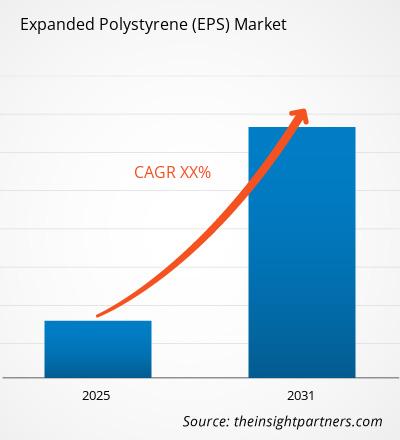
The global Expanded Polystyrene (EPS) market was valued at US$ 12.08 billion in 2025 and is expected to reach US$ 21.17 billion by 2034; it is estimated to record a CAGR of 6.43% during 2026-2034.
Expanded Polystyrene (EPS) Market Assessment and Insights
- North America: North America is estimated to represent 18–22% expanded polystyrene market share in 2025 and grow at a 6.5–7.2% CAGR between 2026–2034, supported by renovation activity, insulated packaging, cold-chain logistics, and energy-performance requirements.
- US: The US accounts for approximately 55–60% of North America's 2025 market, with growth projected at a 6.4–7.1% CAGR during 2026–2034, supported by construction and logistics demand.
- Europe: Europe is estimated at 20–24% share in 2025 and is expected to grow at a 6.8–7.5% CAGR from 2026–2034, led by Germany, the UK, France, Italy, and Spain, where insulation upgrades and packaging applications remain important.
- Asia Pacific: Asia Pacific represents approximately 41–45% share in 2025 and is expected to expand at a 7.7–8.5% CAGR from 2026–2034, led by China, India, Japan, South Korea, and Southeast Asian manufacturing centers.
- Largest Segment: Packaging is estimated to hold 55–59% market share in 2025, with a 7.4–8.0% CAGR from 2026–2034, reflecting electronics, appliances, food, and cold-chain applications.
- High Growth Segment: Grey expanded polystyrene is estimated at 14–18% share in 2025, with an 8.1–8.7% CAGR during 2026–2034, supported by superior thermal insulation performance.
- Key companies analyzed in detail: Alpek, S.A.B. de C.V.; BASF SE; Flint Hills Resources, LLC; Kaneka Corporation; NOVA Chemicals Corporation; Sunpor Kunststoff GmbH; Synthos S.A.; The Ravago Group; Versalis S.p.A.; Wuxi Xingda New Foam Plastics Materials Co., Ltd.
Source: The Insight Partners' analysis based on proprietary research, government publications, company annual reports, investor presentations, industry databases, and expert interviews.
Market trends in the expanded polystyrene market include the evolution from predominantly uniform white grades to differentiated insulation and packaging products with better thermal, mechanical, and environmental properties. The production of EPS is still highly dependent on the availability of styrene, energy consumption, pentane treatment, efficiency of polymerization processes, and conversion capacities of various regions. Graphite-containing grades have become increasingly significant for insulation due to their ability to offer better thermal efficiency at similar thickness, along with recyclable products being developed in Europe’s mature value chains.
The expanded polystyrene market outlook shows that growth will continue expanding in India, Southeast Asia, the Middle East, and some Latin American markets due to housing, warehousing, refrigeration, home appliances, and infrastructure investments. Regulations related to the energy efficiency of construction and the circular economy of plastics will impact the choice of materials and push manufacturers towards developing more sustainable feedstocks, recycling, and more efficient formulations. Companies with vertically integrated raw material supply and decentralized manufacturing capabilities will benefit from more robust costs positions.
Expanded Polystyrene (EPS) Market Report Scope
| Report Attribute | Details |
|---|---|
| Market size in 2025 | US$ 12.08 Billion |
| Market Size by 2034 | US$ 21.17 Billion |
| Global CAGR (2026 - 2034) | 6.43% |
| Historical Data | 2021-2024 |
| Forecast period | 2026-2034 |
Expanded Polystyrene (EPS) Market Analysis
The demand in the expanded polystyrene market is generated from two significant consumption systems – the thermal insulation of buildings and packaging. In construction industry, light-weighted panels and molding materials are used as insulation, keep the shape and are convenient to handle. Demand for packaging includes electronics, appliances, foods, pharmaceuticals and fish packaging and other products that need temperature control. The value chain begins with production of styrene and expandable polymers, then the beads get expanded and molded, trimmed, laminated and converted. The conditions of supply depend on not only the petrochemical industry economy but also the capacity for conversion of the material to various products. Efficient transportation is possible for those who have stable regional supply due to high air content of EPS.
The positioning of firms now relies on the formulation performance, scale of production, proximity to customers, and sustainability claims. In this regard, BASF SE is enhancing its premium grey insulation offering, while Synthos S.A. continues to have an extensive range of European EPS products for both construction and packaging applications. Versalis S.p.A. is investing in recycled EPS production, which demonstrates the increasing importance of circular raw materials. Alpek, S.A.B. de C.V., Flint Hills Resources, LLC, NOVA Chemicals Corporation, Kaneka Corporation, Sunpor Kunststoff GmbH, The Ravago Group, and Wuxi Xingda New Foam Plastics Materials Co., Ltd. are competing with each other through the combination of these factors.
● REPORT CUSTOMIZATION
Tailor This Report To Align With Your Specific Business Requirements
This report can be customized to align precisely with your business objectives, scope, and target markets. Customization options include tailored segmentation, geography, competitive analysis, and strategic insights to support informed decision-making.
Customize This Report →WHAT YOU CAN ADJUST
- ● Segmentations
- ● Geography
- ● Competitive Analysis
- ● Language Preferences
Expanded Polystyrene (EPS) Market:
요구 사항에 맞게 이 보고서를 사용자 정의하십시오.
이 보고서의 일부, 국가 수준 분석, Excel 데이터 팩을 포함하여 모든 보고서에 대한 사용자 정의를 무료로 받을 수 있을 뿐만 아니라 스타트업 및 대학을 위한 훌륭한 제안 및 할인을 이용할 수 있습니다
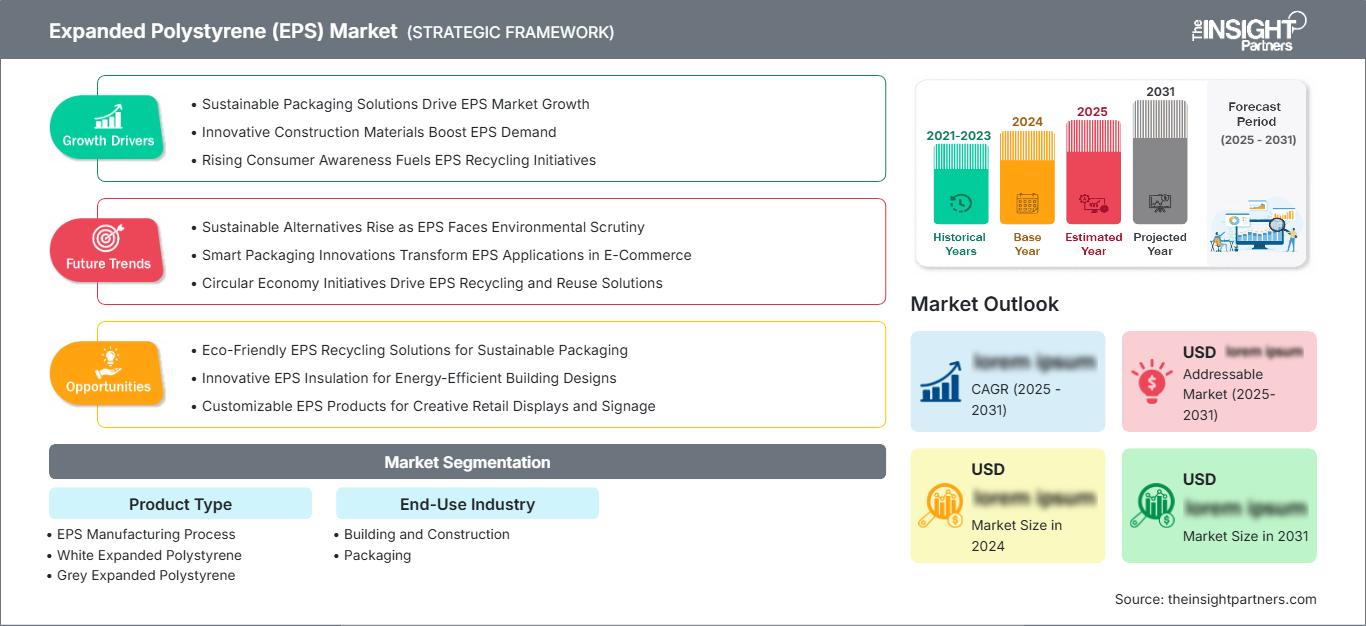
발포 폴리스티렌(EPS) 시장: 전략적 통찰력
-
이 보고서의 주요 주요 시장 동향을 확인하세요.이 무료 샘플에는 시장 동향부터 추정 및 예측에 이르기까지 데이터 분석이 포함됩니다.
Regional Insights
North America Expanded Polystyrene Market
North America is estimated to account for 18–22% of the global expanded polystyrene market in 2025, with growth projected at a 6.5–7.2% CAGR through 2034. Demand is driven by home renovations, construction, roof insulation, packaging for appliances and electronics, and food storage in refrigerated transport. Increasingly stringent energy efficiency regulations are pushing towards more focus on continuous insulation and building envelope performance, which is driving the need for higher value EPS products.
The United States accounts for around 55–60% of North American demand, and Canada and Mexico make their contributions via construction materials, food packaging, automotive logistics, and manufacturing. The regional manufacturers have the advantage of the existing styrenics value chain and extensive converters network; however, volatility in feedstock prices and logistics costs may have an impact on margins. The greatest potential lies in areas where building renovations meet old building stock and where there is the need for packaging in e-commerce and cold chain logistics.
U.S. Expanded Polystyrene Market
The expanded polystyrene market forecast shows that US represents approximately 55–60% of North America's 2025 market and is projected to grow at a 6.4–7.1% CAGR from 2026–2034. Construction continues to be an important demand driver, especially for insulation boards, foundations, roofs, and molded parts. Packaging demand will continue to benefit from appliances, electronics, food service, pharmaceuticals, and e-commerce shipments.
Competition is a combination of resin manufacturers, vertically integrated chemical firms, regional foam converters, and insulation specialists. Demand will continue to be driven by the states' energy regulations, construction retrofitting, and logistics network development. EPS will continue to have strong demand when low density and cushioning characteristics reduce costs and damage during transportation. The future demand will be dependent on managing material costs, insulation effectiveness, fire and building codes, and recycling issues. Growth will therefore favor differentiated grades and applications versus widespread adoption in commodity applications.
Europe Expanded Polystyrene Market
Europe is estimated to represent 20–24% of the global expanded polystyrene market in 2025 and is expected to expand at a 6.8–7.5% CAGR through 2034. Germany continues to be one of the main markets, with the help of building renovations and industrial production. The UK, France, Italy, and Spain add to the demand with insulation, packaging, food logistics, and building works. The European demand is especially sensitive to the issues of energy efficiency and circularity.
UK is driven by renovation needs and demand for light protective packaging, whereas Germany is characterized by strong construction sector and developed chemical/conversion industries. The French and Italian market needs are driven by renovations, infrastructure, food logistics, and appliance manufacturing. Spain drives demand with housing construction, tourism logistics, and food exports. European producers prefer to focus on recycled solutions, collection systems, and material efficiencies. Thus, the region is more likely to witness a gradual shift towards high-performance grades and circular chains instead of pure volume growth.
APAC Expanded Polystyrene Market
APAC is estimated to hold 41–45% of the global market in 2025 and is projected to grow at a 7.7–8.5% CAGR through 2034. China dominates the market on account of electronics, appliances, construction, food logistics, and manufacturing industries. Other countries such as India, Japan, South Korea, and Australia contribute to the demand by offering infrastructure, insulation, packaging, and industrial products.
The combined petrochemical facilities and converter industry of China help in maintaining competitive supply levels, while India derives its demand from the growing trend of urbanization and infrastructure. The emphasis on high performance by Japan and South Korea is different from that of Australia, where the contribution comes from construction and cold-chain industries. Policies favoring energy efficient construction and manufacturing facilities along with logistics infrastructure will further support the demand.
Middle East & Africa Expanded Polystyrene Market
Middle East and Africa is expected to account for approximately 5–7% of global demand in 2025, with growth projected at a 6.8–7.6% CAGR through 2034. Saudi Arabia and the UAE form the key players in regional demand because of their involvement in construction, industrial activities, warehousing, and infrastructural developments. South Africa is a critical market in terms of packaging and construction uses.
The expanded polystyrene market report shows that harsh climatic conditions of the region make thermal insulation an absolute technical need, and infrastructural developments help in demand for light weight construction materials. Saudi Arabia has a lot of benefits due to its urban and tourism developments, while the UAE has combined commercial construction with logistics and food distribution. South Africa has diversification among packaging, construction, and industrial activities.
Segmentation Analysis
Product Type
Product Type is expected to expand at a 7.0–7.5% CAGR from 2026–2034. Demand is becoming more differentiated as converters select grades according to insulation performance, appearance, processing requirements, density, and application-specific mechanical properties. White grades remain foundational, while grey and black formulations address specialized performance requirements.
- EPS Manufacturing Process: This category represents the underlying production route and processing foundation for expandable bead conversion. Its strategic importance lies in controlling bead quality, expansion ratio, density, processing consistency, and downstream molding efficiency across applications.
- White Expanded Polystyrene: White EPS remains widely used because of established processing practices, competitive pricing, and broad compatibility with packaging and insulation applications. Its mature converter ecosystem supports dependable demand across developed and emerging markets.
- Grey Expanded Polystyrene: Grey EPS incorporates performance-enhancing additives that improve thermal insulation characteristics. It is increasingly important for energy-efficient building envelopes, where higher insulation performance can support thinner assemblies and more efficient use of building space.
- Black Expanded Polystyrene: Black EPS serves specialized insulation and packaging requirements where color, heat absorption characteristics, or application differentiation are relevant. Its strategic role is linked to premium applications requiring customized performance rather than broad commodity consumption.
End-Use Industry
End-Use Industry is projected to register a 7.3–7.8% CAGR during 2026–2034. Packaging and construction remain the two principal demand ecosystems, with purchasing decisions increasingly determined by protection requirements, insulation performance, regulatory compliance, logistics efficiency, and total installed cost.
- Building and Construction: EPS is widely applied in wall insulation, roofing, foundations, floor systems, and specialized construction components. Demand is supported by energy-efficiency upgrades, lightweight construction, ease of installation, and the need to improve building-envelope performance.
- Packaging: Packaging is a major consumption area, particularly for electronics, appliances, food, pharmaceuticals, fish products, and temperature-sensitive shipments. Its cushioning, low density, thermal protection, and molding flexibility support continued use across complex distribution networks.
Opportunity Snapshot
|
End-Use Industry |
Revenue Contribution |
Trend Tag |
Adoption Stage |
|
Building and Construction |
Medium |
Energy Retrofit |
Mature |
|
Packaging |
High |
Cold Chain |
Mature |
Expanded Polystyrene (EPS) Market Growth Drivers and Impact Analysis
Expansion of energy-efficient building insulation requirements
Building energy-efficiency policies are creating a durable demand foundation for insulation materials with favorable thermal performance, low weight, and relatively simple installation. EPS is particularly relevant where contractors require cost-effective envelope solutions for walls, roofs, foundations, and floors. Renovation activity can be more important than new construction in mature markets because older buildings often require substantial improvements in thermal performance. The commercial impact extends beyond resin producers to board manufacturers, insulation installers, distributors, and construction-system suppliers. Higher-performance grey grades can capture incremental value where building specifications prioritize thermal resistance. As energy costs and regulatory requirements influence building owners' investment decisions, insulation products that combine predictable performance with manageable installation costs are positioned to retain a strong role in renovation programs.
Growth of protective packaging and temperature-controlled logistics
The expansion of electronics distribution, appliances, fresh food logistics, pharmaceuticals, and other temperature-sensitive products is sustaining demand for protective packaging. EPS provides cushioning and thermal insulation while allowing manufacturers to create customized molded geometries around fragile products. Cold-chain applications are particularly important because packaging performance can influence product quality during transportation and temporary storage. Growth in online retail also increases the number of individual shipments requiring protection against impact and vibration. Producers can therefore pursue application-specific formulations rather than relying solely on commodity grades. The commercial opportunity is strongest where packaging converters can demonstrate reduced product damage, lower shipping weight, and reliable thermal performance. Recycling infrastructure and customer sustainability requirements will increasingly determine which EPS packaging solutions remain commercially viable.
Development of recycled-content and circular EPS value chains
Circularity is becoming a competitive factor as regulators, brand owners, and converters seek to reduce dependence on virgin petrochemical feedstocks. EPS presents opportunities for mechanical and advanced recycling because recovered material can be processed into new polystyrene products when collection, sorting, and contamination control are effectively managed. New recycling capacity can create additional feedstock channels for producers while reducing disposal requirements. The impact is particularly relevant in Europe, where policy and customer expectations are accelerating circular-material adoption. Producers that establish partnerships with waste managers, converters, retailers, and packaging users can improve recovery economics and secure recycled feedstock. Over time, recycled-content grades may become an important product differentiator, especially for customers seeking documented reductions in virgin material consumption without sacrificing processing performance.
Expanded Polystyrene (EPS) Market Future Trends
Higher-performance insulation grades will gain strategic importance
The expanded polystyrene market trends show that future product development is likely to focus increasingly on achieving greater thermal performance without proportionally increasing material thickness. Grey and graphite-enhanced EPS can address this requirement by improving insulation efficiency, allowing building-system designers to optimize wall assemblies and usable interior space. Producers are also expected to refine additives, bead structures, density profiles, and fire-performance characteristics. Such developments can move competition away from basic price comparisons toward technical specifications and lifecycle economics. Building renovation programs will strengthen this transition because retrofit projects often face physical space constraints that make insulation efficiency particularly important. Manufacturers that combine high thermal performance with reliable processing, recycled-content options, and consistent quality will be better positioned to meet increasingly demanding building-system specifications.
Digitalized manufacturing and traceable circular material systems will expand
EPS production and conversion are expected to become more data-driven as manufacturers seek tighter control over density, expansion behavior, energy consumption, and scrap generation. Digital process monitoring can improve consistency while reducing material losses during bead expansion and molding. At the same time, traceability systems can help converters document recycled content, source recovered feedstock, and demonstrate compliance with customer sustainability requirements. Integration between resin suppliers, foam processors, waste collectors, and recyclers may create more predictable circular supply chains. These systems could also improve procurement decisions by linking material specifications with application performance and environmental attributes. As sustainability reporting becomes more detailed, digital documentation may evolve from a compliance function into a commercial differentiator for premium EPS grades.
Expanded Polystyrene (EPS) Market Opportunities
Localized supply for emerging construction and logistics hubs
Manufacturers can pursue localized production and conversion capacity in high-growth markets where imported EPS faces freight and handling disadvantages. India, Southeast Asia, the Middle East, and selected Latin American economies offer opportunities because construction, warehousing, food distribution, and appliance manufacturing are expanding simultaneously. Local manufacturing can shorten delivery times, reduce transportation exposure, and enable customized bead specifications for regional converters. Strategic partnerships with insulation producers and packaging molders can provide demand visibility before capacity investments are made. Suppliers can also develop application-specific grades for hot climates, cold-chain distribution, or high-density construction systems. The strongest opportunities will likely emerge where petrochemical feedstock availability, infrastructure investment, and converter density combine to support competitive regional production.
Integrated recycling platforms for packaging and construction waste
Recycling represents an investment opportunity across both post-consumer packaging and post-construction insulation waste. Companies can establish collection networks, densification systems, sorting facilities, and processing assets close to major consumption centers to improve the economics of recovering low-density EPS. Partnerships with municipalities, retailers, demolition contractors, packaging converters, and building-material manufacturers can increase collection volumes and improve feedstock quality. Recovered material can support recycled-content products while creating a differentiated supply proposition for customers with sustainability targets. Producers with existing polymer infrastructure have an additional advantage because recycling assets can be integrated with established processing and distribution networks. As circularity requirements mature, vertically coordinated recycling platforms could become an important source of competitive differentiation and margin resilience.
Recent Developments
- June 2026: BASF SE - BASF announced the closure of its EPS production assets at the Ulsan Plastics site in South Korea, targeted for mid-June 2026, as part of a broader effort to optimize its global styrenics production footprint and align capacity with changing market conditions.
- March 2025: Versalis S.p.A. - Versalis announced the opening of a Porto Marghera plant capable of producing up to 20,000 tonnes annually of recycled crystal polystyrene and recycled EPS using secondary raw materials recovered from post-consumer EPS waste.
Frequently Asked Questions

- 포괄적인 시장 규모 산정 및 전망 분석
- 상세 시장 세분화 분석
- 심층적인 시장 동향 및 요인 분석
- 지역 및 국가별 인사이트
- 경쟁 구도 및 기업 벤치마킹
- 전략적 비즈니스 인텔리전스
사용 후기

The Insight Partners는 당사의 글로벌 시장 진출 전략을 뒷받침하는 가치 있는 시장 정보를 제공했습니다. 담당 팀은 전문적이고 신속하게 대응했으며 당사의 의견을 세심하게 반영했습니다. 또한 프로젝트 전반에 걸쳐 깊이 있는 분석과 유용한 방법론적 설명을 제공했습니다.
Junmo Kim 최고재무책임자(CFO), Enertech Co., Ltd.
Insight Partners의 SCADA 시스템 시장 보고서는 포괄적이며, 현재 동향과 미래 전망에 대한 귀중한 통찰력을 제공합니다. 팀은 매우 전문적이고, 신속하게 대응하며, 처음부터 끝까지 지원해 주었습니다. 저희는 매우 만족하며 Insight Partners의 서비스를 적극 추천합니다.
란 케뎀 파트너, Reali Technologies LTDs
아주 구체적인 소프트웨어 시장에 대한 보고서를 요청했는데, 팀에서 며칠 만에 보고서를 작성해 주셨습니다. 정보는 매우 관련성이 높고 잘 정리되어 있었습니다. 그 후 보고서에 몇 가지 수정과 추가 사항을 요청했습니다. 팀원들의 응답도 매우 빨랐고, 일주일도 채 되지 않아 최종 보고서를 받았습니다.
장-에르브 젠 의장, 퓨처 애널리티카
The Insight Partners와 함께 중요한 시장 조사 및 예측 작업을 진행했습니다. Insight Partners는 기회와 위험에 대한 명확한 통찰력을 제공하여 계획을 세우는 데 큰 도움이 되었습니다. The Insight Partners의 조사는 사용하기 쉬웠고, 탄탄한 데이터를 기반으로 했습니다. 덕분에 현명하고 자신 있는 결정을 내릴 수 있었습니다. The Insight Partners를 강력 추천합니다.
피유시 나그팔 수석 부사장, 하이빔 글로벌
Insight Partners는 탄탄한 분야 전문성을 바탕으로 통찰력 있고 체계적인 시장 조사를 제공했습니다. Insight Partners 팀은 처음부터 끝까지 전문적이고 신속하게 대응했습니다. 사용자 친화적인 웹사이트 덕분에 업계 보고서에 쉽게 접근할 수 있었습니다. 신뢰할 수 있고 고품질의 조사 서비스를 원하신다면 Insight Partners를 강력 추천합니다.
아다치 유키히코 대표이사, 딥블루 주식회사
The Insight Partners에서 시장 보고서를 구매한 것은 이번이 처음입니다. 처음에는 확신이 없었지만, 웹사이트를 방문하고 나서 위험을 감수하고 시장 보고서를 구매하는 것이 더 편하다는 것을 알게 되었습니다. 보고서의 품질과 고객 서비스에 매우 만족합니다. 처음 보고서를 보고 몇 가지 질문과 의견이 있었지만, 분석가와 이메일로 몇 차례 대화를 나눈 후, 전략 기획 과정에 참고할 수 있는 보고서를 확보했다고 생각합니다. 시간을 내어 긍정적인 경험을 선사해 주셔서 정말 감사합니다. 다른 사람들에게도 귀사의 서비스를 적극 추천할 것이며, 추가적인 시장 데이터가 필요할 때면 가장 먼저 귀사에 연락하겠습니다.
존 스즈키 사장 겸 최고 경영자, 이사회 이사, BK 테크놀로지스
나이지리아 감염성 질환 IVD 시장 관련 정보 요청에 응해 주신 귀사의 지원과 전문성에 감사드립니다. 귀사의 인내심과 지도, 그리고 할인 혜택을 기꺼이 제공해 주셔서 결국 계약을 성사시킬 수 있었습니다. 첫 만남을 통해 귀사가 저에게 심어주신 좋은 인상을 바탕으로 앞으로도 The Insight Partners와 함께할 수 있기를 기대합니다.
치지오케 박사 오니아 전무이사, 파인크레스트 헬스케어 유한회사구매 이유
- 정보에 기반한 의사 결정
- 시장 역학 이해
- 경쟁 분석
- 고객 인사이트
- 시장 예측
- 위험 완화
- 전략 기획
- 투자 타당성 분석
- 신흥 시장 파악
- 마케팅 전략 강화
- 운영 효율성 향상
- 규제 동향에 발맞춰 대응



















 무료 샘플 받기 -