Global AI in Manufacturing Market Forecast to 2034: Key Insights
According to our latest study on "Global AI in Manufacturing Market – Global and Regional Share, Trend, and Growth Opportunity Analysis – by Component, Deployment, Organization Size, and Geography," the AI in manufacturing market size was valued at US$ 26.98 billion in 2025 and is expected to reach US$ 610.96 billion by 2034. The AI in manufacturing market is estimated to register a CAGR of 42.3% during 2026–2034. Intelligent and autonomous manufacturing is expected to act as a future AI in manufacturing market trend.
The future of AI is moving toward intelligent and autonomous factories, where AI-driven systems handle complex production tasks with minimal human intervention. Advanced machine learning, computer vision, and predictive analytics are being integrated into robotics, assembly lines, and supply chains, enabling manufacturers to achieve higher precision, faster production cycles, and reduced operational costs.
AI in Manufacturing Market
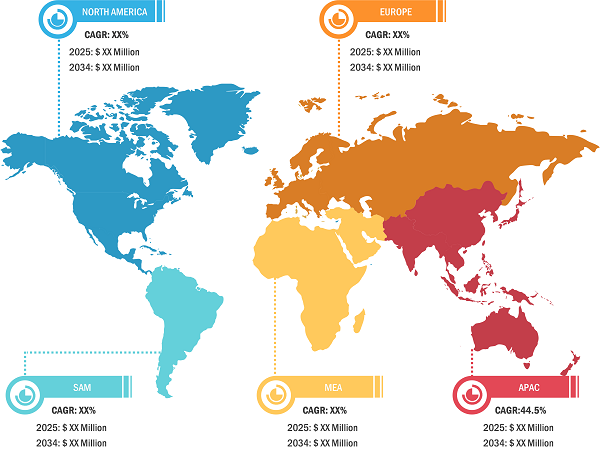
AI in Manufacturing Market Share, Growth & Forecast by 2034
Download Free SampleAI in Manufacturing Market Size and Forecast (2021 - 2034), Global and Regional Share, Trend, and Growth Opportunity Analysis Report Coverage: By Component (Software, Hardware and Services), Deployment (Cloud and On Premises), Organization Size (Large Enterprises and SMEs), and Geography (North America, Europe, Asia Pacific, Middle East and Africa, and South America)
One notable trend is the adoption of digital twins, which create virtual replicas of production lines, machinery, and supply chains. These digital twins allow real-time monitoring, predictive maintenance, and scenario testing, helping manufacturers identify bottlenecks, prevent equipment failures, and optimize processes before real-world implementation. Another emerging trend is AI-enabled collaborative robotics (cobots), which work alongside human operators to enhance productivity, safety, and quality control.
Cloud and edge computing are playing a significant role in facilitating real-time data processing and AI-driven decision-making across distributed manufacturing facilities. Additionally, increasing emphasis on sustainable and energy-efficient manufacturing is driving AI applications for resource optimization, waste reduction, and carbon footprint management.
Manufacturers are investing in AI platforms that combine IoT sensors, predictive analytics, and autonomous systems to create self-optimizing factories, capable of adapting to changes in demand, supply chain disruptions, or equipment performance.
The integration of AI into manufacturing operations is expected to evolve from task-specific applications to fully autonomous and intelligent production ecosystems. This transformation will enhance operational efficiency, improve product quality, and enable manufacturers to remain competitive in a changing industrial landscape.
Government Support and Strategic Investments Drive Global AI in Manufacturing Market Growth
Government initiatives and strategic investments are enabling the development and deployment of advanced AI technologies across production facilities. Policies that encourage digital transformation, smart factory implementation, and AI adoption help manufacturers optimize production, reduce downtime, improve quality control, and enhance operational efficiency. Strong government support ensures that large-scale industrial players and small- to medium-sized enterprises have access to AI infrastructure, training programs, and research funding.
In December 2025, the U.S. Department of Commerce's National Institute of Standards and Technology (NIST) expanded its collaboration with the nonprofit MITRE Corporation. As part of this initiative, NIST invested US$ 20 million to establish two centers aimed at advancing AI-based technology solutions to strengthen U.S. manufacturing and cybersecurity for critical infrastructure. This investment highlights the role of government-backed programs in accelerating AI adoption, fostering innovation, and ensuring competitiveness in the global manufacturing landscape.
Such initiatives promote the adoption of AI-powered robotics, predictive maintenance, and smart production analytics, as well as encourage collaboration between manufacturers, AI solution providers, and research institutions. By providing funding, infrastructure, and standards for AI implementation, governments are creating an environment where intelligent manufacturing solutions can scale efficiently, driving operational excellence across the industry.
Global AI in Manufacturing Market: Segmental Overview
The global AI in manufacturing market is segmented on the basis of component, organization size, and deployment. Based on deployment, the market is divided into cloud-based and on-premise. In terms of organization size, the AI in manufacturing market is categorized into large enterprises and SMEs.
The global AI in manufacturing market is segmented into software, hardware, and services. In 2025, the software segment held the largest AI in manufacturing market share, driven by the adoption of AI platforms across smart factories, production lines, and industrial operations. AI software is used for predictive maintenance, quality control, robotics automation, supply chain optimization, and production planning. Demand for cloud-based analytics, machine learning, and computer vision has boosted software adoption.
Hardware includes high-performance servers, GPUs, industrial robots, sensors, and IoT devices, enabling real-time data processing and automation. Services cover system integration, AI model training, consulting, and maintenance, helping manufacturers deploy, optimize, and scale AI solutions across diverse industrial applications.
Global AI in Manufacturing Market Analysis: Competitive Landscape and Key Developments
The global AI in manufacturing market report highlights factors driving market growth and the key developments of prominent players. Accenture Plc, Advanced Micro Devices Inc, Google LLC, International Business Machines Corp, Intel Corp, Microsoft Corp, NVIDIA Corp, Amazon Web Services Inc, SAP SE, and SAS Institute Inc are among the prominent players profiled in the report. Market players focus on new product launches, expansion, diversification, and acquisition strategies to capitalize on prevailing business opportunities.
- Canadian Sovereign AI Compute Strategy: Budget 2024 announced US$ 2 billion over five years, starting in 2024–25, to launch new initiatives that will give Canadian researchers and AI companies the tools they need to be competitive globally.
- NVIDIA, US Government to Boost AI Infrastructure and R&D Investments Through Landmark Genesis Mission: In December 2025, NVIDIA joined the U.S. Department of Energy's (DOE) Genesis Mission as a private industry partner to keep US AI the leader and the standard in technology around the world. The Genesis Mission, which is part of an Executive Order recently signed by President Trump, aims to redefine American leadership in AI across three key areas: energy, scientific research, and national security. NVIDIA will offer its services to the Department to integrate a discovery platform that unites the US government, industry, and academia.
Contact Us
Phone: +1-646-491-9876
Email Id: sales@theinsightpartners.com