Rising Need for High-Accuracy Flow Measurement Fuels the Coriolis Mass Flow Controller Market Growth
According to our latest study, “Coriolis Mass Flow Controller Market Size and Forecast (2021–2031), Global and Regional Share, Trend, and Growth Opportunity Analysis – by Flow Rate, Application, and Geography," the market was valued at US$ 307.00 million in 2024 and is expected to reach US$ 464.73 million by 2031; it is estimated to record a CAGR of 6.3% during 2025–2031. The report includes growth prospects owing to current Coriolis mass flow controller market trends and their foreseeable impact during the forecast period.
Coriolis Mass Flow Controller Market Analysis - by Geography
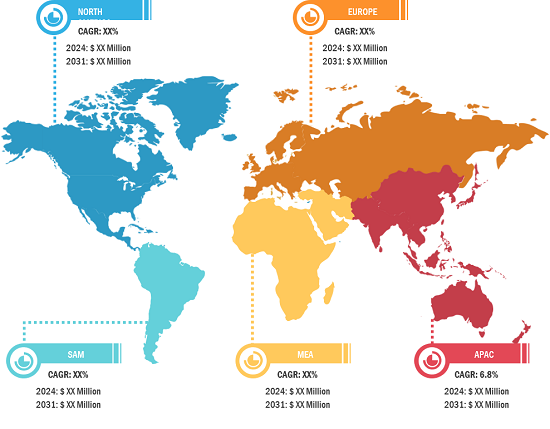
Coriolis Mass Flow Controller Market Share, Demand & Forecast 2031
Download Free SampleCoriolis Mass Flow Controller Market Size and Forecast (2021 - 2031), Global and Regional Share, Trend, and Growth Opportunity Analysis Report Coverage: By Flow Rate (Low, Medium and High), Application (Semiconductors, Food and Beverages Industry, Chemicals, Pharmaceutical and Healthcare Industry, Oil and Gas, and Others), and Geography (North America, Europe, Asia Pacific, Middle East and Africa, and South and Central America)
Source: The Insight Partners Analysis
- The Coriolis mass flow controller market is one of the fastest-growing markets, driven by the increasing demand for highly accurate flow measurement technology. This is happening in these sectors: pharmaceuticals, chemical processing, and food & beverage manufacturing. Production workflows are becoming increasingly complex and quality-sensitive, requiring precise control of gases and liquids. In the case of pharmaceuticals and biotechnology, a slight deviation in ingredient dosing, buffer preparation, or media flow can result in batch failure or compromise product quality. As regulatory standards such as GMP and FDA guidelines impose tighter process control and data integrity, manufacturers are abandoning old volumetric flow technologies that can be affected by changes in pressure, viscosity, and temperature.
- Coriolis mass flow controllers, which measure mass flow directly, provide better accuracy, linearity, and response times, making them the leading choices. The major benefit of their operation under fluctuating process conditions thus, they neither lose performance nor reliability, which significantly reduces risks, increases batch consistency, and facilitates the implementation of advanced continuous manufacturing models in contemporary pharmaceutical sectors.
- Operational efficiency and product uniformity are of equal importance in the chemical and food & beverage industries, thus leading to an almost similar level of interest in Coriolis-based flow measurement in both sectors. Chemical manufacturers use a variety of fluids, some of which can be challenging, such as corrosive, viscous, and multiphase mixtures, and therefore require controllers that can remain stable and precise even when densities or temperatures change.
- Coriolis mass flow controllers are the ideal solution for this requirement, as they deliver real-time, mass-based measurements that are still accurate without the need for frequent recalibration. This enables the plant to run faster and minimize downtime to a minimum. Food and beverage processors, as they increasingly transition to automated, hygienic, and highly repeatable production lines, benefit from this technology, which guarantees the exact dosing of ingredients, uniform blending, and consistent product quality.
- As consumers demand products of higher quality and safety, and manufacturers move toward more automated, data-driven, and traceable processes, the adoption of Coriolis mass flow controllers is constantly increasing. The steadily growing preference for flow technologies that are accuracy-driven and performance-reliable is the major direct driver of robust market expansion in the coming years.
Horiba Ltd., Sensirion Holding AG, Teledyne Technologies Inc., Brooks Instrument, Parker Hannifin Corp., Azbil Corp., Axetris AG, Dwyer Instruments, Inc., Avantor Inc., and MKS Instruments Inc. are among the key players profiled in the Coriolis mass flow controller market report. Other major players were also studied and analyzed during the market study to get a holistic view of the market and its ecosystem.
The report includes the Coriolis mass flow controller market forecast by flow rate, application, and geography. Based on type, the market is divided into low, medium, and high. By application, the market is segmented into semiconductor, oil & gas, chemical, pharmaceutical & healthcare, food & beverages, and others. Geographically, the Coriolis mass flow controller market is segmented into North America, Europe, Asia Pacific, the Middle East & Africa, and South & Central America.
The scope of the Coriolis mass flow controller market report focuses on North America (the US, Canada, and Mexico), Europe (Russia, the UK, Germany, France, Italy, and the Rest of Europe), Asia Pacific (South Korea, China, India, Japan, Australia, and the Rest of Asia Pacific), the Middle East & Africa (South Africa, Saudi Arabia, the UAE, and the Rest of the Middle East & Africa), and South & Central America (Brazil, Argentina, and the Rest of South & Central America). Asia Pacific dominated the market in 2024, followed by North America and Europe.
The Coriolis mass flow controller market in Asia Pacific is segmented into Australia, China, Japan, India, South Korea, and the Rest of Asia Pacific. In terms of revenue, China held the largest Coriolis mass flow controller market share in the Asia Pacific.
China has a significant impact on the global Coriolis mass flow controller market through its role as a major manufacturing giant in the fields of semiconductors, chemicals, pharmaceuticals, and new energy technologies. The country's industrial scene is undergoing a transformation toward automation, smart factories, and IIoT-enabled production lines, which is the main reason for the huge demand for high-precision, digitally integrated flow controllers. Manufacturers are seeking devices that offer real-time diagnostics, automated calibration, and multi-gas or multiphase measurement capabilities to ensure process stability and efficiency. Environmental regulations, energy efficiency mandates, and sustainability initiatives underscore the importance of accurate flow measurement.
Local and foreign suppliers, such as Bronkhorst, Siemens, and Endress+Hauser, are investing in products that strike a balance between high accuracy, robustness, and operational flexibility, enabling pilot-scale experimentation and large-scale industrial applications. On the other hand, Chinese firms are heavily investing in the use of modular, scalable devices that can be integrated with advanced process control systems to achieve energy conservation, reduce process variability, and comply with regulations across various sectors.
Contact Us
Phone: +1-646-491-9876
Email Id: [email protected]