Increasing Demand for High-Performance Computing (HPC) Fuels the Data Center Liquid Cooling Market Growth
According to our latest study, “Data Center Liquid Cooling Market Size and Forecast (2021–2031), Global and Regional Share, Trend, and Growth Opportunity Analysis – by Cooling Type, Data Center Type, Industry Vertical, and Geography," the market was valued at US$4,241.25 million in 2024 and is expected to reach US$22,079.85 million by 2031; it is estimated to register a CAGR of 26.7% during 2025–2031. The report includes growth prospects owing to current data center liquid cooling market trends and their foreseeable impact during the forecast period.
Data Center Liquid Cooling Market Analysis — by Geography
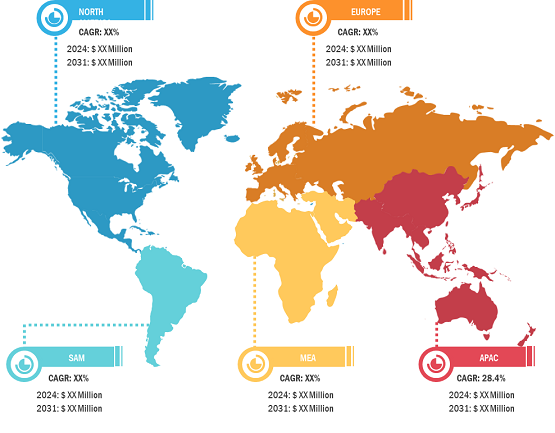
Data Center Liquid Cooling Market Size & Forecast by 2031
Download Free SampleData Center Liquid Cooling Market Size and Forecast (2021 - 2031), Global and Regional Share, Trend, and Growth Opportunity Analysis Report Coverage: By Cooling Type (Room Based Cooling, Row Based Cooling, and Rack Based Cooling), Data Center Type (Hyperscale Data Center, Colocation Data Center, Wholesale Data Center, and Enterprise Data Center), Industry Vertical (IT and Telecom, BFSI, Healthcare, Manufacturing, Government and Defense, Media and Entertainment, Retail, Energy, and Others), and Geography (North America, Europe, Asia Pacific, Middle East and Africa, and South and Central America)
Source: The Insight Partners Analysis
- The data center liquid cooling market is witnessing substantial expansion. This growth is largely fueled by the increasing demand for high-performance computing (HPC), AI workloads, and high-density servers. In server racks, which are primary heat sources, traditional air cooling systems are failing to keep the operating temperatures at optimal levels. As a result, data centers are switching to liquid cooling solutions. Both enterprises and hyperscale operators are investing heavily in energy efficiency, cost reduction, and reliability improvements, of which liquid cooling is a leading technology.
- Direct, to chip and immersion liquid cooling are two technologies that offer better thermal management than conventional air cooling, thus allowing for higher server density and faster computational performance. By removing heat directly from the source, these solutions eliminate the formation of hotspots and ensure that the operating conditions are stable. The advantages of liquid cooling in heavy load scenarios, such as lower energy consumption and quieter operation, are the main reasons for the widespread use of this technology in enterprise as well as hyperscale environments.
- Operational efficiency and sustainability are the main factors behind the increase in data center liquid cooling adoption. Data center operators improve their power usage effectiveness (PUE) and reduce their cooling, related electricity costs, while hyperscale facilities can increase their server density without affecting reliability. Immersion cooling helps edge and modular data centers, where space is limited and extreme heat densities make the situation more challenging.
- Several factors have fueled these changes. Regulatory demands on energy efficiency and sustainability, a surge in digital workloads, expansion of cloud, and AI-driven applications are the key factors prompting widespread adoption. Advanced monitoring, the integration with the building management system (BMS), and AI-driven adaptive liquid cooling also open up new possibilities in this field.
- With enterprises focusing on performance, energy efficiency, and scalability, the demand for liquid cooling solutions is driving the data center liquid cooling market to grow steadily. The principal cause of the strong market growth in the next few years is the requirement for reliable, high-density, and energy, optimized cooling solutions.
Asetek, Inc, Rittal GmbH & Co KG, Stulz SpA, Carrier Global Corp, Daikin Industries Ltd, Delta Electronics Inc, Fujitsu Ltd, Mitsubishi Corp, Schneider Electric SE, and Vertiv Group Corp. are among the key players profiled in the data center liquid cooling market report. Other major players were also studied and analyzed during the market study to get a holistic view of the market and its ecosystem.
The report includes the data center liquid cooling market forecast by cooling type, data center type, industry vertical, and geography. By cooling type, the market is categorized into room-based cooling, rack-based cooling, and row-based cooling. Based on data center type, the data center cooling market is segmented into enterprise data center, colocation data center, wholesale data center, and hyperscale data center. In terms of industry verticals, the market is categorized into BFSI, manufacturing, IT & telecom, media & entertainment, retail, government & defense, healthcare, energy, and others. Geographically, the data center liquid cooling market is segmented into North America, Europe, Asia Pacific, the Middle East & Africa, and South & Central America.
The scope of the data center liquid cooling market report focuses on North America (the US, Canada, and Mexico), Europe (Russia, the UK, Germany, France, Italy, and the Rest of Europe), Asia Pacific (South Korea, China, India, Japan, Australia, and the Rest of Asia Pacific), the Middle East & Africa (South Africa, Saudi Arabia, the UAE, and the Rest of the Middle East & Africa), and South & Central America (Brazil, Argentina, and the Rest of South & Central America). Asia Pacific dominated the market in 2024, followed by North America and Europe.
The data center liquid cooling market in Asia Pacific is segmented into Australia, China, Japan, India, South Korea, and the Rest of Asia Pacific. In terms of revenue, China held the largest data center liquid cooling market share in Asia Pacific.
China is one of the fastest-growing data center liquid cooling markets owing to massive investments in cloud computing, artificial intelligence, and government-backed digital infrastructure. To support AI model training, big data analytics, and smart city initiatives, the rapid expansion of hyperscale data centers has increased rack power densities. As a result, conventional air cooling is becoming increasingly inadequate. Liquid cooling is becoming the preferred solution as it can maintain performance while managing thermal loads efficiently. The strong government involvement in regulating and optimizing data center energy usage is a unique driver in China. National policies promoting green data centers play a vital role in the adoption of advanced cooling technologies that lower energy consumption and enhance efficiency. Moreover, power availability limitations in the most important data center regions are forcing operators to deploy higher-density infrastructures supported by liquid cooling. While cost sensitivity is a factor, large-scale deployments and domestic innovation are anticipated to expedite the adoption process, making China a significant contributor to the market growth in Asia Pacific.
Contact Us
Phone: +1-646-491-9876
Email Id: sales@theinsightpartners.com