Rising Demand for High-Performance Epoxy Resins Drives Epichlorohydrin (ECH) Market Growth
According to our latest study on " Epichlorohydrin (ECH) Market Forecast to 2034, Global and Regional Growth Opportunity Analysis – by Production Method, Application, and End-Use Industry," the market was valued at US$ 3.11 billion in 2025 and is expected to reach US$ 4.45 billion by 2034; it is estimated to register a CAGR of 4.1% during 2026–2034. The report highlights factors contributing to the epichlorohydrin (ECH) market size and prominent players, along with their developments in the epichlorohydrin (ECH) market.
The epichlorohydrin (ECH) market growth is fueled by the rising demand for epoxy resins and intermediates that enhance strength, durability, and chemical resistance in a variety of industries. They are crucial features to guarantee the quality, reliability, and performance of coatings, composites, construction materials, electronics, and automotive parts, where failure of materials can cause inefficiency, shorter life cycle, and loss of operations. The demand increases with the growth of wind energy and transportation industries, as well as the infrastructure development in the emerging economies. Epichlorohydrin will continue to play a significant role as a consistent building block in the development of materials that are high performing and more compliant with the changing environmental standards in the extremely competitive global manufacturing environment to meet the long-term industrial development goals in the worldwide marketplace.
Epichlorohydrin (ECH) Market Breakdown – by Region
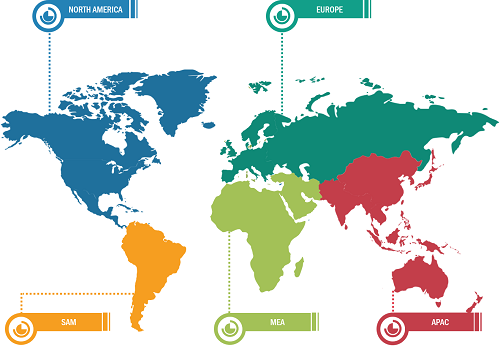
Epichlorohydrin (ECH) Market Share, Demand & Growth by 2034
Download Free SampleEpichlorohydrin (ECH) Market Size and Forecast (2021 - 2034), Global and Regional Share, Trend, and Growth Opportunity Analysis Report Coverage: By Production Method (Propylene Process (Petroleum Based) and Glycerin Process (Bio-Based)), Application (Epoxy Resins, Water Treatment Chemicals, Synthetic Glycerin, Epichlorohydrin Elastomers, Pharmaceuticals, and Others), and End-Use Industry (Automotive (Conventional Vehicles and Electric or Hybrid vehicles), Energy and Power (Solar Panel, Wind Energy, and Others), Paints and Coatings, Building and Construction, Water Treatment, Electrical and Electronics, Textiles, Pharmaceuticals, Consumer Goods, and Others)
The epichlorohydrin (ECH) market analysis has been performed by considering the following segments: production method, application, and end-use industry. By production method, the epichlorohydrin (ECH) market is bifurcated into propylene process (petroleum-based) and glycerin process (bio-based). The propylene process (petroleum-based) segment accounted for the largest epichlorohydrin (ECH) market share in 2025. The ethylene process of petroleum origin is used to make epichlorohydrin as it is technologically established, owing to the constant availability of feedstock, and owing to it producing large volumes of high purity, at industrial volumes. It is a well-known path that provides good control of reactions, stationary operating conditions, and predictable products, thus it is applicable in large volume production of the epoxy resins and the downstream intermediates. Its demonstrated process efficiency reduces variability, allows continuous operation, and fits well with the existing petrochemical infrastructure, which minimizes disruptions during the operations and minimizes cost uncertainty. The process is highly resistant to extreme manufacturing environments and helps in facilitating the efficient management, storage, and transportation of intermediates. Major chemical producers prefer the petroleum-based propylene route since it is the best commercialized and most common route in the epichlorohydrin (ECH) market, especially in the high-volume applications with a consistent quality and reliable supply chains.
Epichlorohydrin (ECH) market trends encompass the utilization of bio-based and glycerin production pathways; the growing use of high-purity grades in epoxy resin and specialty resin applications, as well as process safety and emissions. The existence of environmentally responsible and sustainable manufacturing channels is one of the most noticeable trends in the years to come. Increasing regulatory and environmental concerns, especially in Europe and North America, are compelling manufacturers to abandon the traditional petroleum-based pathways for greener ones and circular production schemes that preserve similar performance and reactivity. Simultaneously, process innovations have made it possible to achieve significant waste reduction and economy in energy usage (~10–20% reduced emissions) without affecting yield, purity, and operating efficiency. Closed-loop systems, automation, and advanced monitoring technologies are also being used to improve plant safety and reduce hazardous by-products. With renewable feedstocks and low-carbon process-based designs, these advances can serve the ESG goals and sustain the cost-effectiveness, quality, and performance that epichlorohydrin brings about to maintain its relevance in the markets dominated by sustainability-driven end-use sectors.
In 2025, Asia Pacific controlled the epichlorohydrin (ECH) market share in terms of revenue, and much of the production was aimed at epoxy resins in construction, automotive, and electronics production. The region has a robust demand for epoxy coating, adhesives, and composite materials that enable speedy industrialization and infrastructure development. Increased production of resin, construction, automobile manufacturing, and electronic assembly plants in China, India, Japan, South Korea, and Southeast Asia has been a continued source of consumption as these sectors need constant and high-quality intermediates to achieve performance, structural durability, and uninterrupted output of their material selection, regardless of location in the growing regional and global supply networks.
OCI Holdings Co Ltd, Aditya Birla Chemicals (Thailand) Limited, Wuxi High Mountain Hi-tech Development Co Ltd, AGC VINYTHAI PCL, DCM Shriram Ltd, Kanto Chemical Co Inc, Sumitomo Chemical Co Ltd, Lotte Fine Chemical Co Ltd, Olin Corp, Nama Chemicals Co SJSC, INEOS Group Holdings SA, Hanwha Solutions Corp, Daisco Chemical Co Ltd, Epigral Ltd, OSAKA SODA CO LTD, Shandong Haili Chemical Co Ltd, Spolchemie, and Shandong Ruifeng Chemical Co Ltd are among the prominent players profiled in the epichlorohydrin (ECH) market report. These players are focusing on providing high-quality products to fulfill customer demand. They are adopting strategies such as product launches, capacity expansions, partnerships, and collaborations to stay competitive in the Epichlorohydrin (ECH) market.
Based on production method, the epichlorohydrin (ECH) market is bifurcated into propylene process (petroleum-based) and glycerin process (bio-based). By application, the market is segmented into epoxy resins, water treatment chemicals, synthetic glycerin, epichlorohydrin elastomers, pharmaceuticals, and others. By end-use industry, the market is categorized into automotive, energy and power, paints and coatings, building and construction, water treatment, electrical and electronics, textiles, pharmaceuticals, consumer goods, and others. The automotive segment is divided into conventional vehicles and electric or hybrid vehicles. The energy and power segment is segmented into solar panels, wind energy, and others.
The geographical scope of the epichlorohydrin (ECH) market report focuses on North America, Europe, Asia Pacific, the Middle East & Africa, and South & Central America. The market in North America is segmented into the US, Canada, and Mexico. The market in Europe is categorized into Germany, France, Italy, the UK, Russia, and the Rest of Europe. The market in Asia Pacific is divided into Australia, China, India, Japan, South Korea, Indonesia, Singapore, Malaysia, Taiwan, Thailand, the Philippines, and the Rest of Asia Pacific. The epichlorohydrin (ECH) market in the Middle East & Africa is classified into South Africa, Saudi Arabia, the UAE, and the Rest of the Middle East & Africa. The market in South & Central America is segmented into Brazil, Argentina, and the Rest of South & Central America.
Contact Us
Phone: +1-646-491-9876
Email Id: sales@theinsightpartners.com