Rising Demand for Bio-Based Products Drives Oleochemicals Market Growth
According to our latest study on " Oleochemicals Market Forecast to 2034, Global and Regional Growth Opportunity Analysis – by Source, Type, Application, and End Use," the market was valued at US$ 39.40 billion in 2025 and is expected to reach US$ 63.93 billion by 2034; it is estimated to register a CAGR of 5.5% during 2026–2034. The report highlights factors contributing to the oleochemicals market size and prominent players, along with their developments in the oleochemicals market.
The oleochemicals market growth is being fueled by rising demand for sustainable and bio-based alternatives to petrochemicals in the personal care, pharmaceutical, food, and industrial sectors. Oleochemicals play a crucial role in the manufacture of soaps, detergents, lubricants, surfactants, and coatings because they are versatile, biodegradable, and show stable performance. Substandard or artificial alternatives may cause decreased efficiency of the products, environmental issues, and loss of consumer confidence. The increasing demand is caused by the growing environmental awareness, increased regulation of petrochemical utilization, and transition into renewable and circular economy solutions. Innovations in bio-refining technologies, growth of feedstock sources such as palm, coconut, and soy, and soaring use of oleochemicals in specialties are benefiting the market. Oleochemicals will continue to be essential as green, high-performance products that align with the changing consumer demands of green, safe, and multifunctional products.
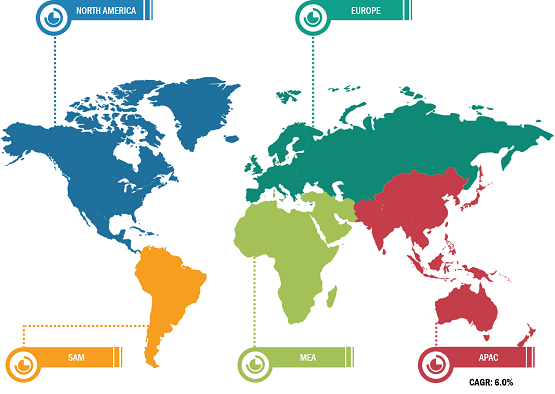
Oleochemicals Market Breakdown – by Region
Oleochemicals Market Growth, Size & Forecast by 2034
Download Free SampleOleochemicals Market Size and Forecast (2021 - 2034), Global and Regional Share, Trend, and Growth Opportunity Analysis Report Coverage: By Source (Palm Oil, Soy Oil, Coconut Oil, Tallow, Castor Oil, and Others), Type (Fatty Acid [Saturated and Unsaturated], Fatty Alcohols, Glycerin, Fatty Esters, Fatty Amines, FAME, and Others), Application (Crop Protection, Food Emulsifiers, Surfactants, Personal Care and Cosmetics, Stabilizers, Oil and Gas, Polymers, Lubricants and Fuel Additives, Feed, and Others), and End Use (Pharmaceuticals and Nutraceuticals, Personal Care and Cosmetics, Food and Beverage, Paints and Coatings, Lubricants, Industrial and Institutional Cleaners, Textiles, Plastic, Homecare, and Others)
The oleochemicals market analysis has been performed by considering the following segments: source, type, application, and end use. By source, the oleochemicals market is segmented into palm oil, soy oil, coconut oil, tallow, castor oil, and others. The palm oil segment accounted for the largest oleochemicals market share in 2025. Oleochemicals made with palm oil are attractive to producers due to their versatility, low cost, and broad availability. They are utilized in personal care, food, and industrial applications. These derivatives, such as fatty acids, glycerin, and esters, are useful in soaps, cosmetics, detergents, and biodiesel because they have functional benefits of moisturizing, emulsifying, and lubricating. This diversity allows them to reach a variety of end-user markets. They are consistent and standardized in terms of their quality, providing uniform performance in formulations, and this is why they are preferable by large-scale manufacturers. This segment has the advantage of a set supply chain, well-established brand recognition of major producers, and continuous growth in developing markets. Its efficiency in procurement and production decreases the indecision of the demand, assists in inventory control, and promotes the development of individual-label and specialty oleochemical products. Oleochemicals derived using palm oil can be adapted to current trends of sustainable sourcing, certified by RSPO, bio-based formulation, and production processes with low impact. This plasticity enables manufacturers to be competitive in dynamic markets. The large-scale manufacturers of palm oil derivatives are participating in it since it is highly demanded, has a fully developed distribution channel, and is a core part of the oleochemicals market.
Oleochemicals market trends are increasing attention to sustainable sourcing of feedstocks and bio-based feedstocks. Manufacturers are using palm, coconut products, and soy derivatives to create eco-friendly and biodegradable products to be used in personal care, food, and industrial products. Consumers and businesses are insisting on transparency, a traceable supply chain, and formulae containing no synthetic additives or harsh chemicals. Increased regulatory compliance and environmental consciousness, especially in Europe and North America, are forcing producers to turn to renewable and responsibly sourced raw materials. Formulation innovations have made it possible to increase performance and efficiency, including improved emulsification, foaming, and moisturizing properties, and decrease the environmental impact. Technologies in processing, control of quality based on data, and automated production systems make the operations more efficient and reduce raw material wastage. Innovations in packaging, such as recyclable package designs, refillable designs, and low-impact distribution, minimize carbon footprint. Their focus on renewable feedstocks, transparent labeling, and sustainable practices is in line with the changing ESG goals. It makes oleochemical products remain competitive and appealing in an environment where sustainability and consumer confidence are becoming important.
In 2025, APAC led the oleochemicals market share in terms of revenue. The geographical area exhibits a high demand for versatile and bio-based chemical solutions that are compatible with the surging industrialization, rising disposable income, and soaring use of green products. The development of manufacturing centers, personal care and food processing sectors, and industrial uses in China, India, Japan, South Korea, and Southeast Asia has enhanced manufacturing capacity and availability of products. These markets are demanding high-quality, consistent oleochemicals to address the changing standards in formulations, product innovation, as well as efficient production in traditional and modern industrial segments, as well as in the growing local and global product supply chains.
BASF SE, Godrej Industries Ltd, Evyap Life Chemistry, KLK OLEO, Fairchem Organics Limited, Oleon NV, JNJ OIL INDUSTRIES, INC., IOI Corporation Berhad, PT. Ecogreen Oleochemicals, P&G Chemicals, Kao Corp, Peter Greven GmbH & Co. KG, Emery Oleochemicals, New Japan Chemical Co., Ltd., NYCO, Zschimmer & Schwarz Chemie GmbH, Wilmar International Ltd, Polyrheo, PATCO Products, Arkema SA, Alnor Oil Company, Acme-Hardesty, Green Oleo S.p.A., and Italmatch Chemicals S.p.A are among the prominent players profiled in the oleochemicals market report. These players are focusing on providing high-quality products to fulfill customer demand. They are adopting strategies such as product launches, capacity expansions, partnerships, and collaborations to stay competitive in the oleochemicals market.
Based on source, the oleochemicals market is segmented into palm oil, soy oil, coconut oil, tallow, castor oil, and others. In terms of type, the market is segmented into fatty acids, fatty alcohols, glycerin, fatty esters, fatty amines, FAME, and others. The fatty acid segment is bifurcated into saturated and unsaturated.
By application, the oleochemicals market is classified into crop protection, food emulsifiers, surfactants, personal care and cosmetics, stabilizers, oil and gas, polymers, lubricants and fuel additives, feed, and others. Based on end use, the oleochemicals market is segmented into pharmaceuticals and nutraceuticals, personal care and cosmetics, food and beverage, paints and coatings, lubricants, industrial and institutional cleaners, textiles, plastic, home care, and others.
The geographical scope of the oleochemicals market report focuses on North America, Europe, Asia Pacific, the Middle East & Africa, and South & Central America. The market in North America is segmented into the US, Canada, and Mexico. The market in Europe is categorized into Germany, France, Italy, the UK, Russia, and the Rest of Europe. The market in APAC is divided into Australia, China, India, Japan, South Korea, Indonesia, Malaysia, Thailand, and the Rest of the Asia Pacific. The oleochemicals market in the Middle East & Africa is classified into South Africa, Saudi Arabia, the UAE, and the Rest of the Middle East & Africa. The oleochemicals market in South & Central America is segmented into Brazil, Argentina, Chile, and the Rest of South & Central America.
Contact Us
Phone: +1-646-491-9876
Email Id: sales@theinsightpartners.com